
The Graphic War
A Soldier’s Dream/A Soldier’s Vision
By Salvatore Cilella · Originally published February 2023 · p. 27
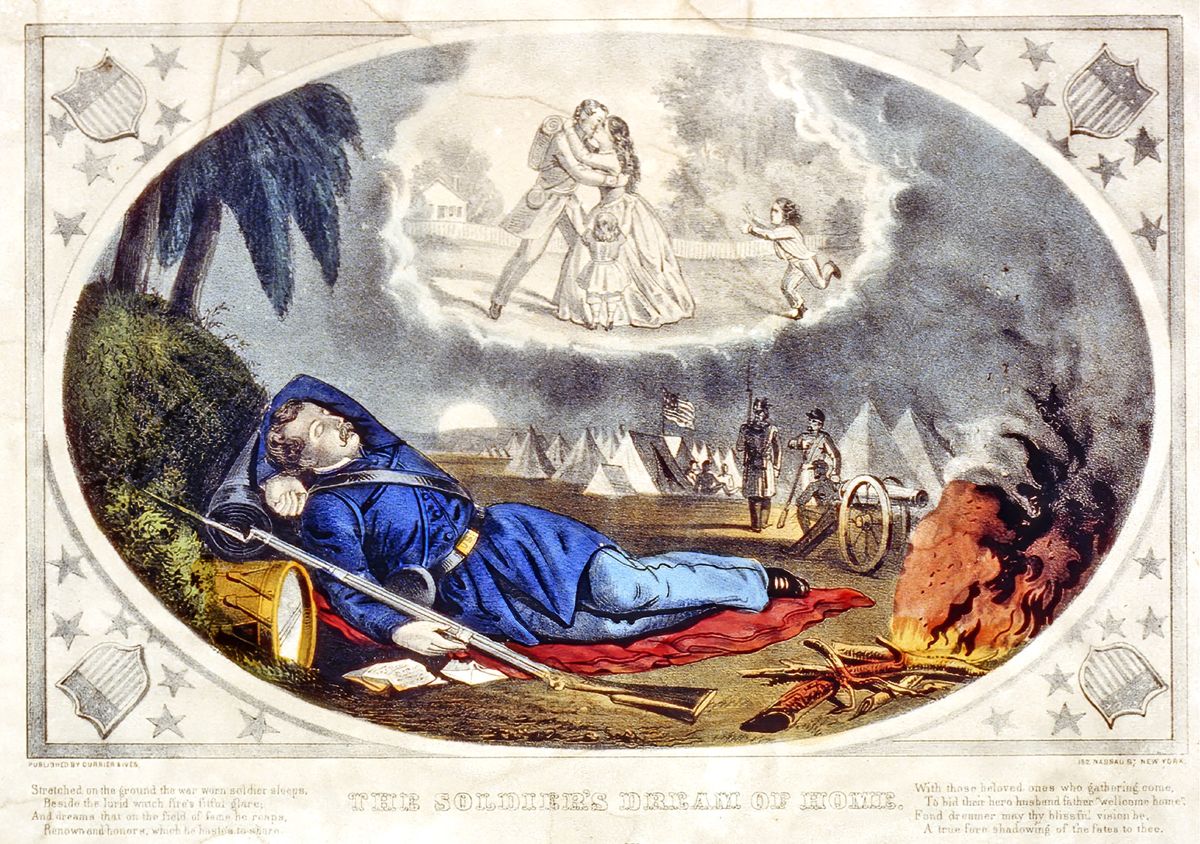
Fond dreamer may thy blissful vision be, A true foreshadowing of the fates to thee.” “Such scenes were meant to reassure families that their men in arms remained inspired, perhaps even protected and blessed, by thoughts of home and hearth.” To complete the sentiment, Currier and Ives produced a companion piece the following year entitled The Soldier’s Home, the Vision. It depicts a woman asleep on a sofa “dreaming of her husband, who carries a flag as he leads the Union army in battle.” The inscription reads:
A Soldier’s Dream/A Soldier’s Vision The Graphic War highlights prints and printmakers from the Civil War discussing their meaning and the print maker or artist’s goals. We have written several times in this column how the Civil War was “good” for American printers, artists, and lithographers. The field was crowded with well-known names at the time: Currier and Ives, The Kellogg’s in Connecticut, the Sartain’s in Philadelphia, and out west in Cincinnati, Strobridge and Company. What began as an attempt to bring the latest news depicting the most recent battle, wellillustrated, from the front, evolved into a lucrative market of all manner of prints. Although they were well sanitized, battle views filled the need of news hungry civilians back home. Religious prints showing the heart of Jesus, the last supper, and Mary appealed to recent emigres from Europe. Small folio prints of women and children sold well, as did memorials to the recently deceased member of a family. Early portraits of Union heroes such as Winfield Scott and George McClellan were eventually replaced by Ulysses S. Grant, William Tecumseh Sherman, and Abraham Lincoln. Even the enemy were portrayed; Robert E. Lee and Stonewall Jackson were immensely popular in northern markets. As historian Brian le Beau has noted “The trauma of the Civil War seems only to have stimulated the public’s interest in mass-produced illustrations of various scenes related to the war. Lithographers and engravers sold thousands of pictures of army camps, military installations, and ships of war.” Additionally, Currier produced “cartoons or graphic satires, of the war; those that might be labeled patriotic prints; those related to secession, politics, and Lincoln’s assassination.” Combining current events with sentimentality, the firm produced The American Patriot’s Dream/ The Night before the Battle in 1861. It is unusual in that it is an early piece. Not to be outdone, Currier produced a second similar print entitled: The Patriot’s Dream of Home. Both images depict a lone soldier asleep before his campfire. In the background his comrades gather around the fire awaiting tomorrow’s unknown. In one version, a cloud over the recumbent soldier depicts his dream of home, populated by his family all of whom welcome him home in their loving embraces. All three generations are there to greet him: his child, his wife, and dutifully completing the tableau, his parents. In the alternate dream version featured here, only his wife and child great him. Below our sleeping hero in the title margin is an eight-line, two stanza poem:
“Ever of him who at his country’s call, Went Forth to war in freedom’s sacred name; She thinks in waking hours: and dreams are all, Filled with his image,
“Stretched on the ground the war worn soldier sleeps, Beside the lurid watch fire’s fitful glare; And dreams that on the field of fame he reaps, Renown and honors which he hastens to share.
On the field of fame. She sees her hero foremost in the fight. Bearing the glorious banner of the free; Triumphing o’er the traitors boasted might, Then home returning crowned with victory.”
With those beloved ones who gathering come, To bid their hero husband father ‘welcome home,’
As historians Neely and Holzer point out, these prints were meant to be reassuring as the war intensified. America’s naivete concerning the tragedy unfolding before them was shattered when Alexander Gardner published and displayed his photographs of the carnage at Antietam. 1. 2. 3.
Endnotes
Brian Le Beau, Currier and Ives: America Imagined, Smithsonian Institution Press, 2021, 72. Ibid, 78. Mark Neely & Harold Holzer, The Union Image: Popular Prints of the Civil War North, Chapel Hill, University of North Carolina Press, 2000, 96. See also 93-95. Le Beau, 98.
After 43 years in the museum field, Cilella devotes his time collecting American prints and maps and writing. His most recent books are Upton’s Regulars: A History of the 121st New York Volunteers in the Civil War (U. Press Kansas, 2009). His two-volume Correspondence of Major General Emory Upton, (U. of Tennessee Press, 2017), received the 2017–2018 American Civil War Museum’s Founders Award for outstanding editing of primary source materials. Upton’s love letters to his wife 1868-70, (Till Death Do Us Part) was published in 2020 by the Oklahoma University Press. His current book, the memoirs of Private Dewitt Clinton Beckwith of Upton’s Regulars for McFarland Press will be released this Spring.