
A Monumental Confederate Gesture
By Joseph Wilson · Originally published February 2023 · pp. 8–9
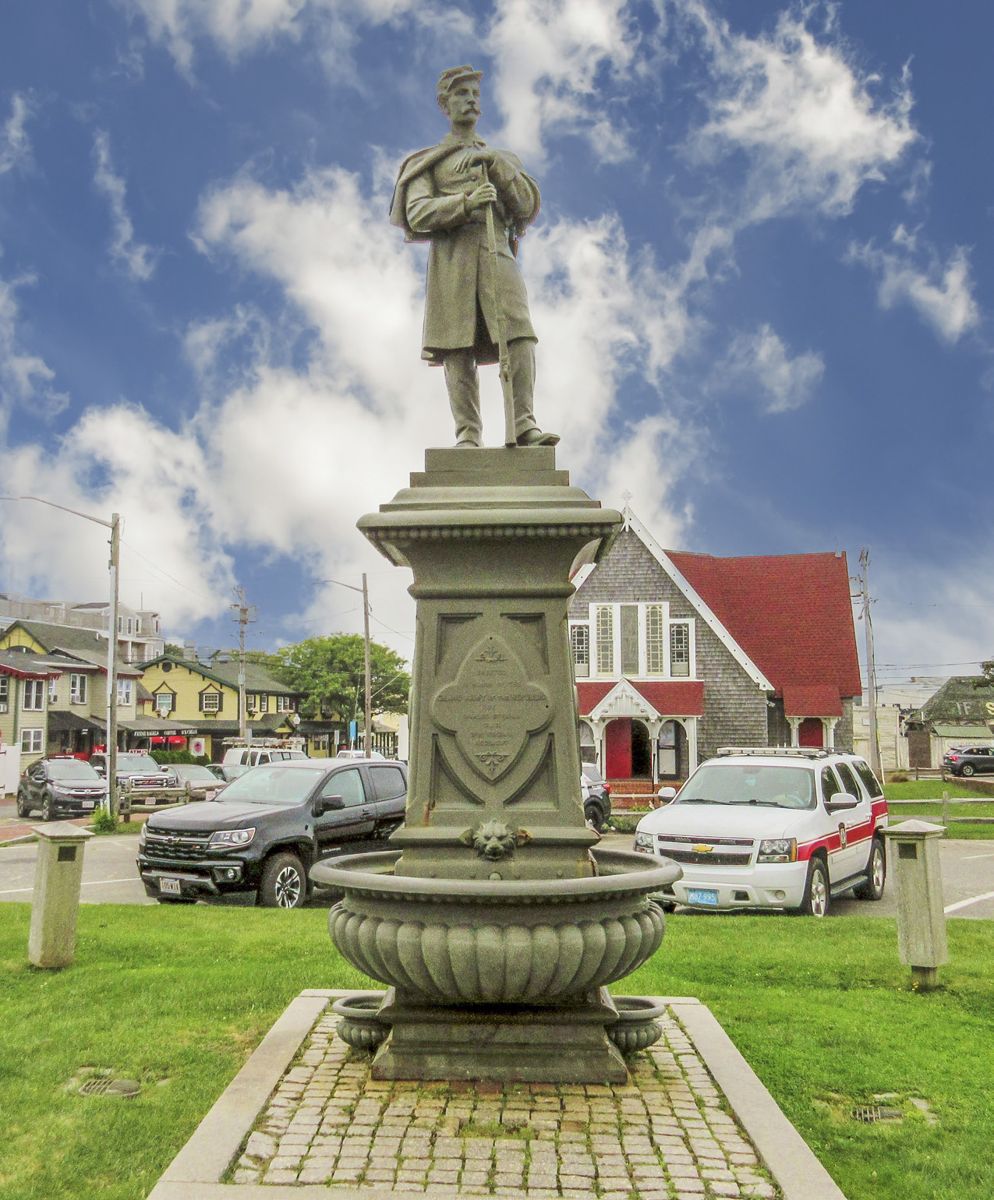
After the Civil War, monuments funded by states and private groups began populating the battlefields. Towns followed by erecting statues along their avenues and town squares to honor local heroes. One extraordinary Confederate soldier took a most unusual approach by funding and erecting a monument that defied logic. His statue didn’t celebrate the Confederacy, but surprisingly honored Union soldiers. Charles Strahan grew up in
Baltimore, Md., and enlisted in the Confederate Army on May 24, 1861. Private Strahan joined the Maryland Guards, a company that was incorporated into the 21st Virginia Infantry. The 21st saw hard fighting in nearly every battle as part of Lee’s Army of Northern Virginia. At the Battle of Seven Pines, Private Strahan suffered a gunshot wound. Yet, he still found it in his heart to forgive his former enemies in the years after the war. When promoted to Lieutenant, Strahan served on the staff of Gen. Isaac Trimble. Like many former Confederate soldiers, Charles Strahan relocated in the north after the war. After dabbling as a coffee exporter in New Orleans, he put down roots in 1884 on the quaint island of Martha’s Vineyard off the coast of Massachusetts. Not long after arriving on the island, Strahan took over a newspaper in Cottage City that he renamed the “Martha’s Vineyard Herald.” Life seemed good for the new publisher, or so he thought. Bitter feelings die hard in old soldiers. A measure of hostile sentiment directed at Johnny Reb still remained on the island. With the approach of Memorial Day in 1887, Strahan advertised in his newspaper that a huge picnic would be held in town for all the Cottage City’s residents to remember the veterans, living and deceased. He never thought after so many years that resentment for a former Confederate and transplanted Southerner still burned in the hearts of some Union veterans. Former Union soldiers refused to attend the picnic with a Rebel soldier present; so, Charles Strahan stayed home. The rebuke shocked the new resident and publisher. Strahan thought of ways to heal the small community of Cottage City that might erase the ill will coming from his former enemies. Then an idea struck like a lightning bolt. He’d erect a huge Civil War soldier’s monument in the center of Cottage City. It would not be a Confederate soldier, but a Federal. A former Confederate soldier commissioning a monument honoring Union soldiers took the town by surprise. The Henry Clay Wade Post 201 of the Grand Army of the Republic was already established in Cottage City. Strahan would present the monument to the GAR Post when it was completed. Being the publisher of an island wide newspaper played a pivotal part in the plan. A subscription for the Martha’s Vineyard Herald cost $2 for one year. All money for any new subscription would go for the monument. Strahan contracted with J.W. Fisk of New York, at a cost of $2,000 dollars, to construct the statue. A base of Quincy granite would support a 7-foottall bronze Union soldier. Funds received amounted to only $1,500 dollars. It’s believed that Strahan put up $500 of his own money to complete the project. The monument became known as “The Chasm Is Closed” monument. Today, the chasm once thought closed is being forced wide open. Although the Civil War ended 157 years ago, the Union soldier atop the structure is coming under fire because it was a Confederate who hoisted him up on his pedestal. In 1907, Cottage City became Oak Bluffs. Ample space was left on the monument by Strahan hoping one day it might feature the name of a Confederate soldier. At a rededication in 1925, the local Women’s Relief Corps of Oak Bluffs added Strahan’s name on a new plaque. Now well into his eighties, Charles got his wish. The plaque that so far remains to this day reads, “Erected in
A closer look at Charles Strahan’s monument.
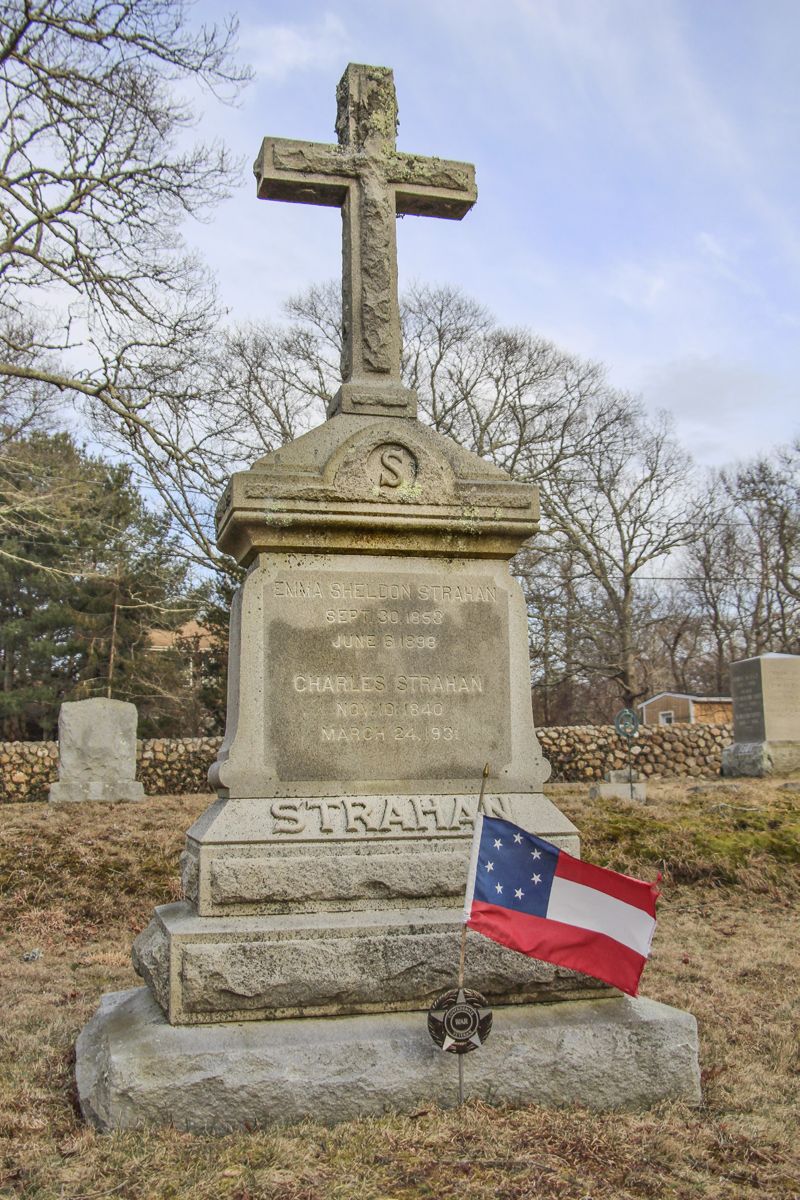
honor of the Grand Army of the Republic by Charles Strahan, Co. B, 21st Virginia Regiment.” A second controversial plaque added at the ceremony in 1925 graced the statue for nearly 100 years before residents and Boston activists demanded its removal. In 2019, the activists had their way. The second plaque is gone. The tablet read, “The Chasm Is Closed – In memory of the restored Union this tablet is dedicated by Union veterans of the Civil War and patriotic citizens of Martha’s Vineyard in honor of the Confederate soldiers.” The offending phrase they objected to read “in honor of Confederate soldiers.” But the political activists made it known that they want the entire monument removed. The offending tablet now resides inside a museum in Oak Bluffs. A section of the museum features an exhibit titled “The Chasm Is Not Closed.” Indeed, the Chasm is getting wider in America by the day. A monument erected to heal is now swept up in a controversy that is fueling division by people who are over 150 years removed from the Civil War. This is a crusade that threatens the statue’s future.
During the Obama years, President Obama and his family enjoyed frequent visits to Martha’s Vineyard. As usual, the President’s advance team ran point for his visits. They considered the statue put up by a Confederate to be offensive to the Obamas and wanted it covered up or removed for maintenance so as not to insult the first black president. According to locals, that never happened. Strahan’s attempt to foster reconciliation is having the opposite effect in our politically correct America. At the 1891 dedication, Charles Strahan spoke eloquently of a post-Civil War America when he said, “As your father and my father stood shoulder to shoulder at Valley Forge and Yorktown, and stood by their guns on the deck of the Constitution and Chesapeake, so the sons of the gray will stand with the sons of the blue, should any foe, domestic or foreign, dare attack that flag.” Such sentiment can only be dreamed of today. Charles Strahan forgave his former enemies despite still carrying the scars of a Yankee bullet. Forgiveness seems to be a lost virtue even if the offensive actions took place hundreds of years ago. The Virginian’s gesture of good will has been replaced by a bitterness that has taken root. Sadly, the chasm is growing wider, not only on Martha’s Vineyard, but across America. Martha’s Vineyard is a beautiful island where many of the rich and famous like to spend time at their summer homes. The island features pristine beaches and seems disconnected from the mainland, but the same problems that infect the mainland now have encroached on the island. I recently had the privilege of viewing and photographing the monument. The Virginian’s unusual tribute to Union soldiers may be gone by any future visit. Charles Strahan is buried in the island’s Oak Grove Cemetery not far from the Civil War monument he thought would bring the country together. He’d be turning in his grave if he knew his effort to reconcile a nation opened a wider chasm 137 years after its dedication. At the dedication, he spoke of Americans living together as brothers under the same flag. A heartfelt feeling lost in today’s America. The monument and the flag are both in trouble! Joseph F. Wilson lectures on Andersonville Prison and The Pennsylvania Reserves. The writer also wrote and produced the documentary film “Civil War Prisons – An American Tragedy” now available on Amazon. Contact - [email protected].