
“Sea Monster” Seen in North Carolina
By Joan Wenner, J.D. · Originally published December 2023 · p. 14
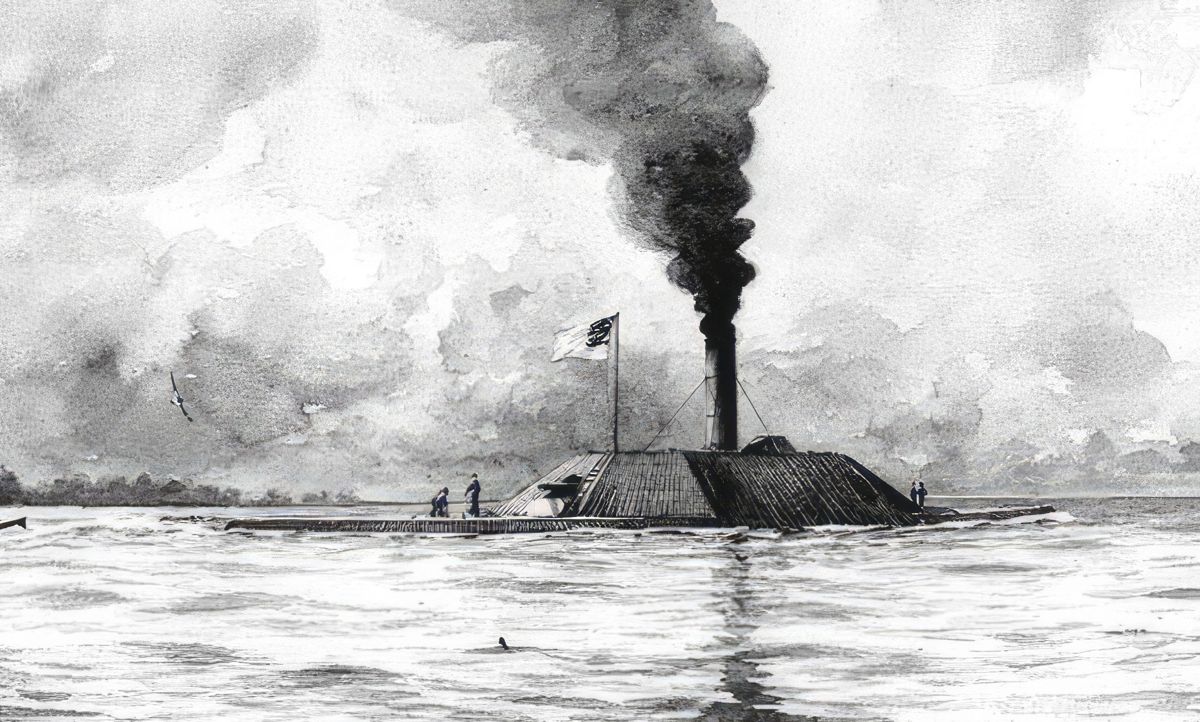
In the Journal of a Secesh Lady, an educated diarist Catherine Ann Devereux Edmondston of Halifax County, along the Roanoke River in northeastern North Carolina, revealed one unusually mild February day in 1863. Writing.”Such weather as we have is almost unprecedented… fine, bracing white frosts…whilst the middle of the day is mild & serene.” Catherine would happen upon two so-called “floating forts” being constructed in former cornfields a distance away from the mouth of the river, the purpose being to limit access by the Union navy. She had taken advantage of the weather to spend several days at Hascosea, one of her family’s properties near the Roanoke River. A two-story wood-clad structure nestled in an oak grove served as a summer retreat from their larger plantation house, Looking Glass, to sort garden seeds and prune scuppernong grape vines. But as the soldiers had discovered, writes author and attorney Hampton Newsome in his 2019 The Fight for the Old North State, Catherine accompanied family members to Halifax on February 15, 1863 to attend to some legal matters. Once concluded, she headed down to the modest Edwards Ferry navy yard, one of those former cornfields on the Roanoke River, to view a local marvel, the unfinished ironclad Albemarle, which she noted in her diary was now nearly completed. “Engine & Propeller in & will, if the Department at Richmond send on the iron to complete her armour, steam down the river next month.” In her opinion, Captain James Cooke, who was now supervising the construction effort, had managed to achieve quite a bit in a short time. During her ‘tour,’ she examined the boat’s two rifled cannon, which she observed were smaller than she expected. Her visit provided “a glimpse into the frantic push to complete the ironclads” Albemarle and Neuse. To contest Federal control of the North Carolina sounds established after the operations at Hatteras Inlet in 1861 and Roanoke Island in 1862, Newsome tells us the Confederates established a half dozen inland navy yards, though limited resources and a shortage of workers hampered construction. The Albemarle was designed for shallow water operations with a flat bottom and a flared side; construction finally began in January 1863. Boatbuilder Gilbert Elliott went to Wilmington to speed the transportation of iron. If armor could be obtained, the vessels could be completed in thirty days, it was determined. By the end of the month, “rapid progress” was reported and the vessel would “soon be ready for work.” Work accelerated on the Albemarle at the Halifax yard with the vessel now afloat in the river, its rudder shipped, and its shell room and magazine being filled. Carpenters had fastened iron to the wooden hull and bolted plating on the deck. Five layers of wood and iron formed her casemate.” The interior layer consisted of foot-thick yellow pine timbers covered by 5-inch pine planks and finished with an outer layer of 4-inch oak planks attached vertically. Atop these carpenters bolted on two layers of 6-inch wide iron plates, each separated by a 2-inch space filled with more wood. In March, additional work was being done. The designers, engineers, and builders had stuck to a straightforward plan, no complicated turrets, no elaborate ventilation system, and no iron hull. With her two 200-hp engines, perhaps from a local sawmill, it was suggested, turning two propeller shafts, she drew nine feet fully loaded. Meanwhile, work proceeded at Whitehall on Albemarle’s sister ship Neuse, which some were beginning to call the “Neus’ance.”) Catherine of course, was not the only intelligent, and prejudiced, member of the North Carolina planter aristocracy that had great hope in the “sea monster.” In April, the unfinished and untested vessel managed to navigate the Roanoke River, defeated opposing craft and then turn the tide by blanketing Federal-held Plymouth with fire. There was agreement that the ironclad had made a substantial difference. A correspondent for the Daily Conservative noted that ‘the Yankees would have been “dug out” of New Bern had the vessel been there. The ironclad, commissioned in April 1864, was indeed impressive. Along with a strengthened prow for ramming, the ship’s battery contained two 7-inch Brooke rifles mounted on pivots within her casement. All Federal scouts and spies determined “that ironclad rams were being built somewhere up the Roanoke and Neuse Rivers.” The Edmonstons, having married in 1846, spent some time in South Carolina but, due to her wishes and ill health, had returned to North Carolina to a parcel of land owned by her brother, John Devereux, chief quartermaster of North Carolina during the Civil War, who incurred a debt of $10,000. Their efforts with the land were not profitable, and the couple “suffered greatly” financially, as ultimately did her brother, who filed for bankruptcy in 1868. Upon Catherine’s early death in 1875 at age 52, the North Carolina Supreme Court proved her last will and distributed certain legacies from what was left in the estate.
Drawing of the CSS Albemarle.
Joan Wenner, J,D. has a law degree and is a longtime contributor to CWN, specializing in researching Civil War maritime topics and individual historical figures. A native New Yorker, she is based in eastern North Carolina. Comments or questions are welcomed at [email protected].