
This And That
M. Jeff Thompson Surrenders in Northeast Arkansas
By Gould Hagler · Originally published December 2023 · pp. 24–25
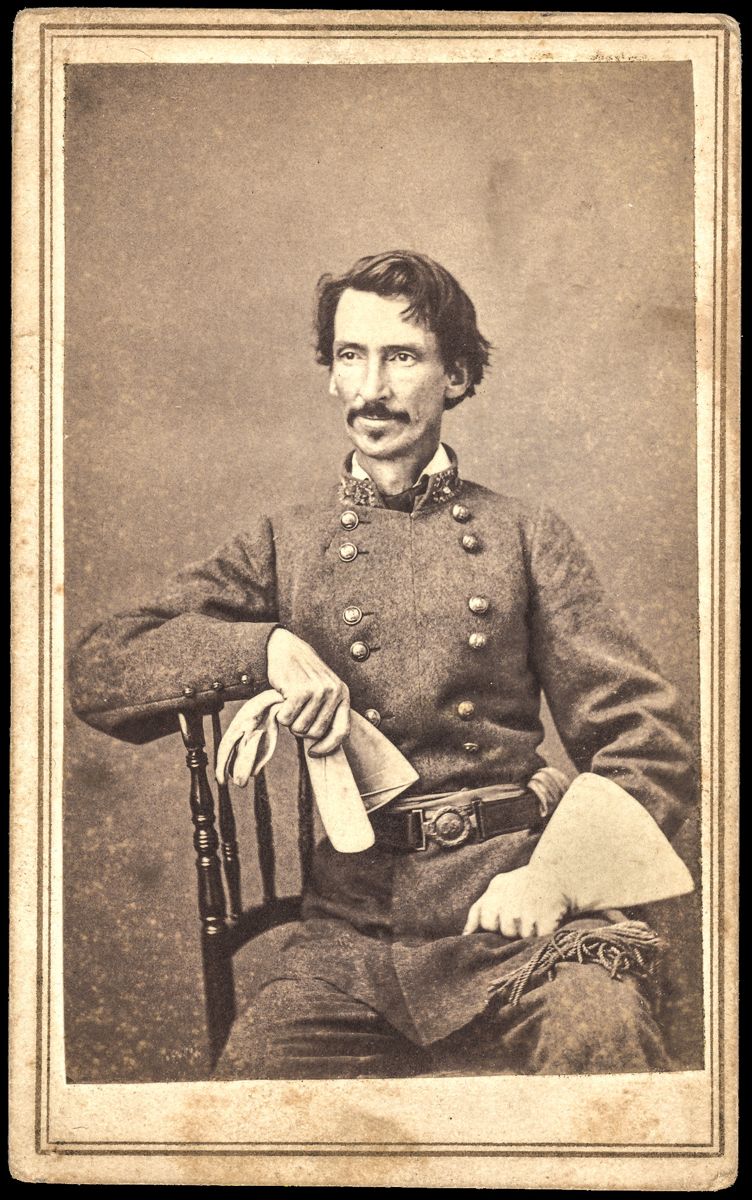
M. Jeff Thompson Surrenders in Northeast Arkansas “He is a witty fellow, and is continually talking about impossibilities.” – Lieut. Col. Charles W. Davis to Maj. Gen. Grenville Dodge, May 10, 1865 Last month’s column dealt with the surrender of Confederate forces in the Department of Alabama, Mississippi, and East
Louisiana. Most readers are familiar with the theaters of war east of the Mississippi and with commanders who led the Federal and Confederate armies that fought there. This month, we cross the river into northern Arkansas, a battleground less familiar to most readers, I believe, and to me, I know. We will also meet some new people, officers who are not household names. The story of the war’s end here is an interesting tale, driven by dynamics different from the factors that marked surrenders in the Cis-Mississippi. The armies to the west did not immediately concede defeat after the larger armies surrendered in Virginia, North Carolina, and Alabama. In his 2019 book Raising the White Flag, David Silkenat wrote that some generals held out hope that a truncated Confederacy could survive west of the river. Other commanders, while cognizant of the hopelessness of their cause, “did not believe that they could honorably surrender until compelled on the battlefield.” According to Silkenat, the TransMississippi negotiations and surrenders “lacked the civility and decorum” that characterized the earlier surrenders and instead were marked by a climate more “chaotic and explosive.” Furthermore, in the west the ordinary soldiers had more of an impact on the “timeline and contours of Confederate surrender” than their distant comrades back east. In the waning days of the Confederacy, Brig. Gen. M. Jeff Thompson commanded the troops in the Sub-District of North Arkansas. Thompson was known as the “Swamp Fox of the Confederacy.” After Confederate militias were driven from Missouri early in the war, Thompson in 1862 and 1863, led raids from Arkansas against Union forces in his home state. He was captured in the summer of 1863 and imprisoned at Johnson’s Island, Fort Delaware, and Morris Island at the mouth of Charleston Harbor.* After his exchange in 1864 he returned to the Trans-Mississippi. It is interesting to note that Thompson, despite his efforts, was never commissioned as an officer in the Confederate army. His commission was issued early in the war by the Missouri State Guard. Nevertheless, in February 1865, Gen. E. Kirby Smith, the commander of the Department of the Trans-Mississippi, put Thompson in charge of the Confederacy’s forces north of the As the area was isolated from other Confederate forces, this was de facto an independent command. The troops under Thompson were doing little or no fighting against the Federals and were not expected by Thompson to ramp up efforts against the foe. The commander’s focus was rather on creating some level of law and order in an area wrecked by guerilla fighting. Thompson tried to rid the region of guerillas but had little success. Out of the 10,000 men theoretically under his command, Thompson, by his own reckoning, could count on only a few hundred to follow his lead and obey his orders. On April 18, 1865, Thompson, having learned of Lee’s surrender, informed General Smith that he would carry on the fight, though he acknowledged that news of events from the east would further demoralize his alreadydisheartened men. During this same period Federal authorities were acting to demand the surrender of the Confederate troops in the area. This was not a simple task, however, as the Federals did not know which Confederate officer was in charge, nor did they know exactly where to look. Federal Maj. Gen. Joseph J. Reynolds, in Little Rock, sent surrender demands to two different Confederate generals on April 14 and 18. The first message was addressed to Maj. Gen. James Fagan, who, based on “the latest orders received,” Reynolds believed was in command of the Confederate forces in Arkansas. The second demand was sent to Thompson, whose status was unclear to Reynolds. In one of his reports, Reynolds wrote that Thompson, “according to his own proclamation…appears to be in command of the rebel organizations north of the Arkansas River.” Reynolds was not the only Federal officer searching for responsible Confederate generals to whom surrender demands could be issued. At the same time Reynolds was messaging Fagan and Thompson, Maj. Gen. Grenville Dodge in St. Louis, commanding the Military Department of the Missouri, dispatched Lieut. Col. Charles Davis to find Thompson and deliver a stern message: surrender on the terms granted to Lee in Virginia or else. Dodge’s letter to Thompson stated that
Confederates refusing these terms “will immediately be declared outlaws, and no terms thereafter granted them.” Once in Arkansas, Davis addressed two letters to Thompson, one sent by a local citizen and one by a Federal officer, who were to seek Thompson and ask him to meet Davis for personal delivery of Dodge’s letter. These efforts by Reynolds and Davis to reach Thompson were independent of each other. Reynolds’s communication reached Thompson first on April 30. Thompson immediately sent a defiant refusal, with a postscript expressing his “regret and horror at the manner in which President Lincoln came to his death.” On May 7, both of Davis’s emissaries reached Thompson with the letters asking him to meet Davis in Chalk Bluff. Thompson at once accepted the invitation and wrote Davis saying he was on the way.** From May 9 to May 11, Thompson and Davis met in Chalk Bluff, discussing the terms and exchanging written messages as Thompson sought and received clarification on several points. In a May 10 message to Dodge, Davis wrote that Thompson “had not yet decided whether to surrender or not.” In addition to displaying his wit and talking about impossibilities, Thompson claimed he lacked authority to surrender without consulting his two brigade commanders. Davis gave him 48 hours to consult and decide. Faced with the deadline imposed by Davis, Thompson stated in writing at 5 p.m. on May 11 that he accepted the terms offered. The generals agreed that there would be two collection points where troops would be assembled for surrender and parole, one on May 25 at Wittsburg and one 11 days later at Jacksonport. Davis, in his May 15 report to Dodge, wrote that Thompson advised him that approximately 5,000 men would surrender. Thompson did what he could to keep the number low. “Unlike Lee, Johnston, or Taylor,” Silkenat wrote, “each of whom sought to keep their commands together during the surrenders, Thompson actively encouraged diehards to leave Arkansas prior to their surrender.” Thompson himself wrote that he used the time granted to “warn all parties who did not desire to surrender to immediately leave the district” and told one of his brigade commanders to “use all kinds of arguments to induce them to go.” In the end, 636 officers and 6,818 enlisted men surrendered
CivilWarNews.com and, with one exception, were paroled. The exception was a Confederate colonel accused of ordering the shooting of a major and six men who had surrendered the previous fall. At Wittsburg on May 25 the surrender was conducted aboard the USS Arkansas in the St. Francis River. The ceremony was not without incident. Some of the men were sullen and, instead of turning over their rifles, tossed them into the river. This angered the greatly outnumbered Federals present, but a coolheaded Colonel Davis calmed the situation by ordering the release of rations to the hungry Confederates. At Jacksonport, 60 miles distant on the White River, the second surrender took place on June 5. In contrast to his poorly-clothed and -shod men, Thompson appeared in an ostentatious white suit. Few of the men arrived with their arms, preferring to leave them someplace where they could be recovered later. Nevertheless, the formalities ended without any snags and the men were released. The eccentric M. Jeff Thompson, however, was not quite done. He left no eloquent written farewell to his men, as did Lee and others. Instead, he expressed his sentiments in a speech before his assembled and paroled men. He uttered no words of praise and expressed no thanks for the men’s service, and if Thompson’s account of his time in command is accurate, few deserved praise or thanks. The general chastised his men for “skulking for the past three years in the swamps.” Some men had done their duty, he acknowledged, but others were “damned, sneaky cowardly dogs.” The dutiful minority and the cowardly dogs alike were paroled and set free. Those who did not show up at the collection points melted away. Thompson moved to Memphis and established a business which failed in 1867, when he relocated to New Orleans. There he served as chief engineer of the Board of Public Works. He lived to celebrate his reunited nation’s centennial in 1876 and died in September of that year. Next month’s column will be devoted to the surrender of the other forces under Gen. E. Kirby Smith.
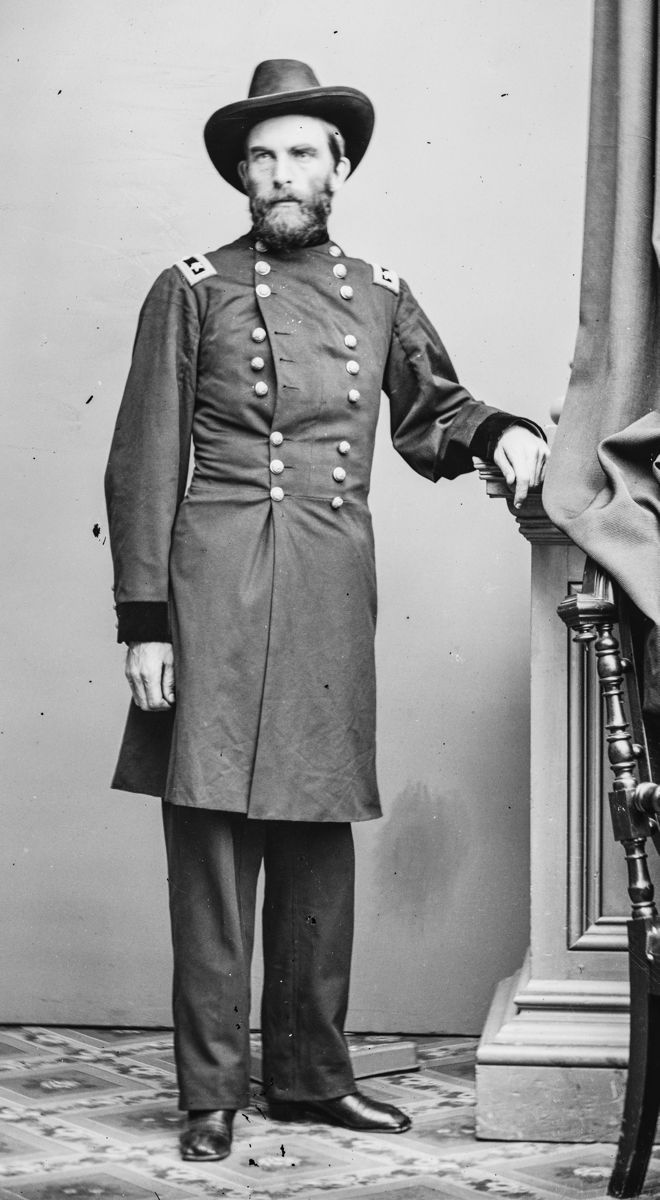
*Thompson was among the “Immortal 400,” Confederate officers taken to Morris Island and kept in harm’s way near the Federal positions there. This action was ordered by Secretary of War Edwin Stanton as retaliation against the Confederates’
imprisonment of Federal officers in Charleston, where they were endangered by Federal artillery. Thompson was one of the few who were exchanged. **The written messages received by Thompson on May 7 stated only that Davis had a letter from Dodge addressed to Thompson, a letter which Davis was ordered to deliver in person. There was no hint in these messages about the contents of Dodge’s letter. It is clear that Thompson did not know of the threatening nature of the letter until he met with Davis on May 9. Thompson’s attitude had certainly changed between April 30 and May 7, but the change was not due to Dodge’s threat. In his memoirs Thompson wrote that when he reached Chalk Bluff “the officer in charge…told me what his orders were” and told him of the harsh measures he was directed to take if Thompson refused. His memoirs stated plainly that at this point he had no reliable force to command and added that civilians he met on the road begged him to surrender. It was the state of his army and the plight of the women and old men that changed his attitude.
Sources: David Silkenat, Raising the White Flag: How Surrender Defined the American Civil War, 2019; The Civil War Reminiscences of M. Jeff Thompson, Stephen Davis, General Editor, Donal J. Stanton, Goodwin F. Berquist and Paul C. Bowers, Editors, 1988; OR, Ser. 1, Vol. 48. Gould Hagler is a retired lobbyist living in Dunwoody, Ga. He is a past president of the Atlanta Civil War Round Table and the author of Georgia’s Confederate Monuments: In Honor of a Fallen Nation, published by Mercer University Press in 2014. Hagler speaks frequently on this topic and others related to different aspects of the Civil War and has been a regular contributor to CWN since 2016. He can be contacted by email at [email protected].