
Critic's Corner
A Great Southern Poet
By Stephen Davis · Originally published December 2023 · pp. 30–31
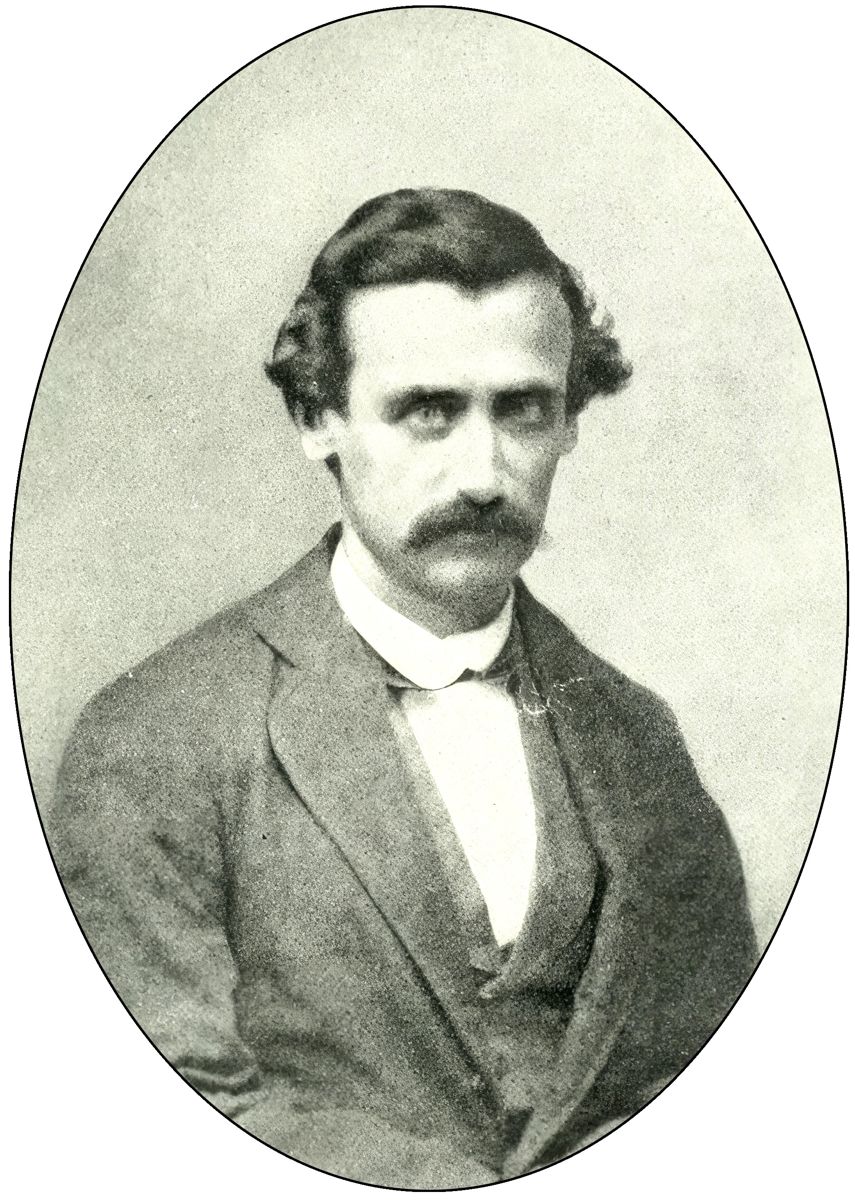
Centuries ago, biography developed as an art form—an admiring narrative of the life and times of a noble man whose course in life could inspire later generations. It is in this mold that South Carolinian Henry T. Thompson set out to write the first authoritative biography of the great South Carolina poet, Henry Timrod: Laureate of the Confederacy (1928). Having recently acquired a copy—thank you, Marc Ramsey—we renewed our acquaintance with this noted man of Southern letters. The poet’s grandfather, Heinrich Dimroth, came to Charleston from Germany in 1765. Anglicizing his name, he became a merchant tailor, married, and acquired considerable property. In the Revolution he served as an officer of the German Fusiliers, stationed along the coast. He died on his plantation near Charleston in August 1794, aged 60. The poet’s father, William Henry Timrod, was born on the family plantation in July 1792. In December 1812 he married Thyrza Prince, daughter of a prominent Methodist minister. Self-educated and inquiring, he became a Charleston bookbinder in hopes of surrounding himself with books. His shop became the gathering place of the city’s literati. The elder Henry Timrod also wrote verse, published as early as 1814 in Poems on Various Subjects. He dedicated one poem to “Harry, my little blue-eyed boy,” who was born on Dec. 8, 1828. The father died in July 1838, leaving his wife and son with plantation property. But Henry Timrod, ca. 1865. (The Photographic History of The Civil War in when their house burned down Ten Volumes, Vol. 9, page 32.)
a few years later, they were cast into comparative poverty.1 Nevertheless, the mother saw that young Harry received schooling in one of Charleston’s best academies. There he befriended Paul Hayne, and shared with him early efforts at verse. In January 1845, sixteenyear-old Harry (sometimes called Hal by his friends) entered the University of Georgia, thanks to a family benefactor. After two years he dropped out “because of ill health and lack of means,” writes his early biographer Henry Thompson.2 But he had already been seized by Erato, the Muse of Poetry. (Wordsworth was his favorite.) He later told his friend Hayne that “a large part of my leisure at college was occupied in the composition of love verses. Every pretty girl’s face I met acted upon me as an inspiration.”3 Seeking a trade, Timrod began studying law in the office of Charlestonian James L. Petigru. But it didn’t take long for him to give that up. “Timrod was too wholly a poet to keep company with so relentless, rugged, and exacting a mistress as the law,” observed a contemporary.4 In 1848, under the pen name “Agalus” (a minor Roman poet), he began sending compositions to John R. Thompson’s Southern Literary Messenger in Richmond, which published his verse. One poem, “The Past,” caught the eye of no less than Whittier. Timrod tried his hand at school teaching and as a tutor, wandering about the Carolinas. The redoubtable Simms became a friend and patron, and after founding Russell’s Magazine (after Russell’s book shop on Charleston’s King Street) in 1857, he began publishing Timrod’s work, as did the Charleston Mercury. But as so often happened in the poet’s sad life, hardship struck when Russell’s folded after its fourth issue. In 1860 Ticknor and Fields, the Boston publisher, ventured to put forth a small book of Timrod’s verse but without commercial success—a keen disappointment to the impecunious artist.5 Then came the war, stirring the young poet’s muse anew. “Ethnogenesis” was written during the Confederate Congressional session of February 1861 in Montgomery, celebrating that “At last, we are/A nation among nations.” Another work, “A Cry to Arms,” urged Timrod’s fellow Southrons to prepare for war with the North, as The arm that drives its unbought blows With all a patriot’s scorn, Might brain a tyrant with a rose, Or stab him with a thorn.6 The poet heeded his own call when, on March 1, 1862, he enlisted in Company B of Col. Lawrence Keitt’s 30th South Carolina, in which he was assigned a clerk’s role. But Timrod’s heart was not in soldiering. A month later he got a job as war correspondent for Robert Barnwell Rhett’s Charleston Mercury. By that time he was engaged to Kate Goodwin, of a well-to-do family from Florence in the Upcountry, whom he had met while teaching there a few years before the war. “But for my engagement with Katie, I would have preferred to remain idle in Keitt’s camp,” Timrod wrote his sister Emily, “but I owe it to the dear girl to show that I have energy and a capacity—when I choose to exert it—to go through the world… boldly and determinedly.” “The terms of my engagement are very advantageous,” he boasted to Emily; Timrod was paid six dollars a day plus travel expenses, prompting him to boast that his terms were “higher even than Personne’s with the Courier.” (“Personne” was Felix de Fontaine, correspondent for the Charleston Courier; he was also being paid $6 a day plus expenses, allowing one journalism scholar, Patricia McNeely, to call him “one of the highest paid correspondents in the war.”) Besides, Timrod was seeking to build a writer’s reputation, and working for a prominent newspaper was a career-boost. “Rhett assures me that all doors will fly open before my reputation,” he confided to his sister.7 Timrod’s assignment was to report from Beauregard’s Army of the West, then encamped at Corinth. But outdoors life enfeebled the frail poet, who gave it up and went home to Charleston, medically discharged as of Dec. 8, 1862. He returned to writing verse, especially patriotic lines extolling the Confederacy. After Chancellorsville he celebrated the Confederate victory with “Carmen Triumphale,” in which he exults that the enemy who “came with many a haughty boast…and swooped like vultures on the coast” had left their bones “bleaching on the sands,/Or mouldering in shallow graves.” “I am glad to say that the muse has not altogether deserted me,” he wrote to a friend. Yet disappointment came when fellow Charlestonians could not arrange for publication of his writing for a London edition; Frank Vizetelly, war correspondent for the London News, had even offered to furnish illustrations for the volume.8 Then opportunity knocked at Columbia, the state capital. In January 1864 he became a partner, with De Fontaine and Julian Selby, of the daily South Carolinian. Timrod contributed as associate editor; his first piece appeared on January 13. With his prospects relatively secure, he married Katie Goodwin a month later. “He is making himself a fine prose writer,” Simms wrote Hayne in early May ’64, referring to Timrod’s essays. In one, “A Theory of Poetry,” which dates from 1863, Timrod discusses Wordsworth and Poe, affirming “I look upon every poem as strictly a work of art.” Simms acknowledged that “he has only to prepare a couple of dwarf essays,” which even for a daily was not taxing work. “Tim,” as Simms called him, and Katie were living in a small house in downtown Columbia when they were blessed with a little boy, Willie, born on Dec. 24, 1864.9 But the bard who once asked “why may not love and life be one?” was then beset by ill fortune. Sherman’s army swept into Columbia in mid-February 1865 and much of the capital’s downtown area was burned, though the Timrods’ residence to the east, on Henderson Street, survived. When the South Carolinian failed, the poet and his family fell into hard times. Young Willie, not yet a year old, succumbed to death in October. After selling furniture and some silver, the struggling Timrod was forced to accept handouts from friends and neighbors. De Fontaine re-established the Carolinian in December 1865, with Timrod and Simms as editors, but after four months they had not been paid. Timrod thought of starting a private school in the capital and resuming teaching, but he could procure no pupils. He wrote some editorials for the Columbia press, but again got nothing for them. “You ask me to tell you my story for the last year,” he wrote Hayne in late March 1866; “I can embody it all in a few words: beggary, starvation, death, bitter grief, utter want of hope.” When he sent some poems to Northern periodicals, they were rejected. (It would be two decades before Northern magazines welcomed the submissions of Joel Chandler Harris and other Southerners.)
He was so depressed that, referring to his work, he confided to his longtime friend, “I would consign every line of it to eternal oblivion for one hundred dollars in hand.”10 Simms and Hayne, struggling themselves, could offer no help. In the fall of 1866, sympathizers in the legislature brought Timrod’s name up for a messenger’s job, but he got only eleven out of ninety votes. At least the governor hired him as an office clerk—but only for thirty days. A few months later, around Christmastime, General Wade Hampton persuaded a Methodist minister to take a bit of money to Timrod for the care of his family. Embarrassed, the poet reluctantly accepted, and from then on Hampton and others at least provided for Timrod’s most pressing needs. “One of my literary friends, a man of fine capacity, is literally dying by inches, of poverty and disease together,” Simms wrote an acquaintance in March 1867. Of course he was referring to Henry Timrod. Jay B. Hubbell, the authority on Southern literature, writes, “Timrod did not starve, but the want of proper and sufficient food had its effect upon his weakened condition.”11 And yet he kept writing. “It was natural,” wrote a friend years later, “that he should yearn to be permitted to give expression in his own melodious verse to the noble thoughts which crowded his teeming brain.”
Perhaps Timrod’s most famous composition is “Memorial Ode,” which was recited at dedication services of Confederate soldiers’ graves in Charleston’s Magnolia Cemetery on May 10, 1867. “Sleep sweetly in your humble graves,” the poem begins,
Sleep, martyrs of a fallen cause; Though yet no marble column craves The pilgrim here to pause.
Timrod was heartened that autumn when a benefactor began talking of collecting all his verse for publication. Proof sheets for a book even appeared. The poet was clutching them during a visit to a friend’s house on Laurel Street in Columbia when he suffered a hemorrhage of the lungs, spitting blood all over the pages. He was dying of tuberculosis. Physicians kept Timrod in bed, but he could not refrain from composing. When, on October 4, doctors told him there remained no hope, he was shocked. “Must I so soon depart, who hoped to achieve such great things?” he exclaimed. On Monday, October 7, 1867, he was correcting proof sheets for his hoped-for compilation when he breathed his last. Soon his body was laid to rest in the yard of Trinity Episcopal Church in downtown Columbia.12 The melancholy bard, denied fame and fortune in his lifetime, pondered his luckless fate in one of his last compositions, “Why
Silent.” “Already, I think, for a little praise,/I have paid too dear,” he laments, While the world, in its worldliness, does not miss What a poet sings.
Endnotes: Henry T. Thompson, Henry Timrod: Laureate of the Confederacy (Columbia: The State Company, 1928 [repr. AMS Press, New York, 1971]), 9, 11-12, 14; Patricia G. McNeely, “Henry Timrod: Reluctant Confederate Who Became Poet Laureate” in Patricia G. McNeely, Debra Reddin van Tuyll and Henry H. Schulte, eds., Knights of the Quill: Confederate Correspondents and their Civil War Reporting (West Lafayette IN: Purdue University Press, 2010), 160-61; Guy A. Cardwell, “Henry Timrod” in Robert Bain, Joseph M. Flora and Louis D. Rubin, Jr., eds., Southern Writers: A Biographical Dictionary (Baton Rouge: Louisiana State University Press, 1979), 455. Thompson, Timrod, 15; Jay B. Hubbell, The South in American Literature 1607–1900 (Durham: Duke University Press, 1954), 467. Thompson, Timrod, 16. Thompson, Timrod, 16-17. Thompson, Timrod, 17-18, 20, 23, 27-30; McNeely, “Timrod,” 162. Thompson, Timrod, 32; Timrod, “Ethnogenesis” in Richard Beale Davis, C. Hugh Holman and Louis D. Rubin Jr., eds., Southern Writing 1585–1920 (New York: Odyssey Press, 1970), 609; Timrod, “A Cry to Arms” in Thompson, Timrod, 95. Thompson, Timrod, 32-33; Patricia G. McNeely, “Felix Gregory de Fontaine: Chronicling the Horrors of War” in Knights of the Quill, 50. Thompson, Timrod, 34-35; McNeely, “Timrod,” 171; Stephen Davis, “Henry Timrod: Poet Laureate of the Confederacy,” Civil War Times, vol. 21, no. 10 (February 1983), 25. Thompson, Timrod, 36-38; Timrod, “A Theory of Poetry” in Thomas Daniel Young, Floyd C. Watkins and Richard Croom Beatty, eds., The Literature of the South (Glenview IL: Scott, Foresman, 1968 [1952]), 310. Thompson, Timrod, 38-41, 44-45, 125 (“Sonnet”); Marion Brunson Lucas, Sherman and the Burning of Columbia (College Station: Texas A & M University Press, 1976), map, “Columbia Buildings Burned Feb.17-18, 1865.” Thompson, Timrod, 43-44, 48; Hubbell, The South in American Literature, 471. Thompson, Timrod, 9, 48-52, 126, 140. Ibid., 127. “Why Silent” is one of the half-dozen pieces by Timrod reprinted in Clyde N. Wilson, ed., The Land They Loved Volume
I: Southern Poets and Poems, 1606–1860 (Columbia: Shotwell Publishing, 2023), 126-27.
If Henry Timrod worked in the clutches of Erato, the Muse of Poetry, Stephen Davis is a devotee of Clio, the Greek Muse of History. He’s been writing on the war for well-nigh onto a half-century, having first been published in Civil War Times Illustrated back in ‘76. He is the author, among other titles, of a two-volume study of Gen. John B. Hood’s war service (Mercer University Press,
2019-2020). Next year Savas Beatie will publish The National Tribune Remembers the Atlanta Campaign. The Tribune served the same purpose as did Confederate Veteran for exRebels; it allowed Union veterans to submit and have published reminiscent articles on their war experiences. Of the hundreds of articles on the Atlanta Campaign appearing in the National Tribune from 1877 to 1911, Steve has chosen seventy-six pieces for reprinting—and bringing to a modern readership.