
Confederate History Atop A Mountain
By Joseph Wilson · Originally published August 2023 · p. 33
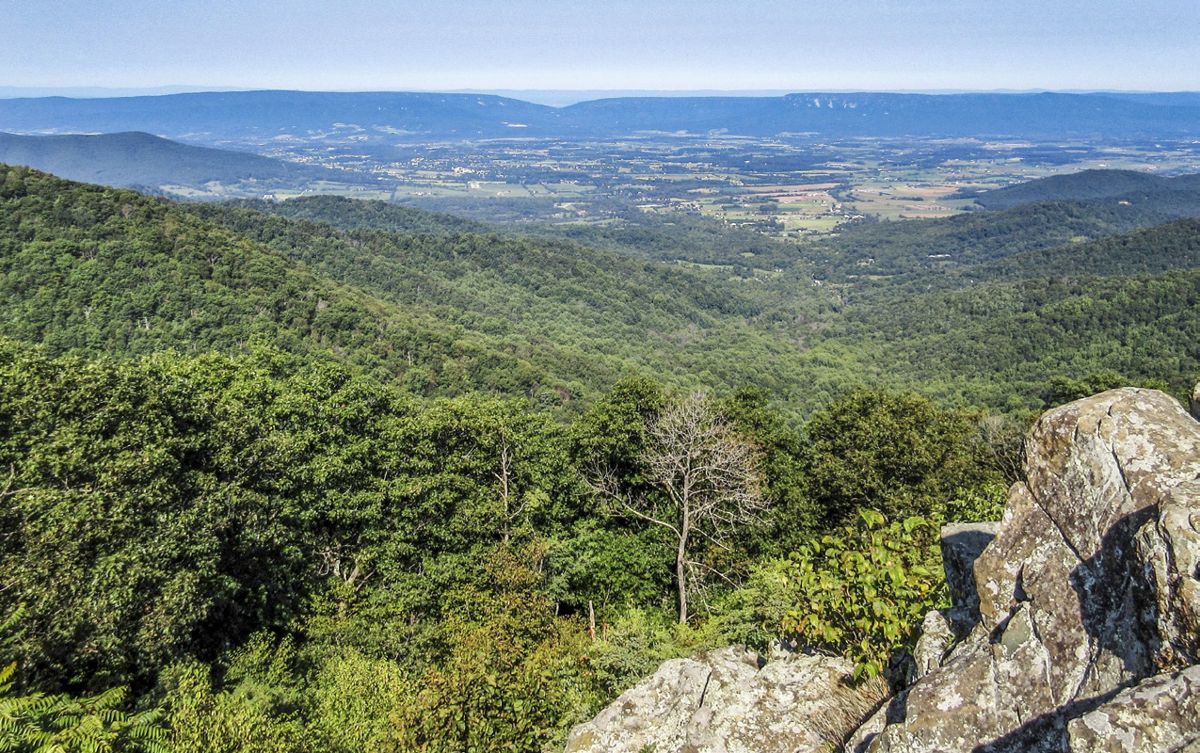
Virginia’s Blue Ridge Mountains are a familiar destination for many folks who enjoy hiking remote trails in pursuit of the numerous beautiful waterfalls that flow down from the mountaintop. Finding Confederate history in an isolated boneyard while hiking in the mountains so far from civilization wasn’t expected. My passion for the Civil War was on hold for the week. Or so I thought. Only cascading waterfalls and spectacular vistas were anticipated. A secluded cemetery with Confederate soldiers buried on the brow of the summit suddenly shifted my focus back to history. The Skyline Drive in the Shenandoah National Park winds along the peaks of the Blue Ridge Mountains. The single road offers a multitude of quiet trails for wandering off into the heart of the mountain. After a hardy breakfast, my travelling cohort and I grabbed our walking sticks looking for adventure. Hiking down the mountain in pursuit of a waterfall quickly followed. Proceeding down the trail in the morning chill we took in the beauty of the great outdoors. Then history intruded on our mountain getaway. Halfway down the trail to the targeted waterfall an old weathered wooden sign that read “Cave Cemetery” stood alongside a small
Private John G. Cave’s headstone.
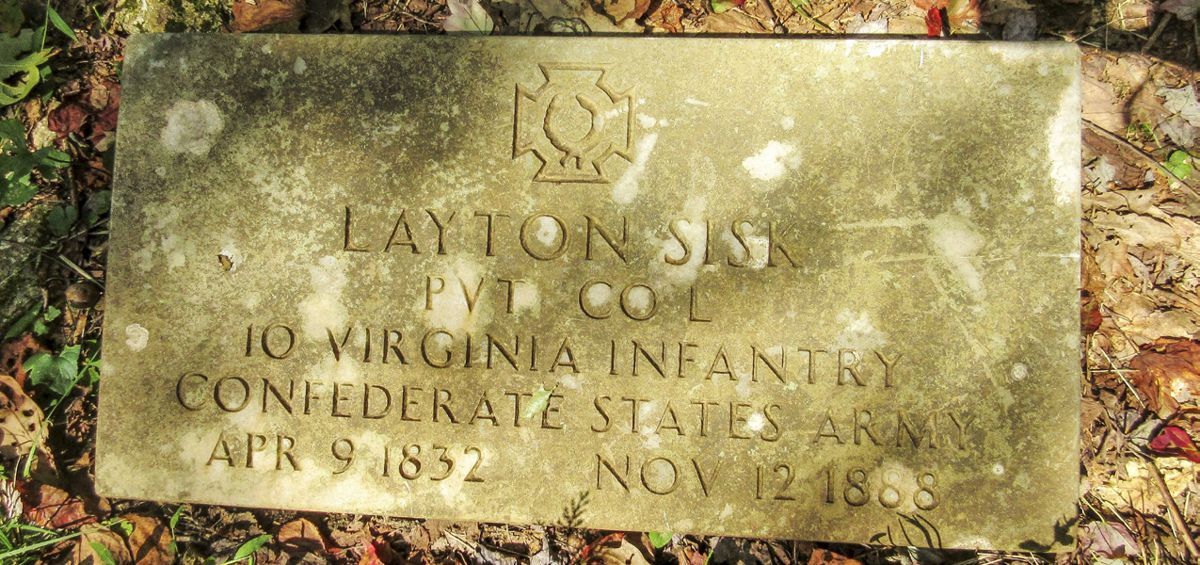
foot path that intersected with the main trail; no cemetery appeared anywhere. The path strayed off the trail and disappeared into a thick wooded area. Being curious, I veered up the foot path on the trail less traveled. After walking a while, a clearing finally revealed a small untidy cemetery with approximately 35 graves. Indeed, the Cave Cemetery did exist. A graveyard high up in the Blue Ridge on the side of a mountain far from anything or anyone seemed out of place. Being a graveyard enthusiast, a close examination of the stones followed. I was astonished to find the graves of three Confederate soldiers. One soldier was John G. Cave who served with the Rockbridge Light Artillery. Many of his family were buried in the graveyard named for them. Two other soldiers buried in the cemetery served in the 10th Virginia Infantry. Privates John Weakley and Layton Sisk grew up on the mountain with John Cave. These boys came down from the Blue Ridge to enlist in the Confederate Army. I theorized that all three patriots who volunteered to fight for their country returned to the highlands after the war in good standing. A theory I later questioned.
Private John Weakley’s headstone.
Later, conversation with a Park Ranger enlightened me about the obscure cemetery and the ways of mountain folk. People who populated the Blue Ridge long ago were born on the mountain and they wanted to rest in peace for all eternity on the mountain they loved. They wouldn’t have it any other way. When the National Park Service created the Shenandoah National Park in 1935, it was written into the agreement that the old mountain dwellers who predated the park retained their privilege of being buried on the mountain if they wished. The soldiers whose remains rested in such an unusual cemetery so far from the maddening crowd piqued my interest. When I got home, I searched their names on the Civil War Soldier’s database to see what I might find. What I found at first startled me. All three went AWOL and deserted. My first thought deemed them cowards. A firing squad should have been formed for the scoundrels; but after thinking about it, I may have been too harsh. Further study revealed other possible narratives. Initially, the soldier’s names and regiments stood out. After a second look at the gravestones, I noticed that two are marked with the Southern Cross of Honor. Why would the Cross be on the stone if they deserted? Seems the boys were proud of their Civil War service. Or the families were proud enough to put the Southern Cross on the stones. There were approximately 103,000 Confederates gave up on the war and went home. The Union actually had many more desertions than the South. Historians would like you to believe that most Confederates took unauthorized “French Leave” but later returned to the army. That’s not the reality. While it may be true for some, not all the fighting men went back to their company. Many Southerners did go home as the war grew old and never returned, and for good reason. Some soldiers returned home as families living in the mountains and bordering on starvation wrote, begging them to return. Folks in the mountains didn’t have large farms and few, if any, slaves. All the planting and work needed to survive shifted to the women during the war. The young men were essential in supporting their families in the harsh lifestyle of mountain folks. Another dreaded winter on the mountain without their men might bring devastation or even death to families led only by women. Family prevailed when soldiers faced a choice between a war that wasn’t going well and family loyalty. John Cave enlisted in October 1863 and served for a year before going home in the winter of 1864, reportedly a severe winter. Layton Sisk enlisted on May 24, 1863, but went AWOL a month later for reasons unknown. When summer ended Layton returned to the army in September and continued fighting till the end. John Weakley deserted twice. He enlisted in 1861. He went AWOL in June 1862 but returned. After serving another year, he went AWOL again in September 1863 and never went back. Weakley’s grave shows he died in 1864. Did illness plague Weakley? Or maybe he was severely wounded at the Battle of Gettysburg and sought family care. Cave and Sisk both lived long after the war. Sisk died in 1888. Cave passed away in 1907. Many reasons for quitting the war prompted Southern boys to go home. Cowardice wasn’t one of them. Besides the singular act of going AWOL, these boys had very different stories. They likely knew each other and grew up together. But their motives may have been very different. Cave could have quit the war to support his family. Sisk seemed to take “French Leave,” but returned to the fight. Weakley may have suffered ill health or was wounded at Gettysburg. Another scenario may come into play. Weakley’s early enlistment in 1861 may have been a forced enlistment by General Stonewall Jackson. Resistance in the Blue Ridge formed in the beginning of the war after men were ordered to report for enlistment into the Army. Most opposition to enlistment came from German Baptists, commonly called Dunkards, who populated the Shenandoah Valley. Some place the number of those refusing to enlist from the Blue Ridge at around 1,000. Many of those resisting found a secure hiding place at Swift Run Gap. Jackson sent a force of infantry and artillery to the mountains and shelled Swift Run Gap. The attack had Virginians firing on Virginians; a Civil War played out within a Civil War. Outnumbered and facing an organized military force, the resistance quickly crumbled. All three men buried in the Cave Cemetery may have had a strong opposition to the war. Maybe they enlisted under threat of punishment. These hardy mountain men may have simply put family and religion above a war that they didn’t support. If forced to enlist against their religion, or leaving the war to care for family, they may be innocent of my premature charge. I hereby withdraw my preliminary allegation of cowardice. Another piece of Civil War history I encountered on the mountain featured Fisher’s Gap. Jackson led his army across the Blue Ridge Mountains at Fisher’s Gap as they left the Shenandoah Valley and headed east on their way to Fredericksburg where a battle would be fought near the end of the year. The main trail to the waterfall runs through Fisher’s Gap. As it turned out, I was walking along the same trail taken by Jackson and his army in late 1862. A creek running alongside the trail likely supplied water for the canteens of the Stonewall Brigade. The plan for this trip was for a mountain getaway in the fresh frosty mountain air while relaxing beside magnificent waterfalls or gazing at panoramic views of the Shenandoah Valley. As so often happens, history interrupted, but the welcomed war stories added another element to the retreat. Maybe the universe aligns to those who love history and led me to the story. I’ll never know the complete story of those three Confederate soldiers buried in a concealed cemetery way up on the side of a mountain. But I do ask their forgiveness for my initial assumption! Joseph F. Wilson is a member of Old Baldy CWRT and The General Meade Society. The writer lectures on Civil War topics and is the writer and producer of the documentary “Civil War Prisons – An American Tragedy” available on Amazon. YouTube channel – “Joseph F. Wilson.” His email is [email protected].