
Through The Lens
Are You Going To Run Like Sheep?
By Stephanie Hagiwara · Originally published August 2023 · pp. 16–17
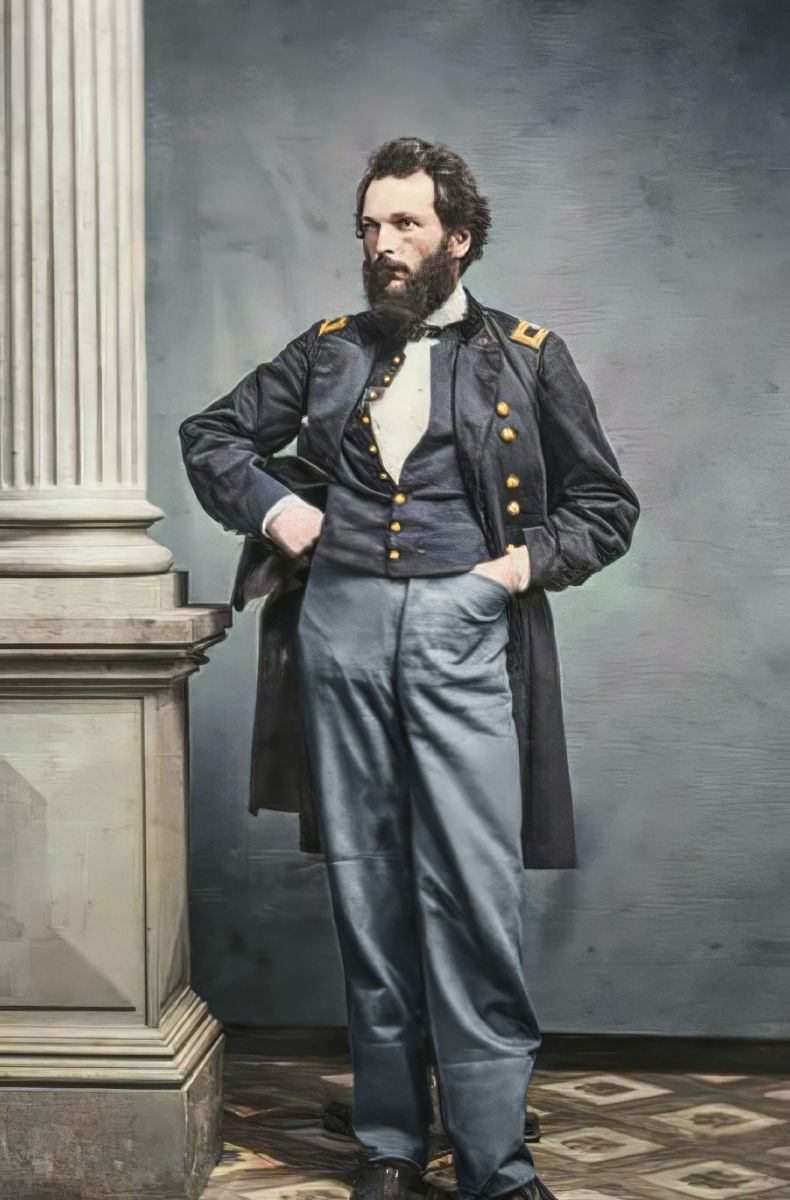
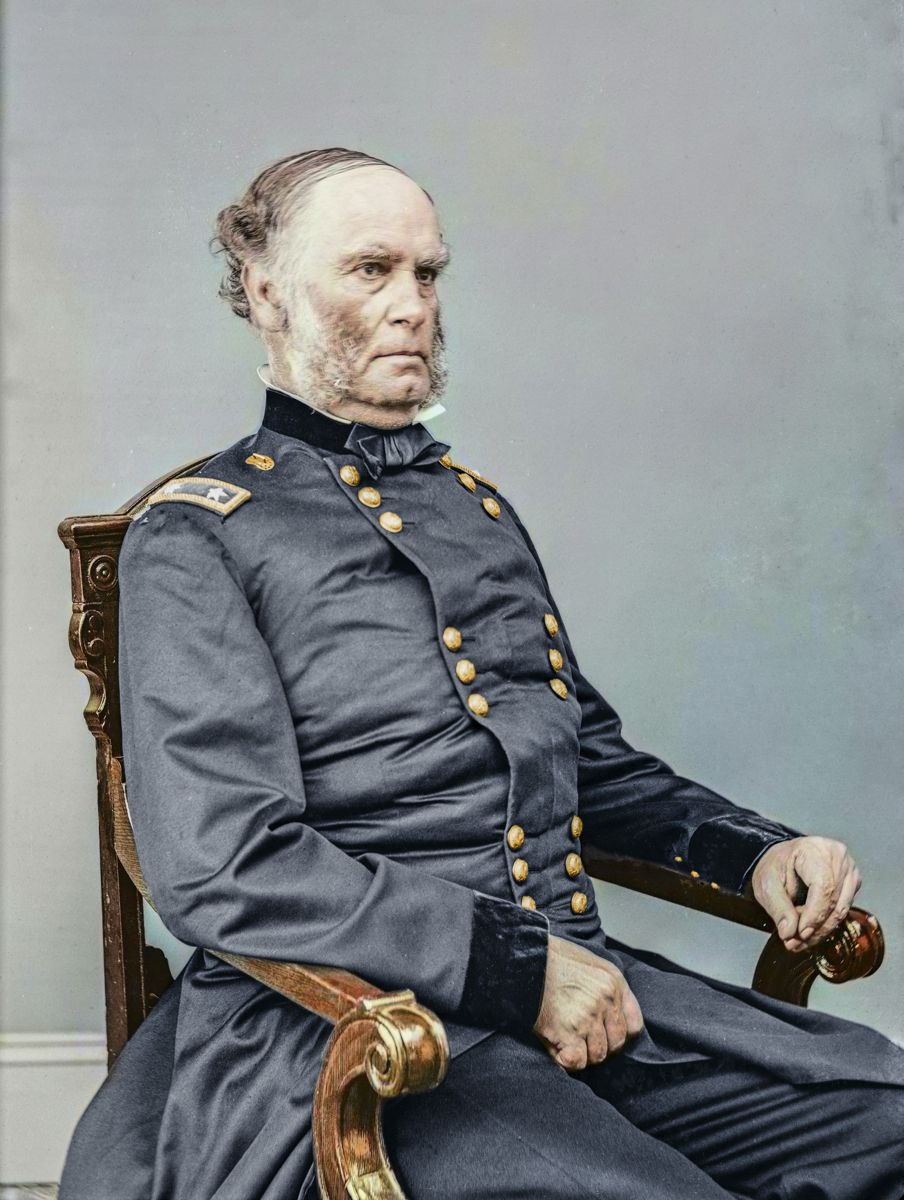
Are You Going To Run Like Sheep? “I give captured slaves their freedom on the ground that they became captured captives and therefore subject to my disposal instead of a former captor or assignee.” – U.S. Gen. Samuel R. Curtis At the Battle of Pea Ridge, Ark., March 7-8, 1862, U.S. Gen. Samuel R. Curtis, Army of the Southwest, drove C.S. Gen. Earl Van Dorn, Army of the West, off the battlefield in a decisive victory, establishing Federal control of most of Missouri and northern Arkansas. Van Dorn agreed to join his army with C.S. Gen. P.T. Beauregard’s in Corinth, Miss. In his zeal, Van Dorn ordered all arms, ammunition, food, machinery, and stores shipped out of the district, stripping the area of all military manpower and equipment. Following Van Dorn’s departure, Curtis was ordered to capture Little Rock, Ark. and declare himself the state’s military governor and rule by martial law. Curtis was a West Point graduate, Mexican-American War veteran, and civil engineer. The abolitionist had given up his seat in Congress to fight in the War. On the morning of March 27, Curtis was promoted to major general in a small ceremony. In the afternoon he learned his 20-year-old daughter had died of typhoid fever which she had contracted while visiting the army camps. On May 20, having gathered sufficient forces to make the march to Little Rock, Curtis was informed that his supply chain was stretched to its limit. It was agreed to establish a waterborne supply chain. The navy’s supply vessels fought past Confederate batteries but were stopped by low water levels on the White River. Undeterred, Curtis announced if the supply boats could not come to him, “I must go to them.” Curtis left Batesville, Ark. during the last week of June to meet the supply boats at Clarendon, Ark. For the first time in the War, a Federal army would operate for two weeks without a supply base. In the height of summer, the men marched through the heat and foraged aggressively. According to an Arkansan, “…almost every thing which could not be eaten was destroyed.” Curtis seized printing presses in every town the army passed through. Before the preliminary Emancipation Proclamation was announced on September 22, 1862, and lacking the authority to do so, Curtis printed and issued stacks of emancipation forms. Waving “freedom papers,” over 3,000 refugee slaves left the area. “No troops—no arms—no powder—no material of war — people everywhere eager to rise, complaints bitter,” wrote C.S. Gen. John S. Roane. Determined to drive out the invaders, Maj. Gen. Thomas C. Hindman assembled a fighting force from nothing. Hindman ordered Gen. Albert Rust to attack James’s Ferry, six miles from Cotton Plant, Ark. He appealed to local citizens to destroy anything that could sustain the Federals. Hundreds of trees were cut to create timber blockades to give Rust time to reach the crossing first. Still, the Federals won the race. On July 6, the Federals reached James’s Ferry where pioneers cleared the timber blockade. On July 7, the low water level meant the Federals could wade across the Cache River. Col. Charles E. Hovey, the former Illinois Normal College president, sent 400 men, including the 1st Indiana Cavalry with a 3-in. rifled cannon to scout the road ahead. Four miles south they reached a road fork in the middle of Parley Hill’s plantation. They took the southeast road to Clarendon. At Hill’s nearby home, “the command confiscated a ready cooked dinner, and also a couple of wagon loads of bacon and molasses,” and were fired upon. The Confederates trotted back to the fork to take the Des Arc Road. The Federals rushed after them, “to drive the rebels away from the army’s line of march.”
On July 7, the Battle of Cotton Plant began three-quarters of a mile from the road fork amid a swamp. The Federals approached a line of 30 or 40
Rebel horseman and both sides fired. The Confederates fell back into the trees. Expecting the daily experience that “the enemy would fire only one volley and then seek safety by rapid flight into the depths of the wild woods,” U.S. Col. Charles H. Harris, 11th Wisc., deployed four companies of the 11th as skirmishers and four companies of the 33rd Ill. in a battle line; the cannon was posted in reserve left of the road. Waiting in the swamp were about 1,000 cavalrymen, the advance from the force of five Texas cavalry regiments, three Arkansas infantry regiments, one Arkansas artillery battery, a total of about 5,000 men.
These inexperienced men were armed with a variety of single and double-barreled shotguns, squirrel rifles, buck and ball muskets, and “in one thing only were all armed alike, and that was with big knives.” The surprised Federals fell back. The 12th Texas Cavalry, dismounted, and “yelling like savages and swearing like demons,” advanced. The Federals opened a steady fire with the cannon blasting as fast as could be reloaded. Hovey, at the fork in the road, galloped to find his troops wavering. Hovey grabbed a rifle and cartridge box from a wounded soldier and went to an unoccupied tree, firing
Col. Charles E. Hovey. Colorization © 2023 civilwarincolor.com, courtesy civilwarincolor.com/cwn. (Public Domain)
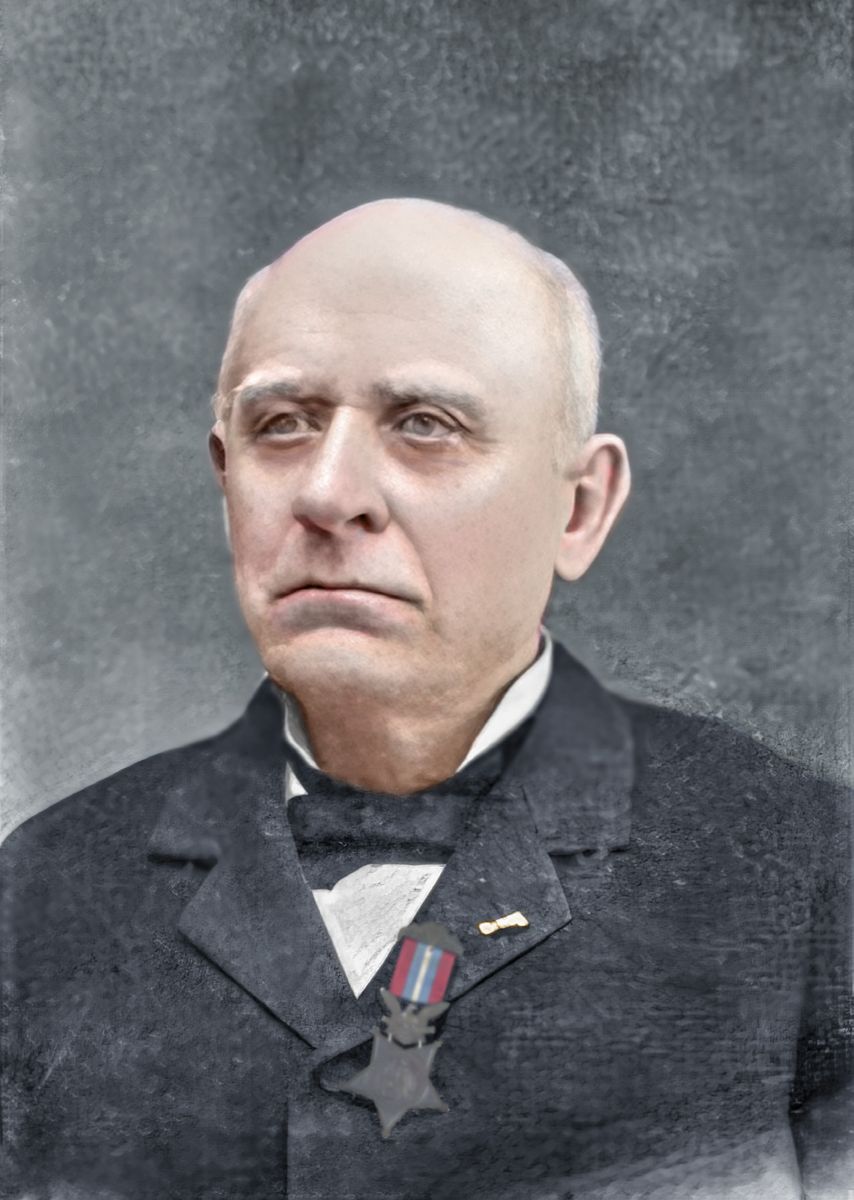
towards the enemy. Within two or three shots a spent bullet hit his chest, sending Hovey staggering from the blow. Hovey plucked the bullet out and shouted that the rebellion, “did not seem to have much force in it.” His men cheered. When the dismounted 16th Texas Cavalry advanced thirty minutes later, the outnumbered Federals gave way. Hovey ordered a retreat. Four of the gun crew had been wounded and their cannon was stranded. “Boys, save the gun,” shouted Capt. Potter. Sgt. Edward A. Pike ran towards the Confederates. He “seized the trail and tore down the road with the cannon as if it had been a baby wagon.” Pike would earn the Medal of Honor for this act. Hovey on horseback caught up with his retreating men in Hill’s cornfield. Waving his sword he yelled, “… Are you going to run like sheep?”
CivilWarNews.com He organized his men into building breastworks out of fence rails, branches, and cornstalks, and positioned others in the heavy timber. The 12th Texas Cavalry, riding four abreast, and yelling Comanche war whoops, charged the breastworks “at full speed and in great force.” The Federals rose and shot at point blank range, then frantically began reloading. Bodies soon covered the ground. Riderless horses rushed in all directions. The remnants of the 12th led the Confederate retreat. Two hundred men with two 3-inch rifled cannon from Col. William Wood’s battalion, 1st Ind. Cavalry, arrived. They advanced into the swamp. Spotting the Confederates, the cavalry charged. The Confederates fired a “tremendous volley” hitting the officers in the front. For twenty minutes both sides fired at close range before the Confederates began retreating. The Federals switched from firing canister to solid shot and explosive shells. Hundreds of Texans raced each other from the field. The Arkansas infantry were surprised to see the Texans stampeding towards them, knocking some men down. The Texans vanished in a cloud of dust. The infantry followed, ending the last serious Confederate effort to prevent Federal control of the state. Alas, Curtis missed his rendezvous with the supply vessels by a single day. Relinquishing the Little Rock operation, the army marched 45 miles to Helena, Ark., suffering with the heat, bad water, and few rations. Curtis would have the consolation of moving into Hindman’s mansion and flying a large United States flag from the roof. However, Curtis would never receive the credit he earned for his accomplishments in the field. Sources: Shea, William L. “The Confederate Defeat at Cache River.” Arkansas Historical Quarterly 52 (Summer 1993): 129–155 • Pea Ridge: Civil War Campaign in the West: The University of North Carolina Press, 1997 • Way, Virgil Gilman, History of the Thirty-Third Regiment Illinois Veteran Volunteer Infantry in the Civil War, 22nd August, 1861, to 7th December, 1865: The [Regimental] association, 1902
•
•
Quiner, E. B.. The Military History of Wisconsin: Clarke & Co., 1866
Stephanie Hagiwara is the editor for Civil War in Color.com and Civil War in 3D.com. She also writes a column for History in Full Color.com that covers stories of photographs of historical interest from the 1850’s to the present. Her articles can be found on Facebook, Tumblr and Pinterest.
Gen. Samuel R. Curtis. Colorization © 2023 civilwarincolor.com, courtesy civilwarincolor.com/cwn. (Library of Congress)