
The Unfinished Fight
William Gregg and Essays on Domestic Industry
By Craig L. Barry · Originally published April 2023 · pp. 12–13
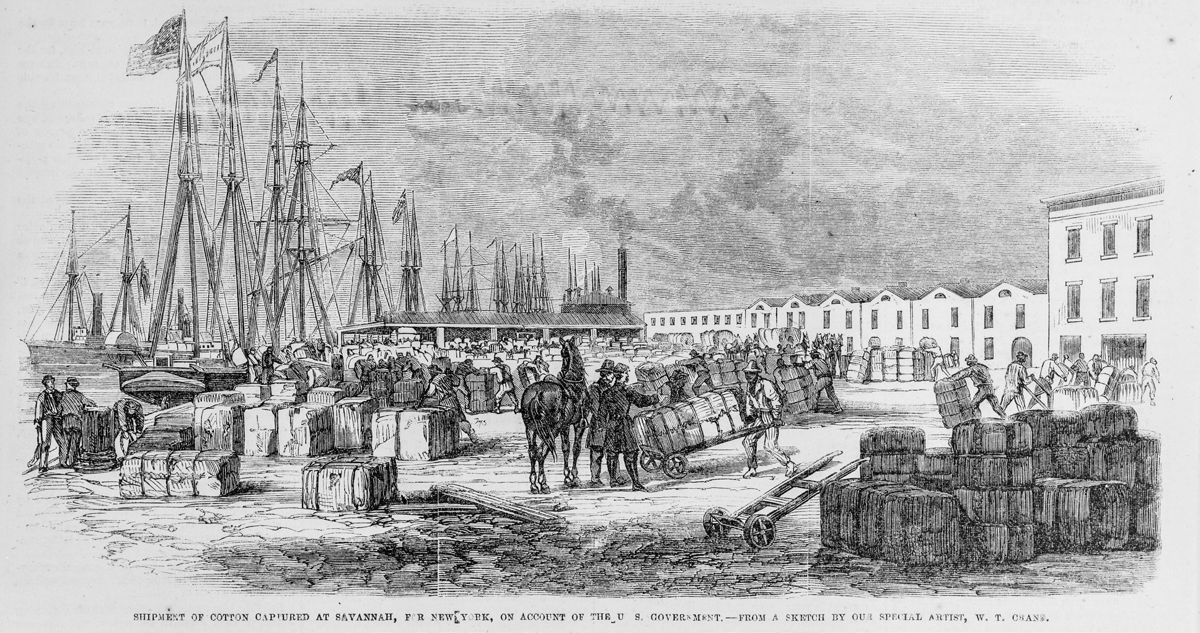
William Gregg and Essays on Domestic Industry The urban centers of the antebellum South were long content to rely on importing virtually every civilian necessity and ignored soothsayers like William Gregg who advocated economic self-sufficiency for the region. Gregg published his ideas in an 1845 pamphlet “Essays on Domestic Industry” wherein he argued, somewhat prophetically as it turned out, that economic domination by the North was best headed off by Southern industrialization. He managed enough support for his own efforts but failed in the broader scope of facilitating any major change in the cotton-based agrarian economy of the region. The prophetess Cassandra was the daughter of King Priam who argued unsuccessfully against bringing the Trojan horse into the city of Troy. “Timeo Danaos et dona ferentis,” said she, “Beware of Greeks bearing gifts.” William Gregg lived until 1867 and was forced to see his most dire predictions become reality. The purpose of this column is not to surmise what might have happened if the South had diversified its economy, if not completely industrialized; rather, how the difficulties of the time revealed some truly remarkable ways of coping with shortages in the civilian sector, and what it reveals about the character of the Southern people on the home front during the 1860s. The first point to consider is the difference between “making do” with substitutes and “doing without” a critical necessity. A common example given is the ability of Southern women to concoct substitutes for almost everything. The 1863 Confederate Receipt Book offers receipts (recipes) for making coffee from parched corn, okra, or peanuts, apple pie “without apples,” and “artificial” oysters. However, there was no ingenious substitute for salt. This did not mean that they had to endure bland food without salt as a seasoning, but rather there was no way to adequately preserve meat for the winter months. This is quite a different level of sacrifice when hunger looms large in your immediate future. The Receipt Book offers some suggestions of course: “We need salt as a relish to our food, but it is not essential in the preservation of our meats. The Indians used little or no salt, yet they preserved meat and even fish in abundance by drying. This can be accomplished by fire, by smoke or by sunshine, but the most rapid and reliable mode is by all these agents combined. To do this select a spot having the fullest command of sunshine. Erect there a wigwan five or six feet high, with an open top, in size proportioned to the quantity of meat to be cured, and protected from the winds, so that all the smoke must pass through the open top. The meat cut into pieces suitable for drying (the thinner the better) to be suspended on rods in the open comb, and a vigorous smoke made of decayed wood is to be kept up without cessation Exposed thus to the combined influence of sunshine, heat and smoke, meat cut into slices not over an inch thick can be thoroughly cured in twenty-four hours. For thicker pieces there must be, of course, a longer time, and the curing of oily meat, such as pork, is more difficult than that of beef, venison, or mutton. To cure meat in the sun hang it on the South side of your house, as near to the wall as possible without touching. Savages cure fish by pounding it fine, and exposing it to the bright sun.”
They were kidding themselves about curing meat with no salt. There are two “safe” methods for preserving or curing meat, and both require some salt. First is soaking in brine, and the second is dry curing. The reason for salting of meat during curing was to draw out the bacteria that cause spoilage. The natural bacteria that are always present in the blood and tissues of live animals begin to multiply as soon as it is butchered. If meat is left exposed to the air, slow oxidation of the fat takes place which causes rancidness. What is described in the Confederate Receipt Book is cold curing (smoking) the meat in the Native American tradition at very low temperatures of less than 100 degrees Fahrenheit for long periods of time. This is possible but Native Americans primarily preserved fish this way, not the Southern staple, pork. Low temperature smoking dries the meat and flavors it but does not kill the bacteria in pork or “cook the meat.” The method would perhaps work better in winter in terms of extending safe usage, but most meat would spoil in a few days during the summer months. As the War wore on and most salt was diverted to the military, desperate civilians began digging up the dirt floors of their smokehouses to recover whatever salt had accumulated from falling off the meat hanging there in previous years. A distinction might be made between the Southern urban and rural populations, however, both were faced with shortages which, though they manifested themselves differently, led to many of the same difficulties. The crunch was being felt by Southern cities as early as autumn 1861, when several unpleasant realities became clear. First, the war was not going to be over in 90 days and the military was going to take much of the labor force at the same time industrialization became a priority. The Crenshaw Woolen Company in Richmond was about a year old in late 1861. It was one of the few mills producing broadcloth of “light blue and grey cloth required for the uniforms of the Confederacy.” An account of that firm’s enterprise from late 1861 suggests the dilemma that was developing for new industries in the Confederate Capitol, the Richmond Enquirer noted in an article dated October 17, 1861: “The sudden blockading of the ports of the South bade fair for awhile to terminate, or very much cripple, at least, the operations of the Crenshaw mills, as far as the manufacture of broadcloths was concerned, by cutting off the supply of logwood; but fortunately the much talked about ship Tropic Wind, which ran the blockade in April, brought within available distance of Richmond a full cargo of the necessary material, found on board a wreck which was encountered on the coast of Cuba. The Crenshaw Company are now enabled to furnish their less fortunate manufacturing friends throughout the South with as much logwood as can be needed for months to come. The Crenshaw Works are now exclusively engaged under a Government contract, in the manufacture of regulation cloth for army uniforms, blankets, and stocking yarn, all for the use of the army. About 5,000 yards in all of cloth is manufactured weekly, and about 450 blankets. The latter, of which large numbers have already been furnished to the army, are quite equal to the English army blanket, many of which are made of shoddy, and superior to those of the Yankees.” The article goes to say that about 130 workers were employed at the Crenshaw Woolen Company, 25 of whom were female, who earned wages of about $7.50 a week. “Several children” as young as 10 to 12 years were also employed “in the light and simple labor of filling shuttles.” . The male employees were principally foreigners relocated to Richmond “from the English, Irish, and German factories.” Their labors are superintended by experienced “overseers from England.” At a glance it is clear
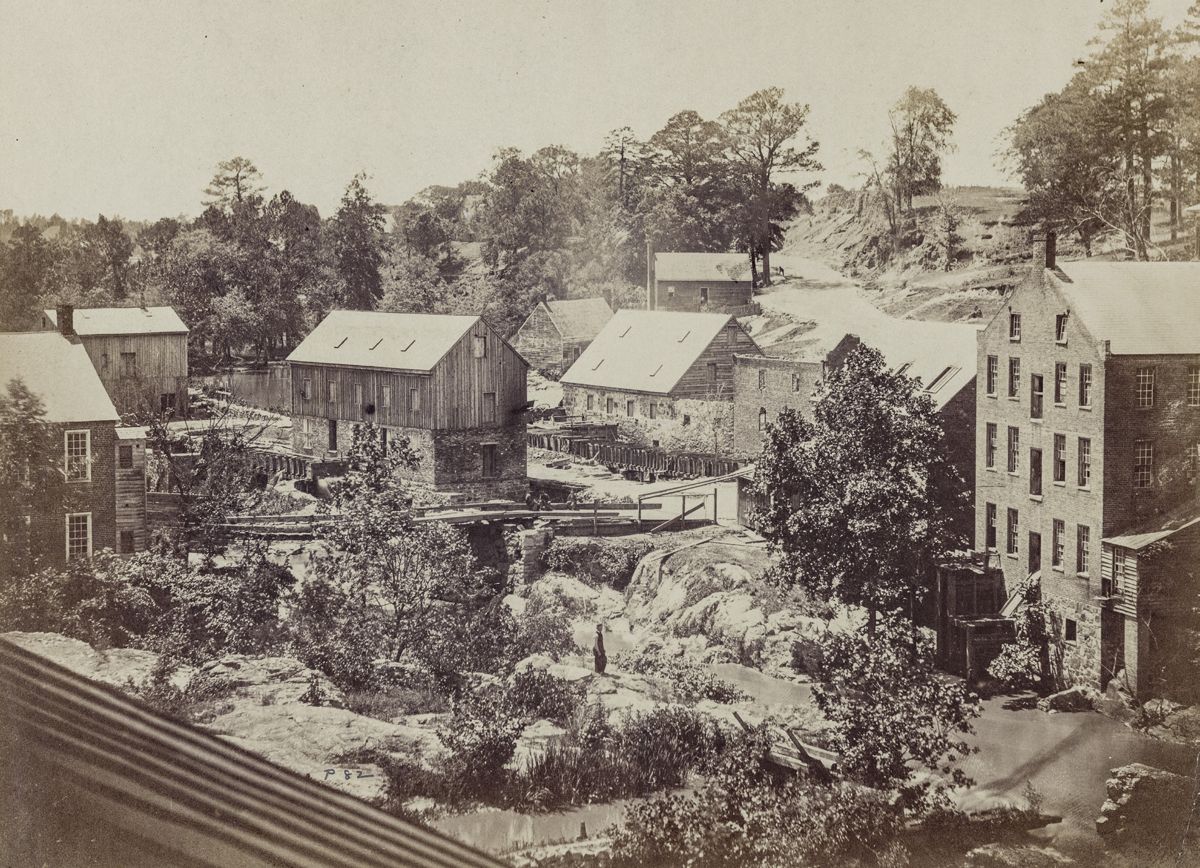
View on the Appomattox River, near Campbell’s bridge, Petersburg, Va. (Library of Congress)
CivilWarNews.com the blockade of Southern ports was already causing shortages, in this instance, logwood dye, necessary to produce cloth for army blankets and uniforms; more alarming, the factory’s workforce was not comprised of local men, an early indicator of labor shortages to come. The workforce available in Richmond during late 1861 was already limited to women, children, and foreigners. Hence, for the home front, the war’s most dramatic and immediate effect could be summarized as the shortage of men. It was estimated that women had to use substitutes for 75% of their household goods and scarcity quickly became a fact of life. The inevitable result to the economy of severe shortages and continued printing of paper money was runaway inflation in the cities.
The war also tested the strength of the rural Southern Appalachian economy, producing scarcity and contributing to serious setbacks in agricultural production by 1862. While many rural Southerners had been subsistence farmers, these were also businesses involved in the local exchange of goods and services, in other words, a barter economy not fully dependent on currency. Local citizens traded with merchants and drew on the specialized skills of millers, tanners, and blacksmiths. Many rural communities were moreor-less self-sufficient on a subsistence level. As the war progressed, however, rural civilians also dealt with scarcity and hyperinflation. Local citizens became increasingly bitter as farmers and merchants drained the local food supply to seek high prices elsewhere and were paid in currency, a thing largely unknown previously in the rural Appalachian mountain region. Yet even as the war brought economic chaos, it also, paradoxically, revealed how thoroughly Southern Appalachia could rely on trade networks between different regions to survive. As the war dragged on, the two armies themselves foraged local food supplies down to levels that were not selfsustaining for some local areas. Continued habitation in some of these localities could not be maintained after mid-1863. Still, after mid-1863 the war and the Southern Confederacy continued for nearly another two years. History has somewhat slighted the role of Southern nationalism, or at least the extent to which Confederate civilians desired a life free from the political machinations of their Northern neighbors. Historians generally work backwards from Appomattox for their explanations. Others resign themselves to the national obsession with Confederate military success in the Eastern Theater and the genius of Confederate Generals Robert E. Lee and Thomas J. Jackson, and others, while being less impressed with the Western Theater’s military leaders. It is important to note the style and substance of Confederate military strategy sprang from the expectations and will of the Confederate Home Front. Gary M. Gallagher, noted in The Confederate War (Harvard Press, 1999) that Confederate civilians accepted the shortcomings of their political leaders and made sacrifices for a shared vision of their own homeland. This story is a seldom told part of American history that has not been adequately recognized or appreciated. The facts of U.S. Civil War history and the effects on the Confederate home front are not always politically correct, but it is a part of American history none-the-less. Craig L. Barry was born in Charlottesville, Va. He holds his BA and Masters degrees from UNC (Charlotte). Craig served The Watchdog Civil War Quarterly as Associate Editor and Editor from 2003–2017. The Watchdog published books and columns on 19th-century material and donated all funds from publications to battlefield preservation. He is the author of several books including The Civil War Musket: A Handbook for Historical Accuracy (2006, 2011), The Unfinished Fight: Essays on Confederate Material Culture Vol. I and II (2012, 2013). He has also published four books in the Suppliers to the Confederacy series on English Arms & Accoutrements, Quartermaster stores and other European imports.