
Shenandoah Valley Battlefields Foundation
Originally published April 2023 · pp. 32–33
Shenandoah Valley Battlefields Foundation Piedmont Battlefield 2022 saw great progress in permanently protecting key portions of the twenty battlefields the Foundation is charged with protecting, caring for, and interpreting. One battlefield where nothing had yet been protected, the Piedmont Battlefield, where Union forces under General David Hunter scored one of the first Union victories in the Valley on June 5, 1864, is now headed toward being largely protected by the Foundation. Thankfully, the battlefield occupies pristine and beautiful farmland which had been kept in near 1864 condition by its owners for the last 150 years but, with residential
Virginia Cavalry during the Civil War. The Foundation created and installed 18 new interpretive markers on the McDowell Battlefield, including 15 on the Sitlington’s Hill battlefield trail and three at other sites, including “Hometown Foes” at a new location on US 250. The Foundation also installed new site and orientation kiosk at the Sitlington’s Hill trailhead, located off US 250 about a mile and a half east of the Village of McDowell. The site sign also functions as an entrance sign for the battlefield. An orientation sign provides visitors with an overview of the battle and Jackson’s Valley Campaign, information about the Sitlington’s Hill trail, and information about and directions to the Highland County Museum.
McDowell
The Foundation has completely updated and upgraded the visitor experience at the May 8, 1862, McDowell Battlefield in Highland County, Va., developing and installing new exhibits, interpretive markers, and signage. The project included a new exhibit room at the Highland County Museum, interpretive markers at sites throughout the battlefield, and trail and orientation signage at the Sitlington’s Hill trailhead. The new exhibits were made possible by a generous donation from Col. Hugh Sproul, the Foundation’s outgoing Board Chairman, who made the donation in honor of his great grandfather, Archibald Alexander Sproul, who served in the 10th
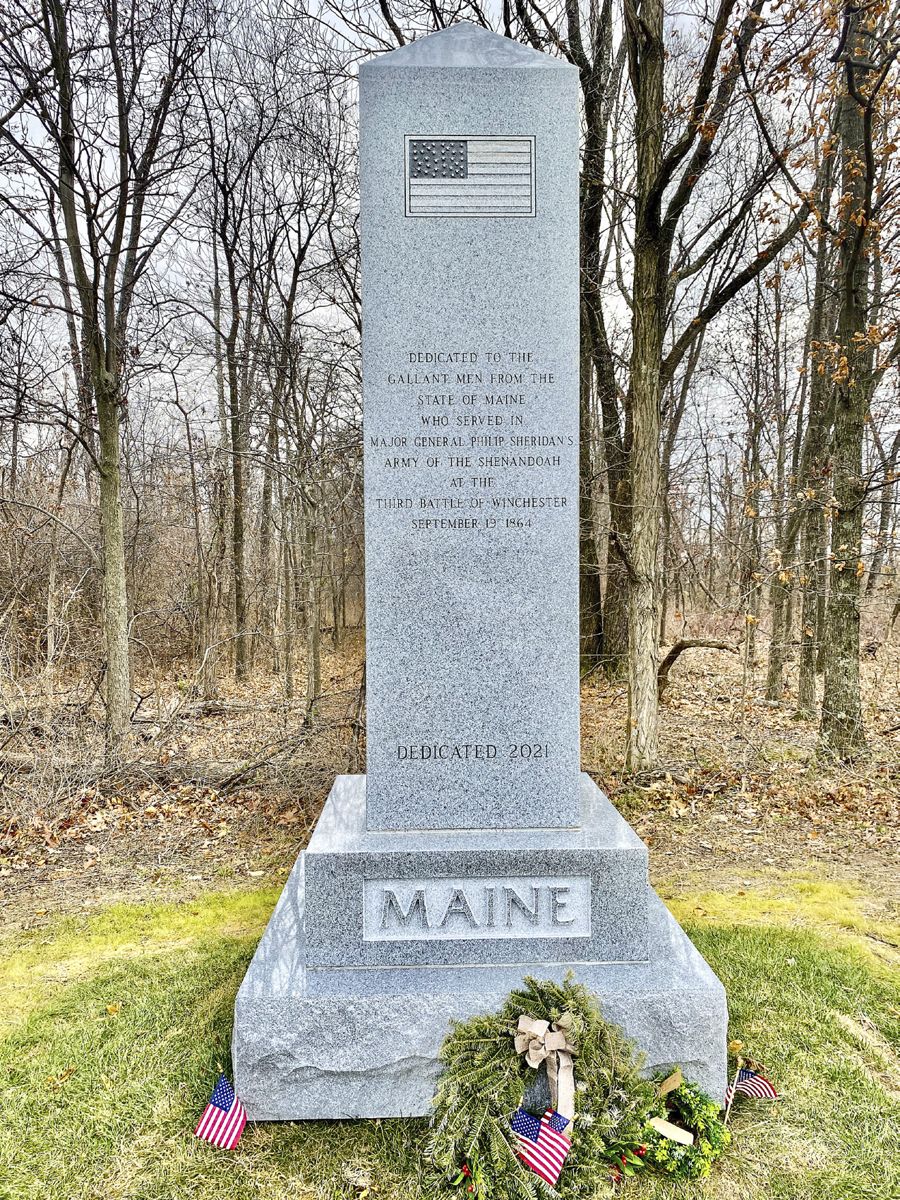
A monument to Maine soldiers was dedicated at the Third Winchester Battlefield Park on September 25, 2021. The dedication began with remarks from Foundation Chairman Emeritus Nick Picerno and included messages from Maine lawmakers. A keynote address was given by former Maine State Archivist David Cheever. The dedication included a presentation by historian Peter Dalton on Captain Ira Gardner, 14th Maine Infantry, and his experience during the Third Battle of Winchester. The Maine Monument is the fourth monument erected on the Third Winchester Battlefield since 2017. The monument’s location was chosen because of its close proximity to where the 1st Maine Light Artillery went into action and near where all Maine regiments in the XIX Corps passed through as the battle raged through the Middle Field on September 19, 1864. A quote by John Mead Gould, who fought with the 29th Maine Infantry at Third Winchester, is inscribed on the back of the monument: “We are glad that we could suffer for our country’s good; we glory in our strength and in all that is creditable to a soldier, but war we hate; it shall never exist again if we can prevent it.” The Foundation is also looking forward to the erection of another monument on the Third Winchester Battlefield in 2023, this one to soldiers from Ohio.
Jessie Rupert and the Woodworth Cottage Institute By 1869, Jessie Hainning Rupert had lived on two continents and four states. She had been orphaned and taken in, and then, when her benefactor died, turned out again. She had lived in both the North and the South, and been a citizen of Virginia under the flags of two different countries. She taught Sunday school to slave children with the man who became famous as Stonewall Jackson, built a reputation as an up-and-coming educator, teaching at a female seminary in Lexington, Va., and then in New Market. She married into one of the most prominent families in the Middle Shenandoah Valley, only to find herself ostracized by her husband’s family because of her social and political beliefs. She was made a prisoner of war during the Civil War, only to be released by her old friend, Thomas “Stonewall” Jackson, then the Valley’s Confederate commander. She was the mother of three children and lost her husband to suicide after just five years of marriage. In 1869, with the help of the Freedman’s Bureau, funds raised by veterans of the Battle of New Market, and a town lot that she inherited from her husband’s estate, Jessie constructed her “Woodworth Cottage Institute,” a school on New Market’s main street for the education of poor white children and the children of recently freed slaves. The whites attended during the daytime hours, and the blacks through the evening, with classes being held on the structure’s first floor and Jessie and her children residing on the upper two floors. The historic building remains standing today and now, thanks to a significant investment by the Commonwealth of Virginia, the Foundation has purchased the site and structure. Plans are being developed to preserve the sprawl, industrial solar fields, warehouses, and data centers advancing, that condition could not be expected to long continue. One 3-acre tract near the battle’s center was purchased last year and is now under easement held by the Virginia Department of Historic Resources. A much larger adjacent tract, consisting of 146 acres of farmland occupying almost the entirety of the area where the forces collided, is in progress for a conservation easement. Several grants have been obtained to purchase the easement and efforts continue to raise all the funding needed. In the coming years the Foundation expects to provide interpretive access, meaning that for the first time visitors will be able to experience and appreciate the battle where it happened.
Map prepared for the Shenandoah Valley Battlefields Foundation by Brendan West
Battle of Piedmont, Va., June 5, 1864.
site, restore the exterior, and rehabilitate the first floor as a visitor center and museum.
Battle of Hupp’s Hill October 13, 1864
Union Confederate
Hupp’s Hill Appeal
Land Preserved by Shenandoah Valley Battlefields Foundation Preserved by the National Park Service Partner Preserved Property ley Run ick t S
Target Property miles
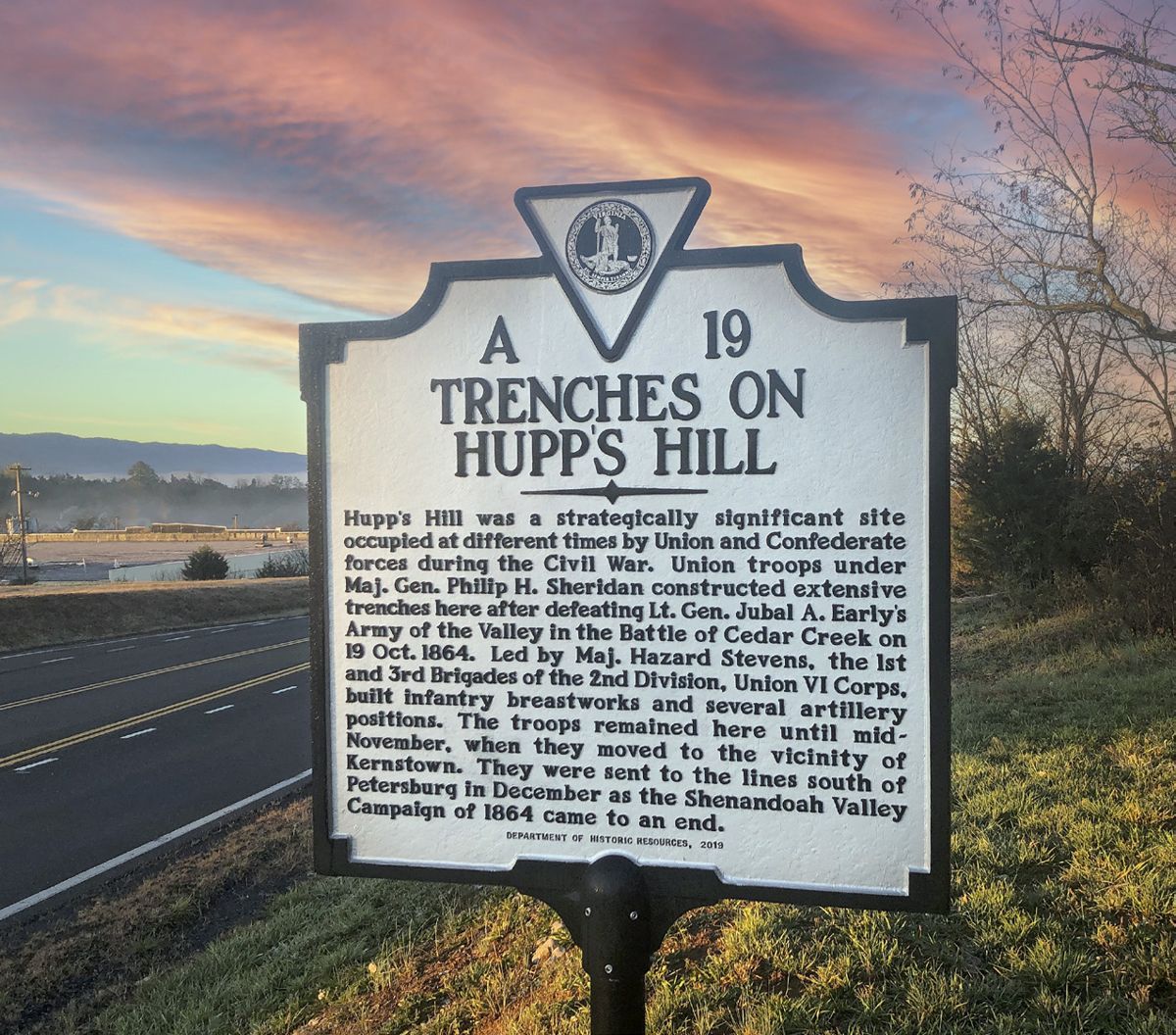
Roadside marker for trenches on Hupp’s Hill. Marker reads: Hupp’s Hill was a strategically significant site occupied at different times by Union and Confederate forces during the Civil War. Union troops under Maj. Gen. Philip H. Sheridan constructed extensive trenches here after defeating Lt. Gen. Jubal A. Early’s Army of the Valley in the Battle of Cedar Creek on 19 Oct. 1864. Led by Maj. Hazard Stevens, the 1st and 3rd Brigades of the 2nd Division, Union VI Corps, built infantry breastworks and several artillery positions. The troops remained here until mid-November, when they moved to the vicinity of Kernstown. They were sent to the lines south of Petersburg in December as the Shenandoah Valley Campaign of 1864 came to an end.
The Foundation is currently seeking donations toward preserving 35 acres at the heart of the Hupp’s Hill battlefield, just southwest of the Cedar Creek battlefield. The Battle of Hupp’s Hill occurred on October 13, 1864, just six days before the much larger Battle of Cedar Creek. The action at Hupp’s Hill erupted when Confederate General Jubal Early and his staff rode to these heights to observe the Union Army encampments on hills and ridges above Cedar Creek. Early ordered his artillery to fire upon the Union forces, thus triggering two Union infantry brigades to attack the Southern position. One brigade retreated but the other, under Col. George Wells, became engaged in fierce combat (resulting in Wells’ death) before being pushed back. The action at Hupp’s Hill had a pivotal effect on the campaign in the Valley. Knowing that Early and the Confederates were at his front in strength, Sheridan recalled the VI Corps under Gen. Horatio Wright to his force. At Cedar Creek on October 19, 1864, the VI Corps’ stand proved critical to preventing a complete rout of the Federals, and helped turn an apparent war-changing Confederate victory into a crushing defeat that ensured permanent Union control of the Valley. The Foundation is seeking $180,000 in donations toward preserving this tract and other important battlefields in the Valley. Contributions can be sent to the Foundation at P.O. Box 897, New Market, VA 22844.
Map of the Battle of Hupp’s Hill, Oct. 13, 1864.