The Library of Congress Collection
The Library of Congress Collection — September 2022
Originally published September 2022 · p. 41
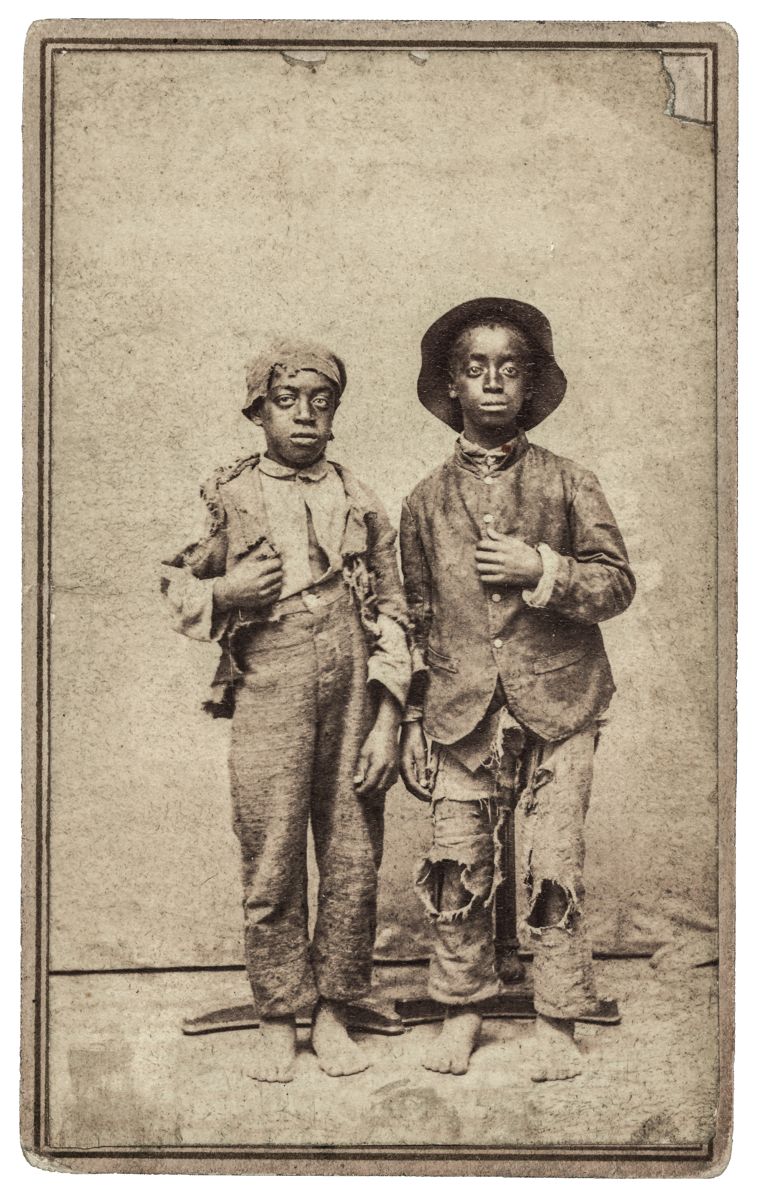
CO LLEC T I O N Two African American boys, barefoot, and wearing ragged clothing.
Most African Americans in Missouri lived in what R. Douglas Hurt, the author of Agriculture and Slavery in Missouri’s Little Dixie, referred to as “Little Dixie” prior to the Civil War. The Southern states of Kentucky, Virginia, and Tennessee, provided the majority of the new immigrants to these counties. These settlers brought with them a Southern culture that was dependent on slavery and included commercial agriculture in the form of hogs, hemp, and tobacco. According to Hurt, the seven counties of Clay, Lafayette, Saline, Cooper, Howard, Boone, and Callaway comprised the core of antebellum Little Dixie. Each county’s entire population in 1850 was at least 24 percent made up of slaves. These counties led the state in tobacco and hemp production and were among the top 10 slave counties in terms of population. The farm owners believed that the labor-intensive, back-breaking job required by the hemp and tobacco crops was better suited for slaves. As a result, the majority of African Americans in antebellum Missouri were transported there as slaves to work in agriculture. There weren’t many free African Americans. They were domestic workers and laborers, mostly on riverboats or levees. Before the Civil War, free African Americans had the legal right Medium: Photographic print on carte de visite (CDV) mount: albumen; 10 x 6 cm. Reproduction Number: LC-DIG-ppmsca-11186. William A. Gladstone Collection (Library of Congress). The William A. Gladstone Collection of African American Photographs provides almost 350 images showing African Americans and related military and social history. The Civil War era is the primary time period covered, with scattered examples through 1945. Most of the images are photographs, including 270 cartes de visite. For information visit http://loc.gov/pictures/collection/gld.