
Emerging Civil War Series Spotlight
Originally published September 2022 · pp. 12–13
Determined to Stand and Fight: The Battle of Monocacy, July 9, 1864 by Ryan Quint. Savas Beatie, 2017.
Editor’s Note: Civil War News is pleased to continue a new monthly series highlighting books in the Emerging Civil War Series (ECWS) published by Savas Beatie, LLC. The mission of the series is to offer compelling and easy-to-read overviews of some of the Civil War’s most important battles and issues. Each volume features more than a hundred and-fifty photos and graphics, plus sharp new maps, visually engaging layouts, and thought-provoking appendices. To date, forty-three books have been published in the series. The Army Historical Foundation honored the Emerging Civil War Series with its Lieutenant General Richard G. Trefry Award for contributions to the literature on the history of the U.S. Army, calling it “an invaluable collection of Civil War battlefield guides.” The series has also served as a fertile starting point for a lot of “emerging voices” in the field, something important to us here at Civil War News. About the Book: In early July 1864, a quickly patched together force of outnumbered Union soldiers under the command of Maj. Gen. Lew Wallace prepared for a lastditch defense along the banks of the Monocacy River. Behind them, barely fifty miles away, lay the capital of the United States, open to attack. Facing Wallace’s men were Lt. Gen. Jubal Early’s Confederates. In just under a month, they had cleared the Shenandoah Valley of Union soldiers, crossed the Potomac River, invading the north for the fourth time in the war. The veterans in Early’s force could almost imagine their flags flying above the White House. A Confederate victory near Washington could be all the pro-peace platforms in the north needed to defeat Abraham Lincoln in the upcoming election.
Then came Monocacy. Over the course of that one day, Union and Confederate soldiers attacked and counter-attacked, filling the fields southeast of Frederick, Md., with dead and wounded. By the end of the day, Wallace’s men retreated, but they had done their job; they had slowed Jubal Early. The fighting at Monocacy soon became known as the “Battle that Saved Washington.” Determined to Stay and Fight by Ryan T. Quint tells the story of that pivotal day and the even more pivotal campaign that went right to the gates of Washington, D.C. Readers can enjoy the narrative and then easily follow along on a nine-stop driving tour around the battlefield and into the streets of historic Frederick. Another fascinating
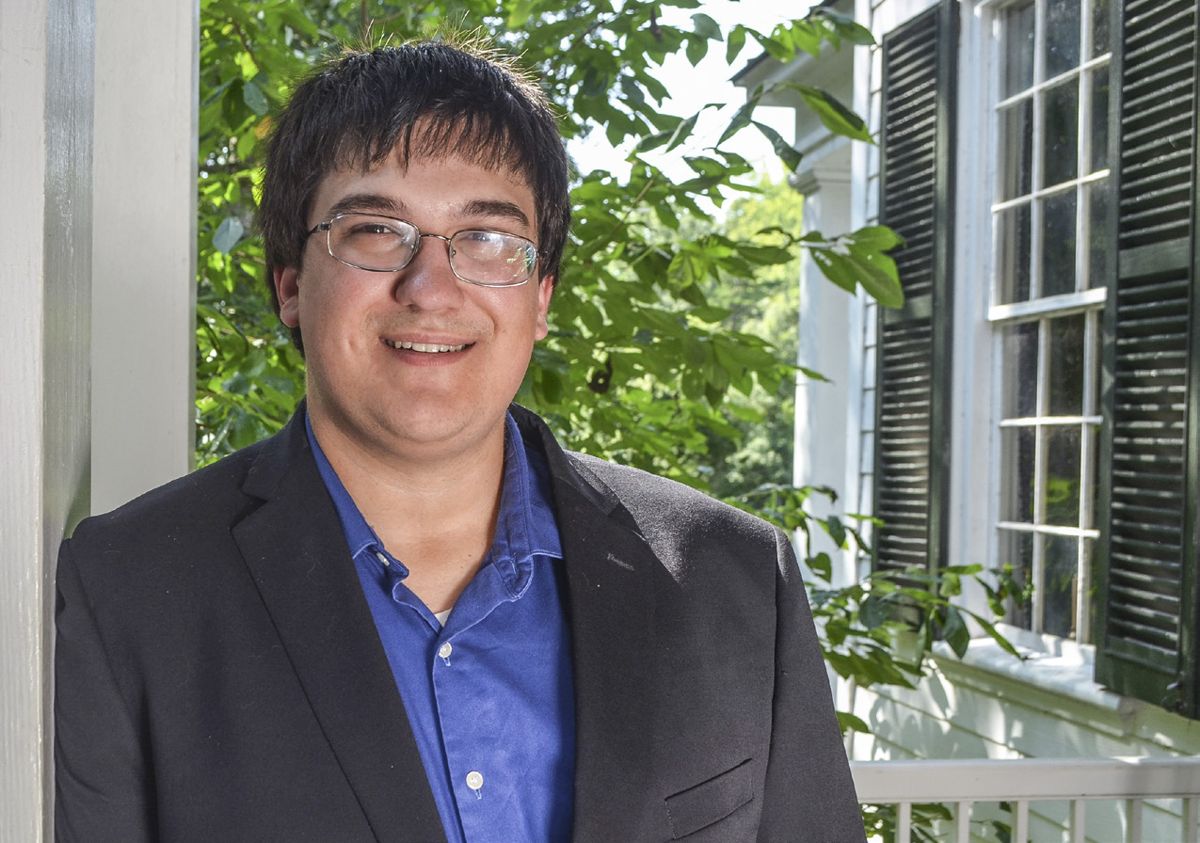
About the Author: A Maine native, Ryan Quint is a Park Guide at the Fredericksburg & Spotsylvania National Military Park. He formerly worked at the Richmond National Battlefield Park, Colonial Williamsburg, and the George Washington Foundation. Ryan has a history degree from the University of Mary Washington. “Behind the Scenes” by Ryan Quint When I reflect on the battle of Monocacy and the origins of what eventually became Determined to Stand and Fight, I think back to how the engagement outside Frederick, gave me a greater appreciation for the Civil War’s smaller actions. As a student of the Civil War, I had certainly spent my fair share of time studying Antietam or Gettysburg, but then came the documentary No Retreat from Destiny. Depicting Jubal Early’s 1864 Invasion of Maryland and the ensuing battles of Monocacy and Fort Stevens, I first watched the film sometime around junior year of high school. I was drawn to the fact that these smaller engagements were just as dramatic and had just as much human interest as bigger battles that had entire bookshelves devoted to them. So, I made it my mission to read as much about them as I could get my hands on. Fast forward a couple of years, and I was an intern at Fredericksburg & Spotsylvania National Military Park in the summer of 2013. On one particularly slow day out at the Wilderness Exhibit Shelter, I pulled out Glenn Worthington’s Fighting for Time; Worthington’s words were some of the first written about the battle, and as a witness to the actions as a young boy, Worthington’s perspective was particularly gripping. I was working with Chris Mackowski that day, and at some point, he asked me what I was reading. The ensuing conversation was the first time I spent any considerable amount of time discussing Early’s Maryland Invasion with another historian, and eventually Chris invited me to write a guest post about Lew Wallace’s role in the battle. That marked my introduction to Emerging Civil War. As I worked my way through those first guest posts, I was reminded about the importance of small, and sometimes forgotten, battles. Especially surrounded by the behemoth stories of Fredericksburg, Chancellorsville, the Wilderness, and Spotsylvania, I realized that Monocacy was just as important to the participants as those much bigger and bloodier engagements. So, I read more, and wrote more. I made the battle of Monocacy the topic of my senior thesis for my history degree at the University of Mary Washington. I went on my first trips to the Monocacy National Battlefield, and saw the red brick Worthington House, where young Glenn saw the fighting from his basement. Then came the offer from Chris to write the Emerging Civil War Series book for Monocacy. I was nervous about taking the leap to that next step, but had plenty of support from friends, family, and from the park staff and volunteers at Monocacy who helped with all sorts of research and answered questions, no matter how mundane. The book began to take shape over a year; my senior thesis became Chapter 5, and gradually the whole thing began to take shape. The time finally came to visit Monocacy to take all the photographs, and fittingly, I went with Chris to take them. Without his suggestion to write about Monocacy, I’m not sure I ever would have. No blog posts, no senior thesis, and certainly ECW book. I’m extremely thankful for those suggestions, and for the gentle nudging along the way. I remember a very cold January night going to the post office to pick up three boxes full of the book when it came out in early 2017. I eagerly opened the boxes when I got home and stared at the cover, not fully believing my eyes; I put aside the first copy in the box for myself and pulled the rest out. It was a bit of an outof-body experience signing the inside pages for people who had bought copies of the book; I was a published author. At the time I write this, it’s been more than ten years since I saw No Retreat from Destiny; it’s been eight since that conversation at the Wilderness with Chris, and it’s been about five years since Determined to Stand and Fight came out. What remains still is my focus on smaller battles. Understanding those actions that have been all but swept under the rug of memory has driven me with new projects and new appreciations for the people who were thrown into conflict in the 1860s. What got you first interested in the battle of Monocacy? When I was in high school, I saw the documentary No Retreat from Destiny. Before then, I had never heard of the battle of Monocacy. The documentary was well done, and I wanted to learn more about the battle. What inspired you to translate your interest in the battle of Monocacy into a book? As I started reading more about it, I interned with the National Park Service. As a break from the battlefields where I was interning, I read more about Monocacy and decided to take a crack at writing some blog posts for
CivilWarNews.com Emerging Civil War. I don’t think I did anything groundbreaking or made earth-shattering discoveries with those blogs, but it was enough to get the creative bug, so to speak. After I made Monocacy the topic of my senior research topic at college; the book for the Emerging Civil War Series was just the next step. Were there particular misconceptions about the battle of Monocacy you were hoping to clarify? When some talk about Monocacy, they shrug it off and say something along the lines of, “The Confederates could have never taken Washington, D.C., anyways.” To me, that always seemed like missing the point. Even if the Confederates couldn’t hold the capital, the threat of nearly 15,000 combatants getting into the city during a crucial election year when Abraham Lincoln wasn’t so sure he’d win always stuck out to me. How would the Northern people react to that? Would Lincoln and his cabinet have to be whisked away to safety? The Federals’ stand at Monocacy and the fighting near Fort Stevens made it so those dire situations didn’t need to happen. As you did your research, did you come across any new discoveries? Was there anything that surprised you? I was fortunate to get permission from a family that owned a photograph of James Van Valkenburg, a Confederate officer killed at Monocacy, to print his image in the book. I know that seems like a small thing, but I’ve always believed in the power of photographs and images. With a photograph, the person becomes more than just a name on the page, they become an individual, and as far as I’m aware, before my book that image had not been published.
What was the most challenging part about writing the book? Why? There are a lot of Confederate sources for the part of the battlefield that today is preserved as the Monocacy National Battlefield, but there are not as many for the northern part of the battlefield, near what was known as the Jug Bridge. Trying to piece together what happened there was a bit difficult. The Confederate commanders who oversaw the fighting at the bridge, Stephen Ramseur in the morning and Robert Rodes in the afternoon, were both killed later in 1864, before either wrote an official report. Who is someone in the book you came to better understand or appreciate? Why? I already had a pretty strong respect and appreciation for Lew Wallace, the Federal commander at Monocacy, but researching and writing the book only further strengthened that. Here was a guy that no one, at least not Grant or Henry Halleck, whose opinions were the only ones that arguably mattered in the summer of 1864, cared much for, and who actually thought Wallace was a hindrance to the Federal war effort. When they dropped the ball and did almost nothing until it was too late, Wallace stepped up and did his best with a cobbled-together force. Wallace was sometimes his own worst enemy, and let his mouth run a little too much, but I still think he’s an underappreciated figure for what he did during the war. Is there some part of the battlefield, or some other related historical place, that your book helped you better appreciate or understand? Why? Near the Thomas Farm, where the battle came to a head, one of the assaulting Confederate brigades was able to use some folds and rises in the ground to advance without taking very heavy fire. That protection allowed them out to outmaneuver a Federal brigade, forcing the Union battleline back. Walking those hills in preparation for the book allowed me to understand those pivotal minutes better. What did you learn about the writing process by writing this book? No matter how many times you or someone else reads the drafts, there will be a typos. It’s a cruel fact of life. What sort of feedback have you gotten on the book since it came out? Is there something people particularly enjoy or are surprised by? Feedback has been overall positive; I couldn’t be happier with it. I think people enjoy having a chance to read about something that hasn’t always been the marquee attention grabber; it gives them opportunities to learn stories they haven’t read a thousand times before. Have you had to make revisions since the first draft? If so, what have you had to update? Those typos I mentioned earlier? The second edition has already been put together to fix some of those. I say “some” because, again like above, I’m sure there are others that have evaded prying eyes. I work at and talk about some of the biggest battles of the entire war as a part of my day job. so I appreciate the chance to research and write about the smaller actions once I get home. Since Determined to Stand and Fight has been published, I have spent the intervening years researching and writing a book about the Battle of Dranesville. It should come out sometime in 2023, and that’ll be another exciting chance to introduce people to events that are outside the usual scope of study. What advice would you give to young writers who are thinking about writing their first book? Constructive criticism can sometimes seem mean-hearted, but it very rarely is. Rather, it is people who want to help, and can help, make you a much better writer. Don’t take it personally, and if you’re willing to listen, your writing will come out much stronger than it went in.