“Defending Against Jackson’s Chancellorsville Flank Attack”
Originally published September 2022 · pp. 36–37
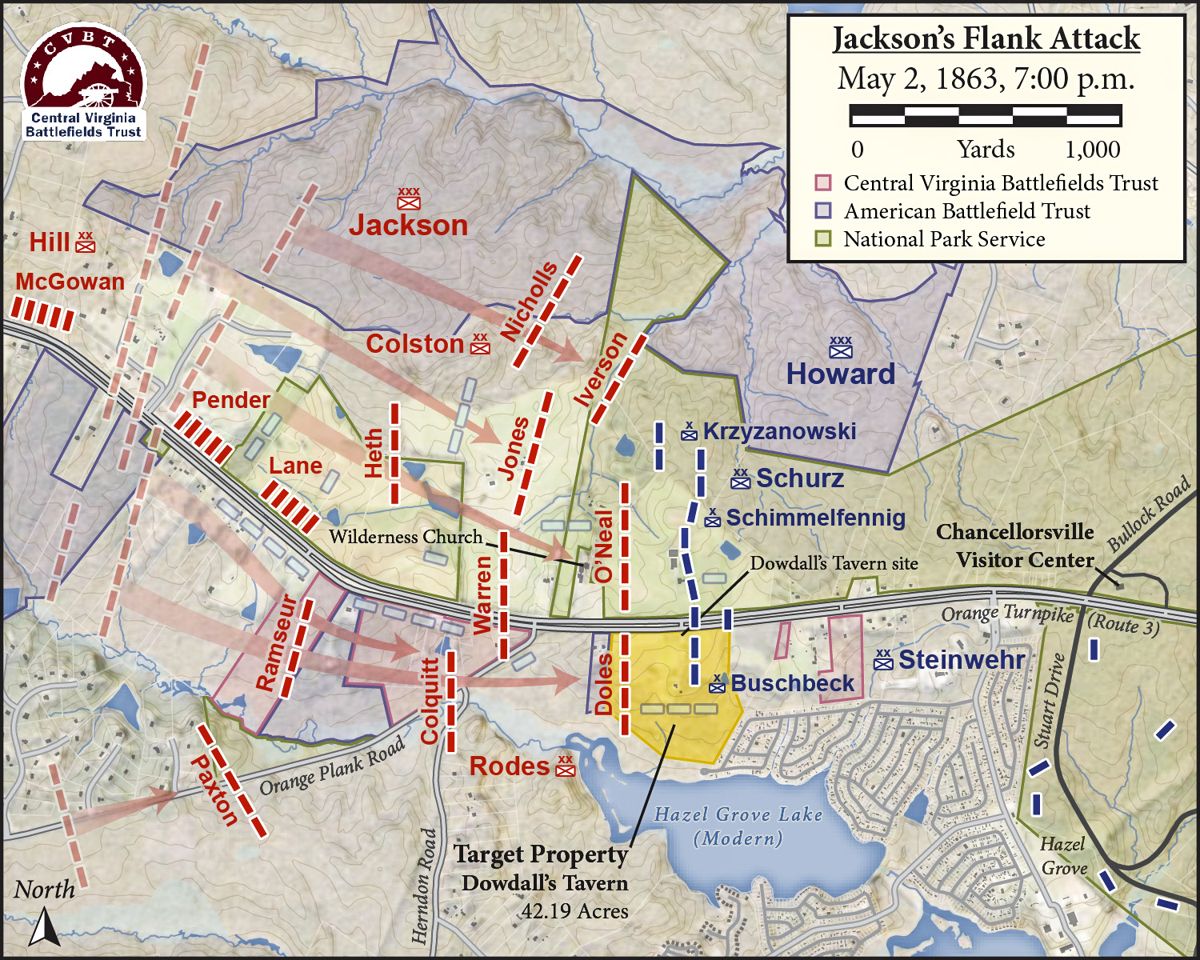
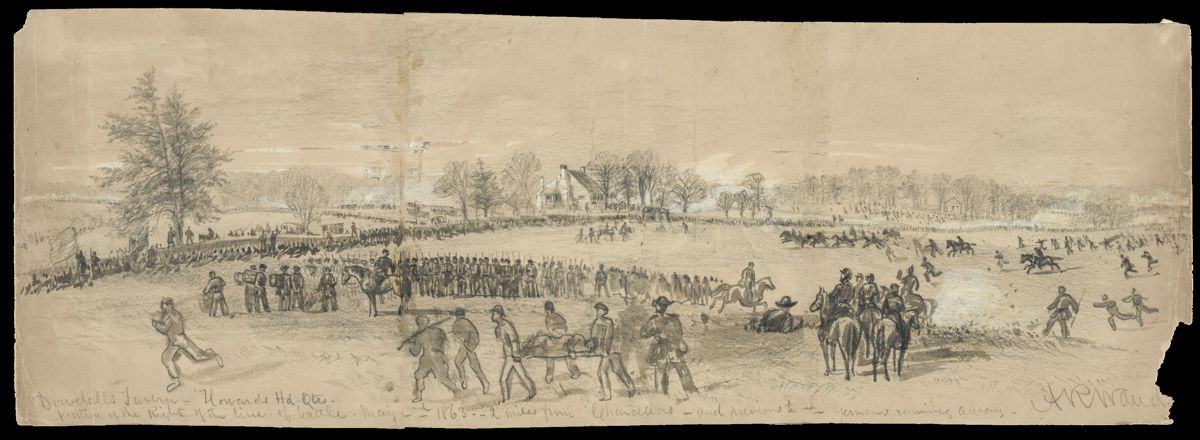
“Defending Against Jackson’s Chancellorsville Flank Attack” Since 1996, Central Virginia Battlefields Trust has worked diligently to acquire properties associated with the battles of Fredericksburg, Chancellorsville, the Wilderness, and Spotsylvania Court House. One of CVBT’s areas of greatest success has been along the route of Gen. Thomas J. “Stonewall” Jackson’s Chancellorsville flank attack. Starting with acquisitions in 1998, and up to the most recent victory with the “Beckham Tract” this year, the long string of “Flank Attack” preservation opportunities and successes continues. Jackson’s Chancellorsville flank attack has received significant attention from several different perspectives by historians. However, sometimes overlooked in the story of the smashing Confederate success are the Federal efforts to stop, or at least slow down, the momentum of the avalanche-like assault along the Orange Plank Road and Orange Turnpike. Gen. Joseph Hooker, commanding the Army of the Potomac, believed that the May 2, 1863, reports he received about Jackson’s 28,000-man marching column indicated the Confederates were retreating toward Orange Court House or Gordonsville, not targeting his right flank held by Gen. Oliver O. Howard’s XI Corps. Howard, after earlier being upbraided by Hooker about making some effort to protect his flank, did make some minor changes to his line should an attack from the west be attempted. Despite receiving little direction from Gen. Charles Devens, who commanded the Third Division of the XI Corps on the far right, some of Devens’ officers worried about their troops’ vulnerable disposition. However, some blame also goes to Hooker, who ordered a brigade away from Howard to the III Corps in hopes of capturing some of Jackson’s marching Confederates, who, again, Hooker believed were in retreat. Howard did not help matters though by joining the loaned brigade for part of their detached excursion. At about 5:15 pm, Jackson ordered Gen. Robert Rodes to begin the attack. The massive assault, over twice as large as Pickett’s Charge at Gettysburg, flushed small game from the surrounding Wilderness as they moved east. Wildlife invaded the XI Corps camps as its many soldiers rested and cooked their evening rations. The routed Federals made their way east as fast as their legs could carry them. Holding briefly, and then folding, were the two brigades of Devens’ Division. As they retreated, word spread to the other two XI Corps divisions. Gen. Carl Schurz’s Third Division next met the gray tide. Effectively shifting his men to face west, Schurz’s Division attempted to put up a defense near the Wilderness Church. It briefly checked the advance; however, outflanked on both ends, it soon dissolved. Near the intersection of the Orange Plank Road and Orange Turnpike, at the Wilderness Church, Capt. Hubert Dilger set up his six-gun artillery battery in effort to put a dent in Jackson’s juggernaut. Firing double canister at the charging Confederates, Dilger’s cannoneers stood to their guns as long as possible, doing as much damage as they could before withdrawing. Dilger later received the Medal of Honor for his brave actions. His citation stated in part that he “fought his guns until the enemy were upon him… .” Schurz noted in his official report that, “Captain Dilger limbered up only when the enemy’s infantry was already between his pieces. His horse was shot under him… .” Dilger was forced to leave a cannon behind only after trying to “drag this piece along with the dead horses still hanging in the harness… .” Posted near Dowdall’s Tavern, at the time of the battle the home of Rev. Melzi Chancellor, and also Howard’s headquarters, was Gen. Adolph Von Steinwehr’s Second Division, the last XI Corps division. With Barlow’s Brigade earlier detached to the Third Corps, the division consisted of only Col. Adolphus Buschbeck’s Brigade. (CVBT)
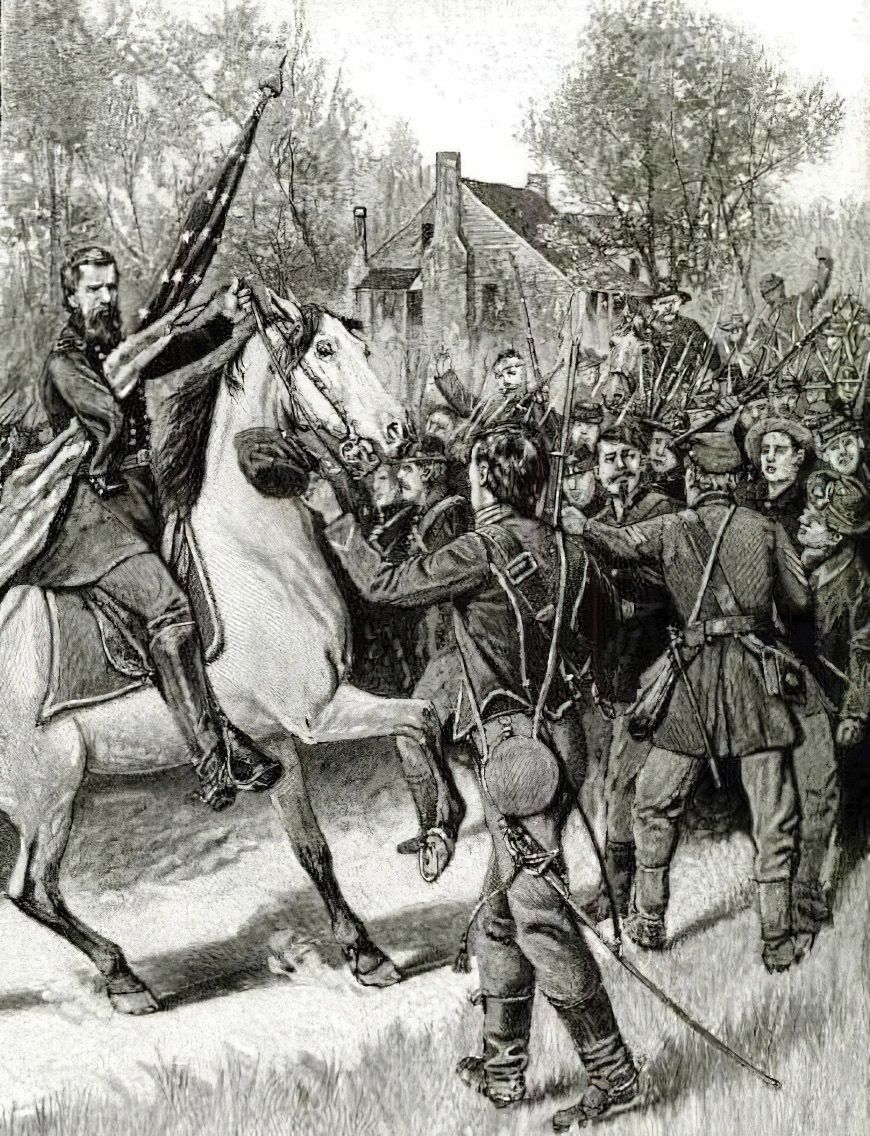
Howard arrived back at his headquarters just in time to see his corps start disintegrating. On horseback, Howard bravely grabbed a flag, tucked it under his right arm stump and implored his men to rally, stand, and fight. Many continued their flight, but some answered Howard’s call, particularly Buschbeck’s Brigade, which consisted of 29th New York, the 154th New York, 27th Pennsylvania, and the 73rd Pennsylvania. Three of the regiments fought south of the turnpike. The 29th New York was on the road’s north side. Using rifle pits, Buschbeck’s regiments temporarily halted the progress of that part of Jackson’s attack column. Von Steinwehr implored Buschbeck to hold the “position as long as possible.” The division commander also noted, “The men fought with great determination and courage.” Flanked on both ends, like their comrades previously, Buschbeck’s Brigade fell back, but not before losing about onethird of its men killed, wounded, or captured. As the brigade withdrew, they stopped twice and fired volleys before they finally reached the III Corps’ position. Buschbeck, willing to stand and fight, even offered his division commander to “advance again to a bayonet charge.” During the
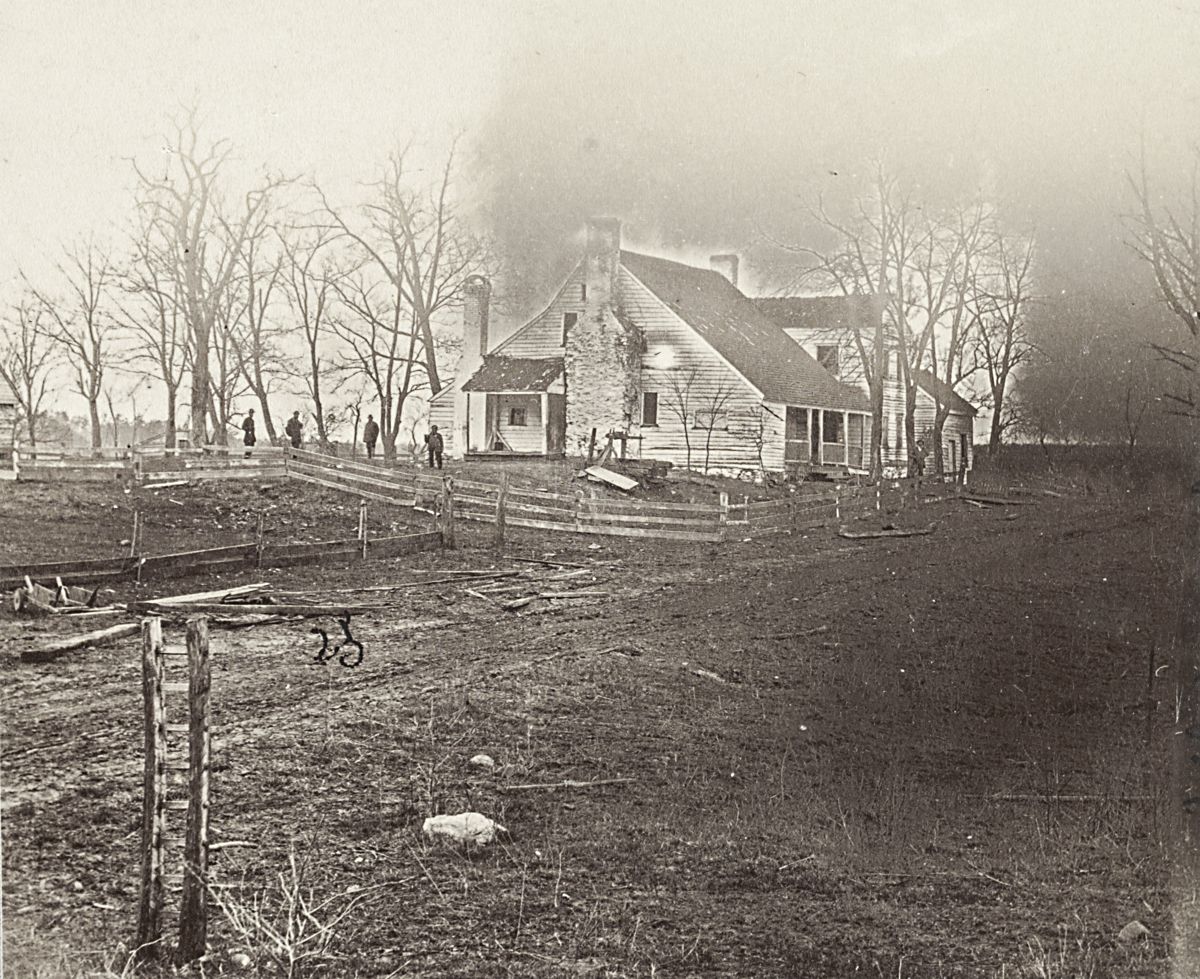
Dowdall’s Tavern. George E. Chancellor’s house on Plank Road in 1865. (Library of Congress)
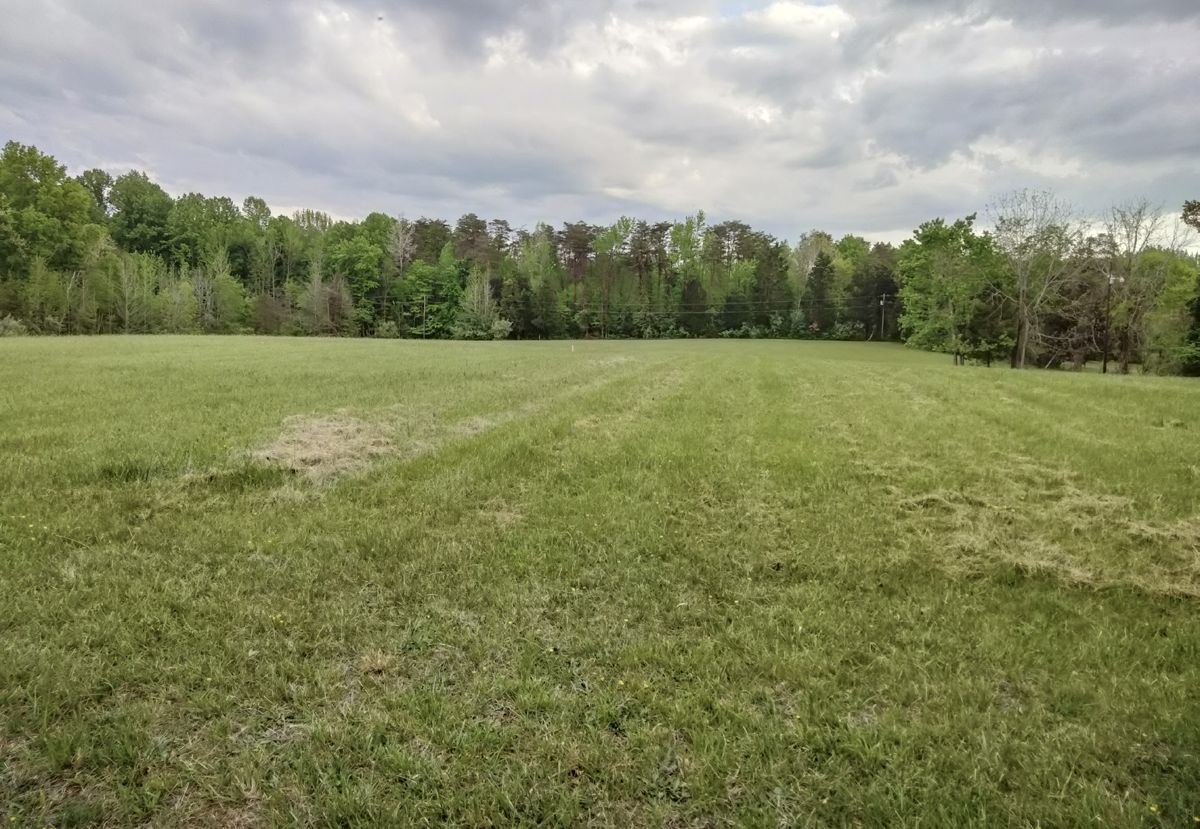
CivilWarNews.com fighting, three of Buschbeck’s four regimental commanders received wounds. The official record reported that the brigade lost 494 men and officers in their defensive attempts. General George Doles, commanding a brigade in Robert Rodes’ Division, mentioned being checked twice in his report. One pause came early in the attack for about 10 minutes, and then at the so-called Buschbeck line of rifle pits and entrenchments for 20 minutes, where Doles claimed they received “a very severe fire from musketry and battery of four pieces… .” While darkness and a confusing mixture of units eventually slowed the momentum of Jackson’s attack, the defensive efforts on the part of the XI Corps, especially Buschbeck’s Brigade and Dilger’s Battery, deserve credit for the part they played as well. Considering the situation under which they found themselves, some of the XI Corps responded about as well as possible. CVBT has again partnered with the American Battlefield Trust to save yet another key piece of Jackson’s flank attack. This 42-acre parcel is where Dowdall’s Tavern stood and Col. Buschbeck’s Brigade attempted to slow the assault. You can help save this pristine piece of hallowed ground forever. For more information and to make a donation, visit: https://www.cvbt.org/dowdallstavern. Tim Talbott is the Chief Administrative Officer with the Central Virginia Battlefields
Trust. The mission of CVBT is to preserve land associated with the four major campaigns of: Fredericksburg, Chancellorsville, the Wilderness, and Spotsylvania. To learn more about this grassroots preservation nonprofit, which has saved over 1,700 acres of hallowed ground, visit: www.cvbt.org.