
Book Reviews
Book Reviews — September 2022
Originally published September 2022 · pp. 38–40
Civil War News book reviews provide our readers with timely analysis of the latest and most significant Civil War research and scholarship. Contact email: [email protected].
A Different Perspective on a Historic Town Gettysburg 1963: Civil Rights, Cold War Politics, and Historical Memory in America’s Most Famous Small Town. By Jill Ogline Titus. Gallery, notes, bibliography, index. University of North Carolina Press, https://uncpress.org. Nov. 2021. Hardcover $95, paperback $27.95. Reviewed by Thomas J. Ryan
Gettysburg 1963 is a comprehensive critique of myriad events associated with the centennial celebration/ remembrance of the Battle of Gettysburg and its ramifications. The author, Jill Ogline Titus, provides insight into the longterm after effects of the July 1863 three-day engagement when the nation’s fate hung in the balance. Titus examines racial progress in America as reflected in the microcosm of the small south central Pennsylvania community that experienced traumatic events and embedded its name in the minds of people worldwide. The author relates the significance of the battle that brought prominence to this community, while emphasizing the fate of the black residents abducted by Southern troops.
The author cites Gettysburg’s geographic location a few miles above the Pennsylvania/ Maryland border, and the mindset of some local white residents that reflected the longstanding racial practices of the time. During the battle at Gettysburg, for example, blacks who had not fled to safer environs became vulnerable. When Confederate forces gained control of sectors within the community, they rounded up all the blacks and shipped them South into slavery with the knowledge of their commander, Gen. Robert E. Lee, and his senior officers. Fast forwarding one hundred years to the battle’s anniversary; Titus relates “contemporary racial politics, intertwined with and infused by Cold War principles, profoundly shaped nearly every aspect of the anniversary.” Why? Because the “Civil War of the 1960’s” found Americans divided “along lines of race” not unlike the situation as it existed in the 1860’s. The town of Gettysburg and the battle became a symbol for the American people on both sides of the conflict, and over time millions have trekked annually to this small town to dwell in the mystical atmosphere ingrained in a few square miles by those who fought and died there during July 1863. These visitations were crowned when the “Mission 66” public works project led to constructing a building to house Paul Philippoteaux’s magnificent cyclorama painting depicting “Pickett’s Charge” on the third day of the battle. Titus describes the debilitating aspect of racism perpetuated in the community despite the passing of time. A Social Action Committee formed in 1962 with the goal of improving work-related and educational opportunities for minorities. With the battle’s centennial anniversary fast approaching, however, the community zeroed in on constructing a new Visitor Center that opened to the public in March 1962. That year, nearly two million people descended on Gettysburg. May the following year, Vice President Lyndon B. Johnson came to Gettysburg and delivered a speech “in support of equal rights for Black Americans.” The Pennsylvania Gettysburg Centennial Commission, however, planned on extending the remembrances “to Confederate soldiers, their descendants, and contemporary white southerners,” while, at the same time, excluding references to blacks. Nonetheless, Gettysburg’s mayor did his best to welcome visitors during the celebration, and assured both whites and blacks “their motel reservations will be honored.” The potential fallout over racial issues led President John F. Kennedy to avoid Gettysburg’s centennial celebration, because it might “offer too much political risk for too little potential gain.” Official guests at the 1863 celebration included Robert E. Lee IV and George Gordon Meade III, great-grandsons of the commanding generals at Gettysburg. Concern about potential racial demonstrations led to assigning 185 Penn. State Police officers to help maintain control of the crowd. During the actual ceremonies, views expressed by speakers related the gathering and remembrance at Gettysburg to the ongoing “Cold War” between the United States and the Soviet Union, and debated “Lost Cause” issues as well as “equal justice in housing and education.” Notre Dame University’s Rev. Theodore M. Hesburgh spoke at the Eternal Peace Light Memorial, and challenged his listeners to condemn discrimination, and take something home with them other than photos of the battlefield. In contrast, another crowd at the Peace Light Memorial gave “enthusiastic applause” for George Wallace, future governor of Alabama and a staunch proponent of separation of the races. Some 40,000 visitors gathered near the “Angle” to observe a reenactment of “Pickett’s Charge” with about 1,500 “Confederates” marching across the field to “attack” perhaps 500 defenders in blue; —both groups included descendants of Civil War veterans. In stark contrast to the original event on July 3, 1863, the opponents lowered their weapons and shook hands prior to the U.S. Navy band playing the National Anthem, “while all the participants assembled at attention behind the Angle to salute the flag and recite the Pledge of Allegiance.” Titus points out, however, that Newsweek Magazine cited “the longevity of racial inequality and battle over federal authority and states’ rights itself rendered the lofty sentiments of patriotic unity hollow for some observers.” The irony and tragedy of President Kennedy’s decision not to attend the November 1963 ceremony four months later honoring the Gettysburg Address, but to go to Dallas, Texas instead, dramatically changed “the course of American history.” Secretary of State Dean Rusk accepted an invitation to speak at the Gettysburg Address commemoration that, in effect, became a memorial to both Lincoln and Kennedy, the latter having been assassinated on November 22 in Dallas. The author emphasizes the challenge to the ongoing “Black freedom struggle” by “emboldened Confederate memory demanding additional space on the battlefield for its narratives.” The 1968 assassination of Martin Luther King Jr. drew dramatically different reactions on the Gettysburg College campus depending on the color of the students’ skin. At the same time, the “Lost Cause memory at Gettysburg” was expanding based on the claim that it “strengthened American patriotism.” In her epilogue to this study, Titus offers personal views on “the unpopular war in Southeast Asia,” and its impact, in particular on the students at Gettysburg College. She also comments on the contemporary political scene, and associates the rise of the “Black Lives Matter” with “the escalating campaign against police violence” and “heightened concern over the future of Confederate symbols, and the resurgence of white supremacy….” After going out on this political limb, Titus alleges the issues she cited were “emboldened by an openly racist president,” a reference to former president Donald Trump, whom she censures as “a persistent defender of Confederate symbols and monuments in the face of civil unrest….” In contrast, the author found that Joe Biden delivered “a widely acclaimed speech in the waning days of the 2020 presidential election campaign that “laid out a Lincolnesque vision of a more just future.” So much for impartiality and objectivity! The previous segment notwithstanding, Gettysburg 1963 provides a well-researched and in-depth account of how the Battle of Gettysburg became an integral part of the American political, cultural, and literary landscape, with special emphasis on the fate and progress of black members of the community. It adds a new chapter to our ongoing fascination with a small Adams County, Pennsylvania, town that received thousands of unexpected guests in early July 1863, and how the passage of a century failed to dim the impression those events made on the American psyche while reminding us work remains to improve and ensure equality among the races. Thomas J. Ryan is author of the award-winning Spies, Scouts, and Secrets in the Gettysburg Campaign: How the Critical Role of Intelligence Impacted the Outcome of Lee’s Invasion of the North, June-July 1863, and ‘Lee is Trapped and Must Be Taken’: Eleven Fateful Days after Gettysburg, July 4-14, 1863 (the latter with co-author Richard R. Schaus). He also published Essays on Delaware during the Civil War: A Political, Military and Social Perspective. His latest book pending publication is titled To bring the war to an end!: Abraham Lincoln and Jefferson Davis during the Gettysburg Campaign. He formerly served as president of the Central Delaware Civil War Round Table, as special contributor to the Civil War Page of the Washington Times, and author of a weekly column titled “Civil War Profiles” for the Coastal Point newspaper in Ocean View, Del.
Finding a Confederate soldier’s letters had been more the exception than the rule over the years since the Civil War. Discovering these treasures has become more common in time as more Confederate letters and diaries have been making their way into institutional special collections and book publications in the recent past. John M. Douthit’s letters are no exception. Elaine Fowler Palencia’s latest work, “On Rising Ground: The Life and Civil War Letters of John M. Douthit, 52nd Georgia Volunteer Infantry Regiment” is an examination into the war years of a Georgia father and his family as he struggles through the first part of the War in the Western Theater. Palencia paints an alluring picture and tells the story of the Douthit family and Fannin County, Georgia. She also weaves a fascinating tale of how a small farmer, Douthit, joined the 52nd Georgia, known as the Fannin Rifles. Joining the army helped Douthit avoid the draft. However, this decision meant Douthit would leave behind a pregnant wife and baby daughter. The bulk of the letters used included those between John and his wife Martha, along with two letters John wrote to his sister-in-law and one letter from a neighbor and fellow soldier to
Martha. Accounts from those in the 52nd Georgia Infantry, their brigade, the Official Records of the War of the Rebellion, and some newspapers helped fill in gaps and further explain Douthit’s story. Douthit’s letters also give the reader a glimpse into the life of this small farmer-turned soldier during training camp. His regiment was brigaded with the 40th, 41st, 42nd, and 43rd Georgia; the brigade’s 6,769 men were led by Brigadier General Seth Barton and later came under the command of Brigadier General Marcellus Stovall. During his time in camp, Douthit mentioned voting for officers, which played a significant part in the brigade’s development. Sickness was a prevalent concern of those within the camp. Douthit managed to stay healthy for the time being, but it was not long before he mentioned being ill and lonely for news. After camp, it was on toward East Tennessee, with one bright spot during this dismal time being the birth of his daughter. However, leaving the army to see her never materialized. Douthit’s letters concerning the movements to and around Cumberland Gap, Perryville, and Chickasaw Bayou are particularly interesting. In the movement into Kentucky, Douthit described some citizens showing their support by waving handkerchiefs and Confederate flags but little else. While there is helpful information concerning what he did and saw, Douthit and the regiment were not involved in the battle at Perryville. However, at Chickasaw Bayou, Douthit wrote his wife Martha, “Enemy was firing at us all this time we fired two three or four rounds at them”(Palencia, 101). From this point, Douthit found himself in the siege at Vicksburg where he mentioned camp life, food, sickness, and having remittent fever. After the capture of Vicksburg, Martha would learn of her husband’s death due to illness. While John M. Douthit’s story contains few battle details or great exploits upon the field, it does include the common soldier’s struggle to press on amid adversity. It is a story of a family ripped apart by war and a community left to pick up the pieces. Sadly, no letters covered Champion Hill or Douthit’s feelings toward Vicksburg’s surrender. Palencia’s wellresearched examination into the death and final burial place of John Douthit is commendable. Yet, more primary sources could have proved advantageous concerning other situations and events around Douthit’s time and local while in service. Those that might find this work especially interesting would include those interested in genealogy, Civil War soldier camp life, the life of the common Confederate soldier during the early part of the war, and the effects of loss upon a family and overall community during this war. Stewart Bennett is a Professor of History and Department Chair of Social and Behavioral Sciences at Blue Mountain College in Blue Mountain, Mississippi. His latest contribution to Civil War literature includes, “’A Ghost on Horseback’: The Many Wounds and Curious Death of General William H.T. Walker,” in Lawrence Lee Hewitt and Thomas E. Schott, eds., Confederate Generals in the Western Theater: Vol. 4 (University of Tennessee Press. January 2018). He is continuing his research on the battle of Atlanta, fought July 22, 1864.
Lessons in Persistence & Reason Stephen A. Swails: Black Freedom Fighter in the Civil War and Reconstruction. By Gordon C. Rhea. Images, notes, index, 200 pp., 2021. Louisiana State University Press, lsupress. org. $29.95. Reviewed by Jonathan A. Noyalas
To Captain Luis F. Emilio, a white officer in the 54th Massachusetts Infantry, Stephen Swails, a free black from New York who enlisted in the regiment during the spring of 1863, proved an inspiration. Accounts of Swails’ heroism, wounding in combat, and exemplary conduct appear throughout Emilio’s 1891 regimental history. However, the person Emilio believed possessed “many soldierly qualities,” epitomized “gallantry,” earned the distinction of being the first black soldier commissioned as an officer in a combat unit, and who proved to be an important figure in South Carolina politics after the war; fell into obscurity by the early twentieth century. Fortunately, Gordon Rhea’s fine biography restores Swails’ remarkable life and situates him among the pantheon of heroes in the war for union and emancipation. Rhea, best known for his outstanding scholarship on the Overland Campaign, makes it eminently clear from the outset that although he is this book’s author, this work stands on the shoulders of individuals who played a critical role over the past four decades to resurrect Swails’ story. Particularly significant are Jimmy and Edward Moore, two brothers who rescued a trunk full of Swails’ writings from a garbage dump, and William “Billy” Jenkinson, an attorney from Kingstree, South Carolina, who gathered much material about Swails. Throughout this engagingly written and deeply researched biography Rhea masterfully traces Swails’ life from a young child in Pennsylvania, his family’s move to New York, military service in the 54th Massachusetts, work with the Freedmen’s Bureau, and career in South Carolina politics. The usefulness of this volume rests not only in that it revives the story of an important historical figure or that it serves as an exemplar of biography, but that it utilizes Swails’ life to offer important insight into the obstacles African Americans confronted during the Civil War era in both North and South. Additionally, it illustrates how persistence sometimes broke down barriers. For example, following Swails’ appointment as second lieutenant by Massachusetts governor John Andrew on March 11, 1864, Rhea intricately explores the ways in which Swails and his supporters confronted individuals, especially officials in the War Department, who opposed Swails’ commission solely on the basis of his race. Persistence on Swails’ part, coupled with determination from the regiment’s commanding officer, Colonel Edward N. Hallowell, ultimately resulted in Swails being mustered in as second lieutenant on February 8, 1865. Rhea convincingly contends that Swails and his advocates persevered not only because Swails deserved the promotion based on his leadership abilities and gallantry in combat, but that they were keenly aware Swails’ promotion set an important precedent for all black soldiers in blue. Rhea’s analysis of Swails’ postwar life in South Carolina provides key insights into the complexities of life for African Americans during Reconstruction. Swails’ work with the Freedmen’s Bureau, first near Charleston, and then near Kingstree, underscores the important role Bureau officials played in maintaining peace between ex-Confederates and formerly enslaved people. For example, when a contingent of African Americans threatened violence after two former plantation owners attempted to recover property occupied by formerly enslaved people as a result of General William T. Sherman’s Special Field Order No. 15, Swails intervened and diffused the situation. Swails’ talent to reason with diverse groups propelled him into South Carolina’s political scene, first as a delegate from Williamsburg County to the South Carolina constitutional convention and then state senator. Rhea praises Swails, and deservedly so, not merely for his ability to reach such important political heights, but for how Swails used his platform to promote peace in a state rampant with violence. While Williamsburg County was not entirely immune from conflict, Rhea provides compelling evidence to illustrate how Swails’ desire to listen to people of all races and backgrounds and develop logical solutions to problems created a comparatively more stable environment in the county. Despite Swails’ success in maintaining peace among his constituents, he could not avoid the effects of redemption in South Carolina by the late 1870s. Although he resigned from the senate on November 27, 1877, and was threatened with death if he did not leave, Swails never wavered in his resolve to help improve life in South Carolina. Although he suffered a slew of political defeats in the years after his resignation, the author shows that Swails’ persistence could never be crushed. Students of the African American experience will find much to admire and little to decry in this outstanding volume. But the power of Rhea’s fine study exceeds its historiographical significance. Swails’ life serves as a lesson in the value of persistence. Furthermore, Swails’ story reminds us of the importance of approaching difficult moments with balance, reason, and an open-mind.
Jonathan A. Noyalas is director of Shenandoah University’s McCormick Civil War Institute in Winchester, Virginia, a professor in Civil War Era Studies at Shenandoah University, and founding editor of Journal of the Shenandoah Valley During the Civil War Era. He is the author or editor of fourteen books. Noyalas’ latest book, Slavery and Freedom in the Shenandoah Valley during the Civil War Era, was published by the University Press of Florida.
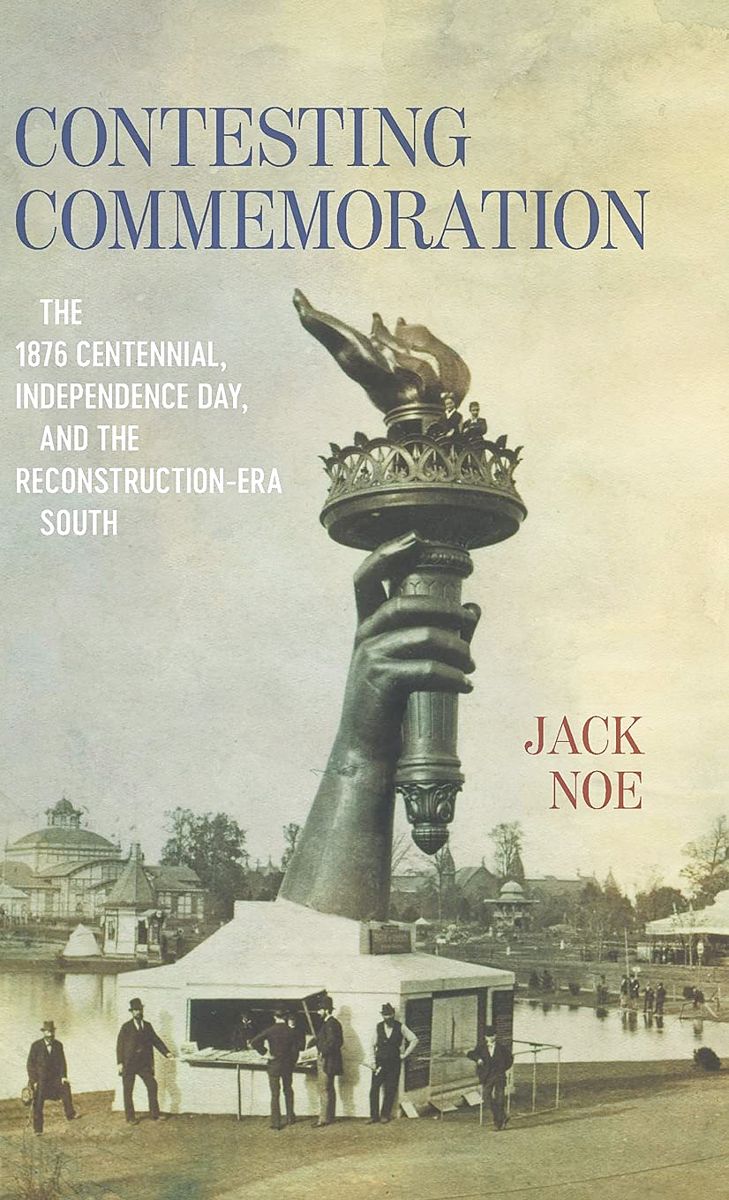
The Fourth of July and the 1876 Centennial Exhibition Contesting Commemorations: The 1876 Centennial. Independence Day, And The Reconstruction-Era South. By Jack Noe. Notes, Bibliography, and Index. 244 pp., 2021. Louisiana State University Press, lsupress.org. $45.00 Cloth. Reviewed by David Marshall
Between May and November 1876, a world’s fair called the International Exhibition of Arts Manufacturers and Products of the Soil and Mine, also known as the Centennial Exhibition or Centennial was held in Philadelphia, Pennsylvania. It attracted more than ten million visitors, one fifth of the U.S. population. Its purpose was to celebrate one hundred years of national existence, presenting an opportunity for whites, African Americans, Northerners, and Southerners to reflect and engage with ideas about their identity as Americans. It provided an opportunity for expressions of nationalism, patriotism, healing sectional wounds, or for the white South to reject reconciliation following the Civil War. Together with the 1876 presidential election of Republican Rutherford Hayes, Reconstruction ended partly due to agreements made with representatives from Florida, Louisiana, and South Carolina. “Contesting Commemoration” provides a captivating representation of post-Civil war reunion and reconciliation, using white Southern reactions to and involvement with these celebrations. Jack Noe offers a colorful discourse on the economic, social, and political aspects of reunification, and the difficulties behind the changes that occurred in a post-Appomattox American identity. Throughout this well written book, a comparison is made between the points of view of white Southerners and African Americans utilizing the voices of many. Noe spends a considerable number of pages in his six-chapter study linking the recent work of historians such as Gregory Downs, Anne Sarah Rubin, and Richard Zuczek. They suggest that white guerrilla-style terrorism, a defiant white public, and Federal military control of the South, resisted the Radical Republican measures to completely unify and rebuild the New South during Reconstruction. An important argument is suggested by historian David Blight that sectional reunion was achieved at the expense of African Americans, resulting in reconciliation by both north and Southern whites and the beginning of the Jim Crow era. In The 1976 Centennial, Independence Day readers will gain an understanding of how former slaves used the memory of the Revolutionary War, and its commemoration to demand the status of full citizenship as per the fifteenth amendment. Noe asserts that a reason for the Civil War was the emancipation of African Americans. Additionally, he further extrapolates the challenges between reunion and reconciliation in this deeply researched narrative. Little has been written on the Revolutionary War Centennial. What has been published on the fair itself, and its design is very different than what is examined throughout this study. Noe emphasizes how America experienced and felt about the events and celebration of American history and the meaning of the Fourth of July throughout this title. The writer tells a story that the North and the South were moving away from an agricultural past and into an industrial future with increased importance as the railroad and other inventions for manufacturers, farmers, and people, allowing the U.S. to become a world economic giant. Noe found that some southern women, such as Ellen Long of Florida, believed the Centennial would unite America, and restore the South to prosperity. Furthermore, he analyzed how over time that some Southern governments and businesses realized the Centennial was an opportunity to showcase their great states and benefit economically by participating in the fair. Finally, this tapestry was a focus of national memory and shared identity that used rituals such as the Fourth of July, and the Reconstruction era to portray our sectional identities and differences. This tome depicts the nationalism fought for by the South between 1861–1865 through commemorative activities such as celebrating our nation’s founding and issues that Southern States had with the Centennial and the Federal government during Reconstruction. During this period, many African Americans were killed or harassed in the South, which resisted any recognition of citizenship for freed people. White Southerners both shunned and engaged with the celebrations of American nationhood. Noe contends that African Americans embraced the opportunity to claim full agency and citizenship. He further postulates that commemorations and historical memory during Reconstruction was intertwined with politics, biased newspapers, partisanship, and racial divisions. While Southern participation in the 1876 Centennial was limited with only Mississippi and Arkansas having any official presence, the Southern States finally had opportunities to market themselves in future fairs in Chicago, New Orleans, Atlanta, and Nashville during the late nineteenth century. They were linked to the idea of a New South, progress, and patriotism. The fairs included black exhibits that focused on education. Noe points out that the fairs forged a link between race and progress during the Jim Crow era. In the end, he suggests that the United States was reunited but far from reconciled. This reviewer recommends this new volume. David Marshall is a high school American history teacher in the Miami-Dade School district for the past thirty-five years. A lifelong Civil War enthusiast, David is president of the Miami Civil War Round Table Book Club. In addition to numerous reviews in Civil War News he has given presentations to Civil War Round Tables on Joshua Chamberlain, Ulysses S. Grant, Abraham Lincoln, the Battle of Gettysburg, and the Common Soldier.