
The Graphic War
Fort Hamilton, Currier & Ives, 1860
By Salvatore Cilella · Originally published October 2022 · pp. 34–35
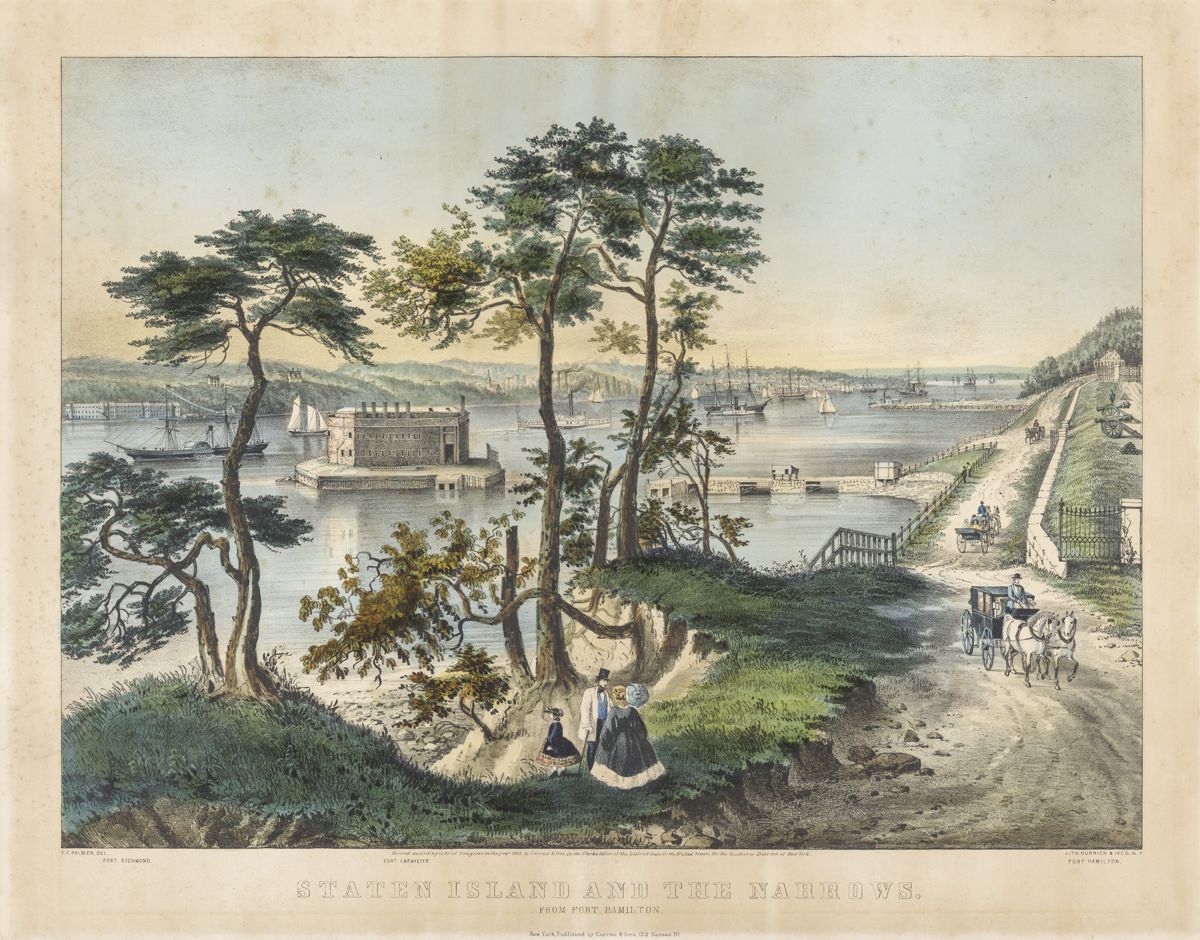
Fort Hamilton, Currier & Ives, 1860 The Graphic War highlights prints and printmakers from the Civil War discussing their meaning and the print maker or artist’s goals.
Well before the war began, Currier and Ives were capturing, in many colorful lithographs, the natural environment, buildings, bridges, parks and particularly the growth of Manhattan and its surrounding areas. In addition, they produced many “newsworthy” prints of current events, some of which we have written about over the past few years. As countless images of the war poured from the firm’s lithographic presses, they fulfilled the public’s desire to visually experience the day’s events, but also see the bucolic, idyllic countryside that never truly existed. With the coming of the War, as one author has cogently noted, “For the picture industry, the war was a blessing.” For Currier and Ives, it was a boon for business.1 Author Bryan Le Beau adds: “Arranged chronologically, Currier and Ives’s prints provide a veritable narrative of the war.”2 As war clouds gathered in the decade leading up to war, the company began producing prints that can be construed as showing power to any enemy, foreign or domestic. One such, published in 1862 showed the military prowess at West Point looking up the Hudson. Our featured print this month is a Fanny Palmer work published by Currier dated 1860. It is entitled “Staten Island and the Narrows/From Fort Hamilton” but it reveals much more. Fanny Palmer’s “prints are layered with a patriotic sense of history in ways that modern viewers may not fully perceive,” according to her biographer, Charlotte Rubenstein. This print, “simply looks like a charming New York view to us today, but midnineteenth-century viewers knew that on July 4, 1776, Fort Hamilton was the site from which” Americans attempted to intercept a British troop ship. The British goal was to launch its invasion of Long Island from Fort Richmond and defeat George Washington. In “1861, people could still remember their grandfathers describing what the revolution was like.”3 Fort Hamilton was named after Alexander Hamilton and sat at the narrowest point in New York Bay. Brooklyn is but a short distance from Staten Island at this point; today the Verrazzano Bridge connects the two land masses. Fort Lafayette was demolished to make way for the bridge. The fort dates back unofficially to the Revolution
Staten Island and the Narrows/From Fort Hamilton. (Library of Congress)
when American forces fired on those incoming British troop ships. By the War of 1812, it became apparent that the fort provided, along with the natural constriction of the bay at that point, an excellent deterrent and defensive position. In Palmer’s depiction, Fort Hamilton is shown to the right with peaceful carriage rides along the forts outer bank as generic cannon point toward Staten Island and the narrows, Fort Richmond and Fort Lafayette are represented to the left. In the 1830’s, New York City was beset with labor unrest. The city relied on the 27th New York Militia Regiment to keep the peace. The mayor supported a city police force, but was voted down by anti-government protesters who thought the 27th was doing fine job and nothing more was needed. The federal government agreed, and in 1839, “it allowed the Twenty-seventh to drill at Fort Hamilton (making it the first National Guard training camp in the nation); in 1840 granted the fort $20,000 for additional armaments; and in 1841 dispatched Captain Robert E. Lee for a five-year stint as post engineer, charged with improving the fort’s defenses along with those of other military installations in the area.”4 Lieutenant Thomas “Stonewall” Jackson also served at Fort Hamilton, and Captain Abner Doubleday served as the post commander in 1861, shortly after serving at Fort Sumter during the bombardment that started the Civil War. In 1848, Jackson found himself herding horses and recruits at the fort.5 Lee, on the other hand, spent his years at the fort, recommending, planning, and executing engineering projects that enhanced the fort’s readiness and effectiveness. According to Douglas Southall Freeman, “Reaching New York on the night of April 10, 1841, in a period of very bad weather, Lee soon discovered that his task was not as interesting as he had hoped it would be – that it was laborious but technically not difficult. His instructions were to institute somewhat elaborate repairs at Fort Lafayette, and to make various changes in Fort Hamilton, particularly in the parapet, so as to adapt it to barbette guns.”6 Lee found that “superintending dull repair work,” dealing with the board of engineers’ plans, and suggesting ways to better the defenses of New York city was, in historian Freeman’s judgment, “scant return for five of the most valuable years of Lee’s life.”7 The Mexican War awaited him. By the time the country was
CivilWarNews.com torn by Civil War, the Narrows boasted a ship barrier, defending New York forts adjacent to Brooklyn, Fort Hamilton, and across the bay, Staten Island’s Fort Wadsworth, from Confederate attacks. “The forts also provided troops to help put down the 1863 New York Draft Riots. Fort Hamilton also served as a prisoner-of-war camp, and an exterior “New Battery” of guns was added.”8 Historic parts of Fort Hamilton exist, one being the Robert E. Lee house. The Fort remains an active Department of Defense military post, the only one in New York City. Thanks to artist Fanny Palmer and the Currier & Ives company, we have a fairly accurate view of the Narrows and forts on the eve of the war. •
• •
•
•
•
• •
William Fletcher Thompson, Jr., The Image of War: The Pictorial Reporting of the American Civil War (New York: Thomas Yoseloff, 1960), 37. As cited in Bryan F. Le Beau. Currier & Ives: America Imagined. Washington: Smithsonian Institution Press, 2001, 72. Ibid. Charlotte Striefer Rubinstein, Fanny Palmer: The Life and Works of a Currier & Ives Artist, Syracuse: Syracuse University Press, 2018, 197-198. Edwin G. Burrows and Mike Wallace, Gotham: A History of New York City to 1898, New York: Oxford University Press, 1999, 636. James I. Robertson, Jr., Stonewall Jackson: The Man, The Soldier, the Legend. New York: Macmillan,1997, 47,79, 82. Douglas Southall Freeman, R. E. Lee: A Biography, New York: Scribner’s Sons, 1934, I, 186. Freeman, Lee, I, 200. https://en.wikipedia.org/wiki/Fort_Hamilton
After 43 years in the museum field, Cilella devotes his time collecting American prints and maps and writing. His most recent books are Upton’s Regulars: A History of the 121st New York Volunteers in the Civil War (U. Press Kansas, 2009). His two-volume Correspondence of Major General Emory Upton, (U. of Tennessee Press, 2017), received the 2017–2018 American Civil War Museum’s Founders Award for outstanding editing of primary source materials. “Till Death Do Us Part,” an edit of Upton’s letters to his wife 1868-70, was published in 2020 by the Oklahoma University Press.