
Emerging Civil War Series Spotlight
Originally published October 2022 · pp. 12–13
The Great Battle Never Fought: The Mine Run Campaign, November 26 – December 2, 1863 by Chris Mackowski Savas Beatie, 2018
Editor’s Note: Civil War News is pleased to continue a new monthly series highlighting books in the Emerging Civil War Series (ECWS) published by Savas Beatie, LLC.
About the Book: The stakes for George Gordon Meade could not have been higher. After his stunning victory at Gettysburg in July 1863, the Union commander spent the following months trying to bring the Army of Northern Virginia to battle once more and finish the job. The Confederate Army, robbed of much of its offensive strength, nevertheless parried Meade’s moves time after time. Although the armies remained in constant contact during those long months of cavalry clashes, quick maneuvers, and sudden skirmishes, Lee continued to frustrate Meade’s efforts. Meanwhile, in Washington, D.C., Meade’s political enemies launched an all-out assault against his reputation and generalship. Even the very credibility of his victory at Gettysburg came under assault. Pressure mounted for the army commander to score a decisive victory and prove himself once more. Smaller victories, like Bristoe Station and Rappahannock Station, did little to quell the growing clamor, particularly because out west, in Chattanooga, another Union general, Ulysses S. Grant, was once again reversing Federal misfortunes. Meade needed a comparable victory in the east. And so, on Thanksgiving Day, 1863, the Army of the Potomac rumbled into motion once more, intent on trying again to bring about the great battle that would end the war. The Great Battle Never Fought: The Mine Run Campaign, November 26-December 1863 recounts the final chapter of the forgotten fall of 1863 when George Gordon Meade made one final attempt to save the Union and, in doing so, save himself.
Q&A with Chris Mackowski What got you first interested in the Mine Run Campaign? The area around Fredericksburg, Va., has probably the most incredible Civil War story in the country because it covers such a vast swath of time, from the spring of 1862 through the summer of 1864. Four major battles happened in that time: Fredericksburg, Chancellorsville, the Wilderness, and Spotsylvania. The National Park Service preserves parts of all four of these battlefields. Like a lot of people, when I first started piecing those events together within the larger story of the war, I followed the armies from Chancellorsville up to Gettysburg, and then, oh look, there’s Brandy Station along the way, and from Gettysburg I just sorta jumped to the Wilderness. That’s a 10-month gap! Well, what happened in there? That’s what let me to Mine Run. I became fascinated with this forgotten campaign that had all the potential to become a battle every bit as big as the other four battles around Fredericksburg. The fact that it didn’t, that it all really boiled down to the moral courage of George Gordon Meade, was a gob-smack to me. The campaign really comes down to what didn’t happen and why, but it had huge implications for the armies and the officers involved; it really set the stage for the 1864 Overland Campaign even while it also had all these echoes of the battle of Fredericksburg from a year earlier. The whole story comes together in just incredibly fascinating ways. What inspired you to translate your interest in Mine Run into a book? I’d wanted to write a book about Mine Run for quite a while, actually, but I wasn’t sure the market would handle it. So, we went through all the other battles in the area first. I worked on most of those with my partner-in-crime, Kris White. I did Hell Itself: The
Battle of the Wilderness myself, and then I even did North Anna, another overlooked battle I’m fascinated with. By then, we had a book in the Emerging Civil War Series about the Bristoe Station Campaign, so it made sense to pick up that story and finish off the “forgotten fall” of ’63. I wasn’t sure Ted Savas would bite on the idea, but little did I know when I pitched it to him that he was as big a Mine Run fan as I was. In fact, he helped locate the Payne’s Farm battlefield, which had for years been misidentified. Finding the “lost” battlefield provided a vital jump-start to the process of remembering; having the battlefield led to increased awareness, interpretation, research, and tours. I hope it will lead to more preservation, too, for there’s much out there left to save. I was pleased when Ted offered to write an afterword for the book that outlined that whole part of the story, which was really cool.
Were there particular misconceptions about Mine Run you were hoping to clarify? There aren’t necessarily a lot of misconceptions about Mine Run because people forget about it altogether! If there is a misconception, it’s that it was no big deal. People don’t realize that it had the potential to be every bit as big as, say, Chancellorsville. Another reason people don’t realize its potential is because the only part of the battlefield that’s been preserved is Payne’s Farm, where serious fighting took place on November 27. There were minie balls by the bucketful, a North Carolinian said. We’re lucky that the American
Battlefield Trust has preserved that pristine part of the battlefield. But sometimes people look at Payne’s Farm and think that’s all there was. Because not more has been preserved, people don’t think there was more to it. If there’s any hope of the Mine Run campaign assuming a more prominent role in the popular chronology of the Civil War, it’s in the battlefield itself. If the land is preserved, then we’ll all have a tangible plot on which to ground ourselves. This ties back to the importance of preservation in general, of course. The first step in forgetting a battle is losing the battlefield. Think “Salem Church” as the poster child.
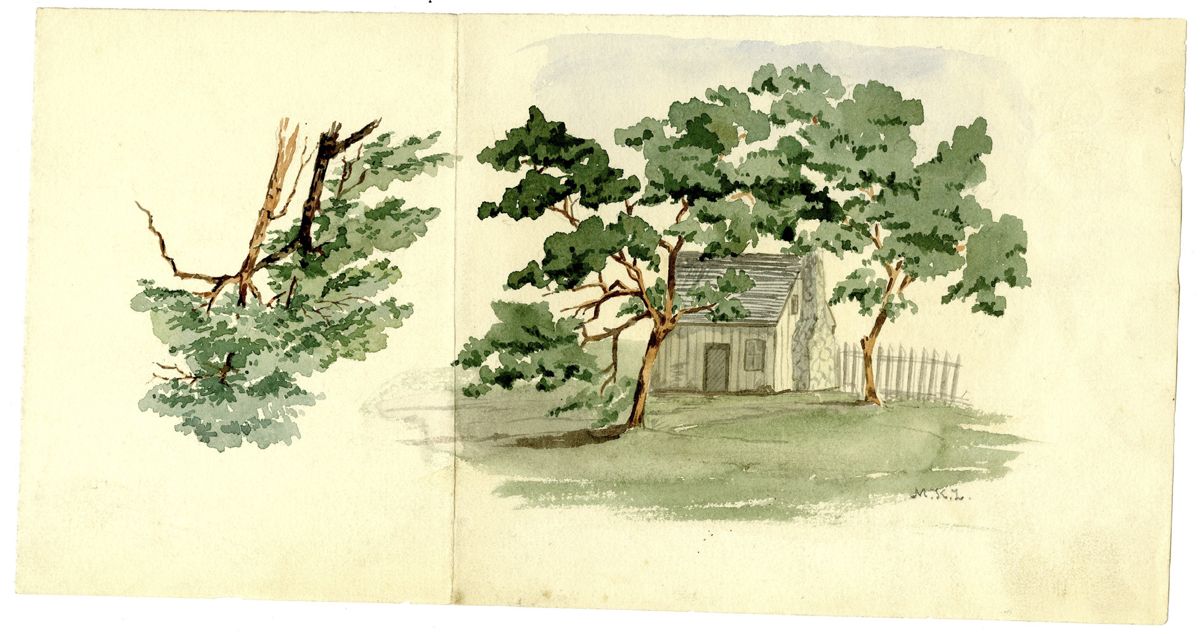
As you did your research, did you come across any new discoveries? Was there anything that surprised you? I was amazed at how much of the Confederate line is actually still there. It just hasn’t been preserved. A friend of mine, Ron Veen, lives out there. He took me with permission through his neighbors’ yards and all over the place. We could match up nearly the entire length of Lee’s line with old survey maps the NPS did back in the 1920s. Lee built an incredibly strong set of fortifications at Mine Run. They were enough to scare off the Union army just by sight; most of that line is still there, almost all on private property. Another surprise to me was how Lee was really starting to feel the losses from Chancellorsville and Gettysburg by the time he got to Mine Run. He built this incredibly powerful line and was understandably content to sit there but in doing so, he lost an incredible opportunity to deliver a crippling blow against Meade. The Army of Northern Virginia just didn’t have the offensive punch it once had; it was made worse by the absence of Longstreet’s First Corps in the west. Finally, I came across a great find that had never before been published: a watercolor sketch of New Hope Church, a painting by a relative of Henry Wadsworth Longfellow. Longfellow’s son was grievously wounded fighting near the church, and as Longfellow later nursed his son back to health, he wrote the poem “I Heard the Bells on Christmas Day.” One of their relatives was a professional artist, and she did this watercolor of the church, which was in the archives of the Longfellow House in Boston. I was thrilled to uncover that wonderful little gem. What was the most challenging part about writing the book? Why? So little has been written about Mine Run, and much of that was wrong, so there wasn’t a very clear trail blazed ahead of me. That was okay because it really offered me a chance to add to the literature. Sometimes it’s nice to have someone else’s work to check your own work against; I didn’t really have much opportunity for that! Because I really believe it’s fundamentally important to know a battlefield before you write about a battle, learning the ins and outs of this battlefield was tricky because so much of it is in private hands. I met a lot of new folks who were kind enough to let me and Ron walk around on their property!
nonfiction the way Grant’s Last Battle or even Strike Them a Blow tend to lean.
Everything was at stake for count, in the for series, by more than him. Halleck was peppering seven thousand words. It also has him, Lincoln was pressuring the smallest font size of any of him, Grant was winning at our books: 9.5. I had to shrink the Chattanooga, Dan Sickles was type size down to get everything back stabbing him in Washington; to fit. There’s a lot crammed in he desperately needed a big win. there! Rather than throw away the lives of his men, he chose to avoid What sort of feedback have needless sacrifice at the expense you gotten on the book since it of his own career. That took came out? Is there something tremendous courage. people particularly enjoy or I saw this as Meade’s story are surprised by? The most so much that I wanted to have common thing I hear is, “Wow, I his photo on the cover, which is didn’t know anything about that.” something we don’t normally do No surprise, few people do. The for a battle-oriented book. But next most common thing I hear this is a story about Meade as is, “Is there anything left out much as it’s a story of a campaign there?” Oh, yes, there surely is! Is there some part of the battlefield—or some other related historical place—that your book helped you better appreciate or understand? Why? I earned a much better appreciation for all the fighting along the Orange Turnpike around Robinson’s Tavern, where the Federal II Corps won the race for a key intersection and controlled the battlefield. I also earned a better appreciation for the intensity of the fighting around New Hope Church. What did you learn about the writing process by writing this book? From a purely research-oriented perspective, this book contains my heaviest lifting, and I’m proud of it for that reason. A friend told me it didn’t have the typical “Chris Mackowski storytelling” flavor to it, though, and that might be true. It’s definitely a straight-up, straightforward history book as opposed to a work of creative
About the Emerging Civil War Series The mission of the Emerging Civil War Series is to offer compelling and easy-to-read overviews of some of the Civil War’s most important battles and issues. Each volume features more than a hundred and-fifty photos and graphics, plus sharp new maps, visually engaging layouts, and thought-provoking appendices. To date, forty-three books have been published in the series. The Army Historical Foundation honored the Emerging Civil War Series with its Lieutenant General Richard G. Trefry Award for contributions to the literature on the history of the U.S. Army, calling it “an invaluable collection of Civil War battlefield guides.” The series has also served as a fertile starting point for a lot of “emerging voices” in the field, something important to us here at Civil War News.