
The Unfinished Fight
Elmira Prison Camp May 1864
By Craig L. Barry · Originally published October 2022 · pp. 14–15
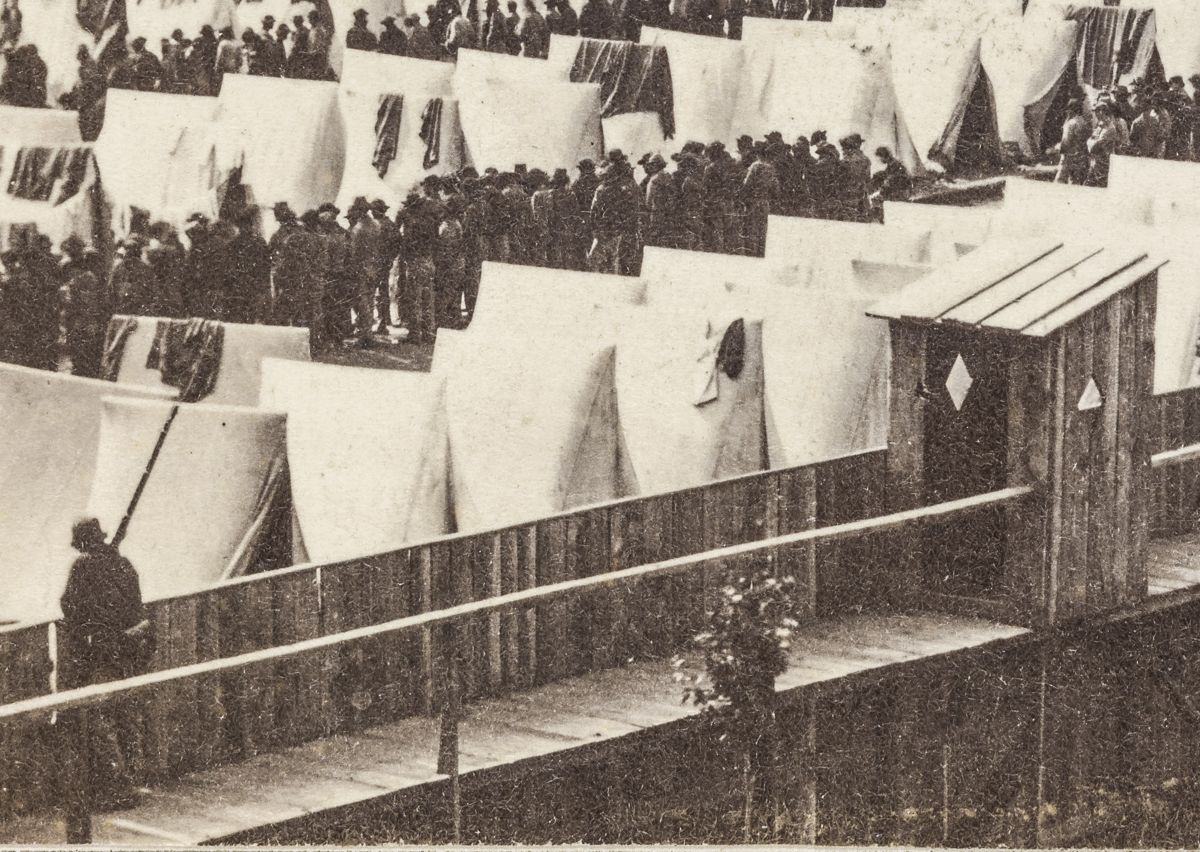
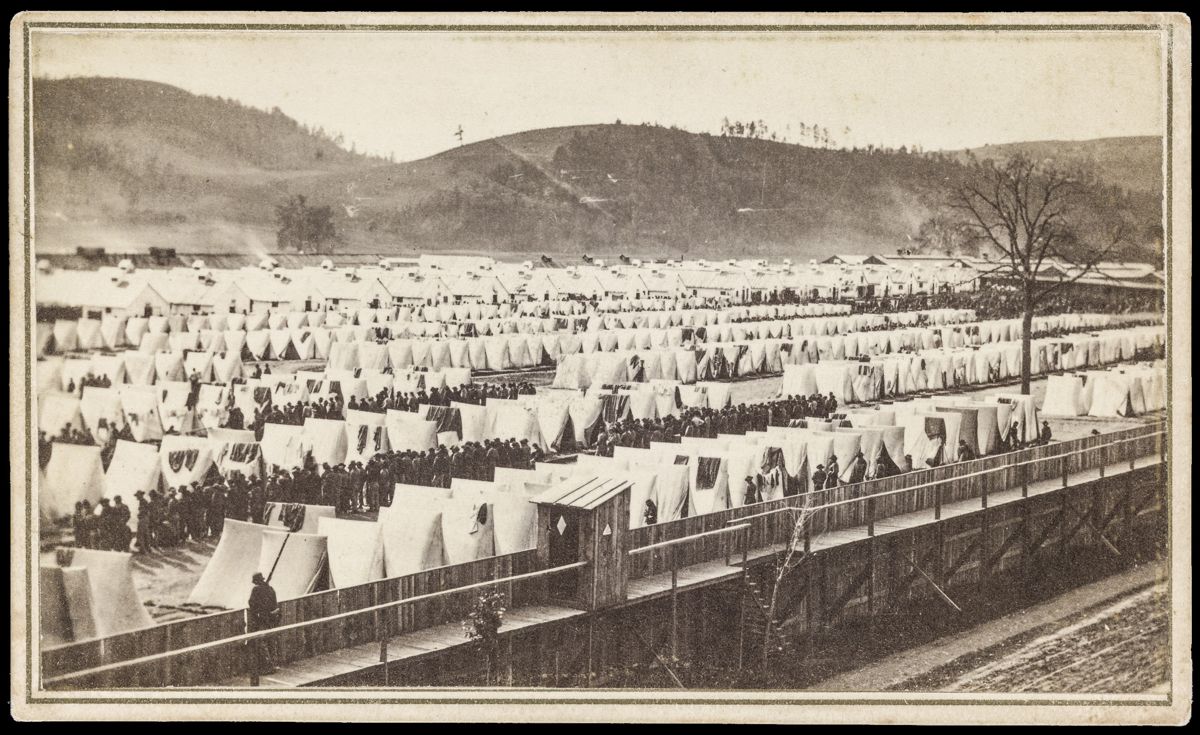
Elmira Prison Camp Shootings at Union Civil War prison camps like Elmira were not unusual. Conditions at Elmira were overcrowded and the usual targets were unarmed Confederate prisoners who approached the so-called “dead line.” However, there was one incident that occurred during May 1864 that involved a guard shooting another guard during an argument. This was not common at all. How did it happen? On the night of August 13, 1864, two off duty privates of the 56th New York Militia named Conauton and Burtis were in their quarters at Camp Chemung. They got into an argument about which were the best fire engines in the city of Brooklyn, New York, of all things. The discussion grew more heated and the Corporal on guard duty (Crummell) was summoned. He was armed with a loaded and capped “Enfield rifle,” most likely the very commonly encountered Enfield long rifle, pattern of 1853. The weapon discharged in the direction of Conauton and Burtis, whether intentionally or accidentally, at more or less point-blank range. As stated in the medical report, the Minié ball entered the chest of Conauton, exited at his shoulder blade and had enough steam to continue straight through Burtis. It then lodged in the knapsack of a third soldier, whose name has not been recorded. Since the Enfield rifle in question was serving the cause of the Union at the time, the ammunition would have most likely been the standard threering, soft lead .58 caliber conical “Minié ball” that caused so much carnage to those unfortunate enough to be hit by one on a Civil War battlefield. The Union did not import .577 English cartridges for the Enfield rifle but very often issued standard regulation .58 caliber “rifle-musket cartridges” for both. Privates Conauton and Burtis were both taken to one of the six
Elmira Prison hospital wards for treatment. Conauton survived his injuries. Oddly the second man hit, Burtis, was not as lucky. Corporal Crummell was placed under arrest, but subsequently charges were dropped when Conauton testified that the accident was unintentional. It was documented that “the entire camp was dispirited” by the whole episode. Other than luck, is there any possible explanation for why Conauton survived and Private Burtis did not? In terms of ballistics, the soft lead .58 caliber Minié ball immediately “mushroomed out” upon impact with tissue or bones. The flattened, and sometimes splintered, lead projectile caused a much larger exit wound leaving the body than it did entering. Hence, the projectile that went straight through Conauton was much larger when it next struck Burtis with the most likely result being greater tissue, blood vessel, and bone damage. This, more so than pure velocity, is why immediate surgical amputation was so often required when a projectile of this type struck the bone of an arm or leg. If loss of life resulting from this accidental shooting seems a foolish tragedy, it is worth mentioning that the vast majority of soldiers chosen for ‘prison duty’ were not the cream of the crop from West Point, or even the best and brightest of the local rearguard militia. Generally, these assignments were given to volunteers who were not able to serve in the field for one reason or another. For example, the first Elmira Prison commandant was Major Henry V. Colt of the 104th New York Volunteers, brother of the well-known gun-maker, Samuel Colt. Major Colt enhanced his qualifications for the Elmira Prison post after he sustained a serious injury while jumping over a ditch marching towards a battlefield. The portly Major landed awkwardly and the tip of his scabbard stuck in the ground while his momentum drove the grip or handle of the saber into a very sensitive part of the male anatomy, resulting in, among other problems, a chronic inguinal hernia. Fortunately, Henry Colt and his wife already had two children back in New York before the war because there is no mention in his biographical data of any more children afterwards. While two prison guards accidentally shot during an off-duty argument about fire engines was unusual, Major Colt’s disability from his clumsy attempt to jump that ditch in Virginia is potentially one of the strangest and most embarrassing accidental self-inflicted wounds of the Civil War. One struggles to find any record of an incident remotely similar. Most infantry officers before, during, and after the Civil War-era did not wear a saber unless on parade or in battle, especially not while on the march. Officers had a baggage wagon and the cutlery generally rode in the “in the rear with the gear.” It almost sounds like a comedy skit or a circus clown act, but such were the men assigned to run the Union prison system. However, once his ditch jumping days were behind him, Clayton Holmes noted of Major Henry Colt in A History of the Elmira Prison Camp, (1912) that “[He] was generally well regarded by fellow officers and prisoners at Elmira. Major Colt was considered a fair man and a man of good judgment.” As far as the final disposition in the case of Private Thomas Conauton, he was very fortunate compared to other soldiers struck at close range by a Minié ball fired from an Enfield rifle. The medical report concludes:
“The patient convalesced without an unfavorable symptom and was returned to duty in less than five weeks from the reception of the wound. On March 19th, 1866, he was carefully examined. Externally, nothing could be seen except the cicatrices and marks of the sutures, while on auscultation and percussion, a dullness was found at the middle lobe of the right lung, confined to a space of about four inches in circumference, where pleuritic adhesion had taken place. Otherwise that lobe was perfectly healthy, as were the remaining lobes of both right and left lungs, he was in perfect health.” Craig L. Barry was born in Charlottesville, Va. He holds his BA and Masters degrees from UNC (Charlotte). Craig served The Watchdog Civil War Quarterly as Associate Editor and Editor from 2003–2017. The Watchdog published books and columns on 19th-century material and donated all funds from publications to battlefield preservation. He is the author of several books including The Civil War Musket: A Handbook for Historical Accuracy (2006, 2011), The Unfinished Fight: Essays on Confederate Material Culture Vol. I and II (2012, 2013). He has also published four books in the Suppliers to the Confederacy series on English Arms & Accoutrements, Quartermaster stores and other European imports.