
Through The Lens
Carrying the War North John Hunt Morgan’s 1863 Raid – Part III
By Stephanie Hagiwara · Originally published October 2022 · pp. 20–21
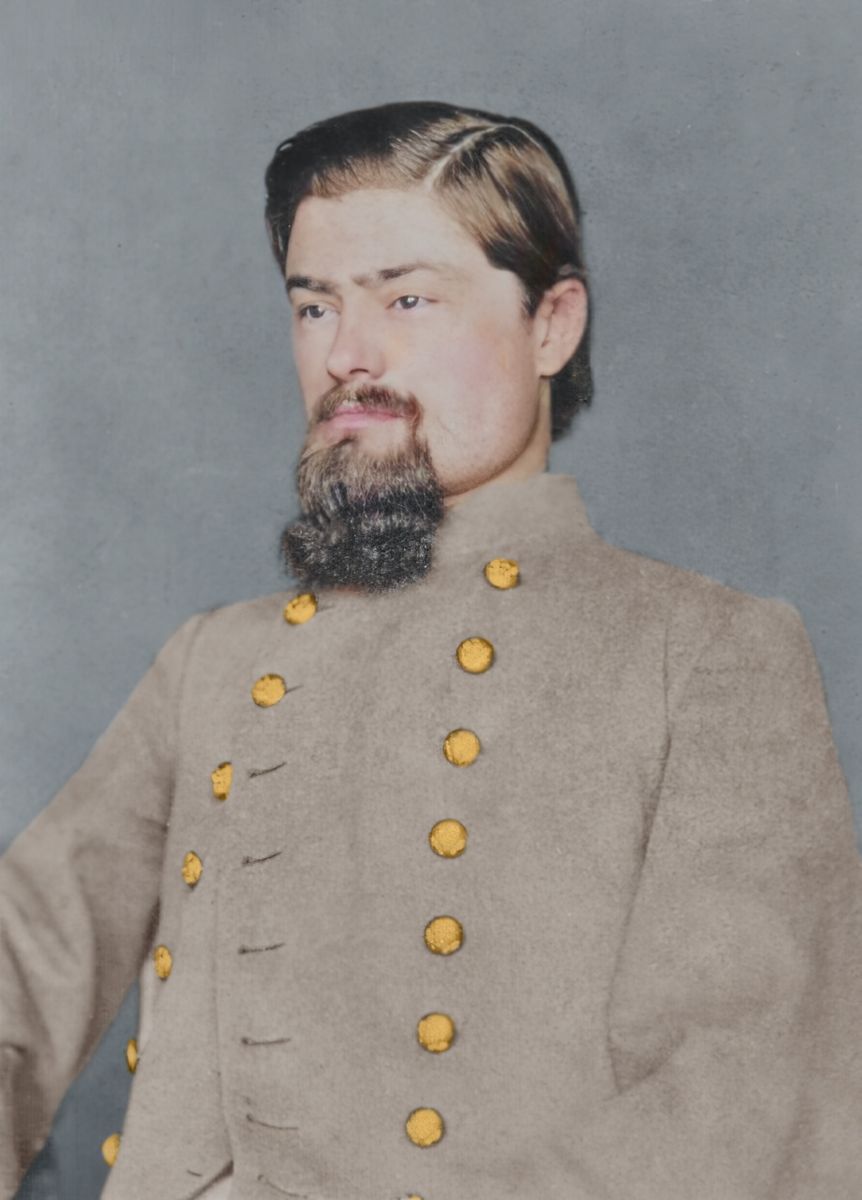
Carrying the War North John Hunt Morgan’s 1863 Raid – Part III of the approaching 14th Ky. were killed or wounded by the Spencer Guards. The surprised Confederates rapidly retreated, then the 7th Ky. Cavalry attacked the Indiana right flank. McGrain’s men, armed with “It would have been an Henry repeating rifles, held off inexpiable shame if, in all the the assault for 20 minutes. “The Confederate army, there had been shells sang the ugly kind of no body of men found to carry music over our heads,” recalled the war, however briefly, across Indiana State Senator Simeon K. the Ohio [River], and Morgan by Wolfe as Lt. Elias D. Lawrence this raid saved us, at least, that fired his two 3-in. Parrots and disgrace.” – Col. Basil Duke, 2nd Capt. Edward Byrne one of his Ky. Cavalry 12-pdr. howitzers. Dismounted Confederates continued to attack On July 8, 1863, C.S. Gen John the flanks, charging “them with a Hunt Morgan, 2nd Ky. Cavalry, yell and great determination.” In captured boats to ferry his men 30 minutes, the only Civil War from Brandenburg, Ky. over the pitched battle in Indiana was Ohio River into Indiana as part over. of his “Ohio and Indiana Raid.” The Rebels spent the afternoon Only Col. Basil Duke, Morgan’s plundering stores, ransoming brother-in-law and second in buildings, gathering food, horses, and supplies. Morgan read the newspapers. News of the July 4 defeat at the Battle of Gettysburg, Pa., and the surrender of Vicksburg, Miss., dashed his hope to join Gen. Robert E. Lee’s Army of Northern Virginia in the field. Still, Morgan’s Raiders continued fighting and outmaneuvering local militia and tearing up train tracks and burning trestles. The men rode an average 21 miles a day and forty miles between camps, dozing in the saddle, and taking anything that took their fancy. According to Duke, “I saw very few articles of real value taken— they pillaged like boys robbing an orchard. … They would (with few exceptions) throw away their plunder after awhile, like children tired of their toys.” What the men needed was a continuous supply of fresh horses. In the heat, the best horses would last about twenty miles, others would collapse sooner. Morgan’s reputation of stealing horses while leaving a trail of half-dead horses behind him was based on necessity. On July 13, Morgan crossed the Whitewater River into Harrison, C.S. Col. Basil Duke, 2nd Ky. Cavalry. Colorization © Ohio, burning the bridge behind 2022 civilwarincolor.com, courtesy civilwarincolor.com/ them. The headquarters of Gen. cwn. (University of Kentucky Libraries Special Collections Ambrose Burnside’s Army of the Ohio was located twenty miles and Research Center)
command, knew that Gen. Braxton Bragg, Commanding, Army of Tennessee, disapproved of the men operating outside Kentucky. On July 9, Morgan’s men reached Corydon, the original capital of Indiana, until 1825. U.S. Col. Lewis Jordan, 6th Ind. Legion, had prepared breastworks from fence rails and logs stretching a mile along a low ridge. Local volunteers were armed with muskets and squirrel guns. Capt. George Lahue, Spencer Guards, anchored the left flank. Maj. Thomas McGrain Jr., Ellsworth Rifles, covered the right flank from a hill with a view of the entire battlefield. It was 450 inexperienced men vs. Morgan’s 1,800 veterans and four artillery pieces. The Battle of Corydon began about 1 p.m. when twelve men
CivilWarNews.com away in Cincinnati. Morgan decided on a night march to slip past Cincinnati and its suburbs as he headed toward West Virginia. “It was a terrible, trying march,” according to Duke. In the dark night, only scouts were allowed light to search for clues of the road the previous brigade had taken. Sleep deprived men fell from their saddles and horses staggered, “like one intoxicated.” By dawn’s first light they had bypassed immediate danger. By 4 p.m. they reached Williamsburg, Ohio, 28 miles east of Cincinnati. It was Morgan’s longest march. The men had traveled more than 90 miles in a period of about 35 hours. The opposition was catching up with Morgan. U.S. Gen. Edward Hobson commanded a Provisional Division created to capture Morgan. Hobson’s 2,500 cavalry, mounted infantry, and six pieces of artillery had been chasing Morgan through Kentucky, Indiana, and gaining ground in Ohio. Thousands of volunteers had heeded the call to fight the invaders and fell trees to block their route. Lt. Commander Leroy Fitch, USN Mississippi Squadron, deployed his fleet of shallow-draft gunboats to keep pace with Morgan’s men and clear the river of any boats he could use.
On July 18, a dense fog was rolling in when the men reached Buffington Island, Ohio, about 8 p.m. Guarding the crossing were 300 infantrymen behind earthworks with two heavy guns. Instead of risking men in the very dark night, Morgan decided to make camp. Duke selected the 5th and 6th Ky. regiments to attack the work at daybreak. On July 19, the Battle of Buffington, the largest Civil War battle in Ohio, began about 5:30 a.m. At daybreak, it was discovered that the earthworks were abandoned. While trying to determine where their foe had gone, the Confederates discovered Gen. Henry Judah, 5th Ind. Cavalry approaching. In the dense fog, the Confederates fired at point blank range. They chased after the retreating Federals until they spotted a long line of blue coats, about 1,000 men across the road. Duke arranged the 5th and 6th Ky., about 500 men, into battle position. Byrne moved up his two howitzers. At 6 a.m. Judah’s Yankees, armed with carbines and pistols attacked. Fitch had positioned his flag boat, USS Moose, at the waterway separating Buffington Island from the Ohio shoreline. At 6:15 a.m., Moose fired its two 24-pdr. guns at Byrne’s howitzers. Byrne
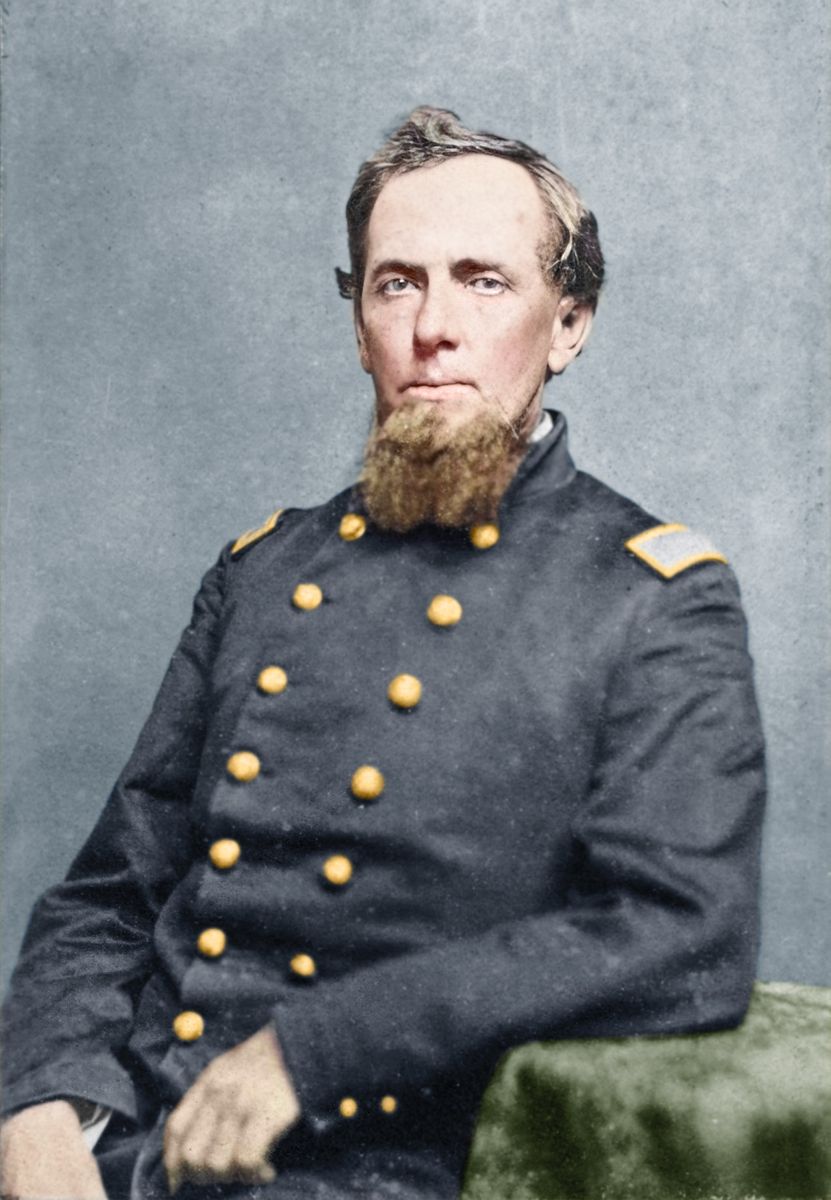
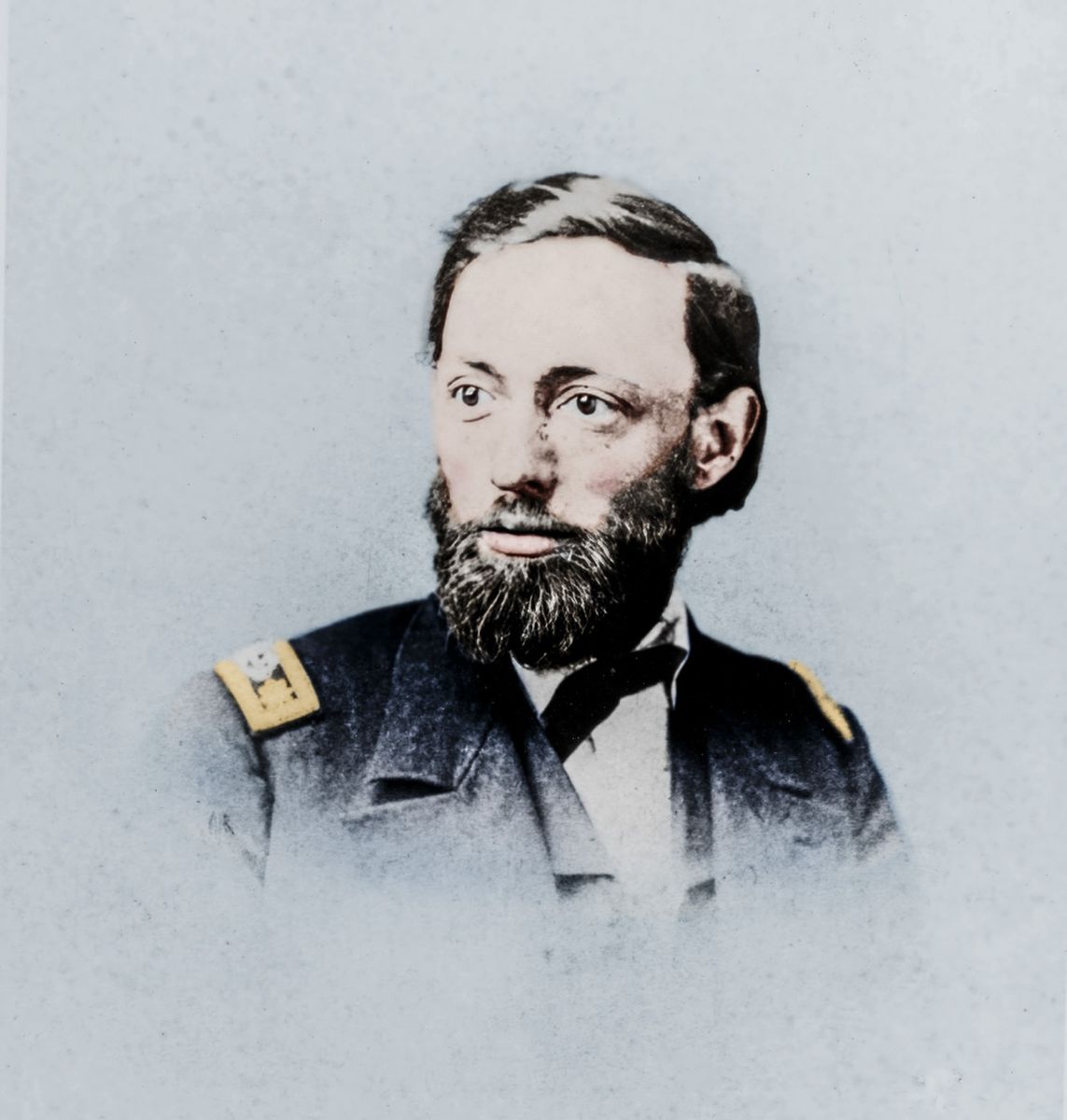
Gen. Edward Hobson. Colorization © 2022 LCDR Leroy Fitch, USN. Colorization © 2022 immediately moved them out of harm’s way. Hobson’s men, led by Col. August Kautz had finally caught up with Morgan and were now in his rear. The Allegheny Belle joined the fight. Duke wished he could send “two or three shots into their hulls.” The Federals, army and navy, were firing from three sides. Out of the chaos, Morgan was able to lead about 700 men trying an escape through the woods. Already across the river to cover the planned crossing, Capt. Kirkpatrick, 9th Tenn., and 110 men ended up walking the nearly 200 miles to Duplin Depot, Va. Col. Adam “Stovepipe” Johnson and 300 men were able to cross the Ohio River. Duke was captured with about 750 cavalrymen. On July 26, unable to cross the river, Morgan surrendered with his remaining men ending the Battle of Salineville, Ohio. Morgan’s Raid accomplished its primary objective, distracting the Federals while Bragg positioned the Army of Tennessee to win the Battle of Chickamauga, Tenn. Burnside was forced to delay his planned invasion of East Tennessee from July to
September. Morgan’s small force was the target of 130,000 men for more than 3 weeks. He destroyed infrastructure and raised Southern morale. Nevertheless, neither Bragg nor his superiors ever forgave Morgan for the loss of 2,000 seasoned cavalrymen. Sources: •
•
•
Mowery, David L. Morgan’s Great Raid: The Remarkable Expedition from Kentucky to Ohio: Arcadia Publishing, 2011 Duke, Basil W. History of Morgan’s Cavalry: Miami Printing and Publishing Company, 1867 Brown, Dee. The Bold Cavaliers: Open Road Media, 2012
Stephanie Hagiwara is the editor for Civil War in Color.com and Civil War in 3D.com. She also writes a weekly column for History in Full Color.com that covers stories of photographs of historical interest from the 1850’s to the present. Her articles can be found on Facebook, Tumblr and Pinterest.