
Book Reviews
Book Reviews — October 2022
Originally published October 2022 · pp. 38–43
Old Glory at the Crossroads 1861–1865: The Original and Complete Tribune Newspapers Civil War Centennial Comic Strip. By Rick Fletcher and Athena Robbins, compiled and edited by Thomas S. Suhs. Illustrated, index, 256 pp., 2021. SelfPublished: [email protected], softcover. $40. Reviewed by Greg Sweatt
“The strip reflected the scope reader is also told the story of the is shown at Vicksburg, in 1863, of war’s history as understood blockade runners and their use of wearing the shoulder straps of a during the time of its initial anthracite coal, because it burned lieutenant general (3 stars) (139), publication.” (2) Other than with little smoke. (116) Small rather those of a major general (2 some slight page yellowing the events are even mentioned such stars). He would not be given his colors in the panels hold up quite as the burning of the Confederate third star until March 1864. well considering the first strip dry dock at Pensacola Bay. (51) Old Glory ends with the appeared over 60 years ago. Old Glory at the Crossroads surrender of the CSS Shenandoah Each Sunday strip was is a product of the time in which in England in November 1865. “published, as close as possible, to it was drawn, reflecting, no (243) the dates of the actual events one doubt, the prevailing attitudes of I have no reservations hundred years prior.” (2) Every those years. It probably should recommending Old Glory at the page in this volume constitutes not be surprising, then, that Crossroads to anyone interested a Sunday’s strip. There are 5 or there is no mention of African in the Civil War, cartoons, or just 6 panels on each page. The date American troops at all; not at a rousing pictorial of the war. on which that strip was published the attack on Fort Wagner (149), Baby Boomers of the 1950’s during the Centennial appears at nor the Crater. (203) The terms and 60’s will get a nostalgic kick the bottom of each page. As a “Redskin,” “Warrior,” “Indians,” from the look and style of these teaser, at the end of each strip, and “Braves” are also used freely comic strips. there is a peek at what to expect in telling the Civil War story. in the next Sunday edition (“Next It is a credit to Fletcher and Gregory S. Sweatt received his Week: Jackson’s Surprise!”). Robbins that they were able to BA in art from the University (131) The book is divided into cover as much of the war as they of California at Davis. He has five chapters, 1861–1865. did with their illustrations and written for Civil War Times, The Artistically Fletcher’s cartoons text in 230 Sundays. It is puzzling, Civil War Courier, Camp Chase are on a level with the finally however, to note the absence of Gazette, and Sea Classics drawn characters in Hal Foster’s any mention of the Emancipation Magazine. His interest in the Prince Valiant comics. The Proclamation, the Gettysburg Civil War began in 1959 with the historical figures are drawn with Address, or even the rejection of Centennial. Now retired from a careful accuracy. The attention Sherman’s surrender terms to Joe job as a wholesale paper sales to detail is quite good. One can Johnston, as these would seem to rep, he has been drawing a Civil look at the characters and identify be major events of the war. Also, War-themed cartoon, Co. A, who they represent: Grant, Lee, although a minor glitch, Grant since 2003. McClellan, Stuart, Bragg, even Raphael Semmes and Benjamin Grierson. As true to form as the soldiers are drawn, though, it is interesting to note that, much like the soldiers in Currier and Ives prints, the Union soldiers all wear blue and the Confederates are all dressed neatly in gray, with few variations. The historical chronology is also quite detailed. Robbins’ writing is thorough. It takes 14 pages of strips to bring the reader from 1860, when with President Buchanan was hoping “for a peaceful settlement of the nation’s problems”) (9) to the surrender of Fort Sumter. (22) Along the way the illustrations and text cover,
Readers of Civil War News who remember or grew up during the Civil War Centennial (1961–1965) will especially appreciate this book. During the Centennial any manner of books, memorabilia, and toys were produced for Civil War historians, enthusiasts, and children (who can forget those blue and gray felt kepis?). Along those lines Thomas S. Suhs has done something quite remarkable, not to mention nostalgic, with his book Old Glory at the Crossroads
The Original Graphic Novel
1861–1865. From January 8, 1961 to June 6, 1965, the comic strip Old Glory was published in the Chicago Tribune and its affiliated newspapers every Sunday in the color comics section. Even though there were other Civil War comics produced during the Centennial, most notably by Classics Illustrated, these were primarily comic books; making Suhs’ undertaking even more impressive. He has found and collected into this one volume all 230 Sunday color strips from the Tribune papers and published them in chronological order; a history of the Civil War through comics. Suhs, from Oak Lawn, Ill., was Director of Recreation for the Oak Brook Park School District. He received his BA from Southern Illinois University at Carbondale. The strips were drawn by Rick Fletcher (1916–1983). Along with writer Athena Robbins (1902-–1996), the duo literally illustrated the Civil War for four years. Both Fletcher and Robbins worked at the Tribune and had collaborated previously on historical strips before launching Old Glory at the Crossroads. Fletcher worked as an illustrator and Robbins as a copywriter. As stated in the book’s introduction,
Excellent Gettysburg Battlefield Guide Significantly Flawed Colonel Gettysburg: Three Days That Saved the United States; Remembering the Civil War’s Most Decisive Battle. Editor Ben Nussbaum. Photos, illustrations, 96 pp., 2022. Fox Chapel Publishing (Revised edition of Gettysburg: 150th Anniversary Companion House, an imprint of Fox Chapel Publishing, 2013). ISBN 978-1-49710-326-9. $14.99. Reviewed by John D. Fowler
At approximately 3 p.m. on the steamy afternoon of July 3, 1863, more than twelve thousand Confederates of the Army of Northern Virginia, the divisions of Generals J. Johnston Pettigrew, George E. Pickett, and Isaac Trimble, emerged from their tree covered positions near Seminary Ridge, formed battle lines, and advanced over open terrain toward the Union troops along Cemetery Ridge. Less than an hour later, the entire force was in full retreat, leaving behind five thousand casualties. Lee’s grand assault, the climactic event of the threeday Battle of Gettysburg, had failed. For more than 150 years, historians have treated the battle as the defining event of the Civil War. Hundreds of books and articles have dissected those three days in July in minute detail. Gettysburg: Three Days That Saved the United States; Remembering the Civil War’s Most Decisive Battle fills the need for a basic guide book and introduction to the battle for casual readers and young learners who are just discovering the Civil War. This commemorative book has been produced in a magazine format, which suits the miniarticles, maps, and illustrations contained within. Indeed, the booklet is lavishly illustrated and packed with photographs from both the modern and Civil War eras. It begins with a brief description of the battle, followed by a short analysis of the strengths and weaknesses of the army commanders, Generals Robert E. Lee and George G. Meade. Readers are then treated to infographics and a detailed timeline similar to what one would find in a museum exhibit. The work also includes an informative section on Lincoln at Gettysburg, with his famous address, as well as interesting and unusual parts, such as an article on William Corby, a Catholic, Union chaplain. The author even provides a nice overview of Civil War medicine and the devastating effects on the human body inflicted by the War’s weaponry. Again, illustrations and pictures similar to a museum display bring medical artifacts and the grim reality of war to the reader. Another important article highlights Jubal Early and the infamy surrounding his decision not to advance late on the evening of July 1 after the stunning Confederate success of the day. Nussbaum also added an excerpt from African American Faces of the Civil War: An Album of Union Soldiers and Their Stories (Johns Hopkins, 2012) by Ronald S. Coddington, which discusses Alexander Newton’s story. Newton, a free black, traveled with a New York National Guard Infantry unit that just avoided the battle. Following passage of the Emancipation Proclamation and a series of Congressional acts enabling black men to serve in the U.S. Army, he eventually joined the Twenty-Ninth Connecticut Infantry in 1863 and served until war’s end. Death and memorialization are covered in a short piece on the origins of Memorial Day and the captivating story of Amos Humiston, a dead Union soldier found after the battle clutching a photograph of his children. Humiston was unknown at the time, and a search for his identity and family swept the North following the battle. The article was written by Mark H. Dunkelman, who wrote a large work on Humiston entitled, Gettysburg’s Unknown Soldier: The Life, Death, and Celebrity of Amos Humiston (Praeger, 1999). The volume also incorporates sections on reenactors, battlefield preservation efforts, the numerous monuments, and shares with readers a look at the 1913 veterans’ reunion on the battlefield. Some more useful and important aspects of the volume are the sections on traveling to Gettysburg and touring the battlefield, as well as a list of further resources for the reader who wants to know more. In fact, the booklet is best used as a guidebook or introduction to the battle. It has limited use to professional historians except as a text for courses in public history or historical memory, where it could serve as the basis for discussion on how historians present the past to a public. The only serious criticism is that, regardless of the book’s title and some of its rhetoric, Gettysburg is not the most decisive battle of the war. Since the 1960s, Civil War historians have increasingly come to three general conclusions that invalidate such a claim. First, the war in the Western Theater was critical if not decisive in breaking the Confederacy’s ability to continue the war. The Rebels simply lost too much manpower, resources, and territory to invading Federal armies as the Western Theater slowly collapsed, exposing the Southern population and infrastructure. Second, the Confederate hightide or closest point to a military victory in the war came with the two serendipitous invasions of Border States, Kentucky and Maryland, in 1862. Had these campaigns ended with Rebel victories, European recognition of the Confederacy could possibly have altered the course of the war. Third, the 1864 campaigns in both the Western and Eastern Theaters were far more decisive to the War’s outcome because of the implications of the 1864 United States presidential election. Indeed, the Confederacy fought on two years after the defeat at Gettysburg, and had Lee won the engagement in Pennsylvania in 1863, it is unlikely his army could have done more than recuperate and continue to forage before another Federal attempt to force him back to the Confederacy. His force was far too weak to take, let alone occupy, a major Federal city. In reality, the best Lee could hope for was a battlefield victory that would eventually lead to Republican defeat in the 1864 elections. Still, the book remains an excellent guide for the novice and the visitor to the battlefield. John D. Fowler, Ph.D., is the author of several books and articles on the Civil War Era. He is the author of Breaking the Heartland: The Civil War in Georgia. He is currently a Professor of History at Dalton State College.
James Montgomery: Abolitionist Warrior. By Robert C. Connor, Illustrated, Bibliography, Index, Casemate Publishers, www.casematepublishers.com 2022, 210 pp., hardcover, $34.95. Reviewed by Wayne Wolf
Robert Conner pens a fairly objective biography of James Montgomery, the abolitionist colonel demonized for burning Darien, Ga., in the movie Glory. Known as the “fighting preacher” and the “Guerrilla Chieftain,” Montgomery believed a Civil War to free slaves was both inevitable and justified. An ardent abolitionist, he fashioned himself the leader of civil and military affairs in southeast Kansas, where he and his family lived in what was dubbed Fort Montgomery. He had some justification for fortifying his home as jayhawkers frequently raided homes during and prior to the Civil War. Montgomery used some atrocities perpetrated by these border ruffians to justify his depredations against Confederate sympathizers and Southern homes, mills, crops, and barns. Thus, he felt authorized to execute five persons near Morristown, Mo., in 1861 in retribution for jayhawker attacks on Union homes. Montgomery’s war record was equally controversial. He was one of the early officers to lead black troops, actively recruited them, and frequently led raids behind enemy lines to encourage slaves to desert plantations, an attribute of economic warfare he felt would cripple the South’s capacity to wage war. In one of his most successful raids near the Combahee River, he freed over 756 slaves but was also censured for burning civilian homes. As commander of the 2nd South Carolina Volunteer Infantry, he summarily shot a soldier for desertion without the formality of a court martial. Militarily, however, he was generally praised by his superiors for bravery under fire, shaping his black soldiers into cohesive fighting units, and leading them personally in major engagements at Westport and Olustee, as well as numerous forays against Gen. Sterling Price’s campaign to secure Missouri for the Confederacy. He resigned his commission in September 1864 due to ill health but rejoined militia units after a short absence as a colonel of troops trying to drive Confederates out of Kansas and Northwestern Missouri. He then returned to his farm in Linn County and raised crops while preaching on the weekends for the First Day Adventist Church. He was, by all accounts, a charismatic preacher who drew people to his sermons as he had drawn soldiers to enlist to end slavery. The author is objective in pointing out atrocities perpetrated by Montgomery as well as how his virulent abolitionist views overtook his moral judgment and his abrogation of civilized rules of warfare. If the historian wishes to read a biography of a radical abolitionist who placed his own views above morality and decency, this book will be appealing. It is well researched, readable, and historically accurate. Dr. Wayne L. Wolf is Professor Emeritus a South Suburban College, past president of the Lincoln-Davis Civil War Roundtable, and the author of numerous books and articles on the Civil War and the common soldier.
Enlightening Anthology about the Old Line State The Civil War in Maryland Reconsidered. Edited by Charles W. Mitchell and Jean H. Baker. Notes, index, 352 pp., 2021. Louisiana State University Press, lsupress.org. Hardcover. $45. Reviewed by Jonathan A. Noyalas
In their ten-volume biography of President Abraham Lincoln, John Hay and John Nicolay, Lincoln’s former private secretaries, offered their perspectives about Maryland’s importance to the Union war effort. Among all border states, Hay and Nicolay argued, none was of “more immediate and vital importance” than Maryland. The state Lincoln’s biographers characterized as “divided by sharp antagonism” has proven fertile ground for historians. This collection of thirteen essays, written by a cadre of fine scholars and ably edited, makes a valuable contribution to the scholarship on the Old Line State. The editors of this outstanding anthology, Charles W. Mitchell and Jean Baker, promise that the essays aim to “bridge the gap between older versions of Maryland’s Civil War history… break fresh ground… challenge long-held assumptions” and “provide new perspectives on old debates.” All the essays in this collection, deeply researched and smartly crafted, help achieve the anthology’s goals. Four essays focus on the experiences of Maryland’s African Americans prior to, during, and in the Civil War’s immediate wake. This group of essays not only provides a fresh analysis of the complexities of life for Maryland’s enslaved people and the tenuous nature of freedom, but resurrects the lives of individuals long-forgotten. For example, Richard Bell, professor of history at the University of Maryland, revives the story of Rachel Parker, a seventeenyear-old free black woman from Pennsylvania abducted by Thomas McCreary to be sold into slavery in Baltimore. Other essays bring clarity to the extent of Confederate loyalty in Maryland. For example, Charles Mitchell’s essay systematically dismantles the idea that support for the Confederacy was significant in Maryland. Mitchell cogently lays out the widespread extent of Unionist sentiment in Maryland and illuminates how advocates of the Lost Cause greatly exaggerated pockets of support for the Confederacy to create the illusion of an ardently pro-Confederate Maryland. Timothy Orr’s insightful examination of recruitment of Union soldiers in Baltimore also challenges this notion. While all essays in this volume enrich understanding of the Civil War in Maryland they also serve as case studies to deepen our knowledge of the Civil War era. For instance, Brian Matthew Jordan’s elegantly crafted narrative about Union soldiers’ encounters with dead after the Battle of Antietam, not only enhances the historiography of the conflict’s bloodiest singleday, but Jordan’s cogent analysis of primary accounts establishes an important framework for comprehending how soldiers coped with the tragic scenes of a battle’s aftermath. Furthermore, Jordan’s essay illuminates how encounters with the dead steeled the resolve of Union soldiers to continue the fight. Similarly, Jonathan White’s outstanding essay, “Achieving Emancipation in Maryland,” offers insight not only into the intricacies of the push for a new constitution in Maryland, one that abolished slavery, but contributes to the broader scholarship about the debates politicians engaged in related to voting rights of Union soldiers. Contributions by Robert Schoeberlein and Robert Cook also do much to enrich perspectives about the Civil War era beyond Maryland’s borders. Schoeberlein’s essay, “Maryland’s Women at War,” admittedly my favorite in this splendid collection, investigates the myriad ways Union and Confederate women supported their causes during and after the conflict. From relief associations, sewing circles, caring for family members of soldiers, and supporting veterans after the conflict, Schoeberlein admirably illustrates that although not permitted to fight or vote, women “expressed their devotion to their respective political alignments in multiple and somewhat different ways.” Cook’s essay explores the complexities of memory in Maryland after the conflict, particularly the efforts of such Confederate veterans as Bradley Johnson to portray Maryland as much more Confederate than it was and the efforts of black Union veterans to counter the rampant Lost Cause. While those interested in the complexities of Maryland’s Civil War era history should certainly regard this important volume as indispensable, its appeal extends significantly beyond the boundaries of the Old Line State. Individuals seeking perspectives on the experiences of African Americans, allegiance, soldiers, recruitment, constitutional issues, women, and memory will find Mitchell’s and Baker’s anthology quite useful and thought-provoking. Jonathan A. Noyalas is director of Shenandoah University’s McCormick Civil War Institute in Winchester, Virginia, a professor in Civil War Era Studies at Shenandoah University, and founding editor of Journal of the Shenandoah Valley During the Civil War Era. He is the author or editor of fourteen books. Noyalas’ latest book, Slavery and Freedom in the Shenandoah Valley during the Civil War Era, was published by the University Press of Florida.
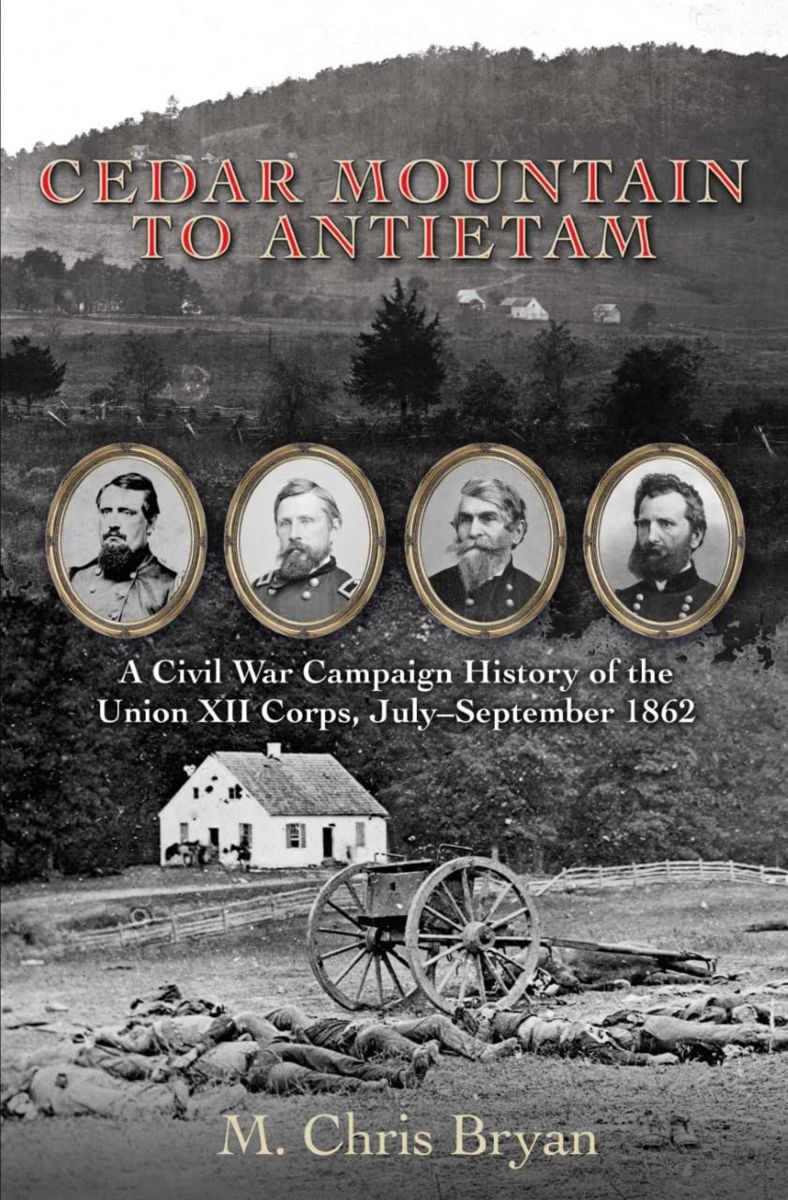
Commendable Contribution Cedar Mountain To Antietam: A Civil War Campaign History of the Union XII Corps, JulySeptember, 1862. By M. Chris Bryan. Illustrations, maps, notes, appendices, bibliography, index, 393 pp., Savas Beatie, savasbeatie.com, 2022, $34.95. Reviewed by Jeffry D. Wert
It seems as if the flow of new books on Civil War battles and campaigns is ceaseless. An emerging generation of historians and serious students of the conflict has offered new interpretations or provided richer details on the engagements and operations. In most cases, these studies are most welcome. M. Chris Bryan has written one such work, a worthy addition to the field of Civil War military history. As the subtitle indicates, the author examined the role of an often-overlooked command during the summer of 1862. Organized as the II Corps, Army of Virginia, the unit fought under Nathaniel Banks at Cedar Mountain on August 9. The corps was engaged in actions during the early stages of the Second Manassas Campaign but was not on the battlefield when the Army of Virginia suffered defeat on August 29-30. In the battle’s aftermath, John Pope was relieved of command, and units of his army were integrated into the reorganized Army of the Potomac under George B. McClellan. The II Corps of the Army of Virginia was designated the XII Corps, Army of the Potomac, commanded by Joseph K. F. Mansfield. On September 17, at Antietam, the XII Corps entered the action in support of an assault by the Union I Corps. Mansfield fell mortally wounded early in the fighting, but his officers and men fought valiantly in the Cornfield, East and West Woods, and the Dunker Church plateau. Casualties in some XII Corps regiments exceeded fifty per cent. The author’s accounts of the corps’s roles in the fighting at Cedar Mountain and Antietam are very detailed. In places, the descriptions are at company levels. At times, the Cedar Mountain narrative gets bogged down and confusing, while the equally detailed Antietam chapters are less confusing. To be sure, describing Civil War combat accurately and with clarity is challenging. The narrative seems overwrought in places, replete with adverbs and adjectives. The difficulty with overusing the former is whether they accurately convey the situation. Nevertheless, the book is based on solid research in manuscripts, newspapers, and published works. The author has made a commendable contribution to the field. Jeffry D. Wert, of Centre Hall, Pa., a longtime book reviewer for Civil War News, is the author of numerous books on the Civil War, including Gettysburg-Day Three and Cavalryman of the Lost Cause: A Biography of J. E. B. Stuart, and The Heart of Hell: The Soldier’s Struggle for Spotsylvania’s Bloody Angle.
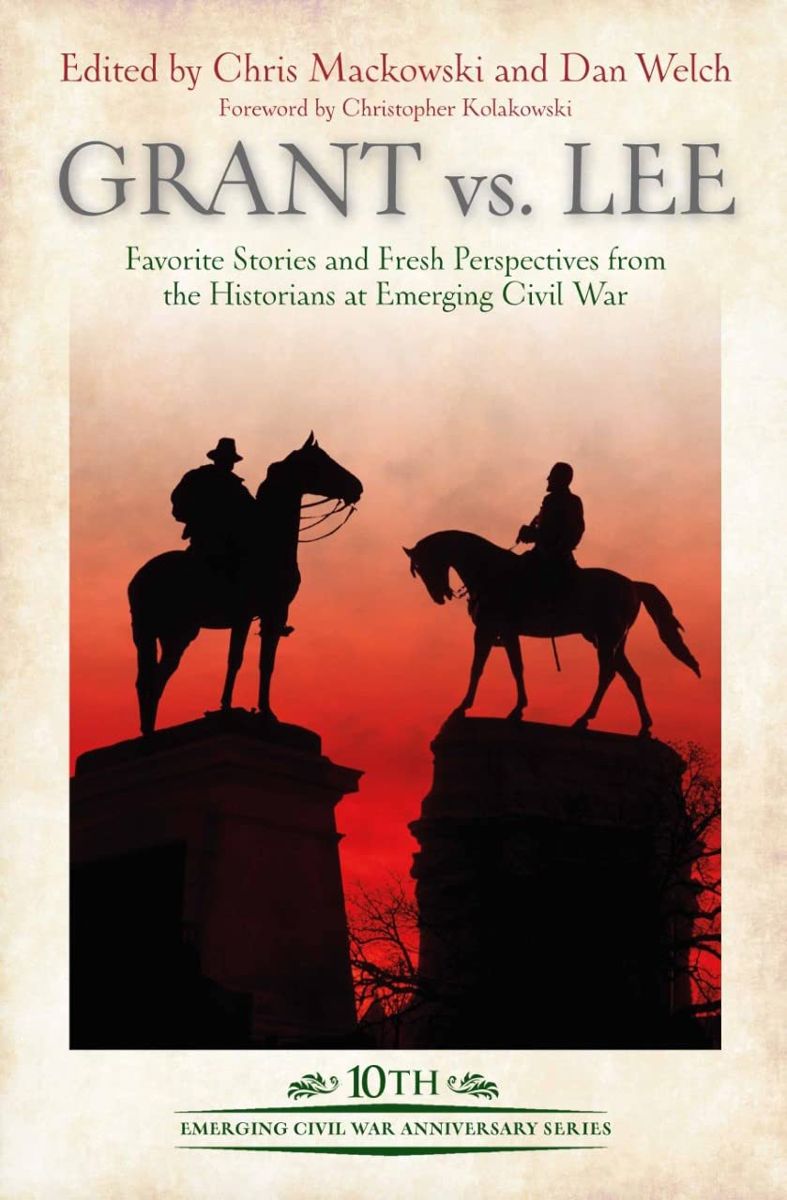
Engaging Read: Grant vs. Lee Opposition Politics Grant vs. Lee: Favorite Stories and Fresh Perspectives from the Historians at Emerging Civil War. Edited by Chris Mackowski and Dan Welch. Images, maps, 312 pp., 2022. El Dorado Hills, CA.: Savas Beatie. www.savasbeatie.com ISBN 978-1-61121-595-3. $29.95. Reviewed by John D. Fowler
In 1864, Union General Ulysses S. Grant became General-inChief of U.S. armies and sought to bring the American Civil War to an end. While Grant had strategic control over armies in all theaters, he traveled with General George G. Meade and the Army of the Potomac as it launched its spring offensive against the Confederacy’s most successful and thus most dangerous force, the Army of Northern Virginia under General Robert E. Lee. Scores of books and articles have been written about the ensuing contest between these two men as the fate of two nations hung in the balance. Grant vs. Lee is an engaging read. It is part of the Emerging Civil War 10th Anniversary Series, that includes elements from the blog, podcast transcripts, the Emerging Civil War series, the annual Civil War symposium, and other original material. For those who are unaware, “Emerging Civil War serves as a public-history-oriented platform for sharing original scholarship related to the American Civil War.” (xvi). Over the decade, the organization has become an important link between historical scholarship and public history. It serves a key role in making history appear interesting, fun, and, most importantly, relevant to a generation that had largely been abandoned by academic historians who chose to focus more on esoteric issues and/or write for themselves and not the general audience. The volume is essentially set up in the format of a guidebook that covers the struggle between Lee and Grant through the Overland Campaign, the siege of Petersburg, the fall of Petersburg and Richmond, and the final Appomattox Campaign. The first few pages of the book contain maps with points of interest marked. The reader is then invited to explore 45 short essays, each linked to the map as a “point of interest.” Most essays are based on blog posts and are arranged chronologically. In addition to the useful maps, the book also includes period photographs, plus crisp black and white shots by Chris Heisey. Indeed, Heisey contributed to a chapter entitled “Photographing Grant vs. Lee” that showcases some outstanding artistic photographs. The volume is also footnoted where appropriate and ends with a useful index. Since many essays involve small incidents and particular people, this frames the work as a micro examination of the struggle between Lee and Grant rather than as an overarching macro view of the campaign. While this is not a serious criticism, it is a weakness. The inclusion of even a small overview of the major events would have allowed a reader unfamiliar with these broader events to place the various articles into proper perspective and thus enhance both understanding and appreciation for the essays included. Since the Emerging Civil War has established itself as an excellent resource for those just beginning to explore the Civil War, an overview chapter seems a must. It would have also increased the book’s value as a guide of sorts for the battlefields of the Virginia campaign of 1864-65. Still, for someone familiar with the larger story, the incidents and personalities covered offer interesting anecdotes. Starting with the beginning of the Overland Campaign in May 1864, the essays explore the savage nature of the nearly continuous contact between both armies as Grant searched for a way to outmaneuver Lee. Small stories relate to other major events such as the Petersburg Campaign, the Crater, the attack of Fort Stedman, the fall of Richmond and Petersburg, and Lee’s ultimate surrender at Appomattox are well covered. Overall, the volume does not break new ground, nor does it contain the overview that would have made it a stronger guidebook and introductory survey of the events covered. However, the collection is engaging, and will no doubt be useful to readers who have a general knowledge of the struggle between two iconic generals of the Civil War. John D. Fowler, Ph.D., is the author of several books and articles on the Civil War Era. He is the author of Breaking the Heartland: The Civil War in Georgia. He is currently a Professor of History at Dalton State College.
During the Civil War The Cacophony of Politics: Northern Democrats and the American Civil War. By J. Matthew Gallman. Notes, bibliography, index, University of Virginia Press, www.upress.virginia.edu. 399 pp., 2021, hardcover. $35. Reviewed by Wayne L. Wolf
This book encompasses the views and attendant dilemmas of politicians and ordinary citizens as they try to define their position on the Lincoln Administration, the war, constitutional issues, and emancipation. Northern Democrats were the loyal opposition to what they conceived as a radical Republican usurpation of the Constitution as it was designed. The Democratic response was anything but unanimous. Rather, Democratic views existed along a broad spectrum from supporting the war to preserve the Union (War Democrats) to total opposition to Mr. Lincoln’s war and the trampling of individual liberties (Copperheads). Between these polar opposites were found politicians and citizens whose views were in flux, changing their place on the spectrum as casualties mounted, when Emancipation became a war goal, and when, geographically, they represented a constituency who either supported the war or opposed it. Democrats generally did not believe the war and emancipation should be won at the point of a bayonet but differences settled through compromise and constitutional changes. The Democratic Party had been formed as a people’s protest against the concentration of power in the federal government. Thus, it is not surprising that in speeches, newspapers, and pamphlets Democrats cast themselves as defenders of the Constitution in the face of a radical Republican agenda. Individual Democratic leaders, e.g. Fernando Wood, Clement Vallandigham, George McClellan, George Woodward, etc., occupied different spots on the continuum of views on the war but each realized that politics were essentially local, familial, geographic, and ethnic. Each of these groups needed to be listened to if success at the polls was to be the eventual outcome. J. Matthew Gallman deserves kudos for using a wide variety of personal narratives, e.g. Johnathan Hale, Willie Waller, Francis Sherman, Manton Marble, etc., newspaper articles, private communications, and diaries (including many from women on the home front) to illustrate the vast range of views held by people belonging to the Democratic Party. The vast majority of these individuals, and Democrats in general, were conservative, patriotic, and merely opposing administration policies they believed ran amok from Constitutional restraints. They felt the Lincoln administration ran over civil liberties by suspending the writ of habeas corpus, closing down newspapers, and jailing dissidents, even incarcerating a United States senator and congressman. This book is filled with primary source material that allows a reader to hear the actual words of the minority party. This is a positive for the reader who wishes to form his own opinion on the validity of each Democrat’s position, but this strength is mildly subverted in the concluding chapter when the author applies 20th Century moral assessments and evokes moral outrage on 19th Century actors. It is difficult for an author to avoid this common tendency to judge politics by contemporary standards but essential for an honest attempt to discern motivations behind political positions 150 years ago. One historical error is noted. The lyrics to “A New Yankee Doodle” did not glorify the military exploits of Jubal Early. Aside from this minor point, the book is eminently readable, instructive, thoroughly researched, and a welcome addition to understanding the actions of the loyal opposition during America’s most trying fratricidal war. Wayne L. Wolf is Professor Emeritus at South Suburban College and the author of numerous books, articles and columns regarding Civil War history. He is the past president of the Lincoln-Davis Civil War Roundtable and a frequent speaker on the Civil War circuit.
Forgotten Soldiers Animal Histories of the Civil War Era. Edited by Earl J. Hess. Photos, notes, index. 270 pp. Louisiana State University Press, 2022. www.lsupress.org. $45. Reviewed by Jonathan White
As a high school reenactor with the 28th Pennsylvania Volunteers in the 1990s, I always looked forward to our monthly meetings at the G.A.R. Museum in Philadelphia, an incredible 1790s house full of flags, muskets, buttons, paintings, and other artifacts from the Civil War. Hanging on one wall was the taxidermied bust of an army mule. Beneath it was a framed poem which began, “Behold a Hero…” A few steps away was a room dedicated to Maj. Gen. George Gordon Meade, the highlight of which was a large glass case that contained the head of Meade’s war horse, Old Baldy. Clearly the veterans who put together the G.A.R. Museum’s collections understood the importance of animals to their late war effort. Now, many years later, scholars are beginning to appreciate and study the importance of animals in history. This fascinating collection of essays, edited by eminent military historian Earl J. Hess, offers perceptive analyses of the many roles that animals played in the Civil War Era. Some stories will be familiar, such as Jefferson Davis’s effort to introduce camels to the U.S. Army in the 1850s. Others are less well known, such as how sectionalism influenced the debate behind the creation of the National Zoo in the late nineteenth century. Three essays focus on horses. David J. Gerleman explains how the armies obtained, shipped, and
CivilWarNews.com CivilWarNews.com treated horses. Through military service and shared suffering, horses and men “created comradery.” Hess explores the “indispensable” role that artillery horses had in the war, including the times they “lost their nerve and ran in panic,” their bravery as “warriors,” and the cleanup when these “biggest living objects on Civil War battlefields … became casualties.” Abraham Gibson argues that the study of animals serves as “both a lens and a mirror” to help us better understand warfare. For instance, he shows how the “dwindling number of horses necessarily shaped Confederate strategy.” Other essays explore the interactions of humans with wildlife, animals as food, dogs in the Civil War Era, and animals after the war. Hess, who contributed three essays plus the introduction, argues that the Civil War “lessened the divide between men and wildlife by placing millions of soldiers in the countryside, where they lived and fought in closer touch with the environment than was normal.” Birds, insects, reptiles, and other critters were in constant contact with soldiers, often as “pests,” but sometimes as sources of food, through hunting, and other times simply as fascinating “creatures” that soldiers would examine and collect as “unusual specimens.” Sensory historian Mark Smith analyzes the importance of bees at the time, not only for their natural functions or the dangers they posed but for their influence on culture. For instance, many soldiers wrote of the “buzz” of cannonballs and bullets. Jason Phillips explores the place of hogs in Southern society. One of his many fascinating insights is that African Americans in the Confederacy “asserted freedom by killing southern hogs.” Another essay by Hess explores vegetarianism in the era; the Vegetarian Society of America was founded in Philadelphia in 1866). Joan Cashin reveals “canine exploitation” during the war as many people had a “cold indifference toward canines” and “some people took a ruthless view of them.” Dogs were “expendable,” they were whipped, killed, eaten, and sent into combat. Writes Cashin, “The war devalued animal life, just as it devalued human life,” leading to “a swift increase in what we could call animal cruelty.” Lorien Foote uses South Carolina as a lens to explore the interactions between dogs and humans. Bloodhounds were a ubiquitous aspect of antebellum southern life, known to slaves as “the detective officers of Slavery’s police” and “a terror to the negro race.” Confederates continued to use dogs in similar ways during the war. One Indiana soldier wrote that dogs “were of more real service to the Confederacy … than many regiments of soldiers would have been.” Black resistance against slavery therefore sometimes involved killing the dogs that could be used to hunt fugitives or to enforce labor on plantations. Brian Matthew Jordan considers the place of regimental pets and mascots during and after the war. Jordan shows how Union soldiers developed “meaningful and affective ties with animals,” and how pets helped comfort soldiers or keep them from being bored in camp. Mascots became “powerful emblems” that symbolized the Union’s cause. The 8th Wisconsin’s eagle, Old Abe, for example, embodied “courage, loyalty, and ideological conviction,” and during Reconstruction, veterans of the Eighth “deployed the eagle as a ‘living rebuke to ingratitude and treason.’” Animals were everywhere during the Civil War, and they still can be found in the records and at historic sites. Last year my family visited the monument of the 11th Pennsylvania Infantry at Gettysburg. As my daughters posed next to Sallie, the regimental terrier at the base of the monument, I told them about our ancestor, Private William S. Allen, who had fought with the Eleventh. My girls loved petting Sallie’s head, just as the soldiers of the Eleventh did in 1863. They got teary-eyed when I told them about how Sallie died on a Virginia battlefield. All students of the Civil War intuitively know that animals were central to the conflict, but little sustained analysis has been given to them as a subject. The essays in this volume will help us better understand and appreciate the sacrifices made by our furry friends, and will hopefully spur further inquiry into the subject. Jonathan W. White is professor of American Studies at Christopher Newport University, vice chair of The Lincoln Forum, and the author or editor of 13 books, including A House Built By Slaves: African American Visitors to the Lincoln White House (2022).