
Through The Lens
Through the Lens — November 2022
By Stephanie Hagiwara · Originally published November 2022 · pp. 22–23
Expedition Hurricane Battle of Port Royal Sound – Part I “If this great leviathan [USS Wabash] could be made to twist and roll, and writhe as she did, what must those tiny vessels in comparison be doing?” – USN Flag officer Samuel Du Pont On April 19, 1861, President Abraham Lincoln issued a proclamation to blockade Southern ports. To implement the blockade, it was decided that blockading vessels needed to be steam powered creating supply chain issues. The average ship burned one ton of coal to fuel five to seven miles of travel and needed to keep steam up so as to chase a blockade runner at a moment’s notice. To supply the steamers, the U.S. Navy required coaling stations on the Southern coastline. To capture potential coaling stations, the navy needed gunboats. To acquire the gunboats, the navy needed to build or refit existing vessels. To acquire the quantity needed, peace time specifications had to be modified. Contracts were issued for 23 ships to be built within 90 days. Additionally, vessels “of every size … were purchased and fitted with batteries, shell-rooms, warned, that due to weather, the expedition needed to depart soon, “for in September,” he wrote, “the West Indian hurricanes may come and make it a second [Spanish] Armada [of 1588].” On the evening of October 1, Du Pont accompanied Asst. Sec. of the Navy Gustavus Fox to the home of Sec. of State William Seward. Lincoln wanted “to have a final discussion on the expedition.” Seward, Du Pont recounted, “pokes a cigar at Fox who, sitting on the same sofa with Lincoln, puffs smoke into the president’s eyes. Meantime there is a desperate hunt going on all over town” for [Sec. of War Simeon] Cameron, [Gen. George] McClellan, and Sherman, while Seward intoned “There’s nobody nowhere tonight!” The meeting began after Cameron and Sherman arrived. It was discovered that the War Department had confused expeditions, resulting in regiments being sent to the wrong locations. At 11 p.m., when it was suggested that the focus of the meeting be returned to the expedition at hand, “McClellan walks in with a lighted cigar, bows respectfully, and takes a seat.” During the ensuing discussion, McClellan reminded all that he had only 114,000 men to defend Washington. Still, he agreed to commit 14,000 men in exchange
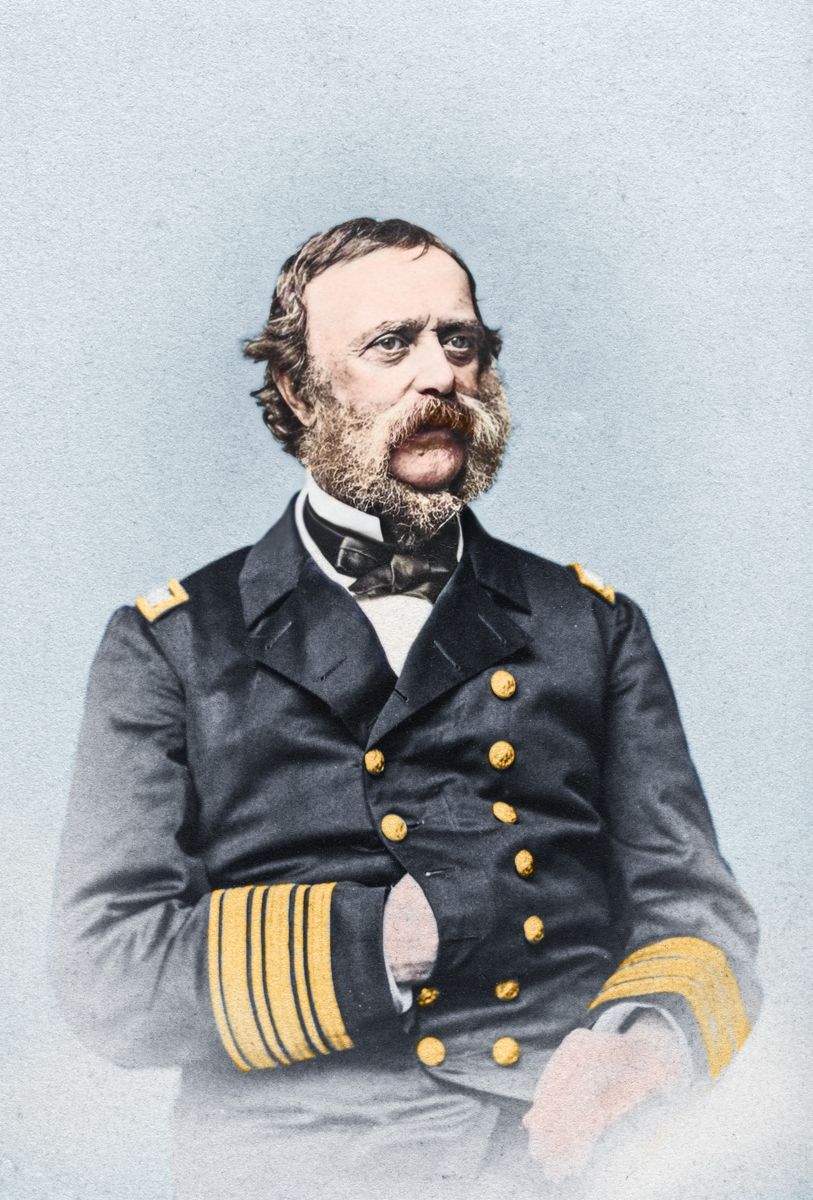
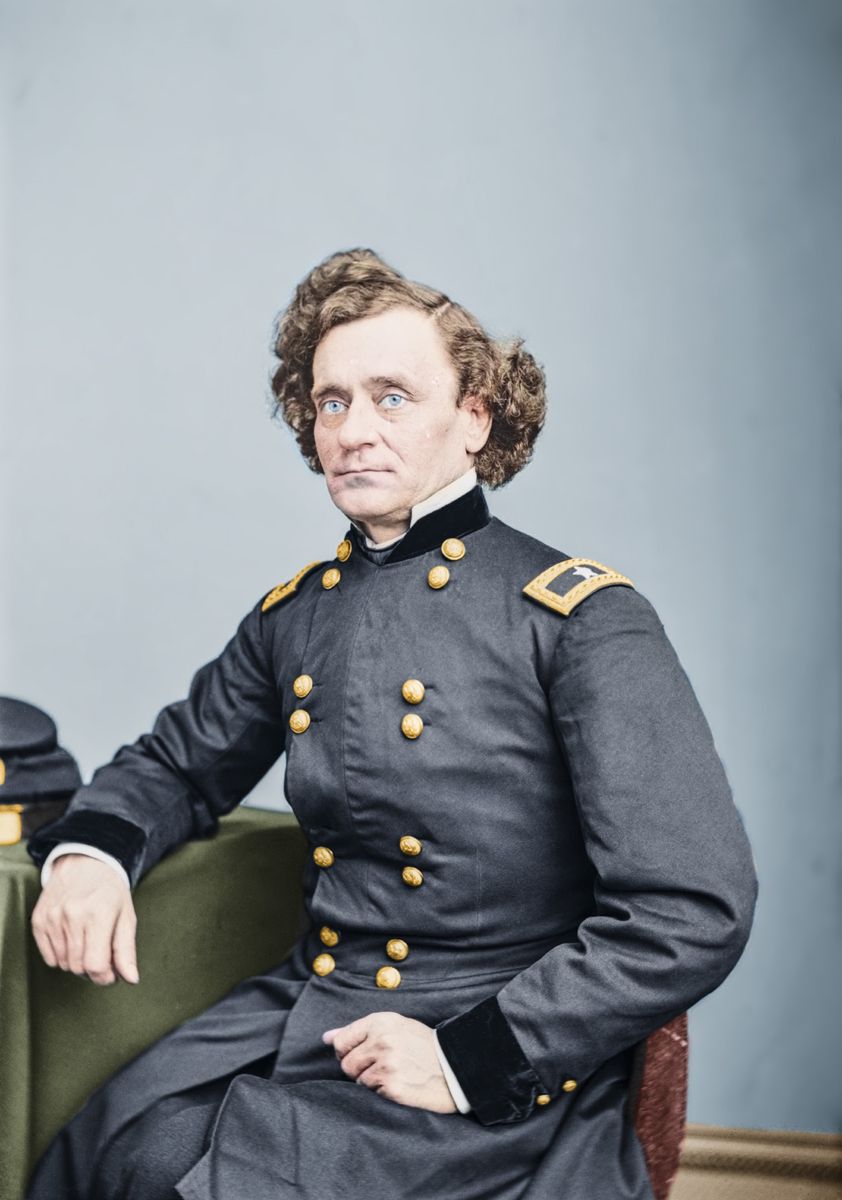
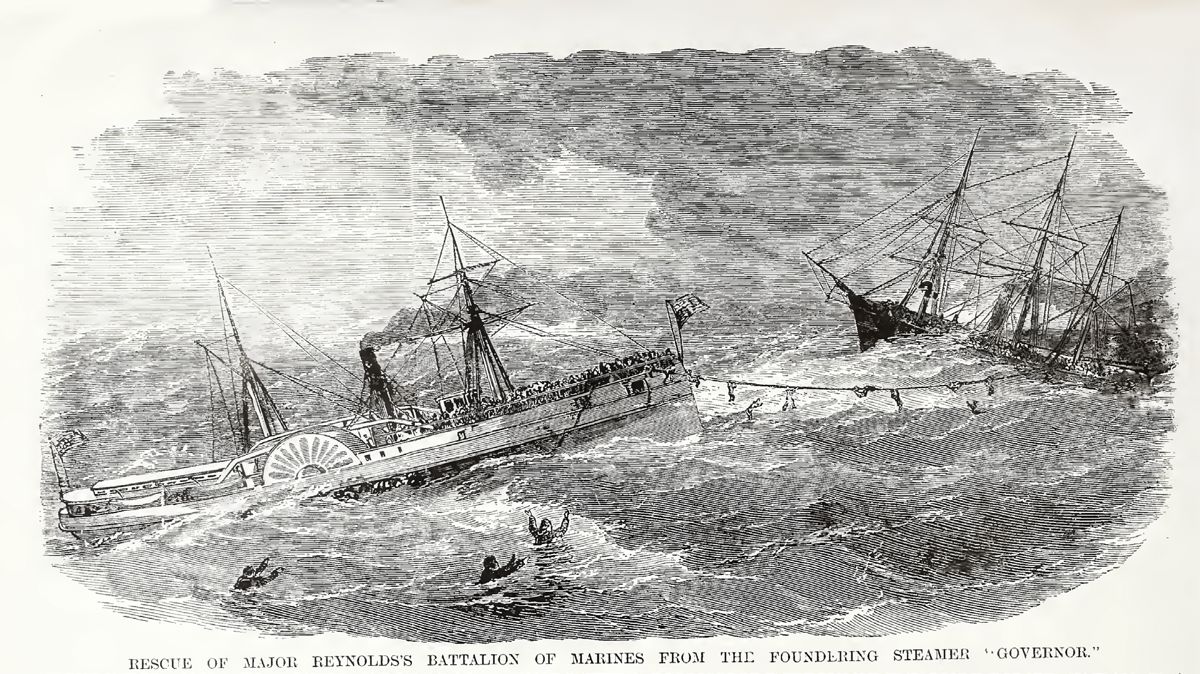
Admiral Samuel Dupont. Colorization © 2022 and magazines, both for this expedition and to supply the general wants of the service.” The expedition grew into the largest Federal amphibious operation since the Mexican– American War. Flag officer Samuel Du Pont would command the Naval forces. Du Pont, son of a wealthy mill owner and nephew of the founder of the Du Pont chemical company, had joined the Navy when he was eleven years old as a midshipman. In 1855, he had been part of a failed efficiency effort to replace seniority-based promotions with a merit system. After 46 years in the Navy, Du Pont, due to “a curious and natural sequence of things … I find myself suddenly thrown up in connection with the most important armament ever made in this country.” Infantry would be needed to capture and hold any forts at the harbor. In August, Lincoln promoted career officer Thomas W. Sherman, a.k.a. “the Other Sherman,” to Brig. General and assigned him to the expedition. Thomas William, no relation to William Tecumseh, had graduated from West Point and served in the Mexican–American War. Both Du Pont and Sherman were frustrated because vessels and regiments earmarked for the expedition were being sent elsewhere. In July, Du Pont for new, untrained regiments. On October 29, after a weather delay, the expedition, 19 warships with 157 guns, 25 colliers and supply ships, 33 transports, 12,000 infantrymen, and 600 marines departed Hampton Roads, Va. The USS Wabash, Du Pont’s flag ship, led the fleet in an inverted “V” order. The vessels had to maintain formation as the destination was a secret to all, only revealed in a sealed envelope in each captain’s possession. The pace was slow, necessitated by the odd collection of ships, including two New York ferryboats. According to Du Pont, it resembled, “a city on the waters.” On November 1, when the fleet rounded Cape Hatteras, N.C., the wind rose, the seas grew heavy, and the sky darkened. About 2:30 p.m. the flag ship sent the signal to the vessel commanders “to disregard the order of sailing and take care of their individual commands.” After witnessing soldiers becoming seasick while living on the boats, awaiting departure, Du Pont concluded that, “soldiers and marines are the most helpless people I ever saw.” The action of the marines on the side wheel steamer Governor would dispute his assertion. The heaving seas broke both the port and starboard hogging trusses on the Governor. Soon the smokestack “went overboard” and the steam pipe burst. It became necessary to run the steam engine intermittently. The ship was taking in water. On board were Maj. John G. Reynolds, a 35-year marine veteran and 385 marines. Reynolds had commanded a battalion at the July 21, First Battle of Manassas, the Marines only major land battle. According to Reynolds, “It was only by the untiring exertions of our men that we were kept afloat. Nearly one hundred of them were kept constantly pumping and bailing, and the rest were holding fast the ropes which supported the hog braces.” In the morning distress signals from the Governor attracted the USS Isaac Smith, which had already jettisoned all her guns except for one 30-pdr. rifle. The Smith’s repeated attempts to attach a hawser, failed. The USS Young Rover approached to convey the news that a large frigate was approaching. The men gave a “heartfelt cheer” as the Rover vowed to “stand by til the last.” The USS Sabine, on a different mission, joined the rescue. She was able to pay out enough anchor chain to get close to the Governor, allowing about 40
CivilWarNews.com men to leap from one boat to the other until the plunging ships broke the chains. The Sabine’s starboard quarter “struck the port bow of the Governor and carried away about 20 feet of the hurricane deck from the stem to the wheelhouse.” The violence of the seas prohibited another attempt. To stay afloat, “All our provisions and other stores, indeed every movable article, were thrown overboard, and the water casks started to lighten the vessel. From half past 3 until daybreak the Governor floated in comparative safety, notwithstanding the water was rapidly gaining on her.” At daybreak, due to high seas, “the men were obliged to jump into the sea, and were then hauled into the boats.” With her passengers removed, it was possible to salvage nearly all the arms and 10,000 of the 19,000 cartridges. Seven men died by drowning or being crushed between the ships. Still, the marines survived to fight another day. Du Pont knew his fleet was not lost but dispersed. He wrote, “This morning the fleet was nowhere. ..The fine ordered fleet, the result of so much thought, labor, and expense, has been scattered by the winds of heaven.
Sources: Ammen, Daniel. “Du Pont and the Port Royal Expedition,” Battles and Leaders of the Civil War. Vol. 1: Century, 1887, pgs 673-676. • Hoogenboom, Ari. Gustavus Vasa Fox of the Union Navy: A Biography: John Hopkins University Press, 2008. • Symonds, Craig. Lincoln and His Admirals: Abraham Lincoln, the U.S. Navy, and the Civil War. Oxnard University Press, 2008. • Symonds, Craig. The Civil War At Sea. Oxnard University Press, 2012. • U.S. War Department, The War of the Rebellion: A Compilation of the Official Records of the Union and Confederate Armies, 128 vols. Washington: U.S. Government Printing Office, 1880–190, Series 1, Vol. 12 (1901), 233-238. •
Stephanie Hagiwara is the editor for Civil War in Color.com and Civil War in 3D.com. She also writes a column for History in Full Color.com that covers stories of photographs of historical interest from the 1850’s to the present. Her articles can be found on Facebook, Tumblr and Pinterest.