
Central Virginia Battlefield Trust
The Mine Run Campaign
By Terry Rensel · Originally published November 2022 · p. 36
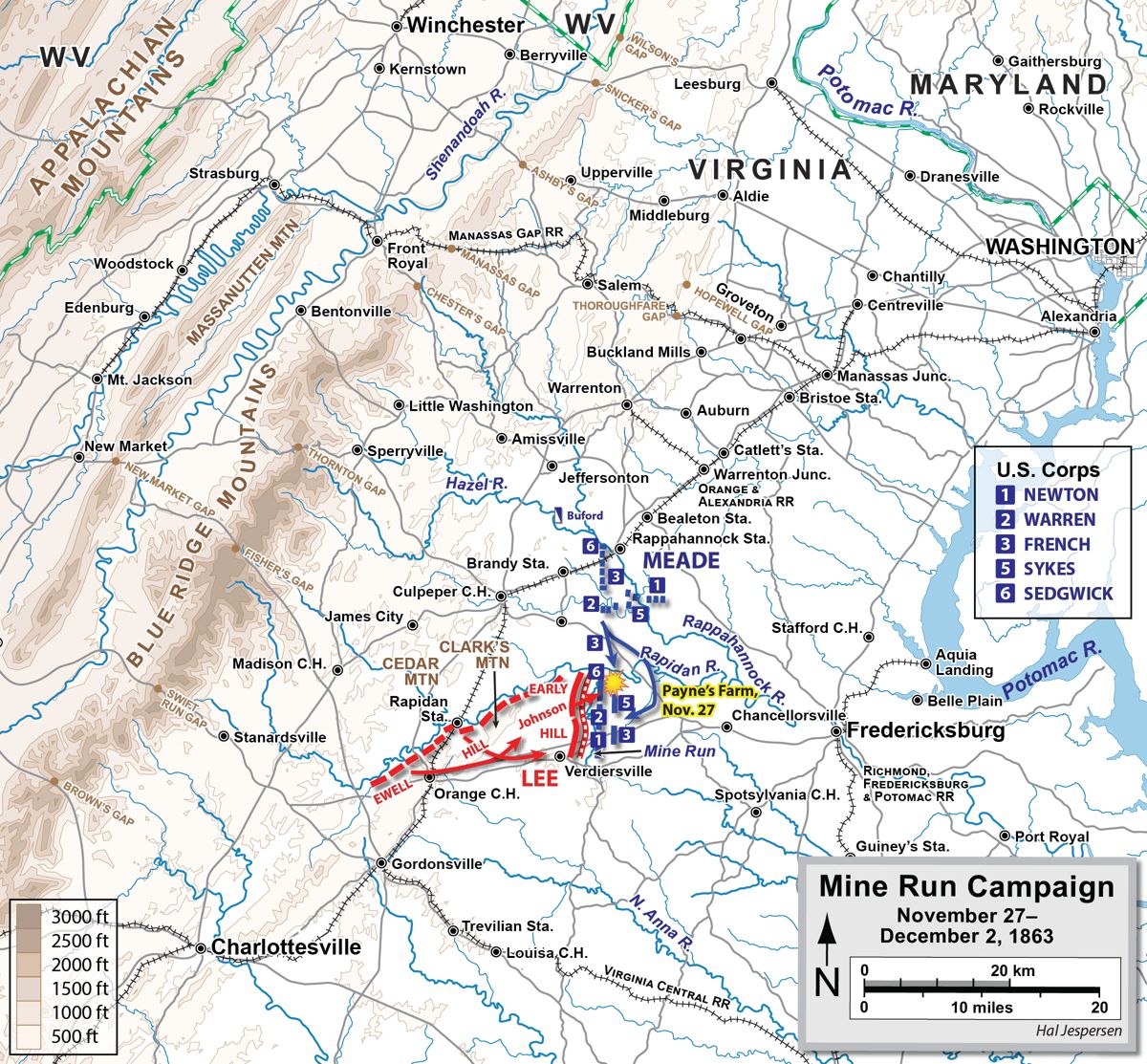
The Mine Run Campaign by Terry Rensel Confederate Gen. Robert E. Lee expected the Union Army to move along the axis of the Orange and Alexandria Railroad, as the armies had been doing all fall of 1863. He had the Army of Northern Virginia watching the Rapidan River from Liberty Mills, below Orange Court House, all the way down river to Raccoon and Mitchell’s Fords. Maj. Gen. George Gordon Meade had other plans in mind. He intended to cross the Rapidan down river, move on Orange Court House, get behind Lee, and attack on ground of his choosing. On November 26, 1863, the Army of the Potomac moved out from their camps around Rappahannock Station and crossed the Rapidan further down river. The I and V corps crossed at Culpepper Mine Ford, the II Corps at Germanna Ford, and the III and VI crossed over Jacob’s Fords. Meade’s plan was to have the II Corps move down the Orange Turnpike to Robinson’s Tavern, the III and VI corps deploy on the right flank of the II Corps, the V Corps move down the Orange Plank Road to New Hope Church, while the I Corps filled in the gap between the II and V corps. Due to poor roads, a river swollen by recent rains, and the III Corps getting lost, instead of being near Robinson’s Tavern by dark, the Army of the Potomac was barely across the Rapidan. The delay gave Robert E. Lee and the Army of Northern Virginia a chance to intercept the Union Army. By the morning of Nov. 27, Lee had his army in motion. Maj. Gen Jubal Early, commanding the Second Corps of the Army of Northern Virginia had his division, then under Brig. Gen. Harry T. Hayes, marching toward: the Orange Turnpike, towards Robertson’s Tavern. When his skirmishers encountered the Union II Corps advanced men just west of the Tavern, both armies decided to wait for reinforcements before bringing on a more general engagement. Early’s other Division, under
Maj. Gen. Edward Johnson’s Division was also making its way towards Robinson’s Tavern, along the Raccoon Ford Road (today’s Zoar Road). Near the intersection with Jacob’s Ford Road (modern Indiantown Road) Brig. Gen. George H. Steuart’s Brigade came under attack from the Union III Corps near William Harrison Payne’s farm. As Johnson consolidated his division to fend off the attack, Maj. Gen. William H. French brought up more of the III Corps Late in the afternoon, before French could decide what he was going to do, Johnson attacked across the entire front. As daylight was quickly fading, the fighting went back and forth, both sides taking heavy casualties. Nightfall ended the fighting, with the Confederates withdrawing to Raccoon Ford Road, and the Federals falling back into the wood line. Johnson took about 550 casualties while French lost nearly 950 men. On the Orange Plank Road, Maj. Gen. J.E.B. Stuart’s Confederate cavalry and Brig. Gen. David Gregg’s Union cavalry encountered one another near New Hope Church, late in the morning. By mid-afternoon, Lt. Gen. A.P. Hill’s Third Corps, had relieved Stuart while Gregg’s men held out until the Union V Corps, under Maj. Gen. George Sykes arrived. Other than some preliminary skirmishing, both armies moved their men into position and waited to see how things would develop. On the 28th, George Meade ordered the army to advance down the Orange Turnpike only to find the positions held by Lee’s army the day before were deserted. As they came over the last rise approaching Mine Run, they could see the Army of Northern Virginia entrenched on the high ground just beyond the river. As the day wore on heavy rains hampered Meade’s advance and the Confederates continued improving their position while their skirmishers and sharpshooters harassed the Union troops. That evening Maj. Gen. Gouverneur K. Warren, commanding the II Corps, proposed a movement around Lee’s right flank. The next morning Warren led his corps, and a division of the VI Corps around Meade’s left and down the Plank Road. As he crossed Mine Run, he deployed his men in a line of attack. At the same time Stuart was conducting reconnaissance beyond the Union left flank and trying to figure out what Meade was up to. He attacked Union cavalry near Parker’s Store, in Warren’s rear. Stuart drove the enemy from the field, taking nearly 100 prisoners, and learning about Warren’s plans. He quicky returned to Confederate lines and informed Lee. Warren, concerned that Lee was attempting to flank him, delayed his assault. Before Warren could resume his advance, daylight ran out on his efforts. Warren spent much of the night planning an assault for the next morning. During the night A. P. Hill, realizing the weakness of his line, strengthened and extended it below the Plank Road. As morning dawned, and the time of the attack drew near, Warren discovered how busy the Confederates had been during the night. The position now seemed so formidable that Warren called off his attack. Shortly before 9 a.m. Meade learned what Warren had done. He quickly issued orders cancelling a planned assault on the Union right. That evening he held a council of war where it was decided that they had lost the element of surprise and the initiative. An attack would not be made. On the morning of December 2, Hill’s men advanced only to find that the Army of the Potomac was gone. They had slipped out of their lines during the night and retreated, marking the end of the Mine Run Campaign.