The Unfinished Fight
The Federal Eagle on U.S. Lock Plates
By Craig L. Barry · Originally published November 2022 · pp. 16–17
![Providence Tool Company distinct U. [eagle] S.](/article-images/cwn-2022-november/cwn-2022-november-the-federal-eagle-on-u-s-lock-plates-01.jpg)
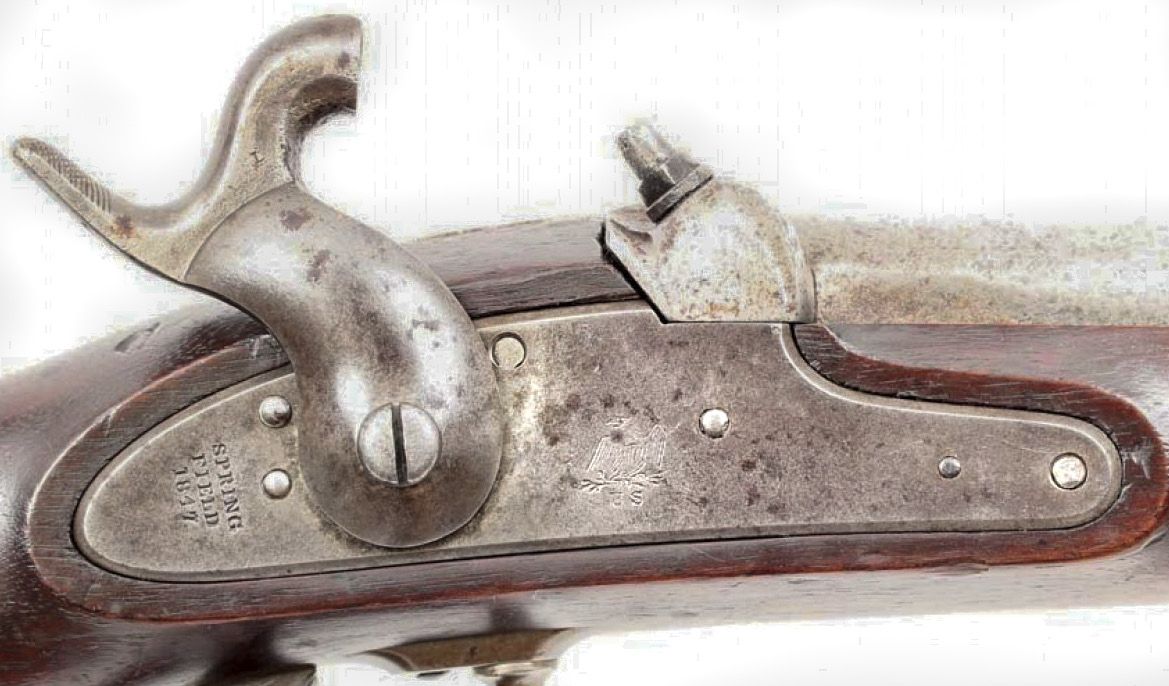
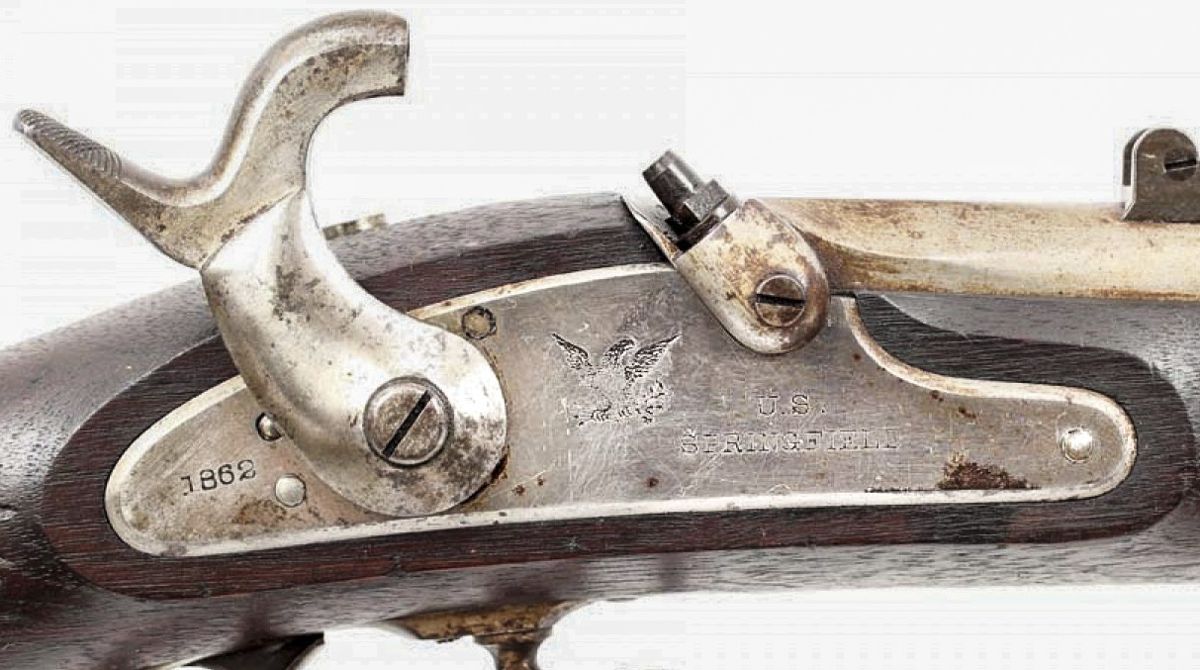
The Federal Eagle on U.S. Lock Plates A question that is sometimes asked about the Civil War rifles and muskets made at the National Armories is why the Federal Eagles on the lock plates of some models look different and face different directions than others. Is that intentional and what did it mean? The one feature found on many U.S.-made infantry arms of the Civil War era is the ubiquitous Federal “spread eagle.” It is the common distinguishing mark found on U.S. armory-produced military arms beginning in 1795; it continued to be stamped on arms produced for the following almost 100 years. However, there are differences. After you inspect a representative number of such lock plates it becomes apparent that the eagle markings are not all identical and some distinctive patterns begin to emerge. One key difference about the Federal Eagle, in particular, is noteworthy.
When the Founding Fathers were looking for a symbol of our new national heritage in 1782, they selected the bald eagle. It is ironic that after renouncing the British monarchy with its long history of heraldry, the first symbol selected to represent the new American republic would be the eagle, one of the most common symbols of European heraldry. In heraldic terms, the Federal eagle is displayed with its wings outstretched or spread, as seen in Pimbley’s Dictionary of Heraldry (1908). While widely used, the eagle was still less common than lion-based heraldic symbols, especially in Great Britain. It is safe to say the eagle is by far the most frequently found ornithology-based heraldic symbol. Traditionally associated from the time of the Greeks and Romans as a messenger of the gods, the eagle represented courage, strength, and immortality. In contradiction to the rules of heraldry, the shield covering the Federal eagle’s breast has an odd number of vertical stripes, thirteen…an obvious reference to the 13 original states. In traditional Western heraldry a shield should not be vertically striped or show an uneven number of stripes. One original U.S. design featured chevrons in place of stripes for this reason. There is one key difference between the first American eagle designs on earlier U.S. muskets and those of the Civil War-era and later. The earlier spread eagles all hold an olive branch in one talon and arrows in the other. The design of the Great Seal shows the eagle facing “dexter,” the heraldic term meaning situated on the right, thus to the so-called honorable side, favoring the olive branch of peace. Ironically, the dexter side of the shield is that opposite the left hand of the spectator. The eagle is found facing this way on the lock plates of all U.S. Model muskets from 1795 to 1842. For some reason the eagle is reversed on the lock plate beginning with the U.S. M1855 rifle-musket; it features a very prominent reversed Federal eagle on the tape primer door. All U.S. military arms made thereafter with an exterior lock mechanism and a lock plate carry the “reversed” eagle. The reversed eagle faces “sinister,” or to the left, with the olive branch also on the left and the arrows now on the right. Hence, in heraldic terms this placement of the olive branch on the left with arrows on the right conveys the opposite meaning from the original design, with the arrows being a traditional symbol of military aggression. As if the message was not clear enough, the eagle is also sometimes depicted during the Civil War-era holding arrows alone in both talons. The reason for the reversal of the heraldic eagle is not documented to my knowledge, but the change in the original design continued for so many years that it is not likely to have passed accidentally without notice. The reversed eagle is not only found on riflemusket lock plates. Breast plates, hat ornaments and other military insignias carrying the Federal spread eagle are also sometimes found reversed. Therefore, it was no doubt an intentional change in design beginning around 1855, according to Robert S. Koppelman, writing in The American College of Heraldry’s October 2003 quarterly, The Armiger’s News. The Great Seal of the United States and other official eagle symbols, including branch of military service flags, have never changed from the original design. Lastly, while most Civil War-era U.S. M1861 riflemuskets have similar looking Federal spread eagle lock plate stamps, there are some minor differences. An obvious variation is the eagle stamp used by Alfred Jenks & Son. The Bridesburg Armory eagle was stamped on close to 100,000 U.S. M1861s produced by Jenks on several Federal contracts. It is noticeably thicker with a shorter neck and broader wingspan. This thicker Bridesburg eagle is the style duplicated by Miroku, a Japanese manufacturer of reproduction U.S. model rifle-muskets for Dixie Gun Works up until about twenty years ago. There are other subtle variations in size and placement among the various period commercial contractors. For example, the Providence Tool Company’s lock plate design placed a slightly larger eagle between the letters “U” and “S,” compared to the Norwich or Trenton lock plates that feature a noticeably smaller eagle with the “U” and “S” placed together elsewhere on the plate. The extra-large eagle in front of an unfurled American flag on the Whitneyville contract U.S. pattern rifle-muskets is so distinct as to constitute a completely different lock plate design from the others. Contributing to the design variations, the tools and dies used in the stamping process wore out and had to be periodically replaced. There is an element of artwork in cutting the dies for the replacement stamps, and some examples from the same maker show differences for no other reason than this. Craig L. Barry was born in Charlottesville, Va. He holds his BA and Masters degrees from UNC (Charlotte). Craig served The Watchdog Civil War Quarterly as Associate Editor and Editor from 2003–2017. The Watchdog published books and columns on 19th-century material and donated all funds from publications to battlefield preservation. He is the author of several books including
The Civil War Musket: A Handbook for Historical Accuracy (2006, 2011), The Unfinished Fight: Essays on Confederate Material Culture Vol. I and II (2012, 2013). He has also published four books in the Suppliers to the Confederacy series on English Arms & Accoutrements, Quartermaster stores and other European imports.