
How the Charleston Mercury Gave Stonewall His Nickname
By Stephen Davis · Originally published November 2022 · pp. 18–19
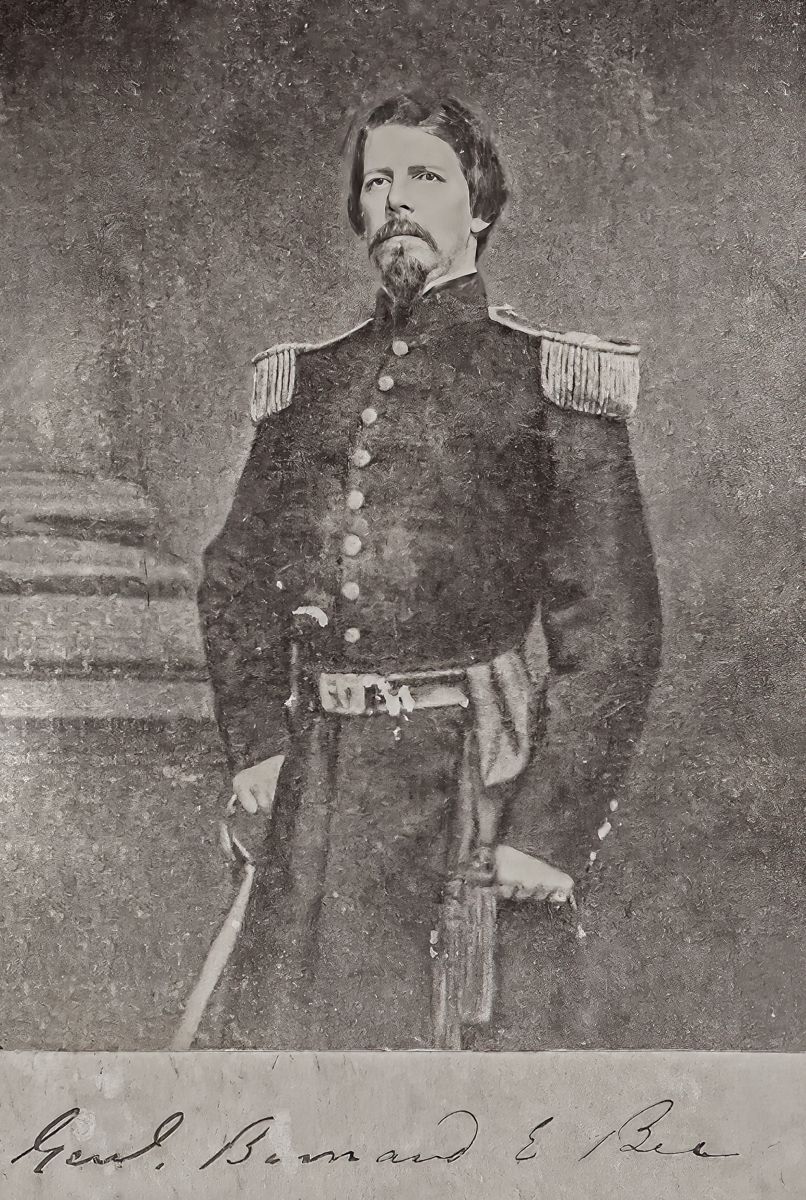
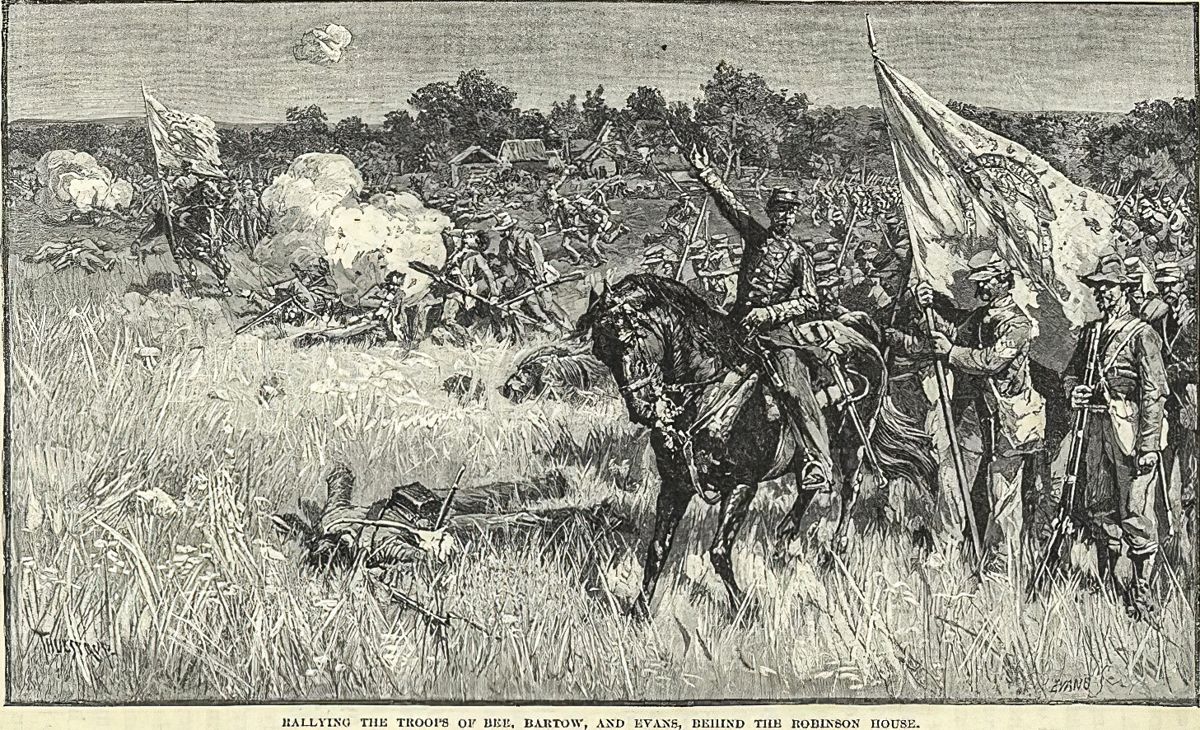
Newspapers, as the saying goes, write the first draft of history. Such was the case of the Charleston Mercury’s reporting on the battle of Manassas, and Leonidas W. Spratt’s article on “Stonewall” Jackson. Everyone knows the story, but there are variants in the literature. “The story was circulating three days after the battle,” writes Dr. Freeman.1 This explains how Mary Chesnut could write in her diary entry of July 24 that her husband James had told her that in the battle, Colonel Jackson’s regiment “stood so stock-still under fire they were called a stone wall.”2 It didn’t take long, however, before the yarn got a positive spin. “Look! there is Jackson standing like a stone wall! Let us determine to die here, and we will conquer!” Brig. Gen. Barnard Bee is said to have yelled in John Esten Cooke’s early biography (1863).3 But there are variants: “Yonder stands Jackson like a stone wall” (SHSP, 1891); “There he stands like a stone wall!” (Mary Anna Jackson, 1892); “Look there at Jackson standing like a stone wall” (Allen Tate, 1928); “Look, there stands Jackson like a stone wall” (Burke Davis, 1954); “There is Jackson standing like a stone wall” (Frank Vandiver, 1957; David Detzer, 2004); “Yonder stands Jackson like a stone wall” (Hennessy, 1989); “Come with me and go yonder where Jackson stands like a stone wall” (JoAnna McDonald, 1999).4 Given all this, it’s probably good to trace back to the story’s first appearance in print: the Charleston Mercury of July 25, 1861”: “There is JACKSON standing like a stone-wall. Let us determine to die here and we will conquer. Follow me!”5 The Mercury’s correspondent went unsigned, but we know it was Leonidas Spratt.6 Leonidas William Spratt was born near Fort Mill, S.C. on Aug. 3, 1818. He graduated from South Carolina College (now USC) in 1850, earned his law degree and began practicing in Charleston. There in 1853 he became copublisher and co-editor of the Charleston Southern Standard, in which he argued for reopening the slave trade. His book, The Foreign Slave Trade: the Source of Political power and of Material Progress, of Social Integrity, and Social Emancipation in the South, was published in 1858, the year after he sold his interest to Robert Barnwell Rhett, Sr., owner of the Charleston Mercury. An ardent secessionist, he was the only newspaperman to sign the South Carolina Ordinance of Secession.7 Shortly after the war started, he signed on as reporter for the Mercury, and headed for Virginia. Sensing a looming battle, he travelled to Manassas Junction in late June. There he watched the battle unfold on July 21, and reported it in bulletins sent to the Mercury, starting at 10 a.m.: “Generals BEAUREGARD, JOHNSTON and BONHAM, have just come to the hill where I have been standing”; “the firing now is at its height” (12:30). Afterward he interviewed an officer on General Bonham’s staff and in Richmond composed a long article on the battle, which he telegraphed to his paper. “Latest Particulars of the Great Battle” appeared on the Mercury’s front page July 25, including the famous paragraph: Gen BEE immediately rallied the remnant of his brigade, and his last words to them were: “There is JACKSON standing like a stone-wall. Let us determine to die here and we will conquer. Follow me!”8 “Preserving this story was Spratt’s major contribution to Civil War journalism,” writes Patricia G. McNeely in her article on Spratt that appears in Knights of the Quill: Confederate Correspondents and their Civil War Reporting (2010).9 Soon afterward Spratt quit the Mercury and joined the army as a private, but was soon promoted to major. He was assigned to General Longstreet’s staff, in which he served until the close of the war. Afterward Spratt practiced law in Charleston raised a family (he got married in June of ’62) and wrote three books of a rather philosophical nature, to judge from the title of the first one in 1894: Man in Continuation at
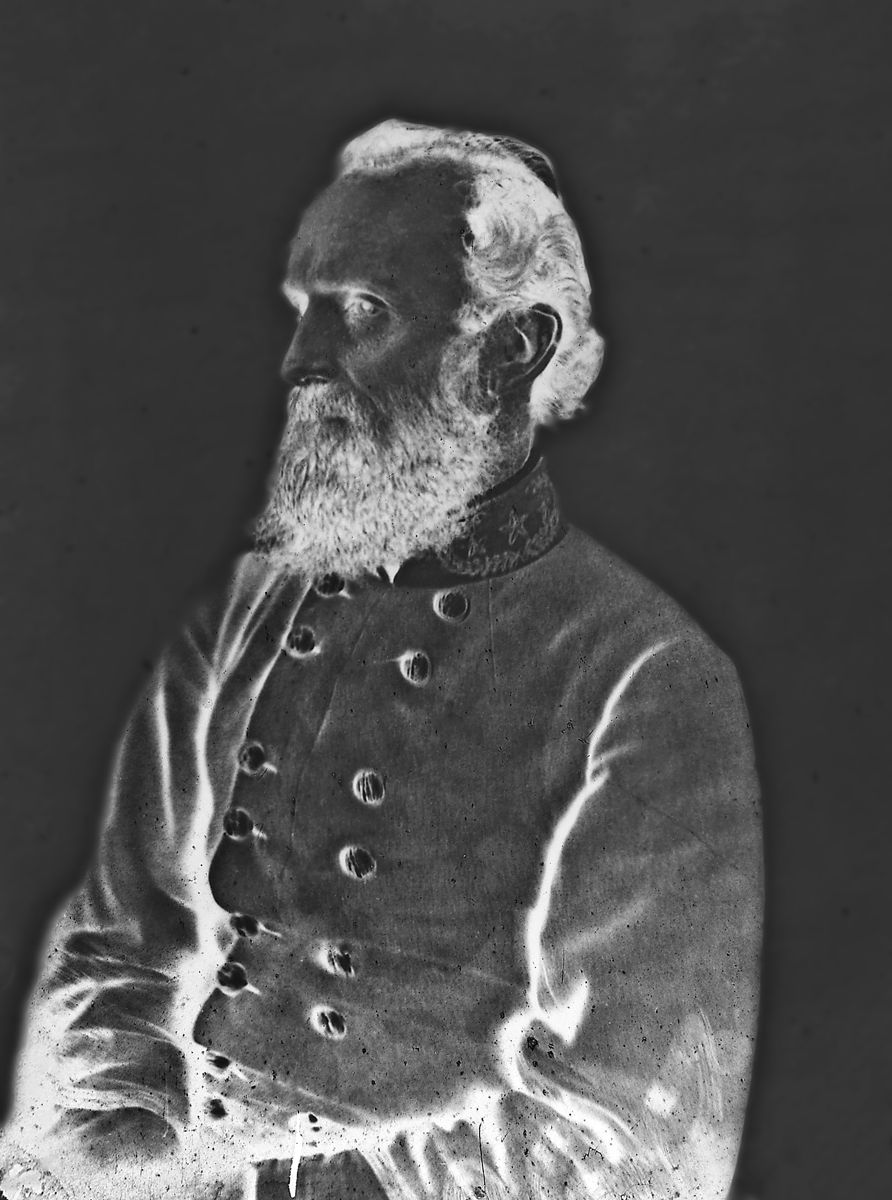
General Thomas “Stonewall” Jackson. (Library of Congress)
this Earth of a Nature of Reality Throughout the Universe by Tradition of that Reality from its original Universe in Force.10 Following his move to Jacksonville, Fla., he became a judge. He died there on Oct. 4, 1903 at the age of 85. His stone in Evergreen Cemetery simply reads,
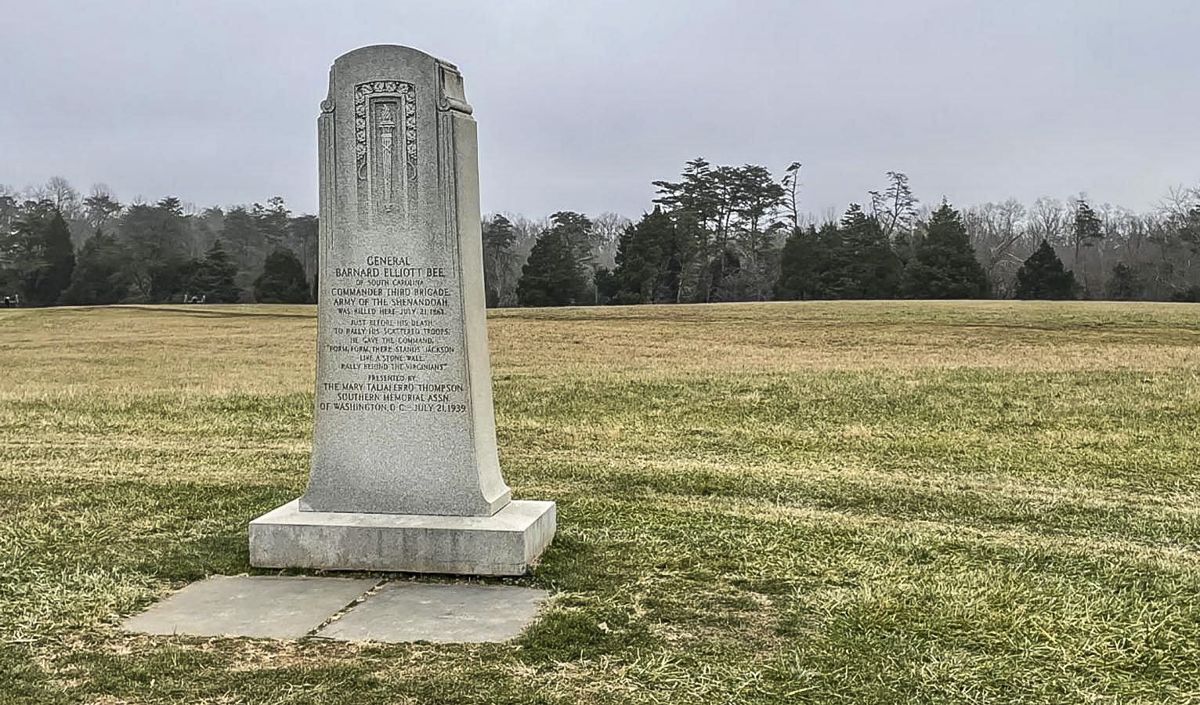
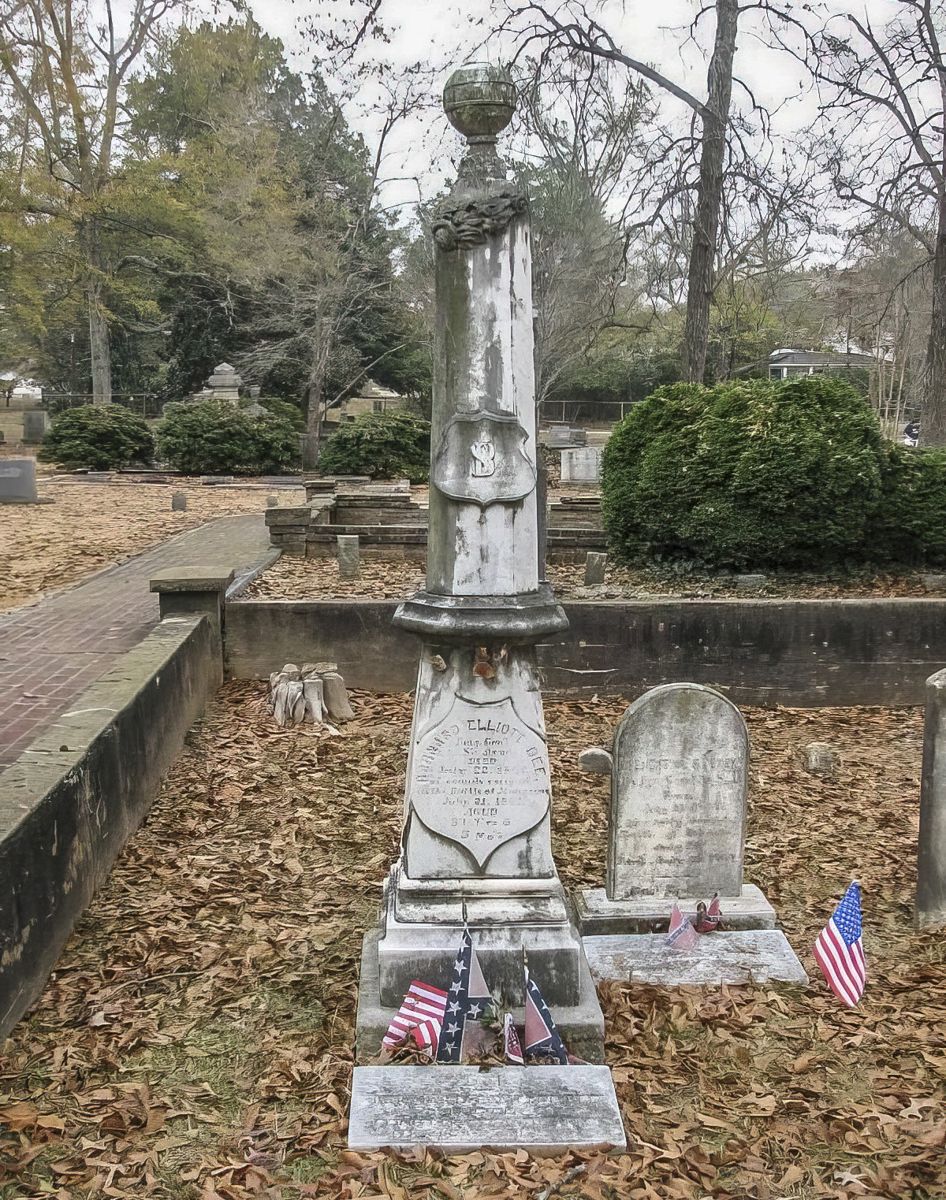
Inscription on Bee’s gravestone: Front: General Barnard Elliott Bee of South Carolina. Commander, Third Brigade, Army of the Shenandoah, was killed here July 21, 1861. Just before his death, to rally his scattered troops, he gave the command “Form, form, there stands Jackson like a stone wall, rally behind the Virginians!” Presented by the Mary Taliaferro Thompson Southern Memorial Association of Washington, D.C. July 21, 1939. Rear: Lucy Steele Clay, Chairman. Alice Boswell Morrison. Julia Neason Streater. Maude Bird Phares. Norma Hardy Britton.
LEONIDAS W. SPRATT AUG. 4, 1818. OCT. 4, 1902. Someone got the dates wrong—an irony bestowed upon a Southern correspondent who captured one of the war’s great stories, and lent it into the literature.
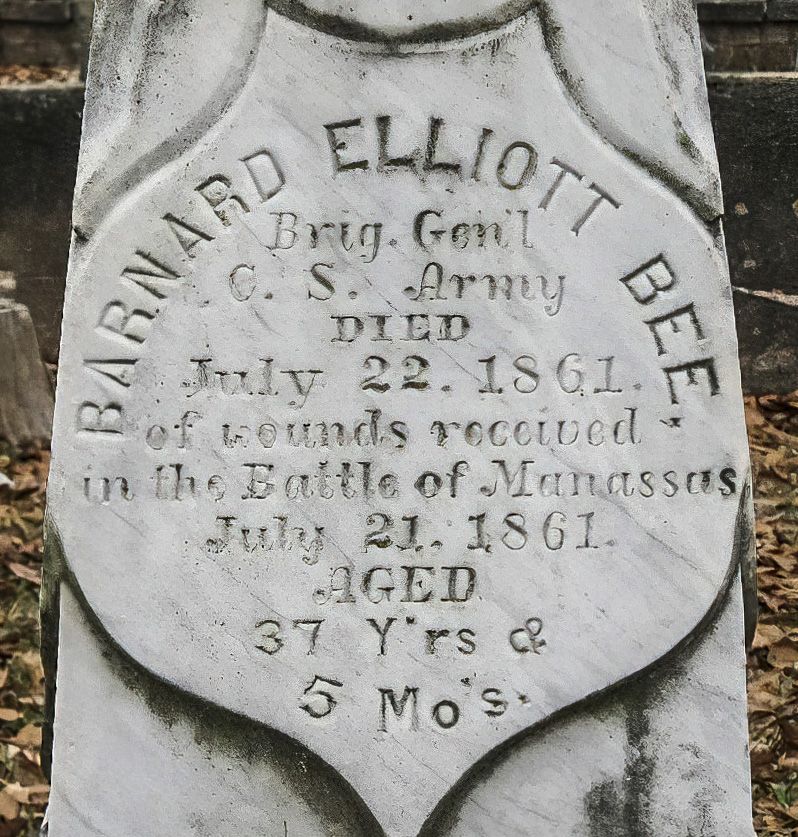
A tall shaft of white marble marks the spot where General Barnard E. Bee fell mortally wounded at the Battle of First Manassas (Bull Run) on July 21,1861. While attempting to rally his broken troops on Henry Hill, Bee pointed to General Thomas J. Jackson and his Virginians and declared, “There stands Jackson like a stonewall!”, thus christening both Jackson and his brigade with their famous sobriquet. Bee died of his wounds the following day and was the highest-ranking officer to die at First Manassas. The monument was erected by the Mary Taliferro Thompson Southern Memorial Association of Washington, D.C., on July 21, 1939.
Notes 1. Douglas Southall Freeman, Lee’s Lieutenants: A Study in Command, 3 vols. (New York: Charles Scribner’s Sons, 1942-44) vol. 1, 733. 2. C. Vann Woodward, ed., Mary Chesnut’s Civil War (New Haven CT: Yale University Press, 1981), 108. 3. John Esten Cooke, Stonewall Jackson (New York: G. W. Dillingham, 1894 [1863]), 68-69. 4. William M. Robins, “The Soubriquet ‘Stonewall’: How It Was Acquired,” Southern Historical Society Papers, vol. 19 (1891), 166; Memoirs of Stonewall Jackson by His Widow Mary Anna Jackson (Dayton OH: Press of Morningside Bookshop, 1976 [1892]), 179; Allen Tate, Stonewall Jackson The Good Soldier: A Narrative (New York Minton, Balch & Company, 1928), 86; Burke Davis, They Called Him Stonewall: A Life of Lt. Gen. T.J. Jackson, C.S.A. (New York: Holt, Rinehart and Winston, 1954), 149; Frank E. Vandiver, Mighty Stonewall (New York: McGraw-Hill Book Company, 1957), 161; John Hennessy, The First Battle of Manassas: An End to Innocence July 1821, 1861 (Lynchburg VA: H. E. Howard, 1989), 83; JoAnna M. McDonald, “We Shall Meet Again”: The First Battle of Manassas (Bull Run), July 18-21, 1861 (Shippensburg PA: White Mane Books, 1999), 128;
David Detzer, Donnybrook: The Battle of Bull Run 1861 (Orlando FL: Harcourt, 2004), 337. Douglas Southall Freeman treats the origin of the “Stonewall” nickname in Lee’s Lieutenants: A Study in Command, 3 vols. (New York: Charles Scribner’s Sons, 1942-44), Vol. 1, 73334. Two more good accounts are James V. Murfin, “How Stonewall Got His Name,” Civil War Times Illustrated, vol. 1, no. 4 (July 1962), 39-40; and John Hennessy, “Stonewall’s Nickname: Fact or Fable?,” Civil War, vol. 8, no. 2 (March-April 1990), 10-17. 5. “BY TELEGRAPH. Latest Particulars of the Great Battle. OUR SPECIAL ACCOUNTS FROM RICHMOND. [FROM OUR OWN C O R R E S P O N D E N T. ] , ” Charleston Mercury, July 25, 1861. 6. J. Cutler Andrews, The South Reports the Civil War (Princeton NJ: Princeton University Press, 1970), 83. 7. Patricia G. McNeely, “Leonidas W. Spratt: Preserving the Legend of ‘Stonewall’ Jackson” in Patricia G. McNeely, Debra Reddin van Tuyll and Henry H. Schulte, eds., Knights of the Quill: Confederate Correspondents and their Civil War Reporting (West Lafayette IN: Purdue University Press, 2010), 14059. A brief announcement of Spratt’s death is in
Confederate Veteran, vol. 11, no. 11 (November 1903), 517, which informs us that Spratt was a cousin of President James K. Polk. 8. Mercury, July 25. 9. McNeely, “Spratt,” 156. 10. Ibid., 159, 163 n.90. Stephen Davis is our “Critic’s Corner” columnist. His latest book is The Atlanta Daily Intelligencer Covers the Civil War (University of Tennessee Press). Dr. Gordon L. Jones, Senior Military Historian for the Atlanta History Center, has called it an “immersive voyage into a wartime South you’ve never seen before. Fascinating and groundbreaking!”