
Critic's Corner
De Bow's Review
By Stephen Davis · Originally published November 2022 · pp. 30–31
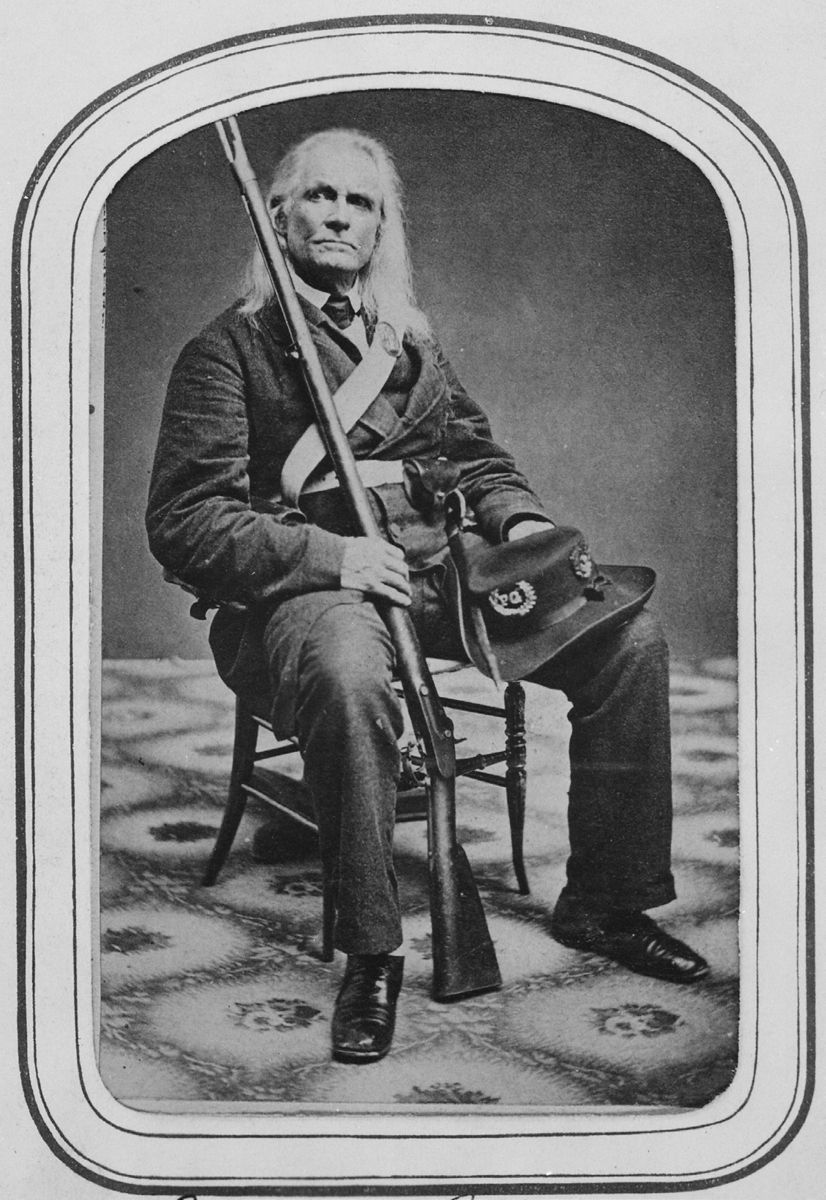
De Bow’s Review When James Dunwoody Brownson De Bow started publishing The Commercial Review of the South and West in New Orleans in 1846, he intended it as a journal devoted to strengthening the South’s economy, particularly by advocating for more manufacturing and commerce. The first issue appeared in
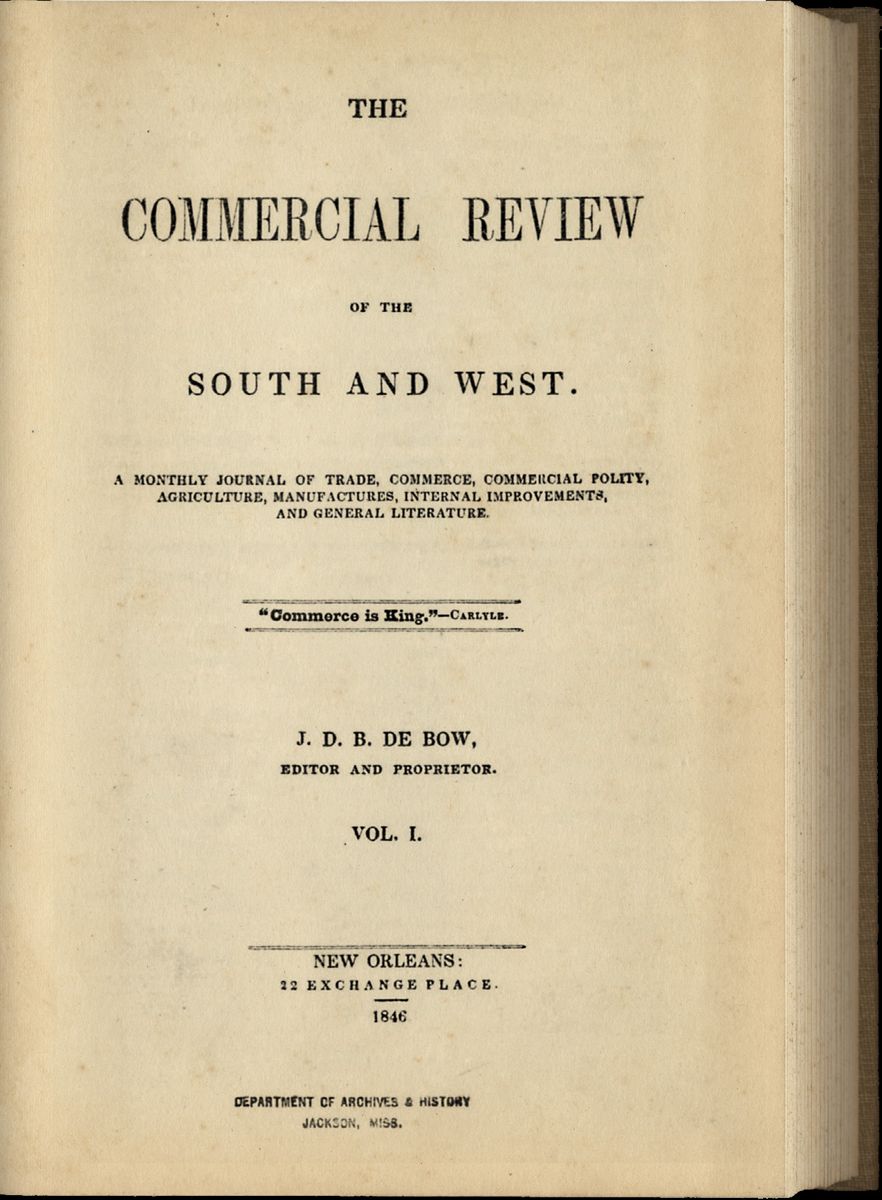
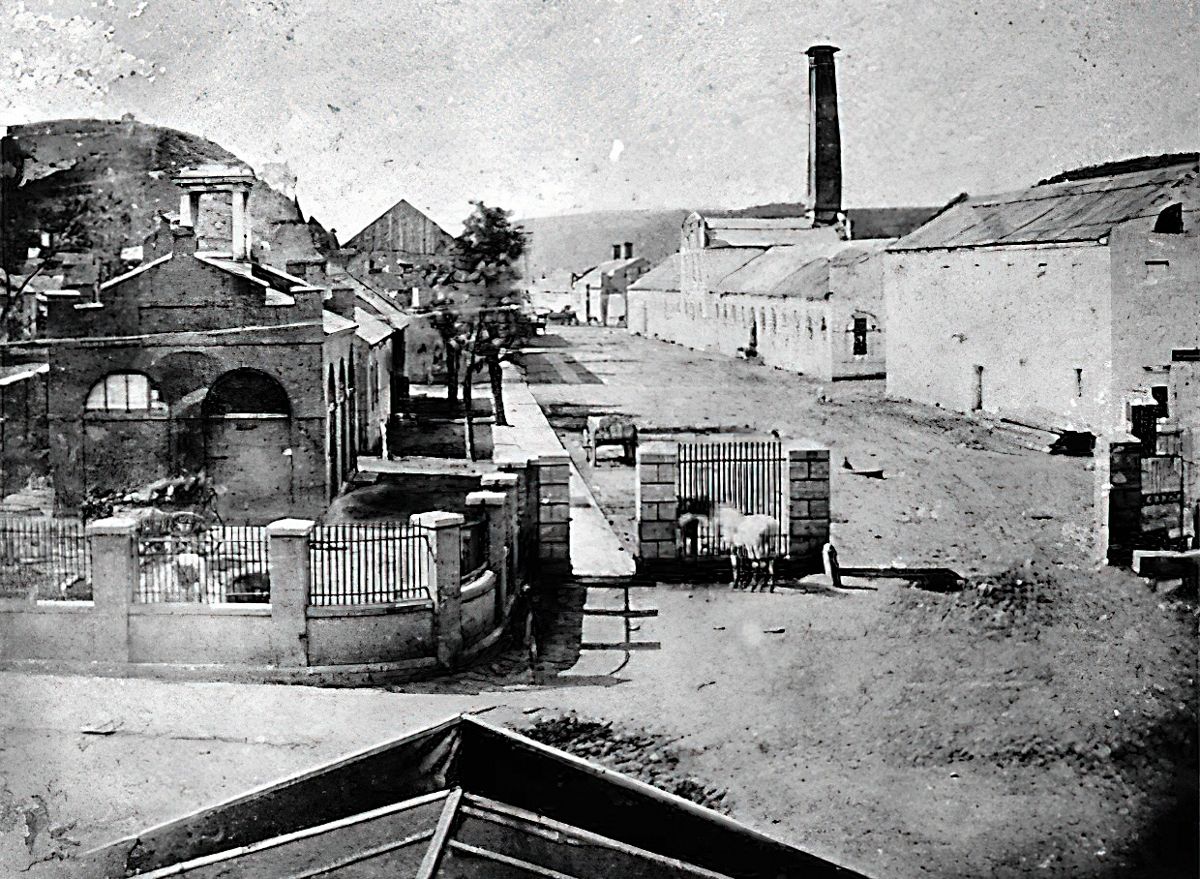
January 1846. In it De Bow laid out his purposes: to promote the interests of the South and West (back then, meaning the area based around Mississippi and Louisiana), to defend their citizens’ rights, and work to develop their resources.1 “Interests” and “rights” for the South in the 1840s meant slavery and social acceptance of Negro inferiority. The Review defended the first and argued the second consistently in the antebellum years. For instance, the journal offered advice to planters on ways to maximize their slaves’ productivity, a chief one being through enlightened management. A Mississippi plantation owner contributed an article that appeared in June 1851 reinforcing this point. It is a fact established beyond all controversy, that when the negro is treated with humanity, and subjected to constant employment without the labor of thought, and the cares incident to the necessity of providing for his own support, he is by far happier than he would be if emancipated, and left to think and act, and provide for himself. Enlightened planters, this unnamed contributor wrote, should share their rules for working and caring for their slaves. That way, the slaves would be happier and the planters richer—a win-win, as we would call it. Accordingly, he described how he had chosen the site for his slave quarters, how he had constructed their houses, what he had fed them, and provided amenities: they could raise their own chickens, till gardens, and at daylight give their children over to the care of a kindly lady. “I have a large and comfortable hospital provided for my negroes,” the planter boasted, where medicine and proper diet were administered. “I have not lost a hand since the summer of 1845,” he added. He even provided a fiddler for Saturday night dancing and a preacher for worshipping the next morning.2 An illuminating sampling of the articles in De Bow’s can be seen in Paul F. Paskoff and Daniel J. Wilson, eds., The Cause of the South: Selections from De Bow’s Review, 1846–1867 (LSU Press, 1982). Samuel Cartwright reassured Southerners that slaves’ dependence upon their masters was caused by a congenital trait, “defective hematosis.” William Gregg advised that if his countrymen only willed themselves to work, they could outstrip Northern factories in the production of cotton goods. “The true secret of our difficulties,” Gregg declared, “lies in the want of energy on the part of our capitalists, and ignorance and laziness on the part of those who ought to labor.”3 J. W. Morgan worried that Yankee schoolbooks were implanting Southern children (National Archives) with “the abominable sophistries and jingling rhymes of Stowe and Whittier,” and announced that all would be well if local scholars turned out texts and parents bought them. “Let us drive these incendiaries from among us,” he exhorted; “let us have sentiments expressed in them which will accord with our own”—meaning, sentiments favoring and defending Southern culture and its peculiar institution.4 In 1857 Edmund Ruffin saw that abolitionists would win the next presidential election, but he prophesied that seceding states could avoid bloodshed and get their share of federal property as well. Indeed, a united South would present such a strong front, Ruffin predicted, as to intimidate the authorities in Washington: “If all the fifteen slaveholding States united in this action, they would be far stronger, at home and for repelling invasion, than would be the Northern States as invaders.”5 After Harpers Ferry, in a piece entitled “What Are We To Do?” Joseph Turner proclaimed that if Southerners boycotted Northern goods and strengthened home industries, they could force Northern abolitionists to cease spreading their heresies.6 (This was the same Turner of middle Georgia, by the way, whose weekly newspaper, The Countryman, gave employment to a young Joel Chandler Harris.) What is remarkable is that when war came, De Bow’s contributors appeared more confident than ever of their country’s future. One writer in December 1861 even laid out the terms by which the Confederacy should accept Federal surrender. Northern vessels, for instance, should be barred from navigating the lower Mississippi except under heavy tariff.7 George Fitzhugh counseled that Confederate generals had only to maintain defensive warfare until Yankees realized their losses and gave up the fight or wilted when
- Joseph A. Turner, ‘What Are We To Do?” DBR, July 1860. 7. [Anonymous], “What of the Confederacy—The Present and the Future?” DBR, December 1861. 8. George Fitzhugh, “Conduct of the War,” DBR, January/ February 1862. 9. James H. Thornwell, “Our Danger and Our Duty,” DBR, May/August 1862. Steve Davis is the author/coauthor of the following books:
• •

• (NPS)

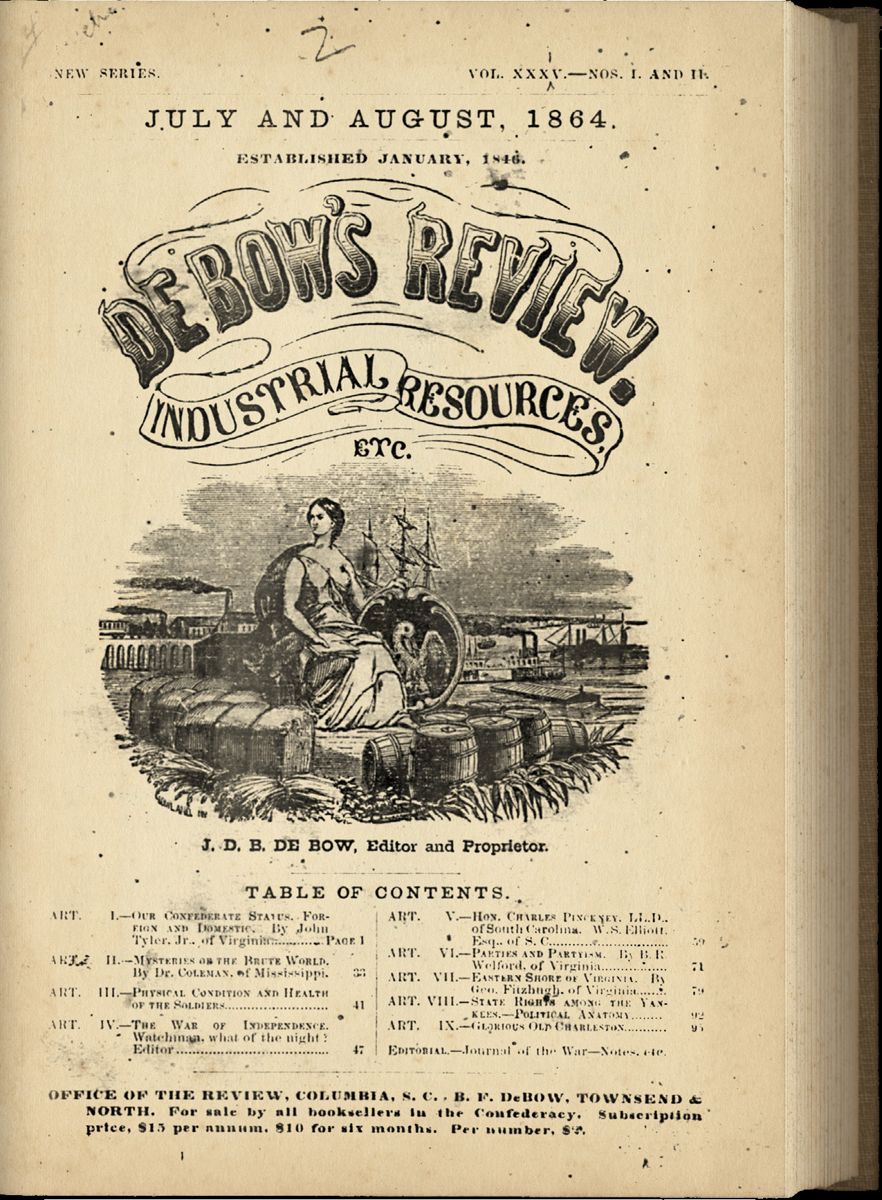
De Bow’s Review Industrial Resources, etc. (Internet Archive)
Southern forces surged across the Potomac. “A half dozen defeats would not injure us,” he confidently predicted,” while “a single one would ruin them, and open the way to Washington and Maryland.”8 Of Paskoff and Wilson’s selections, only that by James Thornwell warned in mid-1862 of the South’s danger. But as a clergyman, he reasoned that a more resolute trust in God would lead to Confederate victory. More than that, the Confederate cause itself was holy. “We are struggling for constitutional freedom,” he attested. We are upholding the great principles which our fathers bequeathed us…. We shall have a government that acknowledges God, that reverences right, and that makes law supreme. We are, therefore, fighting not for ourselves alone, but, when the struggle is rightly understood, for the salvation of this whole continent. It is a noble cause in which we are engaged….9 Thus thoughtful men viewed their society and coped with the tensions it produced. But in this we discern a way of thinking that led them to anticipate, even yearn for a war that at least some reckoned they could not win. It is this impression that renders the pages of De Bow’s Review a rather wistful trip back through time. And it is this impression that makes Paskoff and Wilson’s work an insightful glimpse into a society that took itself forthrightly to war.
Notes 1. Paul F. Paskoff and Daniel J. Wilson, eds., The Cause of the South: Selections from De Bow’s Review, 1846–1867 (Baton Rouge: Louisiana State University Press, 1982), 1-2. 2. “A Mississippi Planter,” “Management of Negroes Upon Southern Estates,” DBR, June 1851. 3. William Gregg, “Domestic Industry—Manufactures at the South,” DBR, February 1850. 4. J. W. Morgan, “Our School Books,” DBR, April 1860. 5. Edmund Ruffin, “Consequences of Abolition Agitation,” DBR, June 1857.