
The Graphic War
Augustus Tholey, Civil War lithographer
By Salvatore Cilella · Originally published November 2022 · pp. 34–35
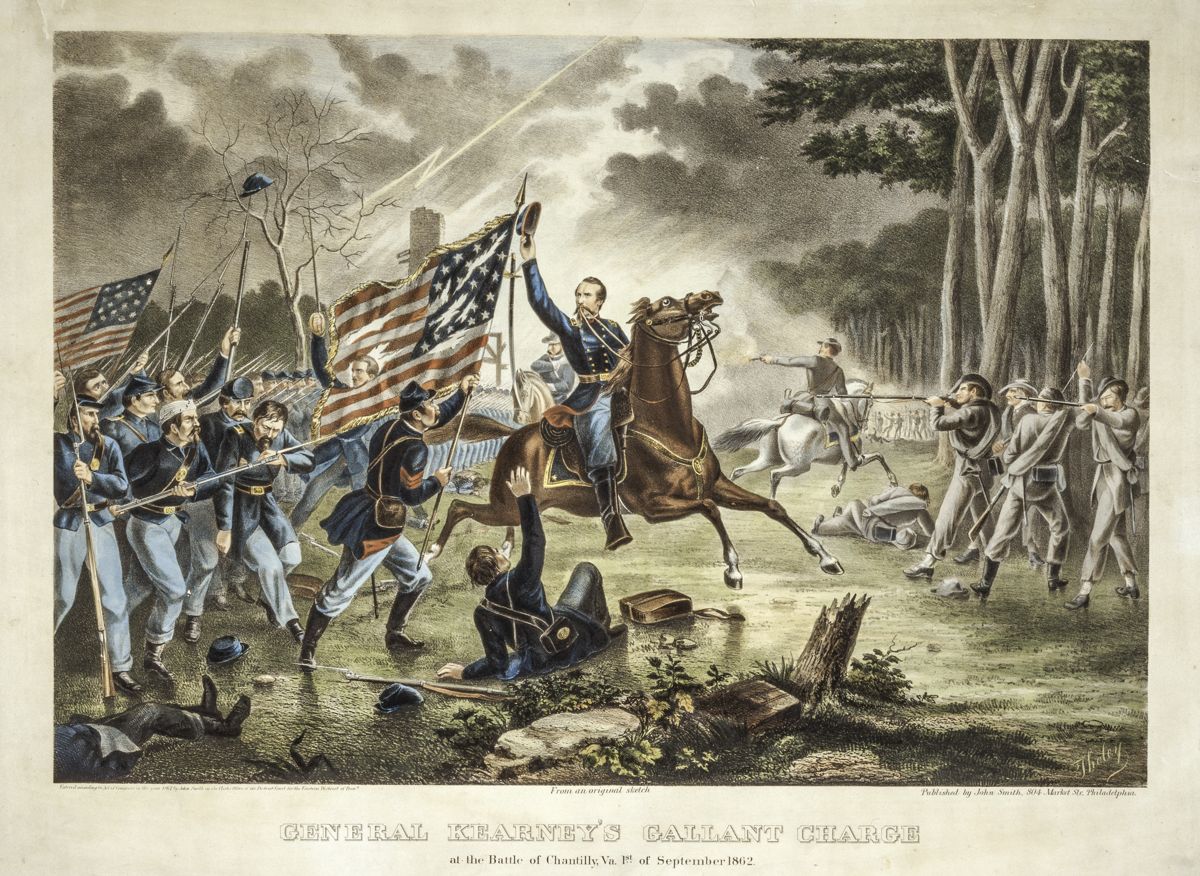
Augustus Tholey, Civil War lithographer The Graphic War highlights prints and printmakers from the Civil War discussing their meaning and the print maker or artist’s goals. Augustus Tholey, the lithographer, is not a household name on the same level as the firm of Currier and Ives, but he did produce a few prints of interest during the Civil War era. One had relevance to the immediate situation on the ground, namely the brilliant and last charge of General Philip Kearny at Chantilly, September 1, 1862. Several other early martyrs for the union cause were depicted by print makers almost immediately. Lithographers portrayed the deaths of Colonel Ephraim Ellsworth, cut down in Alexandria, Va., seizing a Confederate flag; General Nathaniel Lyon’s death in August 1861 at Wilson’s Creek; and Colonel Edward Baker, a casualty of Ball’s Bluff in November, 1861. Authors Harold Holzer and Mark Neely argue that northern artists were not as reticent as southern artists to depict deaths of their heroes, especially after the war, the authors posit, because the north won.
Grandfather Tholey migrated to America from the AlsaceLorraine, now part of France, in 1848 during the European revolutions. Although the revolutions were liberal, they were eventually suppressed in many countries, forcing artists and intellectuals to flee into exile. Tholey, a painter, pastel worker and engraver, brought his two sons, Charles and Augustus, with him when he settled in Philadelphia. For a time, the trio worked for the federal government engraving bank notes. Like most emigrant lithographers, they worked with other printers until they went out on their own settling at 419 Green Street. There they “produced some famous war pictures, such as Lee and his Staff, Grant and his Staff, Lincoln’s funeral in Philadelphia, and the Battle of Antietam.” Much of their work was printed by John Smith of Philadelphia. Smith and Tholey collaborated on Kearny’s Charge at Chantilly, an obviously early Civil War print. Kearny is well known to students of the war. His background was unusual and a far cry from the resumes of his contemporaries. He was born in 1815 with the proverbial “silver spoon” in his mouth. His father was a veteran of the Mexican War, and a member of the blue bloods of New York City. Philip graduated from Columbia University in 1833 and three years later inherited $1million from his grandfather. He always wanted a military life and volunteered for the Mexican War where he lost his left arm. From there he traveled to Europe, where he signed up to fight with Napoleon III’s Imperial Guard during the Italian War. When the Civil War broke out, Kearny retuned home, offered his services to the federal government and became a brigadier general of volunteers assigned to lead a brigade of New Jersey regiments in Franklin’s Division, despite the loss of his left arm. The spring of 1862 found him in the Peninsular Campaign and later that year at Second Manassas, August 2930. He was killed the next day at Chantilly during a cavalry charge when he rode into enemy lines, and attempting to escape, was brought down with a single shot. Tholey’s depiction of Kearny’s final charge rings true. “A severe thunderstorm erupted about this time, resulting in limited visibility and an increased dependence on the bayonet, as the rain soaked the ammunition of the infantry and made it useless.” His horse gallantly rears up as his rider spurs him forward. Authentically, Kearny holds the reins in his mouth, while his good arm and hand holds his hat skyward urging his men onward. Above him, lightning bolts ominously rent the sky. In the far right is a Confederate soldier taking dead aim at Kearny. The title margin reads: “General Kearney’s (sic) Gallant Charge/at the battle of Chantilly, Va. 1st of September, 1862.” Kearny was initially buried in New Jersey, but later, in 1906, reinterred at Arlington Cemetery. The Tholey firm faded from the historical record. Augustus died January 12, 1898. His work is in the Smithsonian, the Library Company of Philadelphia, and the Library of Congress. Endnotes: 1. Harold Holzer, The Union Image, 29. 2. Harold Holzer and Mark Neely, Mine Eyes Have Seen the Glory: The Civil War in Art, NY, Orion Books, 1993, 150. 3. Harry T. Peters, America on Stone, 383.
CivilWarNews.com 4. Smith was active in Philadelphia between 1860 and 1870. Besides publishing prints by Tholey and Anton Hohenstein, Smith was also an accomplished gilder, painter, and looking glass and frame manufacturer. National Museum of American History, Smithsonian. 5. Ezra Warner, Generals in Blue, 258-259. 6. Warner, Ibid., 259. 7. Taylor, Paul. He Hath Loosed the Fateful Lightning: The Battle of Ox Hill (Chantilly), September 1, 1862. Shippensburg, PA: White Mane Publishers, 2003, 70, 77-87, 90.
After 43 years in the museum field, Cilella devotes his time collecting American prints and maps and writing. His most recent books are Upton’s Regulars: A History of the 121st New York Volunteers in the Civil War (U. Press Kansas, 2009). His two-volume Correspondence of Major General Emory Upton, (U. of Tennessee Press, 2017), received the 2017–2018 American Civil War Museum’s Founders Award for outstanding editing of primary source materials. Upton’s love letters to his wife 1868-70, (Till Death Do Us Part) was published in 2020 by the Oklahoma University Press. He is currently editing the memoirs of Private Dewitt Clinton Beckwith of Upton’s Regulars for McFarland Press.
Divided by Conf lict. United by Compassion.