
Central Virginia Battlefield Trust
The Fredericksburg Confederate Cemetery and Gravestone Project
By Raymond (Mike) Burns · Originally published May 2022 · pp. 34–35
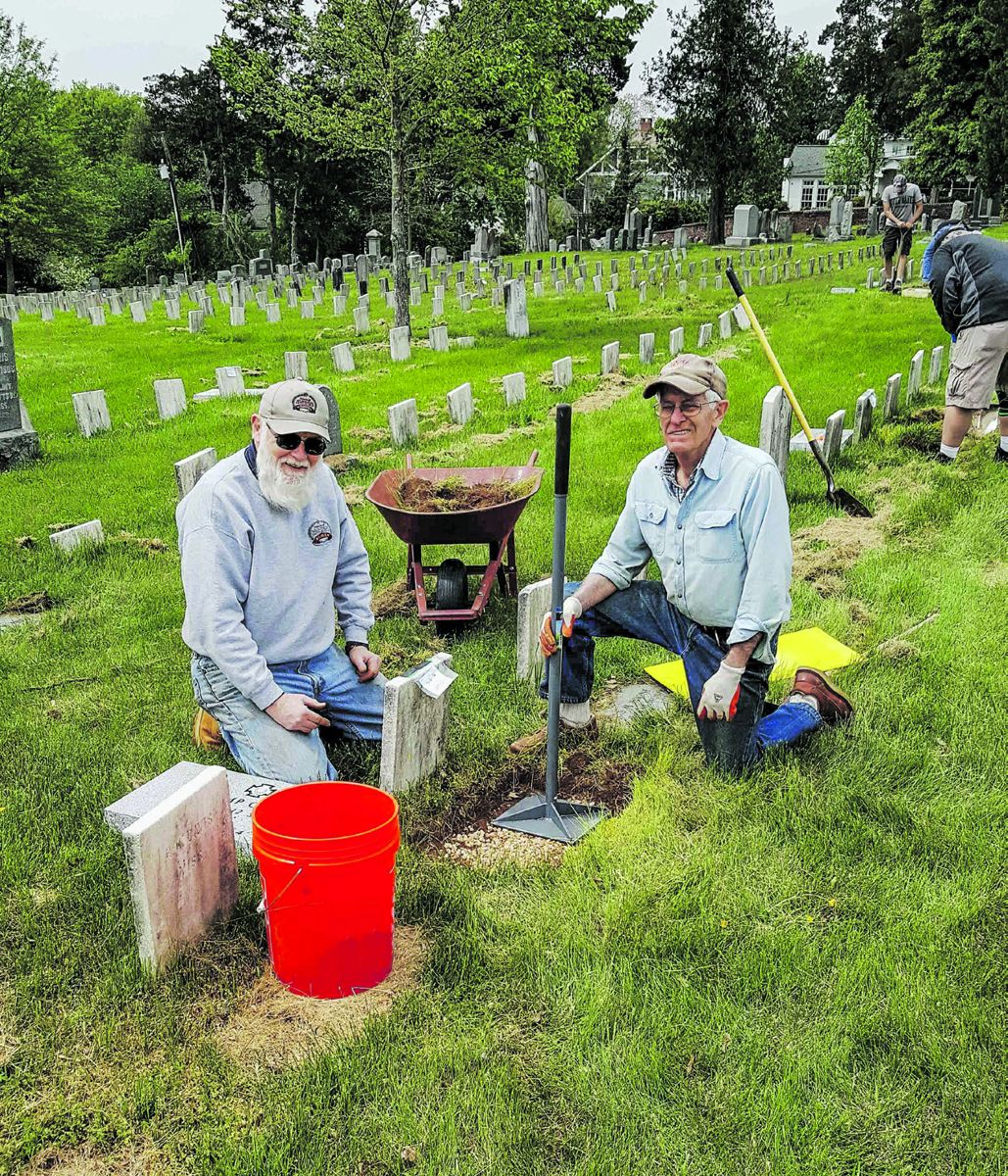
The Fredericksburg Confederate Cemetery and Gravestone Project It began innocently enough with a conversation between a sailor and a Marine. Stop me if you’ve heard this one before. Two wizened old vets looking for yet one more Good Deed to be done. Capt. Fred Howe, USN (Ret.) was the president of the Civil War Round Table of Fredericksburg, Virginia, one of our nation’s oldest Round Tables. Col. Mike Burns, USMC (Ret) was a Round Table member just hanging around, kicking rocks, with time on his hands, and an inability to say NO to virtually any suggested program of interest. Fred’s idea was to start an effort to provide new flat, granite grave markers to supplement the existing headstones placed in the 1880s with funding from the various Southern states. These stones of ‘Georgia Marble’ are relatively porous and have worn badly over the past 130 years. The headstones were replacements for the original deteriorated wooden
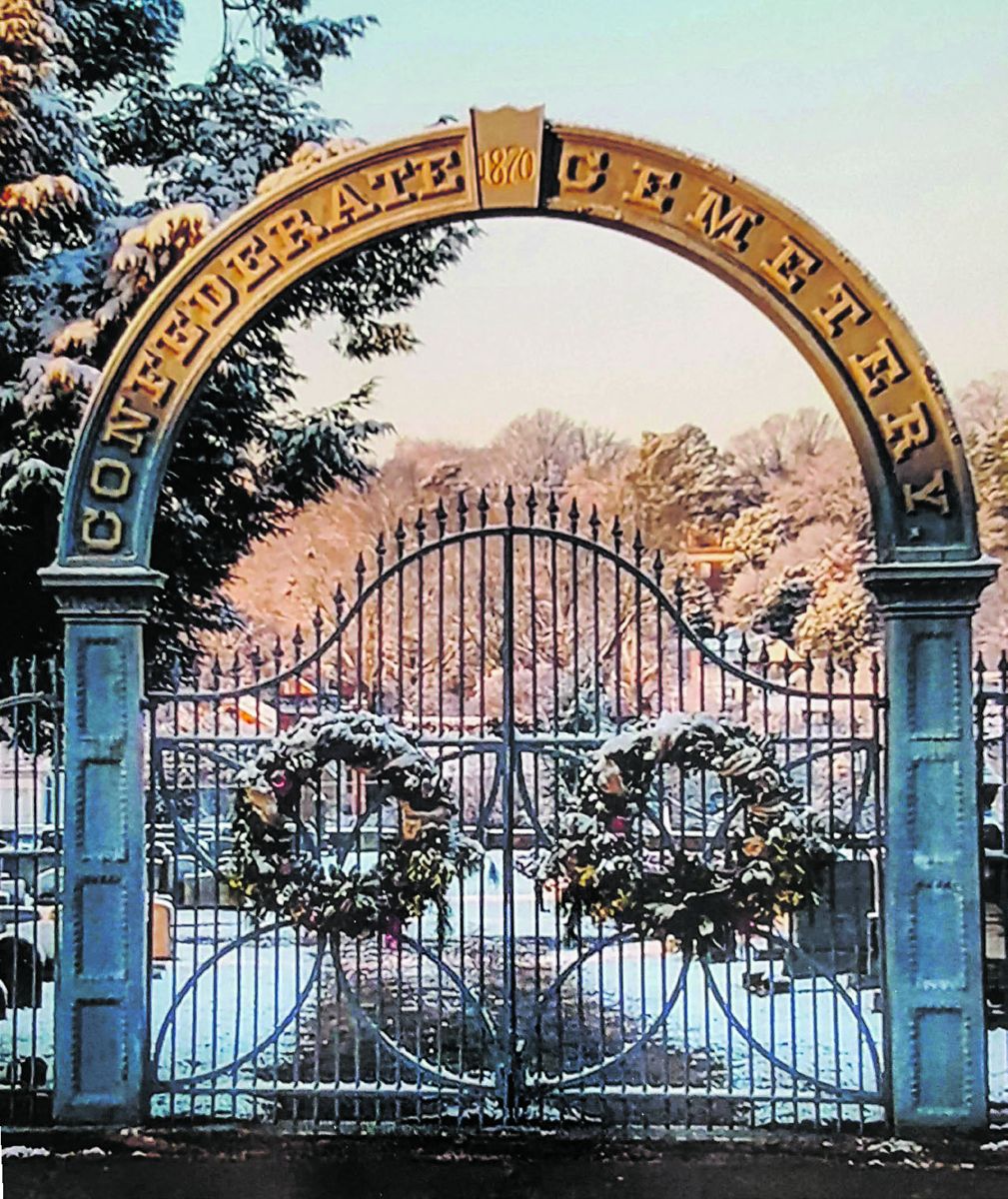
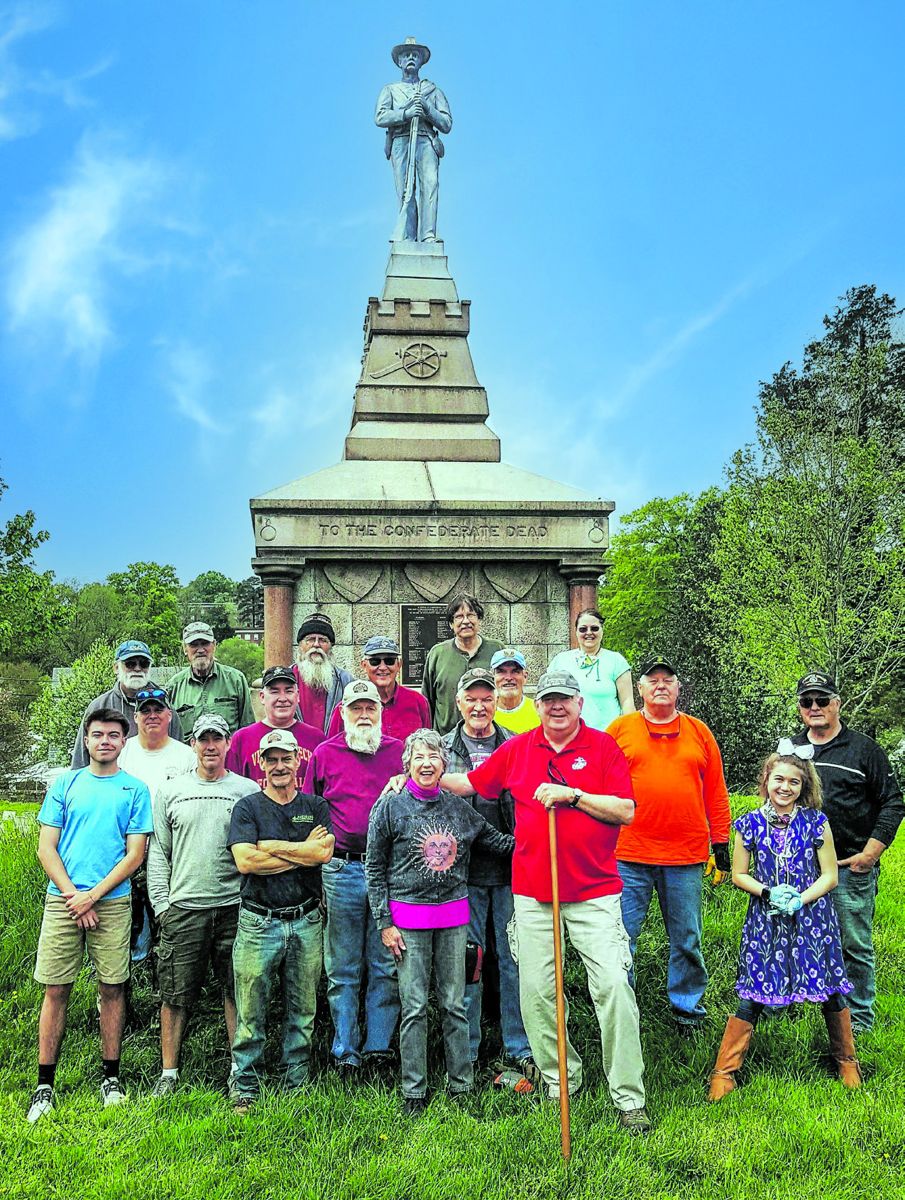
markers placed when the Ladies Memorial Association (LMA) of Fredericksburg established the cemetery, located at Amelia Street and Washington Avenue, in 1866. The cemetery was dedicated in May 1870 to the 3,353 Confederates killed on four area battlefields who were reinterred here. On this spot the Association held one of the earliest Memorial Day observances in the country. As it has for nearly 150 years, this tradition continues annually The cemetery is laid out in four symmetrical sections in the shape of the Maltese cross. Beneath a tall monument of a Confederate soldier in the center lie the remains of 2,184 unknown soldiers. The four sections contain the graves of another 1,369 soldiers. The bodies were brought in from the 1862–1864 battlefields of Fredericksburg, Chancellorsville, the Wilderness, and Spotsylvania Courthouse. Those graves and their headstones are the subject of our ongoing quest. It began in 2011 with the Department of Veterans Affairs (VA) providing the stone for Pvt. William Harris, 1st Texas Infantry, killed at the Wilderness. In 2012 the VA’s National Cemetery Administration (NCA), Memorial Programs Service Processing Site in Nashville, Tenn., authorized another three stones per our request. The years 2013-2016 were filled with VA rule changes regarding who could and could not request stones for Confederate veterans. The U.S. Code, Title 38, Section 2306 states that the government shall furnish, when requested, appropriate government
J. Home’s marker almost disappeared.
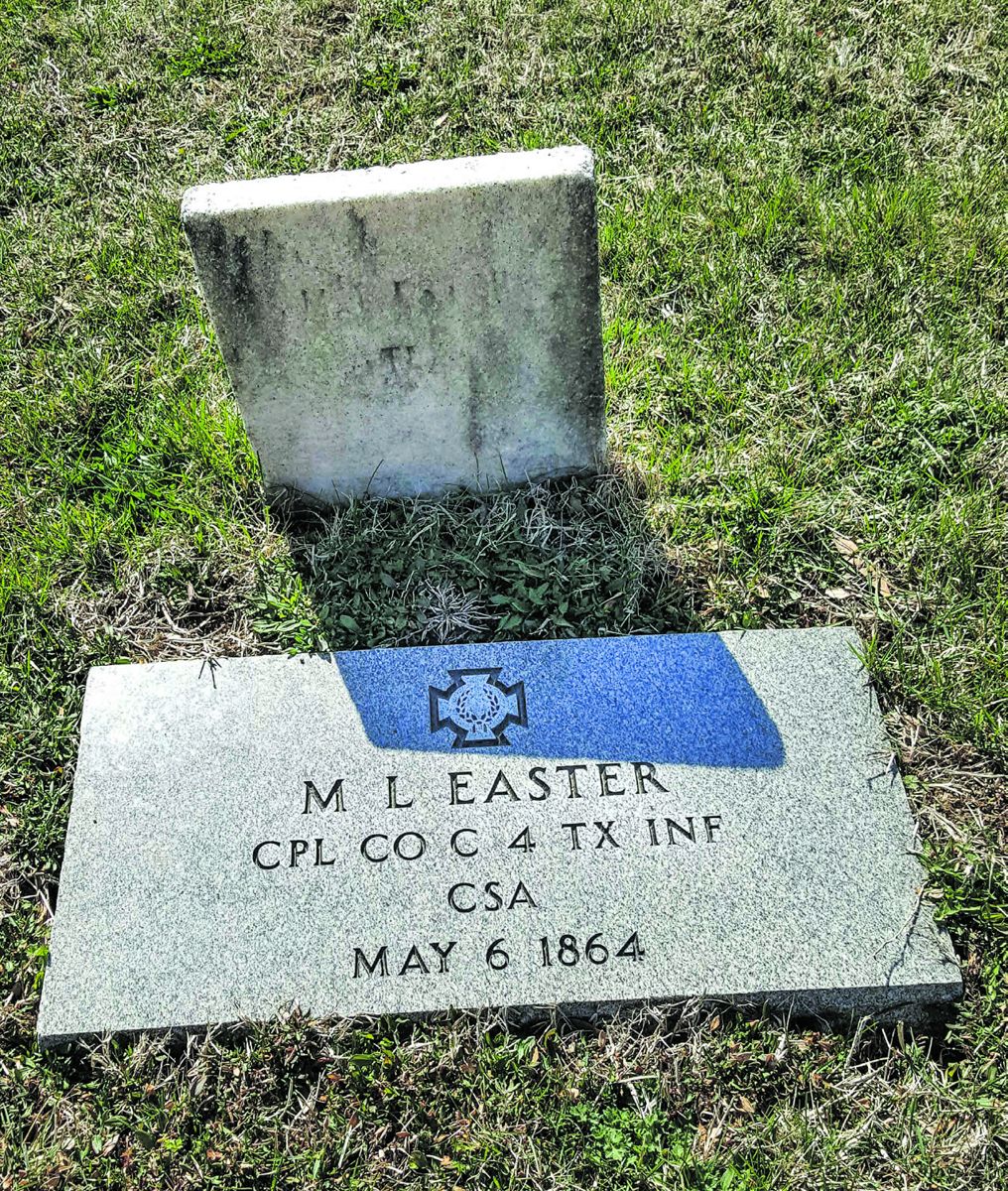
has
Damaged headstone. headstones or markers at the expense of the United States for the unmarked graves of soldiers of the Union and Confederate Armies of the Civil War. We were told in late 2012 that the VA’s general counsel had reinterpreted existing law dated from 1906. The new interpretation concluded that future requests for grave markers had to be signed by the Next of Kin (NOK) or a descendant. The VA then said, in a second explanation, that our request had nothing to do with the NOK rule but that it was denied because the original grave markers were provided by private sources, and not the federal government. In the words of the NCA public affairs specialist in Washington, D.C., “if the Confederate grave already has a marker, even an illegible or broken one, it is considered marked, and is not eligible for VA replacement unless it was originally provided by the federal government.” Union soldiers were buried in National Cemeteries by the federal government. Burial of Confederate soldiers was left to the states and private groups like the Ladies Memorial Associations. Thus, broken, or illegible Confederate headstones were not going to be replaced by the VA. We were told, “That’s the law as it now stands,” and if you want it changed then lobby Congress to change the law or find private funding.
Representative Steve Stiver (R-OH) in 2013, and Senator Rob Portman (R-OH) in 2014, filed Honor Those Who Served Acts. They passed, and April 6, 1917, became the cutoff date for having NOK request a marker. Essentially WWI became the dividing line for requiring NOK to request markers. Since that date, organizations such as an LMA could once again request a marker on behalf of a soldier in their cemetery. In 2016 we applied for and were provided another three flatgranite stones from the Nashville NCA Memorial Program Service. In April 2017 an eighth stone was requested for Pvt. Andrew Jackson Wilson, 49th Alabama Infantry. His stone was worn and broken in half (but glued back together), with just his initials, last name, and “AL” inscribed on his headstone. A phone call and a question from Nashville centered on his actual unit (the 46th AL instead of the 49th). To Err is Human, To Forgive Divine, neither of which is Marine Corps policy, nor VA policy as it turns out. The question was then asked, “Why are you requesting flat-granite markers instead of upright headstones?” Answer, the LMA wanted to retain the original 1880s symmetrical appearance of their cemetery, that the current VA headstones are taller and wider than the Georgia stones, and the graves are much closer together than the spacing one sees in national cemeteries. The NCA answer was that they considered the grave “marked,”
and that a new stone would not be provided, unless the old headstone was removed entirely. I cited NCA policy that states, “the placing of headstones is not to be detrimental to the historic cemetery landscape.” I was told, “sorry, however, you can appeal our decision if you so wish.” Thus began the Appeal Process. The VA denial of our request for Private Wilson’s stone was dated May 2017. We filed a Notice of Disagreement (NOD) in October 2017; it slowly wound its way from Nashville to the Saint Louis, Mo., Appeals Unit, thence to the Washington, D.C., Board of Veterans’ Appeals. We met before a Veterans Law Judge (VLJ) in the Chester A. Arthur Building at 425 “I” Street NW on Monday, January 27, 2020. It had taken 32 months, but we finally had our day in court. And we gave it our best shot. On February 19, 2020, the VLJ ruled that; ORDER – The claim of entitlement to a Government– furnished headstone or grave marker is granted. FINDINGS OF FACT – The decedent is buried in a private cemetery and his grave is unmarked. CONCLUSIONS OF LAW – The criteria for entitlement to a Government–furnished headstone or marker have been met. 38 U.S.C. para 2306; 38 C.F.R. Para 38.630-38.633. The Summary of Reasons and Bases for Findings and Conclusions went something like this: The material facts of this case are not in dispute. The issue is whether the decedent’s grave is unmarked. No statute or VA regulation defines what constitutes a “marked” or “unmarked” grave. In this case, the decedent’s grave no longer has any identifiable markings to memorialize the decedent or to distinguish it from any other grave in the cemetery. All information relating to the decedent is no longer affixed to his grave. Accordingly, the Board finds that the decedent is buried in an unmarked grave, and entitlement to a Governmentfurnished headstone or marker is warranted 38 U.S.C. Para 2306. Victory is ours you might say. Not so fast there soldier, steady in the ranks. Attached to the bottom of the letter was the following missive: “The Board’s decision in this case is binding only with respect to the instant matter decided. This decision is not precedential and does not establish VA policies or interpretations of general applicability. 38 C.F.R. Para 20.1303.” A phone call from Nashville shortly thereafter further dashed the glee and jubilation that resided in our hearts.” I was informed that, “you might have won this particular and singular case, but we still consider them marked, and any further applications for grave markers will be denied, just like Private Wilson’s.” Well, there you have it. I had reviewed approximately 30 previous rulings that the Appeals Board had rendered on this subject, prior to our appeal, and none were successful. So, I frankly did not have another 32 months to dedicate in fighting for yet one more stone. It’s just easier to go out and buy one and place it on the grave. In fact, our records show that we have placed 131 flat-granite stones to date, with another 63 currently stacked in the cemetery awaiting placement once the weather gets better. We will continue because it’s the Right Thing to Do! Many thanks to the Ladies Memorial Association of Fredericksburg, the Civil War Round Table of Fredericksburg, the Rappahannock Valley Civil War Round Table, the Sons of Confederate Veterans, the Central Virginia Battlefield Trust, the United Daughters of the Confederacy, and the Friends of the Wilderness Battlefield. We could not do it without the many volunteers who show up for the work details placing the stones and getting those soldiers identified properly. But first and foremost, our thanks go to those generous donors who make the purchase of the gravestones possible. Your devotion and love in seeing this endeavor through are greatly appreciated. As far as Mike Burns is concerned, it’s a project that may not be completed in his lifetime, but he’s going to keep doing it as long as he’s able. Raymond (Mike) Burns is a longtime member of the Central Virginia Battlefields Trust as well as many other local organizations. Mike is a retired Marine Corps aviator dedicated to continuing education of our history and volunteers to that end. To learn more or to help with this project please contact Mike at [email protected] or call 540-809-3649.