
The Graphic War
Satterlee Hospital Philadelphia
By Salvatore Cilella · Originally published May 2022 · pp. 32–33
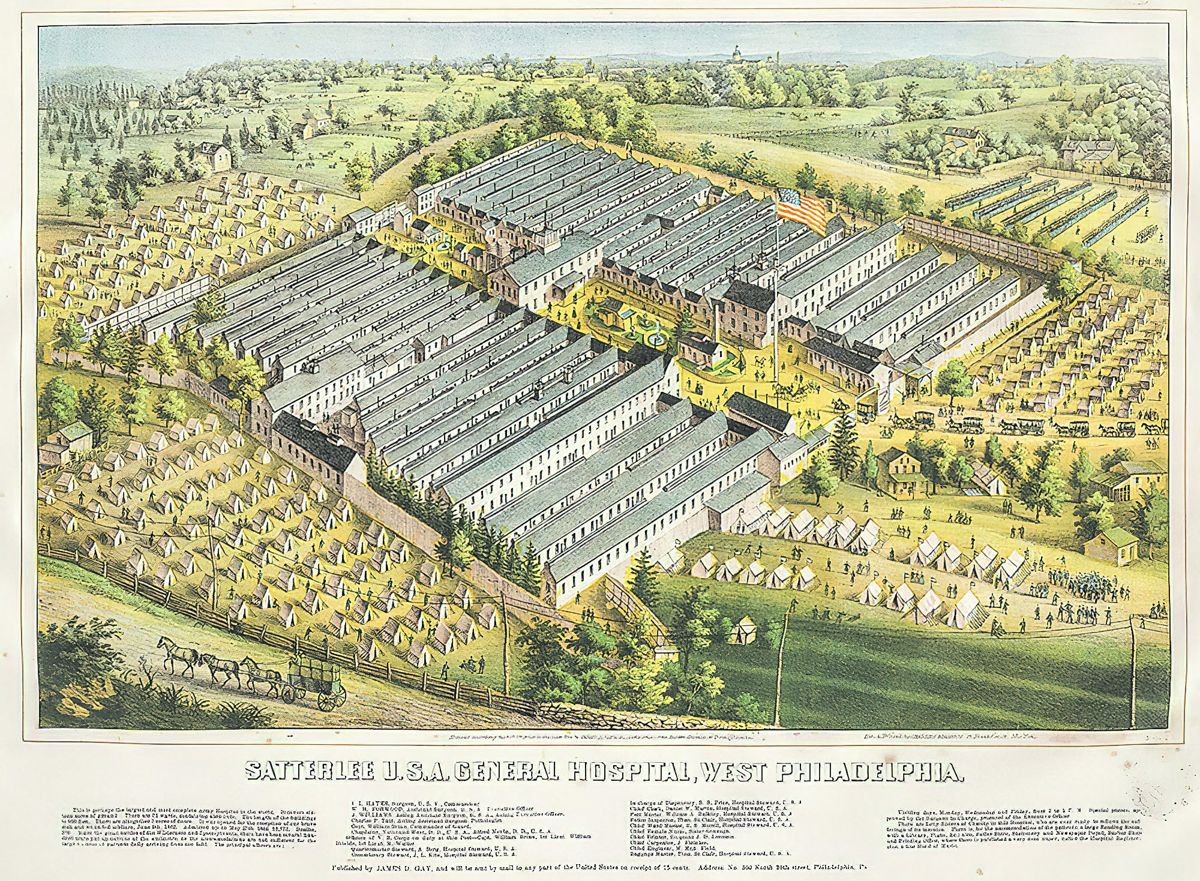
Satterlee Hospital Philadelphia The Graphic War highlights prints and printmakers from the Civil War discussing their meaning and the print maker or artist’s goals.
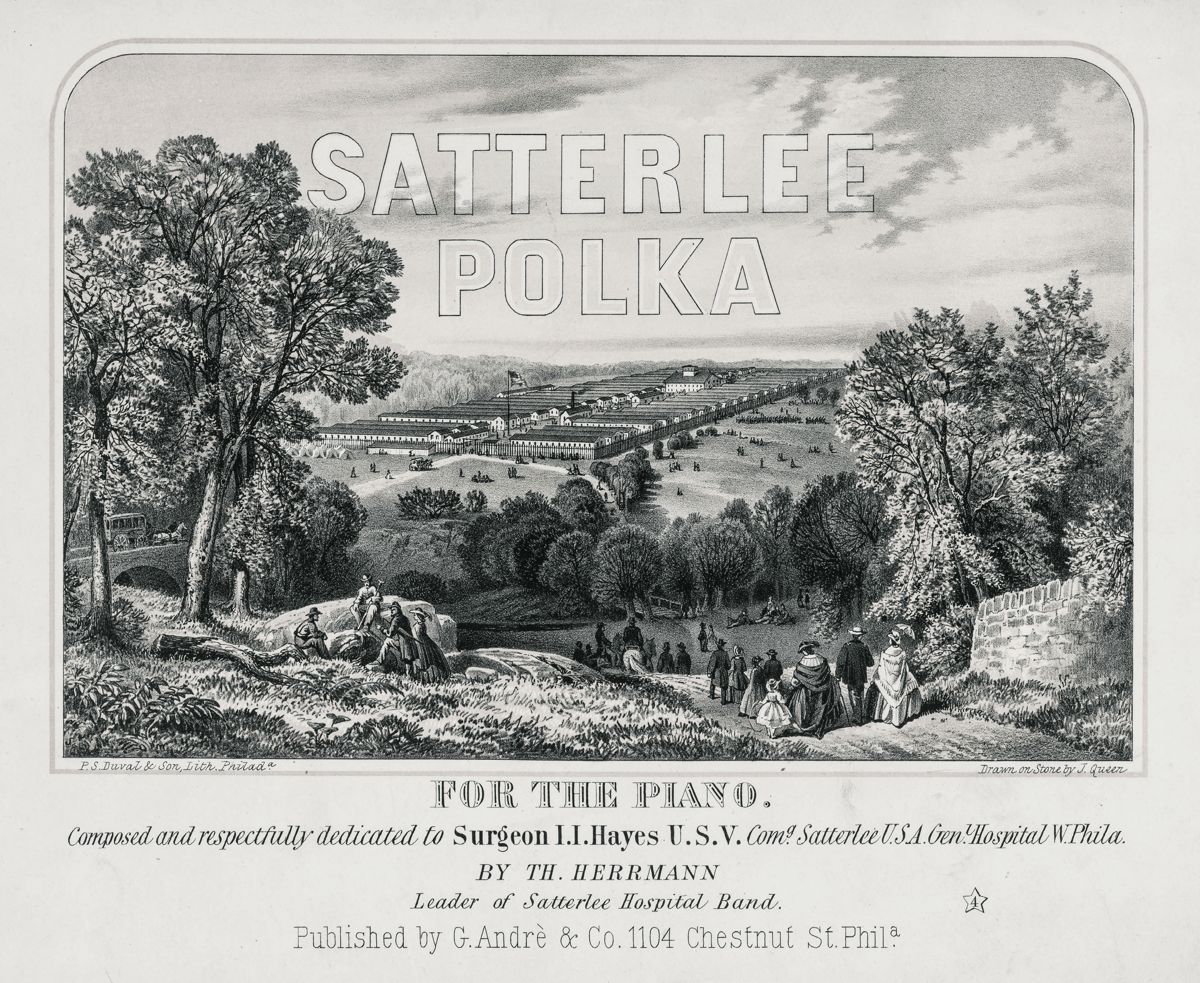
One of the more common Civil War prints available to students of the war shows a Union hospital or camp. Entrepreneurial lithographers, such as Charles Magnus, produced “memories” by capturing the places Union soldiers served or were cared for during the Civil War. The idea was to preserve memories. The lithograph of Satterlee General Hospital, West Philadelphia, is quickly recognized with its neat rows of barracks surrounded on nearly all sides by fields of tents. A gently rolling hillside is to the top. A prominent flag at full staff greets columns of carriages presumably carrying wounded Federal soldiers into the complex. The title margin reads “Satterlee U.S.A. General Hospital, West Philadelphia.” Below are four columns containing all the information one would want about the installation. Some period lithographs, such as this bird’s eye view of a massive hospital complex, are often much more than crude or elegant artistic renderings. In this case, the Satterlee lithograph is a primary source document. The four columns read: “This is perhaps the largest and most complete Army Hospital in the world. It covers sixteen acres of ground, there are 24 wards, containing 4500 beds. The length of the buildings is 900 feet. There are altogether 7 acres of floors. It was opened for the reception of our brave sick and wounded soldiers, June 9th 1862. Admitted up to May 27th 1864 12,773. Deaths, 260. Since the great battles of the Wilderness and Spotsylvania, there have been several hundred tents put up outside the enclosure, as the accommodations are not sufficient for the large number of patients daily arriving from the field. The principal officers are I.I. Hayes, Surgeon, U.S.V. Commanding, W.H. Forwood, Assistant Surgeon, U.S.A. Executive Officer, J. Williams, Acting Assistant Surgeon, U.S.A., Acting Executive Officer, et al… Visiting days, Monday, Wednesday and Friday, from 2 to 5 P.M. Special passes, approved by the Surgeon in Charge, procured of the Executive Officer. There are forty Sister of Charity in this Hospital, who are ever ready to relieve the sufferings if its inmates. There is, for the accommodations of the patients, a large Reading Room, with Library, Piano, &c.; also, Sutler Store, Stationery and Newspaper Depot, Barber Shop, and Printing Office, where there is published a very neat paper, called the Hospital register, also, a fine Band of Music.” The hospital owed its existence to Surgeon-General William A. Hammond who ordered it built in 1862. The first iteration of 2,500 beds was completed in a mere 40 days. Its commanding officer, Pennsylvanian Dr. Isaac Israel Hayes was an arctic explorer who traveled once to the Open Polar Sea; another time he went with the 1853-55 Second Grinnell Expedition. The hospital commander was so popular that a polka was written and dedicated to Hayes. It was produced by Philadelphia lithographers P.S. Duval and James Queen. Supporting the many medical professionals were Roman Catholic nuns, the Daughters of Charity, whose numbers eventually swelled to more than 100.1 The Church played a large role in the hospital’s day to day operations. It operated a small chapel, and the post’s chaplain, Father Peter McGrane, “heard confessions and offered mass daily.” According to the Catholic Historical Research Center, the local archbishop presided over numerous conversions.2 Satterlee opened in time to deal with casualties from Second Bull Run in 1862 when military tents were erected outside the original structures. The hospital’s resources were challenged with casualties from Gettysburg the following year when its population swelled to 6,000 and tested the ability of the “self-contained city” to handle the influx. The hospital closed in August 1865. Probably 50,000 soldiers were treated during the hospital’s short life. Today all that remains in the north Philadelphia neighborhood is a monument in what is known as Grant Park. In 1869, real estate developers moved in and subdivided the land the hospital occupied. By the late 19th century much of the land, renamed “Satterlee Heights,” was residential. Satterlee was originally called the West Philadelphia General Hospital but eventually named after Surgeon R.S. Satterlee.3 He was brevetted during the war for “diligent care and attention in procuring proper army supplies, as Medical Purveyor, and for economy and fidelity in the disbursement of large sums of money.”4 There is no evidence that he visited or ever was associated with the hospital. Endnotes: 1. Daughters of Charity nursed wounded Civil War soldiers at
West Philadelphia Hospital. https://chrc-phila.org/sistersof-charity-nursed-woundedcivil-war-soldiers-at-westphiladelphia-hospital/ 2. Ibid. 3. “Surgeon R. S. Satterlee, Breveted,” New York Times, September 11, 1864. 4. Ibid.
After 43 years in the museum field, Cilella devotes his time collecting American prints and maps and writing. His last professional position was President and CEO of the Atlanta History Center. His most recent books are Upton’s Regulars: A History of the 121st New York Volunteers in the Civil War (U. Press Kansas, 2009). His twovolume Correspondence of Major General Emory Upton, (U. of Tennessee Press, 2017), received the 2017–2018 American Civil War Museum’s Founders Award for outstanding editing of primary source materials. His latest book “Till Death Do Us Part,” an edit of Upton’s letters to his wife 1868-70, was published in 2020 by the Oklahoma University Press.