Through The Lens
Follow Me! Battle of Williamsburg Part I
By Stephanie Hagiwara · Originally published May 2022 · pp. 16–17
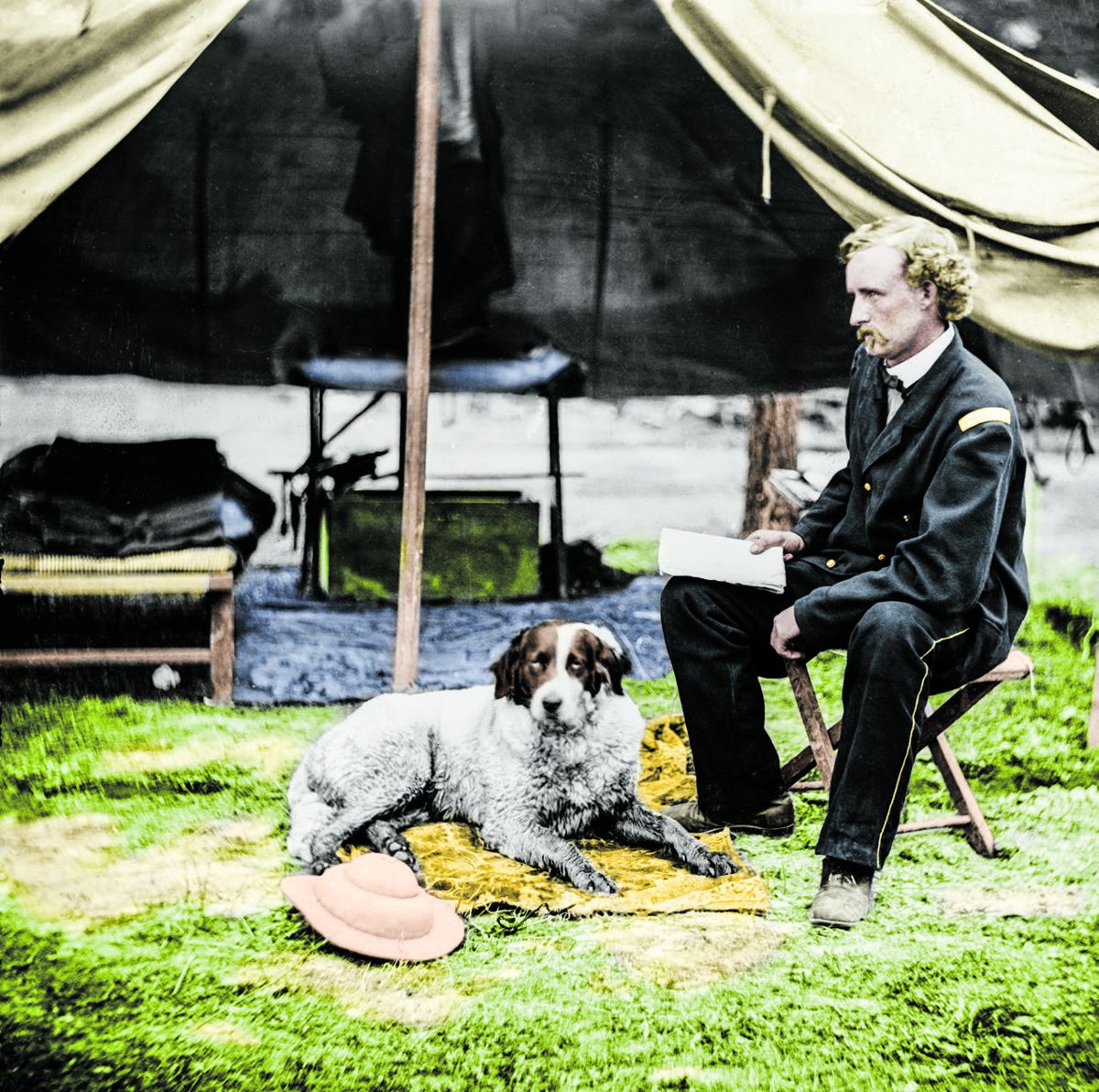
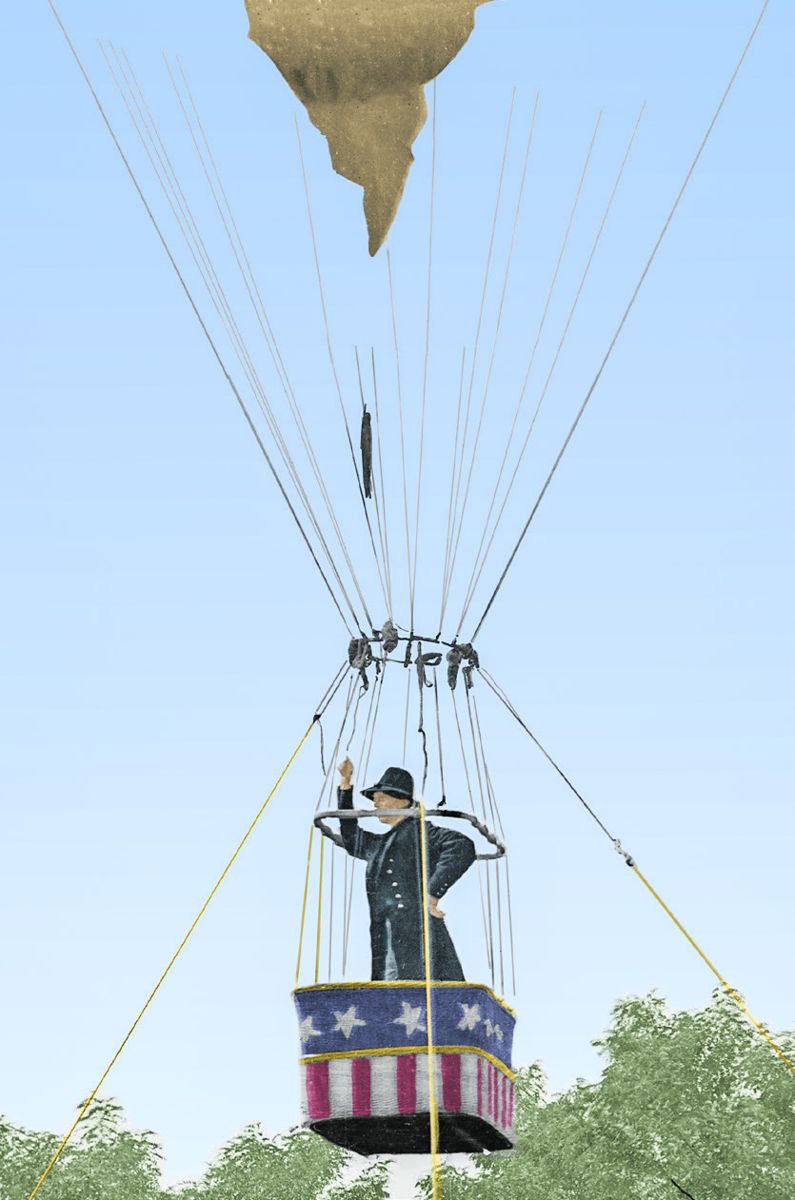
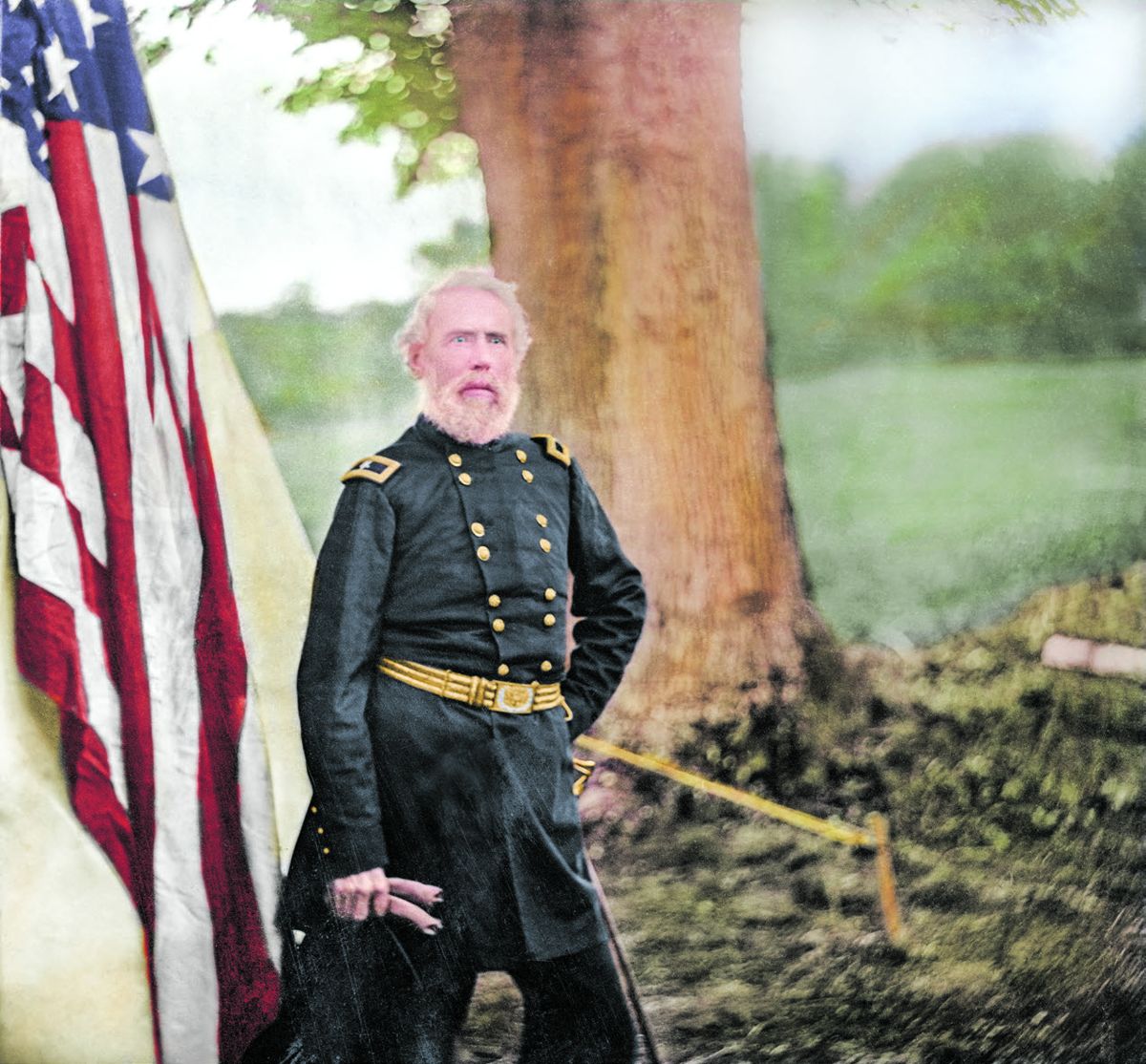
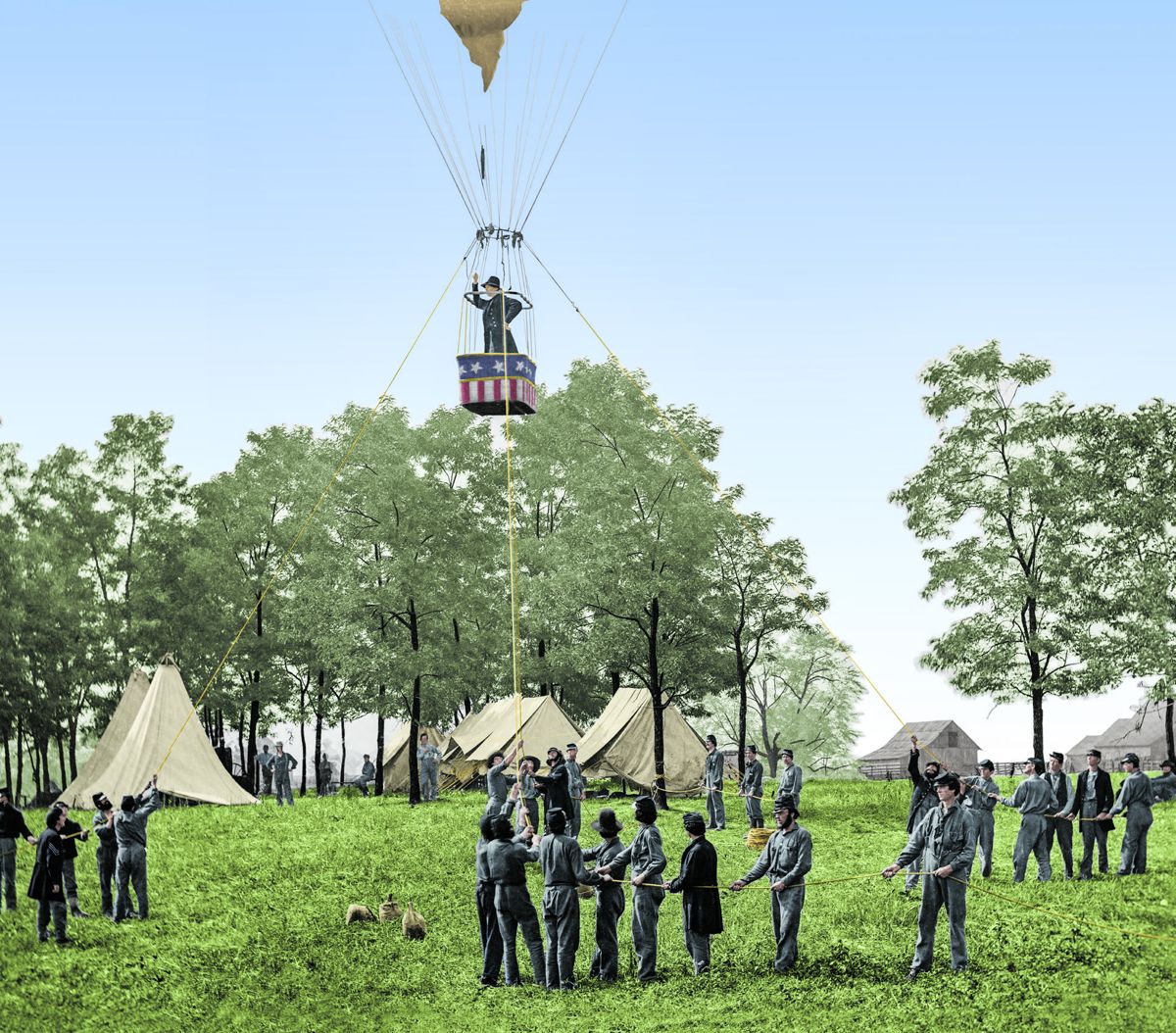
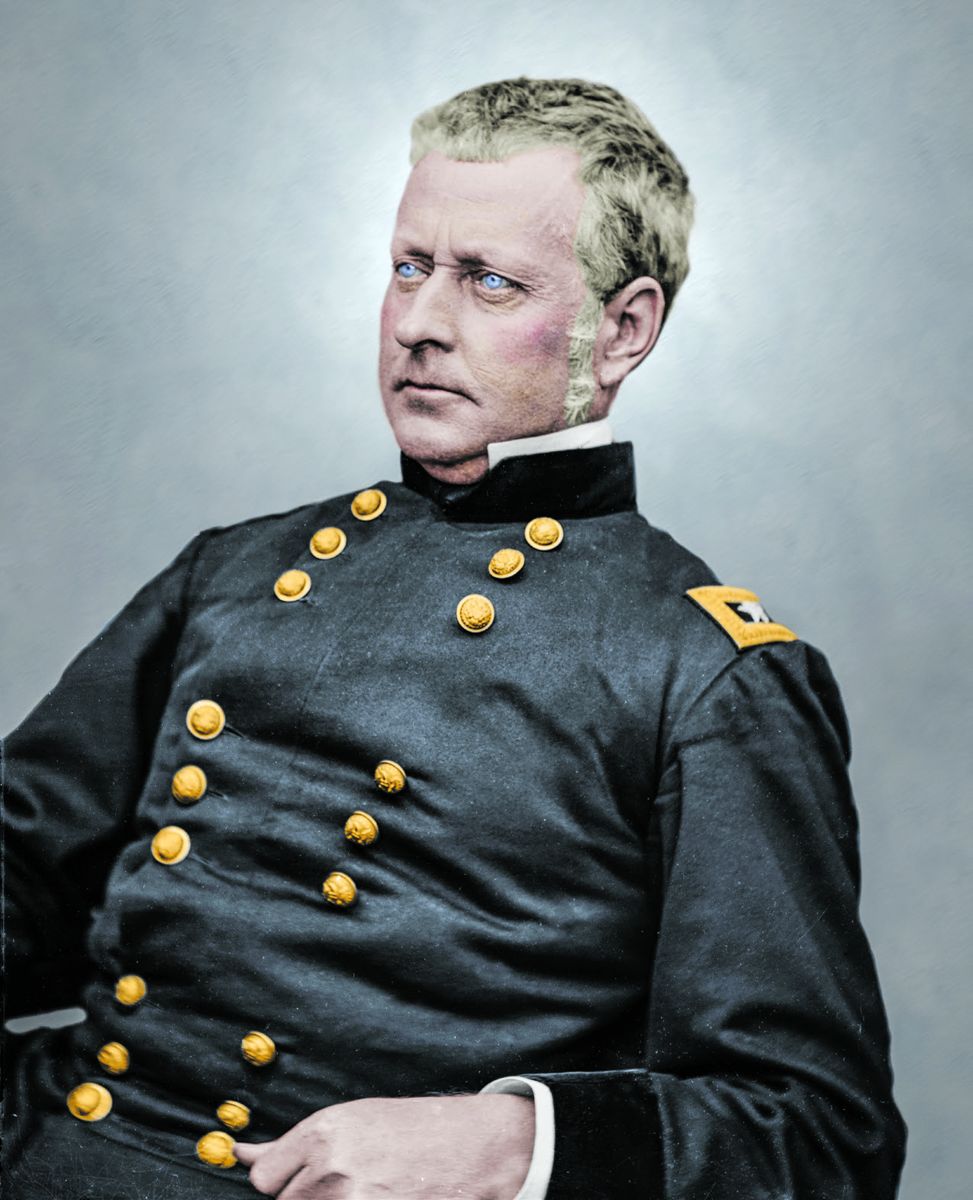
Follow Me! Battle of Williamsburg Part I “Never in my life was I so mortified, never so excited, never so mad. It had at any rate the good effect of making me forget my own danger, and the place was an awful hot one there in the road.” – U.S. Maj. Charles S. Wainwright, 1st N.Y. Artillery On March 5, 1862, U.S. Gen. George McClellan, “Army of the Potomac,” launched the Peninsula Campaign by transporting 121,500 men via ship to Fort Monroe, Va., to the tip of the Virginia Peninsula, and from there start an approach toward the Confederate capitol of Richmond. Blocking the way were the Confederates defending Yorktown. Between April 5 and May 3, McClellan moved and positioned huge siege guns to assault Yorktown. Both sides knew the attack would begin on May 4. On the evening of May 3, 1862, Professor Thaddeus Lowe was ordered to send his observation balloon aloft once “immediately after dark, [and] the other just before reveille.” The designated observer in the balloon’s car was future general, Lt. George Armstrong Custer. On the second ascension of the balloon, Custer realized that “the fires usually observable along the enemy’s line were entirely wanting.” The rising sun revealed the Confederate position to Custer and “the entire absence of their usual occupants surprised me.” Custer and Capt. Theodore Read were the first to enter the abandoned works and the 5th Vt. was ordered to occupy it. The possibility the Confederates would evacuate Yorktown before his assault does not seem to have occurred to McClellan. It wasn’t until noon on May 4, before a slow pursuit on muddy roads began. By mid-afternoon, a few miles outside Williamsburg, U.S. Gen. George Stoneman caught up with the Confederate rear guard at C.S. Gen. John Magruder’s Edwin V. Sumner in the field, The Peninsula, Virginia. Colorization © 2022, civilwarincolor.com courtesy civilwarincolor.com/cwn. (Library of Congress) fallback position. Months earlier, Magruder had constructed a line of 13 redoubts, flanked by creeks and marshes across the four-mile narrow neck of the peninsula. In the center was a 600-yard-wide redoubt he dubbed Fort Magruder. The line faced an open plain filled with rifle pits, stumps, brush, debris, and protective abatis. On May 5, 1862, the Battle of Williamsburg was fought in a torrential rain. The Federals opened the battle with three corps commanders, two divisions, and 18,500 men. McClellan, occupied elsewhere, designated 65-year-old Brigadier Gen. Edwin “Bull” Sumner, II Corps, to command. Sumner’s military career had commenced in 1819. In the late 1830’s he established the Cavalry School of Practice at Carlisle Barracks, Penn. Sumner commanded the Dept. of the West in 1860 and was transferred east in recognition that his experience was needed. Sumner’s leadership would be handicapped by separation from his own men held for use elsewhere and lack of terrain intelligence. U.S. General William “Baldy” Smith’s IV Corps approached the field via the Yorktown Road; Gen. Joseph Hooker’s III Corps division marched on Lee’s Mill Road. Smith and Hooker were more than a mile apart with swampy woods between them. Consequently, they were unable to offer mutual support. After McClellan’s siege preparation delay, “Fighting Joe” Hooker was impatient to get into action. About 7:30 a.m., he directed Maj. Charles S. Wainwright, 1st N.Y. Artillery, to position four guns of Battery H in a fallow corn field, 800 yards from Ft. Magruder which had already opened fire. First to fall was Lt. Eakin, who called out “that he was a dead man” as the first New York cannon entered the field. Amid the explosions, Wainwright drove the horses to the point where they would go into action. “I had all four guns posted; when looking around what was my horror, on seeing that nearly all the limbers had cleared off under shelter of the woods, and that there was not more than one or two men near each gun. … There was a certain amount of excuse for the men. Their captain had just joined them; their other officers knew nothing; two of them were shot down at once, as also a couple of the men, and one horse of the leading gun killed; it was a very hot place for men to have their first experience in; and they were a wretched lot of men.” Wainwright ran to where the men hid themselves behind trees. “Though we slammed at them with our sabres, and poked them out with the point, it was no good; drive two or three to a gun, and by the time you got some more up the first had hid again.” Wainwright appealed to Capt. Thomas Osborn’s, Battery D., asking who would help. Sgt. Horn, “standing up in his stirrups, replied, ‘Every one of us, Sir.’ The men jumped from the boxes, officers dismounted, detachments were regularly formed, and marched to the abandoned pieces as if on drill. A more beautiful thing it was impossible to see, not a man flinching; the infantry on the roadside gave them three cheers, and wasn’t I a proud man?—proud of the First New York Artillery.” Soon the guns of both batteries opened fire, “the air perfectly whistled, shrieked and hummed with the leaden storm.” C.S. Gen. James Longstreet focused his six divisions on checking Hooker as the Confederates continued to evacuate their heavy wagons inch by inch through the mud. On his white horse, Hooker rode up and down the line encouraging his infantry to move forward, waiting for the IV Corps to join the fight. According to Wainwright, Hooker was “as brave as brave could be beyond a doubt. But he seemed to know little of the ground where his infantry were fighting. … His great idea was to go ahead quick until you ran against the enemy, and then fight him.” Hooker sent a message to Sumner begging to attack. From his headquarters on Yorktown Road, Sumner was blind to the battlefield. Sumner, known for his personal courage and inspirational leadership, believed he could not reinforce Hooker “without endangering the center” and Smith’s men held the center. Hooker’s request was denied. Yet Sumner knew the Federals would lose without reinforcements. He needed someone he knew could get the job done. He turned to Gen. Philip Kearny. Three days earlier the onearmed general received command of the 3rd Division, III Corps. In his rush to the battle, Kearny threatened to burn Federal baggage trains if they did not get out of his way. Spotting his former New Jersey regiments leaving the field, he asked where were their officers? Informed they had none, Kearny shouted, “I’m a one-armed Jersey son-of-a-gun, follow me!” The New Jersey men followed. Later that day Kearny proclaimed, “General, I can make men follow me to hell.” Sources: d Wainwright, Colonel Charles S. A Diary Of Battle; The Personal Journals Of Colonel Charles S. Wainwright, 1861–1865: Golden Springs Publishing, 1962 d Sears, Stephen W. To the Gates of Richmond: The Peninsula Campaign: Houghton Mifflin Harcourt, 1992 d Custer, George A. “War Memoirs”, The Galaxy: A Magazine of Entertaining Reading, Vol. XXII, Dec.
1876: Sheldon & Company, 1876 d Bailey, Ronald H. Forward to Richmond: McClellan’s Peninsular Campaign: Time Life Books, 1983 d United States, War Department. The War of the Rebellion: A Compilation of the Official Records of the Union and Confederate Armies. Washington: 1894. Series 1: Volume 11, page Stephanie Hagiwara is the editor for Civil War in Color.com and Civil War in 3D.com. She also writes a weekly column for History in Full Color.com that covers stories of photographs of historical interest from the 1850’s to the present. Her articles can be found on Facebook, Tumblr and Pinterest.