
Book Reviews
Book Reviews — May 2022
Originally published May 2022 · pp. 40–43
A Raid Inspiring Fear and Nonsense
Crosshairs on the Capital: Jubal Early’s Raid on Washington, D.C., July 1864: Reasons, Reactions and Results. By James H. Bruns. Endnotes, index, Casemate Publishers, 2021, 240 pp., hardcover, $34.95. Reviewed by Wayne L. Wolf
In the summer of 1864, the Army of Northern Virginia was in desperate need of food and forage to continue their struggle for independence. The South’s breadbasket, the Shenandoah Valley, was being devastated. To counteract these impediments, a cautious, yet audacious, plan was devised to send Gen. Jubal Early into Maryland. His mission was to scour the Maryland countryside, confiscate as much beef, pork, and fodder as possible to sustain the Army of Northern Virginia for a few more months. If possible, Early was to threaten Washington City, forcing Gen. Grant to send troops north thus relieving the pressure on Richmond’s defenses. A third objective, freeing Southern prisoners at Point Lookout, was contemplated but quickly abandoned when the reality of attacking the fort and transporting the prisoners South was assessed. Jubal Early achieved the first objective of successfully raiding the Maryland countryside for provisions. He likewise stunned the Washington political establishment forcing Gen. Grant to detach troops for the rescue of the capital. Yet, with Washington’s formidable string of forts, rifle pits, and abatis, a successful attack, accompanied by street fighting, was beyond the ability of Early’s small command. The author presents a cogent argument for the reasons Gen. Early was sent North, the overreaction of Washingtonians, and the ultimate short term benefits of the foray. He successfully integrates primary source material into the text to justify his conclusions. A careful editing would have removed several grammatical and historical errors. For example, Gen. Selig should be Gen. Sigel, the Battle of Monocracy was the Battle of Monocacy, Chickamauga was fought in 1863 not 1864, and Lincoln did not lose the 1864 election. While the reader must be careful to check historical facts in this book, as well as spelling and grammar errors, the substance of the treatment of Gen. Early’s campaign is sound and merits a read by historians of these “fear inspired” days of July 1864. Wayne L. Wolf is Professor Emeritus at South Suburban College and the author of numerous Civil War books and articles including Two Years Before the Paddlewheel, The Last Confederate Scout, and Heroes and Rouges of the Civil War. He is past president of the Lincoln-Davis Civil War Roundtable.
Abraham Lincoln, Color-Blind Host A House Built by Slaves: African American Visitors to the Lincoln White House. By Jonathan W. White. Illustrated, index, 251 pp., 2022. Rowman & Littlefield, www.roman.com. $26.00 Reviewed by Harold Holzer
Most Civil War students know the story of Frederick Douglass’ three wartime visits to the Lincoln White House: once to argue for equal pay for black troops; later, at the President’s invitation, to seek ways to spread the word about emancipation; and finally, to attend the 1865 inaugural reception and there tell Lincoln that his speech had been a “sacred effort.” Sandwiched between these historic encounters, however, were a surprising number of meetings with other visitors of color, some like Sojourner Truth were famous, but most were lost to mainstream history. Jonathan White, who has been collecting their stories for years, has now expertly mined them for a compelling instant classic that convincingly demonstrates that “there was no color line” in the Civil War White House, though “Lincoln knew that there could be a steep political price to pay for welcoming black visitors into his home and office.” [xv] This is a vital new argument. Lincoln’s once-strong reputation as an egalitarian liberator has taken a beating over the past half-century, as historians have stressed his shortcomings and emphasized contemporaries who also fought to end slavery. White may not have intended his book as corrective, but in unearthing and retelling these tales, amply quoting the visitors themselves, he has managed to open a window that even Lincoln admirers of the 19th and early 20th centuries seem to have overlooked or neglected.
White, an associate professor of American Studies at Christopher Newport University, Newport News, Va., and a prolific writer on the Civil War era, does not attempt to whitewash (pun intended) meetings at which Lincoln behaved less than nobly. He fully reports the “regrettable”1862 session at which the President urged free blacks to colonize Liberia or Panama, all but blaming them for the rebellion. White does stress the positive, noting it was the first time any delegation of blacks had been welcomed to the presidential mansion, and reminds readers that Lincoln intended his unfriendly words to reassure skittish white voters that his imminent, potentially explosive, Emancipation Proclamation would be designed to achieve military, not humanitarian, objectives. White points out something many historians have missed; that in asking his visitors to weigh, rather than obey, his voluntary colonization proposal, he granted them rare agency. “They did not have to answer the way Lincoln wanted them to… And they did not.” Besides, White asserts, the meeting proved “unlike any other” Lincoln held. “Never again did he lecture a black guest.” The “infamous” 1862 session, he argues, is “the exception that proves the rule.” [45] White makes his case with ample, often touching, accounts of less momentous, but equally revealing, meetings with African American callers and petitioners. As he demonstrates, Lincoln’s open-door policy showed his “willingness to welcome black leaders into his orbit when discussing great matters of state” [50], like voting rights. The doors remained open even as one newspaper derided such a visit as a “hideous travestie” [sic], while another lamented that the White House was being defiled by the presence of “greasy, sweating, and disgusting” men of color. [73] While such critics unashamedly advertised their intolerance, black visitors remarked on Lincoln’s unfailing graciousness. “He didn’t tell us to go round to the back door,” recalled one of six formerly enslaved callers, but welcomed them “like a true gentleman and noble-hearted chief.” [95] When Rev. Richard H. Parker of Norfolk arrived, Lincoln rose “right up” to offer “a hearty welcome,” a courtesy rare enough for Parker to remark on it. [97] When a nurse named Caroline Johnson came to gift the President with a “handsome pyramid” of sculpted wax fruit, Lincoln lauded her work, inspiring his visitor to blurt out that “God has hewn you out of rock, for this great and major purpose.” [104] Ministers gained access more often than others, but farmers came, too, along with barbers, bakers, and artists, as diverse a crowd, in short, as Lincoln’s roster of white visitors, though far fewer in number. The author does not attempt a chronological or even episodic account of these occasions; rather he weaves a tapestry that explores Lincoln’s myriad encounters with people of color, and his own evolving views on race beginning with his days in Illinois. The book deftly combines narrative power and fresh, acute analysis. It might also be noted that in a remarkable feat of scholarship, White recently published a companion book of correspondence, To Address You as My Friend: African Americans’ Letters to Abraham Lincoln (UNC Press, 2021). Full disclosure: White is a friend and colleague, serving as the vice chairman of The Lincoln Forum, which I cofounded, but this achievement is too notable to be suppressed by professional recusal. Judging by the endorsements he has already earned from white and black historians alike, including Henry Louis Gates and Edna Greene Medford, I am far from alone in this assessment. A House Built by Slaves is a welcome and crucial contribution to the Civil War literature, and should be cited as long as Lincoln biography is written. Harold Holzer, Chairman of The Lincoln Forum, won a 2008 National Humanities Medal and the 2015 Gilder Lehrman Lincoln Prize.
Resurrecting a Patriot’s Life Hero of the Southwest First Fallen: The Life of Colonel Elmer Ellsworth, the North’s First Civil War Hero. By Meg Groeling. Photos, map, notes, index, 336 pp., 2021. Savas Beatie, www.savasbeatie. com. $29.95. Reviewed by Jonathan A. Noyalas
On May 4, 1864, Jerome Gardner, a private in the Ninth New York Heavy Artillery serving in the defenses of Washington, D.C., received a pass that afforded him an opportunity to visit area attractions. Among all the places Gardner could have visited in and around the nation’s capital, he chose to board a steam boat on the Potomac River, ventured to Alexandria, Virginia, and visited the Marshall House, the place where Colonel Elmer Ellsworth was killed by the Marshall House’s proprietor, James W. Jackson on May 24, 1861. Gardner’s choice to visit the scene of Ellsworth’s death underscores the celebrity status the twenty-four-year-old Ellsworth achieved. Despite Ellsworth’s popularity during the Civil War, and in the immediate decades that followed, Ellsworth’s place in America’s consciousness is almost non-existent today. Hopefully, Meg Groeling’s insightful biography, grounded in a wide array of primary material and solid scholarship, will do much to reestablish Ellworth’s importance. Groeling, an educator from California and regular contributor to Emerging Civil War, impeccably details Ellsworth’s early life, first in Malta, New York, and then in Mechanicsville, New York, in the book’s early chapters. While the author offers superb insight into Ellsworth’s childhood, including his love of the outdoors, affinity for sports, commitment to temperance, and obsession with military drill, Groeling utilizes the investigation of his childhood as an opportunity to shatter various myths about his early life, chief among them that he grew up in poverty. Various accounts, including those penned by earlier Ellsworth biographers suggest that the Panic of 1837, which destroyed his father’s livelihood as a tailor, financially destroyed the Ellsworths. Groeling’s careful investigation of various records reveal that this claim is erroneous. Groeling’s impeccable research also casts doubt as to Ellsworth’s assertion that he planned to attend West Point, but turned down his appointment. While Groeling ably dismantles various legends surrounding elements of Ellsworth’s early life, the author clearly illustrates how Ellsworth’s status soared to nearly mythical proportions by the Civil War’s outset. Central to Ellsworth’s celebrity was the tour his United States Zouave Cadets made during the summer of 1860 to various northern cities. Although a seminal moment in Ellsworth’s rise to prominence, Groeling cogently argues that Ellsworth could have never achieved such celebrity without persistence, focus, and determination as he confronted various personal difficulties up to that point in his life. Beyond examining the tour’s impact on Ellsworth’s fame, Groeling assesses its broader impact on the North. Performances by the Zouave Cadets, awed students at West Point, encouraged patriotism, and inspired the establishment of new militia companies. Even the Zouave uniforms Ellsworth’s men wore influenced women’s fashion. Additionally, Groeling’s fine study provides an intimate look into the close relationship Ellsworth had with Abraham
Lincoln and his family. Although the two knew each other for only a brief period of time, Ellsworth first met Lincoln in 1859, Lincoln loved Ellsworth like a son, valued the role Ellsworth played in his presidential campaign, and appreciated the service Ellsworth rendered in aiding the presidentelect’s safe passage from Springfield to the nation’s capital. Nonetheless, Groeling’s keen analysis of Lincoln’s attempt to secure Ellsworth a position in the War Department, but not break protocol to do so exposes the relationship’s limitations. Groeling’s skillfully written biography concludes with an examination of Ellsworth’s efforts to raise a regiment in New York City after Lincoln’s call for 75,000 volunteers, fundraising for the regiment, and that fateful day on May 24, 1861. Groeling not only masterfully reconstructs the story with vivid detail, but provides a keen evaluation of how publication of various prints, music, and poetry inspired by Ellsworth’s death raised him to martyrdom in the North. Although Groeling clearly admires Ellsworth, the author does not fall into a hagiographic trap when discussing his decision to remove the flag. The author casts some doubt, as newspapers did at the time, as to the appropriateness and legality of Ellsworth’s actions. Groeling’s well-written, superbly researched, and astutely constructed biography will certainly appeal to those interested in Ellsworth and those with whom he interacted such as Lincoln, John Hay, and John Nicolay, but its attraction is broader. Historians interested in Northern militias prior to the War or those studying the role art and music play in creating fame will find much value in this book. Finally, anyone interested in stories of resiliency and persistence will find this biography inspiring. Jonathan A. Noyalas is director of Shenandoah University’s McCormick Civil War Institute in Winchester, Va., a professor in Civil War Era Studies at Shenandoah University, and founding editor of Journal of the Shenandoah Valley During the Civil War Era. He is the author or editor of fourteen books. Noyalas’ latest book, Slavery and Freedom in the Shenandoah Valley during the Civil War Era, was published by the University Press of Florida.
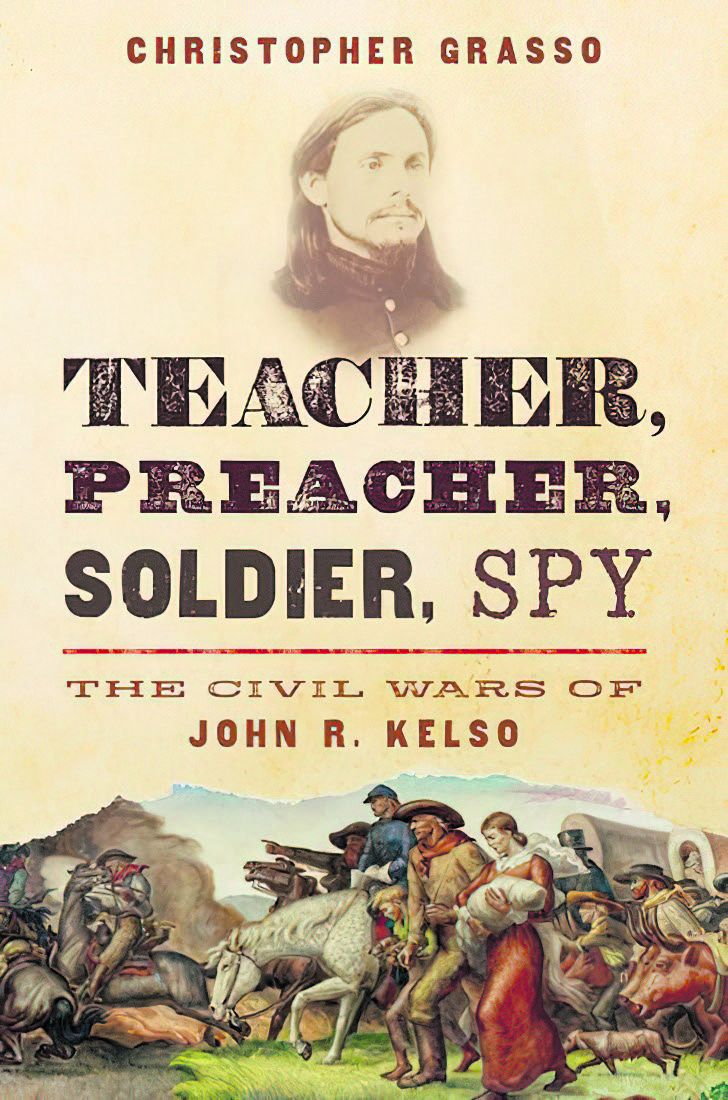
Teacher, Preacher, Soldier, Spy: The Civil Wars of John R. Kelso. Illustrated, notes, index, Oxford University Press, 2021, 529 pp., hardcover, $34.95. Reviewed by Wayne Wolf
significant aspects of the remarkable life of John R. Kelso. In addition to teacher, soldier and spy, he began his adulthood as an avowed Methodist preacher, served one term in Congress from Missouri, authored an extensive autobiography as well as published lectures he gave throughout the country, was a Whig, Radical Republican, and Democrat, dabbled in Spiritualism, and wound up an atheist and anarchist. The Civil War however was the defining event in John Kelso’s life. He joined the 24th Missouri as a private, became a Major in the Home Guard Militia, and a Captain in the 14th Missouri State Militia. His aim in the war was always centered around his belief in universal liberty, abolition, saving the Union, and punishing those who committed atrocities against civilians. He fought at Sugar Creek, Bentonville, Elkhorn Tavern, Neosho, Springfield, Newtonia, and a score of small skirmishes that satisfied his lust for revenge against those he viewed as traitors, bushwhackers, and criminals who roamed southwest Missouri. He bragged about killing 26 rebels with his own hands, engaging in dangerous spy missions for General Samuel Curtis, and witnessing death, horrible hardships, and atrocities at every engagement. The battlefield horrors, and his own wounds, colored his outlook for the remainder of his life. He was always searching to define his own essence, look out for the common man, expose fraud and deceit, engage in hard work, support equal rights for women and Negroes, and cope with the deaths of his two sons, two divorces, and two unhappy marriages. His motto was always to rely on reason, science, and common sense. While he never achieved the greatness he envisioned for himself, in his own way, he embodied the essence of 19th Century America. Christopher Grasso was fortunate to recover the notebooks as well as Kelso’s volume of miscellaneous writings. He has done a commendable job of weaving this new material into previous research on this remarkable man who lived between 1830 and 1891. During his life he experienced the worst of a fratricidal war, was deeply affected by the search for truth in his own life, and was not afraid to alter his stance when science or common sense dictated it. He certainly was the essence of what many young men experienced during the tumultuous years of Civil War, Reconstruction, the Gilded Age, and labor struggles. This is more than the autobiography of a man; rather it is a social, religious, economic, and political look into the last half of the 19th Century. It is highly recommended for any historian searching for the true life of a soldier and civilian who was a man of intense passion in everything he did. Wayne L. Wolf is Professor Emeritus at South Suburban College and the author of numerous books and articles on the Civil War including Two Years Before the Paddlewheel, and The Last Confederate Scout. He is past president of the LincolnDavis Civil War Roundtable and a frequent speaker and lecturer at historic events.
A Warrior Wages Peace
Lincoln and the Fight for Peace. By John Avlon. Simon & Schuster, SimonandSchuster. com. Illustrations, notes, bibliography, index, 354 pp. $30.00. Reviewed by Harold Holzer
Anyone who has watched John Avlon unleash his “Reality Check” commentaries weekday mornings on CNN’s New Day knows the broadcaster can be tenacious even as he advocates for justice and fairness. So, Avlon argues in this compelling new book, was Abraham Lincoln, the peaceloving leader who waged the bloodiest war in our history. Avlon is an insightful historian, as demonstrated by his 2017 triumph, Washington’s Farewell: The Founding Father’s Warning to Future Generations. This was a vivid account of how America’s first president used his last public message to alert his successors to the possibilities, and limits, of power. Having written of the last days of the Union’s founder, Avlon now turns his attention to the last days of the Union’s savior. The result is another superbly researched and convincingly argued page turner, a bold new treatment of a far more complex subject. [Disclosure: I consider the author a friend.]
Unlike Washington, who was chosen President unanimously and enjoyed a prolonged political honeymoon, Lincoln won the White House in 1860 with less than 40 percent of the popular vote, earning no electoral votes at all from the slaveholding South. Immediately confronted by secession and rebellion, not to mention resistance from Northern Democrats, Lincoln opted to fight for the survival of the united nation Washington had helped establish. As in his earlier book, Avlon focuses this study on the concluding days of an iconic presidency. By 1865, when the story picks up steam, victory and reunion were in sight, emancipation declared, the Thirteenth Amendment en route to ratification, and Lincoln’s leadership validated by a handsome, though again regional, re-election mandate. Now, as Avlon describes matters, Lincoln faced a choice every bit as momentous as his earlier decision to wage war: how to wage peace to reunite a country still bitterly divided, but cleansed of the sinful hypocrisy of slavery. As Lincoln would imply in his Second Inaugural Address on March 4, 1865, his options were vengeance toward some or “malice toward none.” Demonstrating his skills as both a reporter and an historian, Avlon shows how Lincoln spent 1865 looking beyond battlefields and political cauldrons toward a coherent, equitable, peacetime order that promised wider participation than ever; Lincoln began championing black voting rights, and discouraged punishment of all but the most prominent rebel leaders. In the closing weeks of the War, Lincoln pursued both the yin and yang of his second inaugural address: “firmness in the right,” by refusing to negotiate on black freedom; and “charity for all,” in encouraging commanders to send defeated Rebel soldiers home with their horses and sidearms. Here was a quest for victory, not vindication. Avlon emphasizes another crucial, often neglected storyline: even as he urged unconditional surrender while contemplating mercy, Lincoln also took himself near the front lines, spending the early spring of 1865 with Grant’s army at City Point, Virginia, close to the besieged and ultimately conquered stronghold of Petersburg. Lincoln insisted on seeing the carnage, sharing in the glory, and defining the peace even as his generals wrapped up the war. In a particularly beautiful account, Avlon describes Lincoln’s emotional, though far from triumphal, visit to the abandoned, smoldering Confederate capital of Richmond on April 4. Exposing himself to danger there from sullen white residents, Lincoln not only walked the streets unafraid; he attracted the adulatory attention of African Americans literally emancipated by the city’s capture only hours earlier. This Lincoln is not a conqueror, but an “instinctive conciliator,” determined to “redeem something from all the blood and loss, if he could reunite the nation and rededicate it to the proposition that all men are created equal.” Avlon’s final hundred pages explore the lost promise of Reconstruction, with considerable blame assigned to Andrew Johnson, “the wrong man at the wrong time.” The book goes even further, offering a long coda on how Lincoln’s humanity and forbearance have inspired 20th century presidents and animated American efforts to confront fascism and later rebuild Germany and Japan after World War II. Avlon hauntingly describes Lincoln’s roadmap to peace as an “unfinished symphony,” but argues hopefully that “in its existing notes, we can find an anthem that can begin to bridge our divisions” or, as Lincoln put it in that extraordinary inaugural address, “achieve peace among ourselves and with all nations.”
Award-winning historian Harold Holzer is Chairman of The Lincoln Forum. He is the winner of the 2015 Gilder-Lehrman Lincoln Prize, is one of the country’s leading authorities on Abraham Lincoln and the political culture of the Civil War era.
Reviewed by Jeffry D. Wert
From its beginnings in the years and decades after 1865, the history of the Civil War has generated a vast literature. Steeped in controversies, the conflict has been fertile ground for clashing interpretations on individuals and on events, to a degree not understood by other historians. That argument may have some merit but, from the day Lee took command of the army on June 1, 1862, he understood that the war was a struggle between democratic societies. He recognized that the attainment of independence for the Confederacy rested with its armies’ battlefield successes that might break the will of the northern populace to sustain the war effort. Although political implications of operations mattered to Lee, the Confederate commander sought victory on battlefields, first and foremost. The author contends further that Lee’s decision to offer battle behind Antietam Creek was a “culmination” of the desire to incite a civilian revolt, (p. 36) by then, however, Lee and his men knew that Marylanders were not going to rebel nor were thousands of them joining the army. According to the author, Lee always intended to confront the Federals in the Hagerstown Valley despite evidence that the army’s vanguard was heading toward Pennsylvania until South Mountain. It seems more credible, as other historians have argued, that Lee refused to abandon the campaign without engaging the enemy. In other chapters the author examines the sources and presents his views on the famous photograph of Confederate infantry in Frederick, asserting convincingly that it was taken in September 1862, not July 1864. He devotes a chapter to where the army’s units camped around Frederick from September 6-10; another on Lee’s whereabouts during the battle, and the civilian reaction to the army’s presence in their state. The author briefly discusses several additional topics in appendices, including sketches of the Potomac crossing by three contemporary artists; who lost Special Orders No. 191 (postulating it was William Nelson Pendleton); Confederate straggling in Maryland; contrabands seized at the surrender of Harper’s Ferry; and when did Lafayette McLaws’s division arrive on the battlefield on September 17. The appendices add to the book’s merit. Rossino concludes that the 1862 Confederate Maryland campaign resulted in a “disastrous close,” arguing that Antietam was a defeat for Lee and his army. (p. 261) “The failed secessionist dream [of a revolt in Maryland] heralded the end of the beginning for the Confederacy,” and brought the rebellious nation “closer to its ultimate ruination.” (p. 262) The book is well-researched and very well-written. Although many students of the four-year conflict may differ with Rossino’s interpretations, the work deserves an audience. History merits also the removal of “moss.” Jeffry D. Wert’s forthcoming book is The Heart of Hell: The Soldiers Struggle for Spotsylvania Bloody Angle, and will be available summer 2022, from University of North Carolina Press.
military, political, economic, and social. Nothing, however, seems to stir the embers of disagreement among historians and students of America’s greatest saga than battles and campaigns. This new book by Alexander B. Rossino covers seven distinct subjects about Confederate operations in the Maryland Campaign. The author’s purpose is to offer his interpretation on these subjects. In his judgment, previous works have been plagued by historians’ “flawed readings of sources,” which is compounded by the “moss” that accumulates over historic events across the years. Consequently, “timeworn” ideas persist, encrusting the interpretations of the past. (p. x) The author’s primary argument addresses the motives of Robert E. Lee for taking his worn out and depleted ranks across the Potomac River into Union territory. He believes that previous interpretations have failed in weighing the importance of the campaign’s political aspect. Lee and the army’s rank and file believed the widespread notion that Maryland’s citizenry only awaited a Confederate presence to revolt and give allegiance to the Southern cause. The author maintains that Lee combined military and political objectives
Operations in the Maryland Campaign Their Maryland: The Army of Northern Virginia from the Potomac Crossing to Sharpsburg in September 1862. By Alexander B. Rossino. Illustrations, maps, notes, bibliography, index, 309 pp. 2021. Savas Beatie, www. savasbatie.com. $32.95.
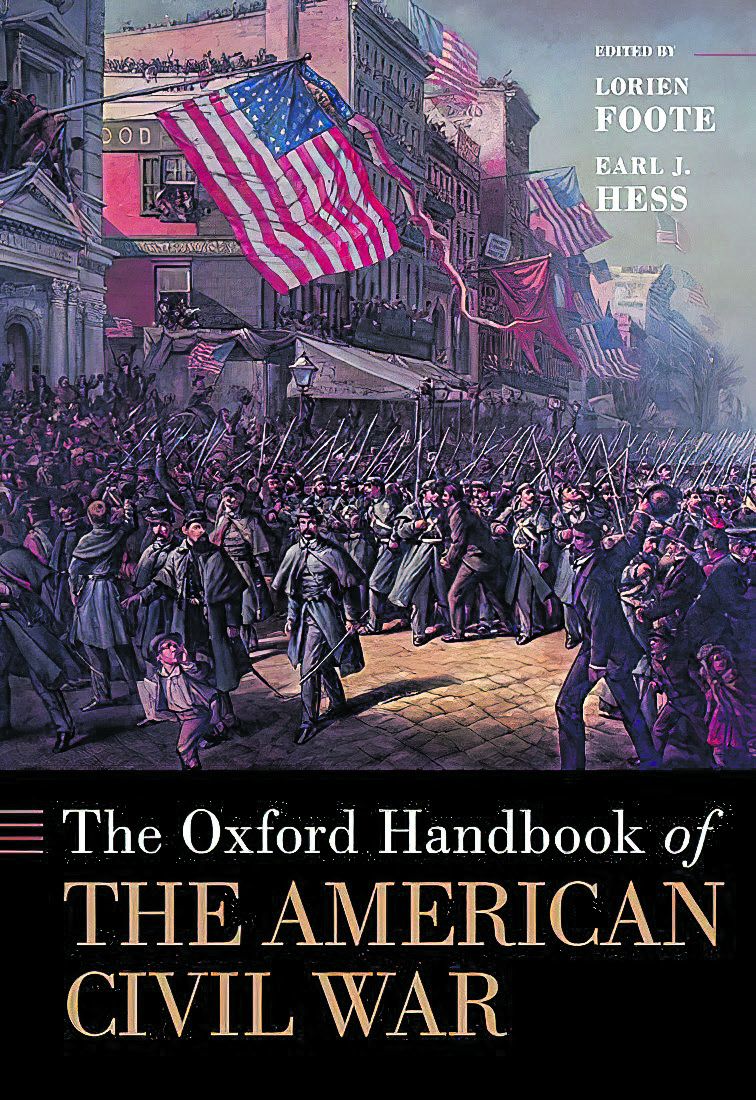
Integrating Military and Social History The Oxford Handbook of the American Civil War. Edited by Lorien Foote and Earl J. Hess. Maps, endnotes, bibliography, index, 696 pp., 2021. Oxford University Press, www.oup.com. $150, hardcover. Reviewed by Gould Hagler
According to the Oxford There are more books in this series than I could conveniently count. The range of subjects is vast, from cuneiform culture to environmental law, from Japanese linguistics to…the American Civil War. A perusal of the catalog indicates that the handbooks are intended primarily for specialists. Scholars would obviously be the market for a volume on Japanese linguistics, but books on the Civil War have a much wider market. This review will assess the work for the general reader. The Oxford Handbook of the American Civil War consists of 39 brief chapters written by 36 different historians, including five by Hess and one by Foote. Most chapters cover a single campaign. Others tackle Bleeding Kansas, the Union blockade, and the postwar occupation of the South. In their introduction the editors explain that the book’s aim is to integrate the narrative of military events with other aspects of the conflict. This handbook, they write, “focuses on military power and what happened to the people, animals, and environments that encountered it.” To tell us more specifically “what happened” as a consequence of the application of this military power, the authors discuss, inter alia, emancipation; refugees; the role of women; the effects of war on politics and of politics on war; long- and shortterm impacts on demographics and economies; guerrilla warfare; devastation of farmland and towns; the morale of soldiers and civilians as the winds of war shifted; and the service of blacks in the Union army. The editors’ introduction is perhaps the strongest part of the book. Foote and Hess discuss the various events interconnected with the military side of the war and argue that the “war and society” approach to military history “enriches the study of war through integrating its social and cultural elements.” Their ample endnotes discuss decades of literature on virtually every aspect of the war and the different approaches taken by historians from the late 19th century to the present. In a short review I cannot discuss individual chapters in detail, but those I found of particular interest include Hess’s chapter on Grant’s North Mississippi Campaign; Wilson Greene’s on Petersburg; Thomas Cutrer’s on the war in 1862 Arkansas; and Kenneth Noe’s on the Kentucky Campaign of 1862. Excellent maps by Hal Jespersen accompany each chapter. Before wrapping up, I must point out some of the weaknesses of this book. The first is a matter of style. In the context of the Civil War, the word “slaves” has a single and unambiguous meaning. Some contributors pepper their narratives with polysyllabic circumlocutions, such as “enslaved African Americans.” Good writing is economical. The use of nine syllables to do the job of a perfectly serviceable onesyllable word is not economical. Other shortcomings are more substantive. One is tiny, but will be noticed by anyone likely to read the sentence in which the mistake occurs: President
Jefferson Davis’s middle initial is not “C.” In another place I wondered how something in the Official Records of the Union and Confederate Navies relates to the matter being discussed, so I checked. The volume cited in the note does not exist: the ORN does not have a series 4, vol. 2. One note out of hundreds, I know, but I checked only a small sample. In some places sources are bunched up in a single note and it is not clear which source goes with which item in the text. In addition, some things in the text that call for a reference don’t have one at all. Several times I thought “hmm, that is interesting, I would like to learn more,” but I received no help. These shortcomings are only mild distractions, but some readers will think that a book that retails for $150 should have fewer of them. I must stress, however, they are not so numerous or so serious that they detract from the value of this well-done series of essays. For the general reader the book offers an overview of the war, campaign by campaign, in easilydigested chapters with useful bibliographies following each one. Many readers will know very little about some of the campaigns, and will be introduced to some things new and interesting. As for the better-known campaigns, readers who are familiar with, say, the Overland Campaign or Chancellorsville, will find that there is still a lot more to learn. Gould Hagler is a retired lobbyist living in Dunwoody, Ga. He is a past president of the Atlanta Civil War Round Table and the author of Georgia’s Confederate Monuments: In Honor of a Fallen Nation, published by Mercer University Press in 2014. Hagler speaks frequently on this topic and others related to different aspects of the Civil War and has been a regular contributor to CWN since 2016. He can be reached at gould.hagler@gmail. com.