Bissonnet Cavalry Officer’s Sword
By Shannon Pritchard · Originally published May 2022 · p. 29
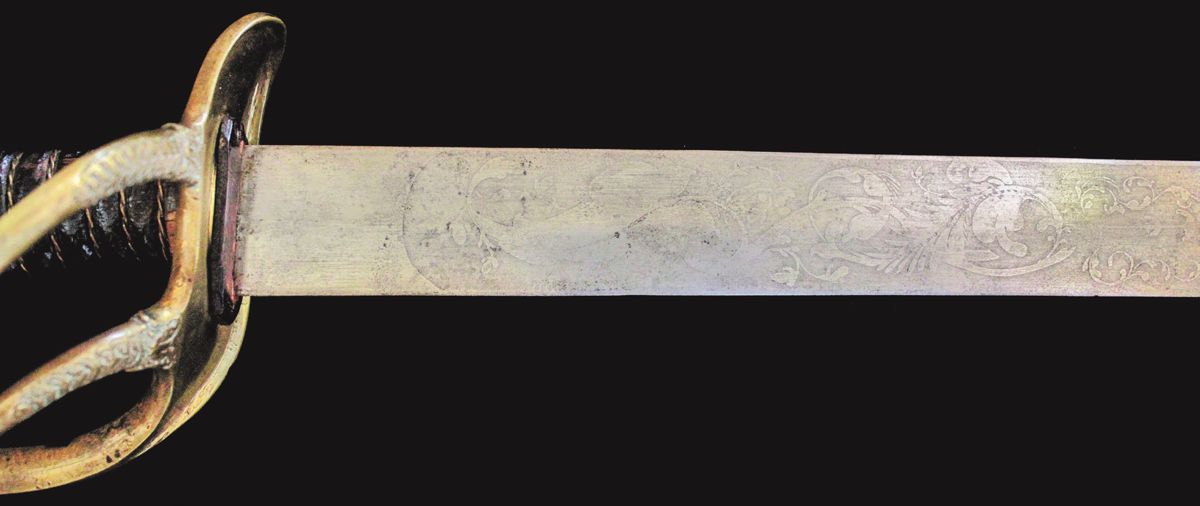
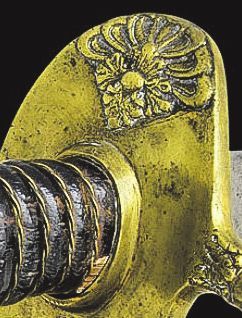
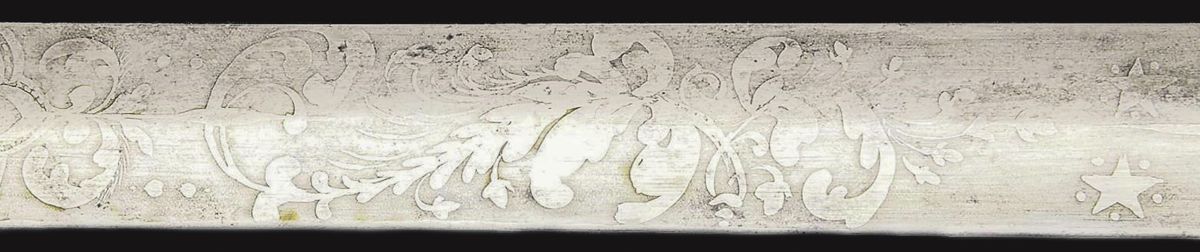
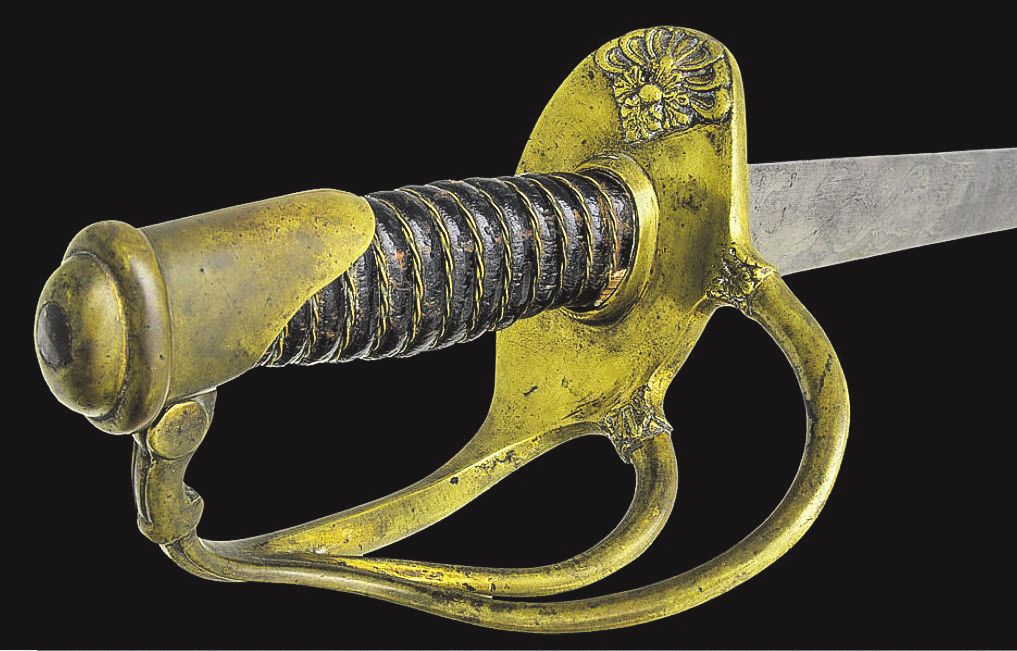
This beautiful Confederate cavalry officer’s sword is signed by the artist near the ricasso where an elegant script inside a scroll reads: “L. Bissonnet / maker / Mobile Al.” Though Bissonnet swords are recognized by Confederate collectors as being among the very best quality swords made in the Confederacy, and his blade etchings are second to none, almost nothing has been published about this obscure man. He etched in a distinct rococo style; in fact, Leech & Rigdon’s swords with rococo etching are often mistakenly sold as Bissonnet products, simply because they have rococo etching. Bissonnet was an artist, and he signed his art; not only are the Leech & Rigdon swords unsigned, but careful study reveals that they were executed by a much less talented artisan and lack the distinctive “fingerprint” of his fine etching. This cavalry officer’s sword has a 36 ¼ inch double-edged straight blade, with etched panels exceeding twenty inches. It is decorated with large stars and foliate scrolls embracing a five-inch panel etched with the Latin phrase: “Patrie Honneur,” which translates roughly to Country’s Honour. The sword’s hilt is decorated with a clamshell pattern in relief, borrowed from Bissonnet’s French homeland; the branches have a foliate design in relief. It is sheathed in its original solid brass scabbard. Louis Laurent Bissonnet was born in France in 1823. He immigrated to the United States in 18571 through Mobile, Ala. In 1860 he was living in Hardin, Texas.2 Sometime in late 1861, Bissonnet had relocated to Mobile, which he had known since his arrival. With the coming of war in 1861, he changed his business model and offered officer’s swords for sale at 86 S. Wilk Street, Mobile, while plying his trade as a jeweler. At that time the Mobile Directory spelled his name Bissonnette; however, he signed his name “Bissonnet.”
At the time Albaugh’s Confederate Edged Weapons was written in 1960 only a single example of his work was known. Since that time other examples, including cavalry, foot, and staff officer swords have been identified. Still, they are extremely rare. Since Bissonnet appears to have been a jeweler and etcher, rather than a cutler, it seems likely that he was buying parts and assembling them, or possibly acquiring complete swords to embellish. He may have relied upon Mobile sword maker James Conning to provide some completed swords, or to assemble parts that Bissonnet acquired elsewhere. It is also possible that Bissonnet purchased cast hilts from sources like Leech & Rigdon and had them mounted on blades by Conning. I have also viewed a French sword etched, altered, and signed by Bissonnet. In any case, it seems quite likely that Bissonnet was the decorator, etcher, retailer, and possibly the assembler of swords that bear his name, but not the actual manufacturer. In 1866, with no market for arms or jewelry, Bissonnet became a grocer in Mobile.3 By 1870 he had returned to Texas and set up shop as a jeweler and gunsmith in Houston, where he remained until his death in 1889.4 He is buried in Houston’s Washington Cemetery.

(Courtesy of OldSouthAntiques.com)
Endnotes: 1. Mobile, Alabama Naturalization Records, Gateway Press 1986 2. 1860 Federal Census 3. Mobile City Directory 1866 4. 1882/1884/1886 Houston City Directory
Shannon Pritchard has authored numerous articles relating to the authentication, care and conservation of Confederate antiques, including several cover articles and is the author of the definitive work on Confederate collectibles, the widely acclaimed Collecting the Confederacy, Artifacts and Antiques from the War Between the States, and is co-author of Confederate Faces in Color.