
Through The Lens
I Shall Never Forsake My Guns
By Stephanie Hagiwara · Originally published March 2022 · pp. 14–15
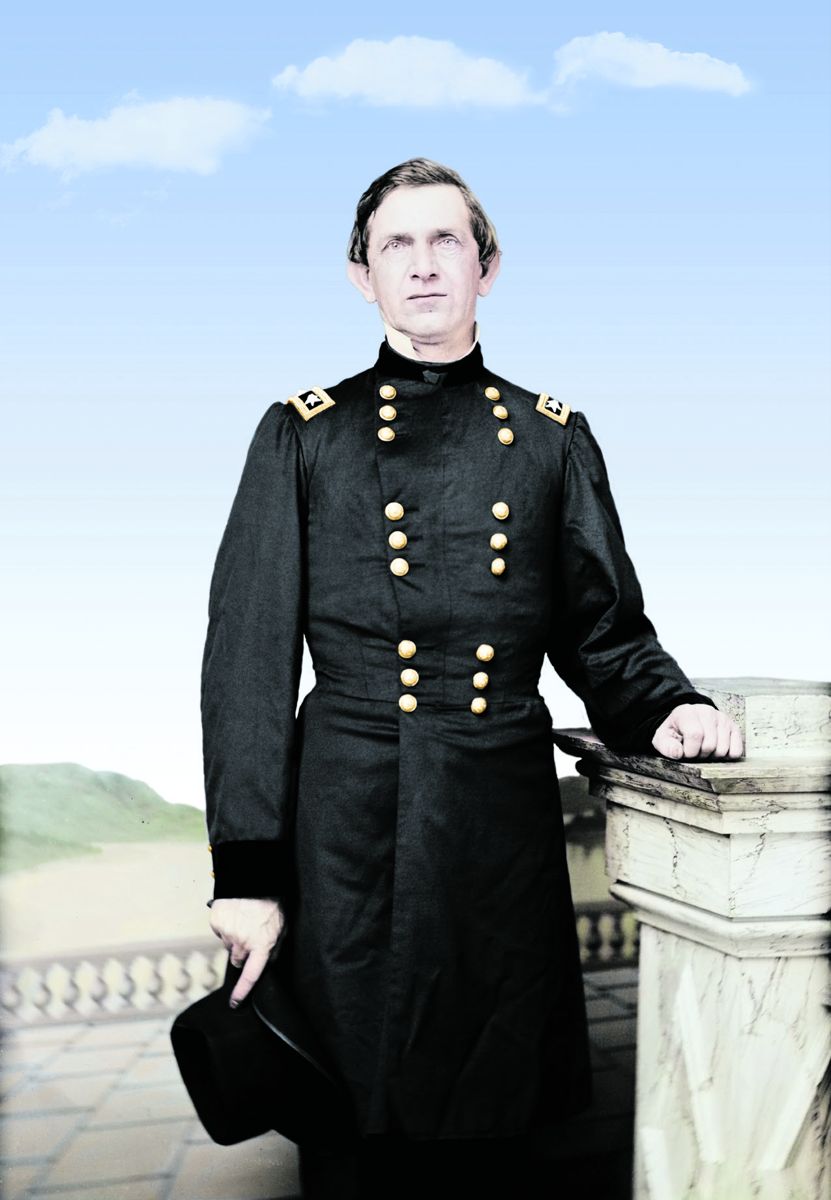
I Shall Never Forsake My Guns Battle of Valverde, N.M. – Part II “Boys, you’ve come too far from home hunting a fight to lose. You must win tomorrow, or die on the battlefield.” – C.S. Col. Thomas Green, 5th Texas Cavalry Regiment In February 1862, C.S. Gen. Henry Hopkins Sibley’s Army of New Mexico was in dire straits. His Texas supply base was hundreds of miles away. Sibley’s assumption that the residents of the New Mexico Territory would donate food and animals to the cause proved false. On February 16, Sibley failed to lure the Federals out from behind the thick walls of Fort Craig, N.M., to seize their supplies. The Army had to act or starve. U.S. Col. Edward R. S. Canby who had been monitoring the Confederate movements, was able to block access to the high ground and the Rio Grande. Career soldiers Canby and Sibley attended West Point at the same time, fought in the MexicanAmerican war, and recently served together in the New Mexico Territory. Unlike Sibley, Canby excelled in administrative skills and, according to a captain, “A more attentive, careful officer never strode a horse. He attends strictly to his duty, times the step, sees that everybody is cared for, and comes up to my idea of a field officer.” The February 21, Battle of Valverde, N.M., began sometime around 7 a.m. at a strategic river ford five miles north of Fort Craig. Confederate scouts from Maj. Charles Pryon’s, 2nd Texas Mounted Rifles, sent word that they reached the river and “no Union troops in sight,” not realizing that the Federals had reached the river first. Emerging from the cottonwood trees, the Federal scouts shouted in Spanish, “There are the Texans— look out!” The Federal artillery and infantry raced into action. From behind the sandhills, the Confederates shot back. Lt. Col. William “Dirty Shirt” Scurry’s 4th Texas Mounted Rifles joined the shooting match. By early afternoon more troops from both sides arrived. Sibley, suffering from alcoholism, turned over command to Col. Thomas Green, 5th Texas Mounted Rifles. Around 2 p.m., Green spotted
U.S. Capt. Theodore Dodd’s, Company B, 2nd Colorado Volunteers, approaching the field. Dodd’s 71 men were dressed in new grey shirt uniforms instead of the standard blue. Green misjudged them as untried volunteers. Green assigned the 5th Texas Mounted Volunteers, Capt. William Lang’s Texas Lancers, to attack them. Lang’s company had not been trained how to fight with their lances. They were nine feet long with 3- by 12-inch blades topped by large pennants mimicking the original Texas flag of red with a white star in the middle. Sibley had seen the 18th century technology used during battle in the Mexican–American War, admired the sight, and procured 200 lances while equipping his army with any other weapons he could acquire. Dodd’s company was getting in position when about 50 galloping horsemen suddenly appeared out of the woods. They charged emitting the “bloodcurdling rebel yell,” the blades on their spears gleaming, and pennants waving in the wind. Dodd’s West Point anticavalry charge training kicked in. He formed his men into a hollow square, two deep, the first rank kneeling with their bayonets; the
Map of the Battle of Valverde from the Official Records Atlas. second rank behind them standing up, waiting with their guns, ready to shoot. “Steady there my brave mountaineers!” Dodd yelled. “Waste not a single shot. Do not let your passions run off with your judgment. … Guns to faces but wait for the command to fire.” The Federals were silent as the Lancers advanced, anxiously waiting until they came within 40 yards. Dodd yelled, “Fire! They’re Texans! Give ’em hell!” The first volley “… sent many brave Texans to bite the dust; many horses were riderless. … After the second volley there were but a few of them left and but one of them got away,” wrote Pvt. Alonzo Ickis. The Coloradans took advantage of the confusion to bayonet and club their foe, ending the only lance charge in the War. Canby reached Valverde about 2:45 p.m. He decided to end the stalemate by assaulting the Confederate left with Maj. Thomas Duncan’s, 3rd Cavalry Regiment, 1100 men and a single 24-pdr. howitzer, and anchor the Federal left with the six-guns and 85 men of career soldier Capt. Alexander McRae’s, 3rd Cavalry Battery. Snow flurries drifted down. “Under all military rules and science we were whipped,” Pvt. William Lott Davidson, 5th Texas wrote. “Outflanked on our right, outnumbered more than two to one in the center and an enfilading fire on our left…” Green disagreed. He sent 250 men from Maj. Henry Raguet’s, 4th Texas to counter Duncan’s advance. Duncan requested reinforcements. Canby sent four companies of infantry to support Duncan, creating a hole in the center of the Federal line. Green sent 750 men from the 4th and 5th in three waves through the center, targeting McRae’s battery that had been moved up 150 yards near a grove of trees. During the eight minutes it took the Texans to reach his battery, McRae fired four or five rounds per gun, rifles, and muskets. A Texas officer, is said to have shouted, “Surrender, McRae, we don’t want to kill you!” McRae, his arm shattered, replied, “I shall never forsake my guns!” McRae was felled by a fatal head wound. “Artillerymen threw lighted fuses into the limber boxes. One of these brave soldiers is said to have leapt atop the caisson and shouted, ‘Victory or Death!’ just before coolly shooting his pistol into the ammunition chest.” As the Federals began a countercharge, Canby realized that “to prolong the contest would only add to the number of our casualties without changing the result,” and sent orders to retreat. Some men marching off the field in parade formation, did not realize they had lost the battle until after they reached Fort Craig. Others accused Canby of being a traitor for retreating prematurely. The shooting stopped at dusk. Many Confederates hadn’t had anything to eat or drink for 24 hours and a significant number of horses were dead. Under a white flag, Canby sent a request for a two-day truce to collect the dead and wounded due to the lateness of the hour and the winter night. Green made the decision not to pursue the Federals. The Confederates had won a “Pyrrhic” victory that they internationally touted as “brilliant.” McRae’s captured three 6-pdrs. and two 12-pdrs. became the “Valverde Battery.” The Confederates suffered 230 casualties; 72 dead or mortally wounded, 157 wounded, and 1 prisoner, a 10 percent casualty rate. The 4th Texas Mounted Volunteers “voluntarily” became an infantry unit due to their heavy loss of horses and mules. Worse, the Confederates were down to five days of rations. Sibley was “heartily despised by every man in the brigade for his want of feeling, poor generalship, and cowardice,” and never led his brigade in battle in
CivilWarNews.com New Mexico again. Federal casualties, despite Canby’s tactical withdrawal, stood at about 475; 111 dead, 160 wounded, and 204 missing, about 17 percent. Canby still held Fort Craig and the Federal supplies, and sent for reinforcements. Sibley knew he couldn’t capture the fort but still had ideas. On February 22, George Washington’s birthday, Sibley demanded the surrender of Fort Craig. Canby replied that if the Confederates wanted the fort, they would have to take it. Instead, supplies known to be in Albuquerque, Santa Fe, and Fort Union, New Mexico, enticed the Confederates to head north. Correction: Part I stated at 300 miles it was the longest march the Confederates had yet made during the War; the march was over 600 miles. Sources: ✤
Taylor, John. Bloody Valverde: A Civil War Battle on the Rio Grande, February 21, 1862,
✤
✤
✤
✤
University of New Mexico Press, 1999 Nelson, Megan Kate. The Three-Cornered War: The Union, the Confederacy, and Native Peoples in the Fight for the West, Scribner, 2020 Whitlock, Flint. Distant Bugles, Distant Drums: The Union Response to the Confederate Invasion of New Mexico, Univ. Press of Colorado, 2006 Thompson, Jerry D. A Civil War history of the New Mexico Volunteer, University of New Mexico Press, 2015 Edrington, Thomas S., Taylor, John M. The Battle of Glorieta Pass: A Gettysburg in the West, March 26-28, 1862, University of New Mexico Press, 1998
Stephanie Hagiwara is the editor for Civil War in Color.com and Civil War in 3D.com. She also writes a column for History in Full Color.com that covers stories of photographs of historical interest from the 1850’s to the present. Her articles can be found on Facebook, Tumblr and Pinterest.