
The Unfinished Fight
Trotter Knapsack
By Craig L. Barry · Originally published June 2022 · pp. 10–11
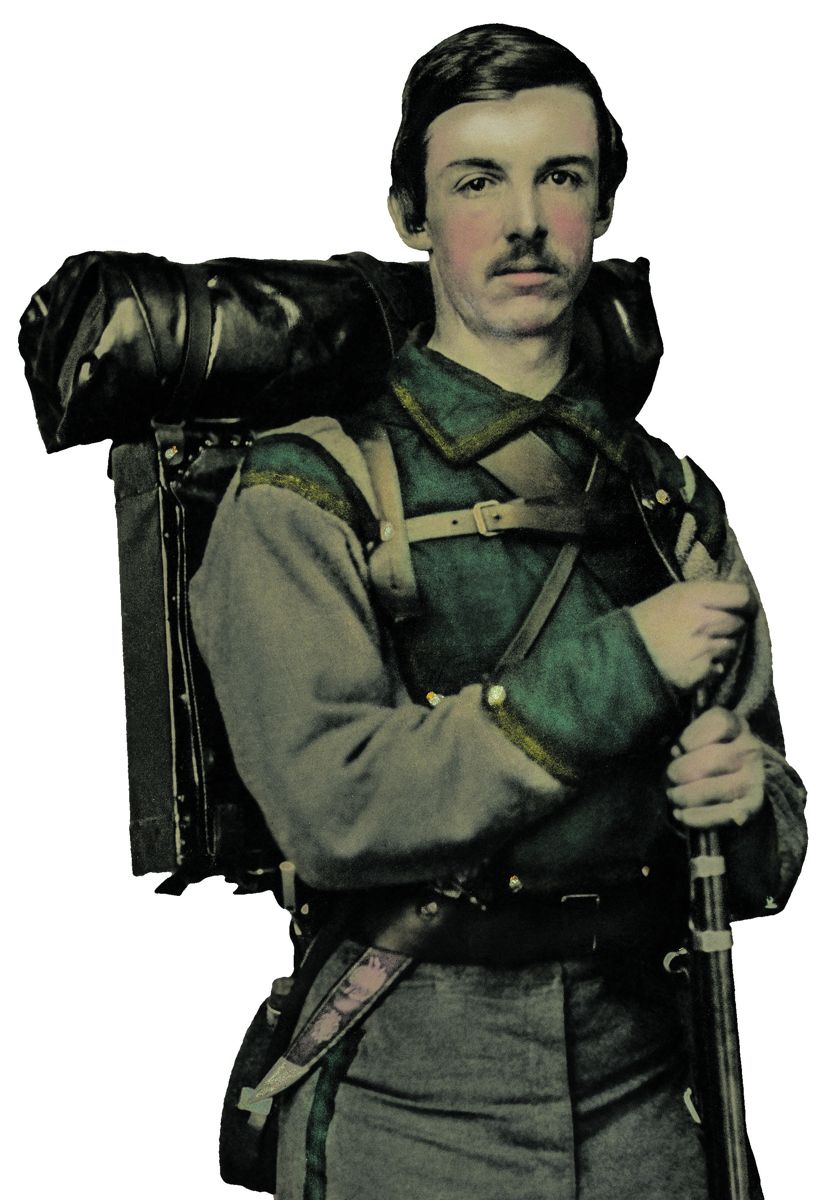
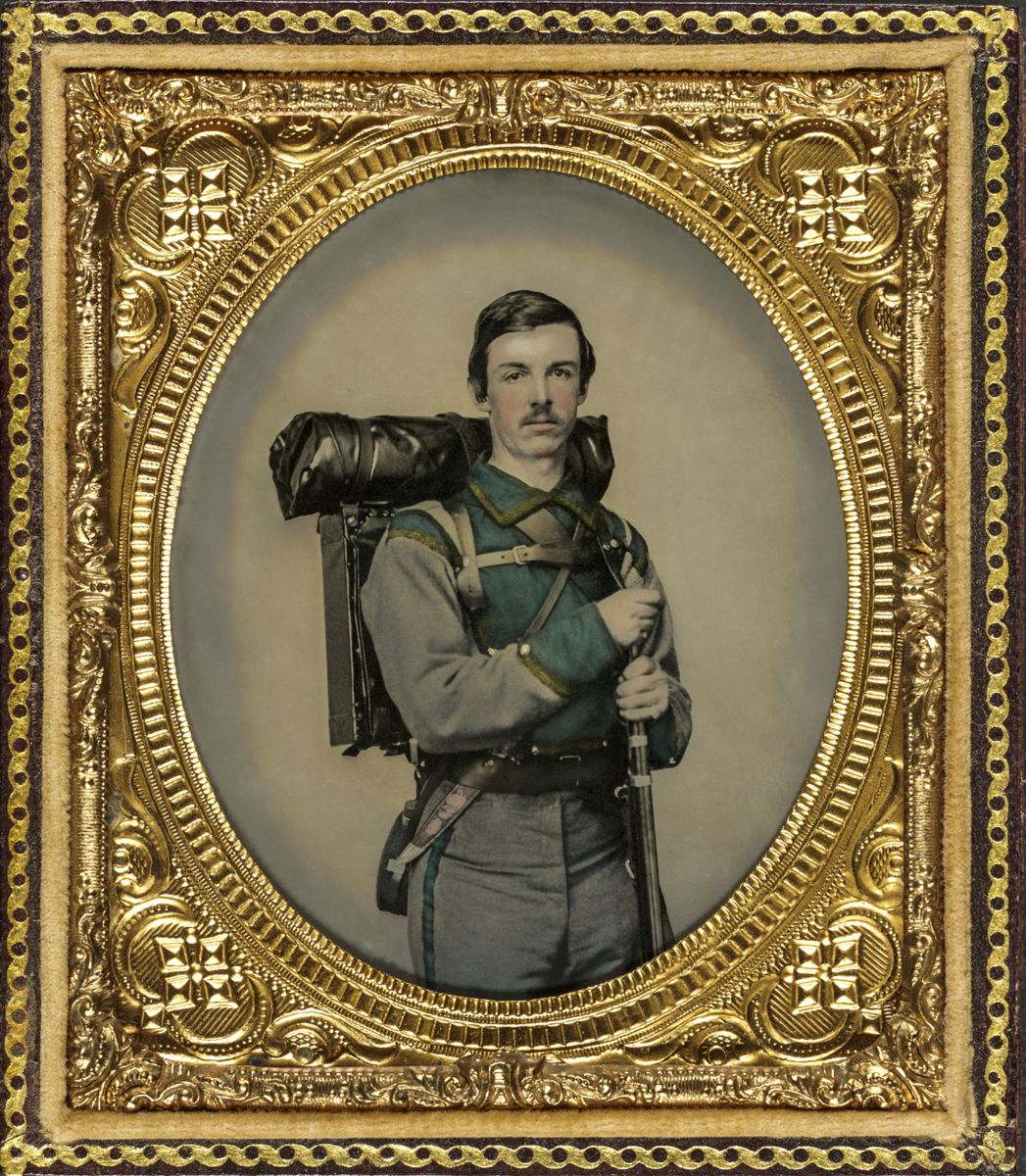
Trotter Knapsack Another common Confederate type knapsack was an imported version from Britain called the English pattern of 1854, or “Trotter pack,” an example of which is on display at Shiloh NPS Battlefield. The British knapsack was named after John Trotter, who designed his first version in 1805. There were two patterns of the Trotter; the first was made of lacquered canvas supported by a wooden frame so that even when empty the packs would “look uniformed.” Today, there are surviving examples without the frame. The pack was fastened to the back by two shoulder straps which were fixed to the top and bottom. These two straps where then connected by a strap across the front of the body.
The second pattern was the British pattern of 1854, the socalled “Box Knapsack.” The Trotter pack was designed to be used with the wood frame inside as the corners were shaped to the contours of the frame. S. Isaac, Campbell & Company of London exported this version by the thousands to the Confederacy. According to surviving documents dating to November 1861: “(General) Johnston’s forces may have received upwards of 3,500 sets of British accoutrements and 1,000 or more knapsacks and mess tins. The single surviving invoice from the second of three known shipments of British equipments to Nashville during this time frame lists: 816 knapsacks & straps, and 816 mess tins & covers, 2,206 pouches [816 of which were described as “buff”], 1,266 buff pouch belts, 1,116 buff waist belts, 1,326 buff frogs, 1,916 buff rifle-musket slings [the buckle type], 1,434 ball bags [816 of which contained zinc oil bottles], 190 loose oil bottles, 500 box straps, 587 brushes, and 3,019 bayonet scabbards. Additional knapsacks and other equipment may have reached New Orleans around this same time period via the recaptured blockade runner Joseph H. Toone. Sailing from Cuba to the Gulf Coast, the vessel was loaded with a cargo of Enfield rifles and (rifle) muskets, “knapsacks with straps” and other stores when she was overhauled on October 4, 1861…Having [not] yet been sent north to the prize courts, the Toone was “recaptured by the enemy on the Mississippi River” on October 12, with apparently most of her cargo intact. In the months preceding its fall [in 1862], hundreds of [British] “knapsacks with straps” were issued at New Orleans, perhaps representing a portion of the Toone rescued cargo. Shipments of equipments to the west continued after the fall of Nashville and the convergence of the armies near the TennesseeMississippi border… Between May 2nd and June 15, [1862] McCown’s Division received some 1,800 knapsacks and sets of [British] accoutrements in addition to
CivilWarNews.com hundreds of British muskets. At Corinth on May 25, 1862, Lt. John T. Buck, Ordnance officer for the 1st Division, 1st Corps, Army of the Mississippi, received 450 knapsacks and 30 enameled haversacks from McMain…and recorded the [total] issuance at Corinth of 13,432 knapsacks during the second quarter of 1862, the bulk of which were apparently received in the months of May and June. Domestic manufacture naturally predominated…A considerable amount of British knapsack hardware has been found in Northeast Mississippi…a series of additional relic finds and contemporaneous documents indicate the significant presence of English knapsacks either on Beauregard’s early summer departure from Corinth [approximately May 29, 1862] but the majority was seemingly associated with Sterling Price’s Army of the West, Van Dorn’s forces, and the Iuka-Corinth campaigns of Fall 1862.” Sam Pittman of Co. K, 34th Arkansas carried one of the imported Isaac, Campbell & Co. Trotter wood frame knapsacks that he was issued in November 1862. He remembered distinctly how he lost it, “…And now came the parting with my old knapsack and all its equipage. The first shot that was fired after we rose up, cut the strap that bound the knapsack to my right shoulder, and it swung around and slipped to the ground. I had no time to think of it, but when I remember the torture it had been and the loss of all my worldly goods, camp treasure, etc. I bitterly lamented the fate that caused me to lug it all over that weary trip and then turn it over to the enemy.” Probably not all his “worldly goods” were lost, but a substantial amount of gear could be packed in a knapsack. The contents often included an issue wool blanket, oilcloth, or gum blanket, and a spare pair of socks. In addition, a “housewife” or needle case… some soldiers claimed “this was the most important single article carried,” as the “ragged Confederate” is an enduring image but still a myth. The fact is that Southern men kept their clothes mended and replaced lost buttons whenever possible to maintain a presentable appearance. All military men were civilians before they were soldiers, and most Southern men of the Civil War-era were not shabbily dressed tatterdemalions.
An early war Confederate infantryman, who is thought to be a member of Company E of the “Lynchburg Rifles,” 11th Virginia Volunteers, based on other identified images. He poses with a US Model 1841 “Mississippi” rifle with sling, a Sheffield Bowie knife, canteen, Trotter box knapsack, blanket roll, and a holstered revolver. The hand tinted photograph is a very fine example by photographer Charles R. Rees of Richmond, Va., who was known for his high-quality photographic skills. The soldier is wearing a ring on the right pinkie finger. Liljenquist Family Collection of Civil War Photographs (Library of Congress).
In addition, a muslin “huck” towel, toothbrush and a couple of small poke bags holding personal items like soap, a clay pipe, and a twist of Virginia tobacco. These were not all necessaries, but certainly were useful to have on hand. The two long straps in the back go over the flap and secure at the bottom rear of the pack. It has been found that crossing these across the back of the flap helps to keep things from shifting while on the march. The two shoulder straps attach to the bottom front of each respective side. There is a small strap that goes across the chest to help distribute the load a little more evenly across the shoulders. Soldiers found out that with any new pack, the leather straps had to be broken in to avoid misery the first time out. Confederate Arsenal knapsacks were apparently supplemented with the imported British Trotter packs. The Army of Tennessee carried an unknown, but apparently significant, amount of British equipment during General Braxton Bragg’s invasion of Kentucky in the late summer of 1862. What the figures suggest is that while some AoT soldiers lost or got rid of their knapsacks on the march, just as some lost or got rid of canteens, very few if you notice, blankets, greatcoats, and revolvers. However, a significant majority kept them for the entire campaign season.
CivilWarNews.com In the overwhelming majority of first-hand accounts researched for this article, surviving information in letters and diaries suggests that many Confederate soldiers on campaign preferred a knapsack to the alternative blanket roll and were disappointed when they were lost. The key to the utility of this piece of equipment was not to overload it to the point of discomfort. The “fresh fish” exhausted by their first long march received ribbing from the seasoned veterans, who had learned to make the difficult decisions of what had to stay and what could be discarded. A Virginia soldier on campaign recalled, “The marching we had now done made all of us discard everything but necessaries, and we began to think that Ritchie Green did a very smart thing, when we left Richmond, to carry nothing in his knapsack but one paper collar and a plug of tobacco!” The veteran Confederate soldier found it critical to learn how little he could get along with and still be somewhat content while on campaign. One Stonewall Brigade soldier recalled just after the retreat from Kernstown when they rested in the Luray Valley during mid-April 1862, “The day we reached here Gen. Jackson ordered all the wagons containing tents and extra baggage to the rear, and so far that we have never saw them again! This was a hard blow to us, since we had gotten in the habit of smuggling many articles into our tents to avoid carrying them and when our tents left, they had dress coats, underclothing, etc., in them. “Old Jack” flanked us that time.” The problem was, of course, that with the tents gone, so was most of the camping gear. It was not yet springtime in that part of Virginia, and it snowed during the week spent in the Luray bivouac. After recuperating about a week, the Second Corps departed for Port Republic, and just as before, they were under “light marching orders.” It would be about a month or six weeks before they were reunited with their baggage, a short while after the Valley Campaign concluded. In the absence of a knapsack, on campaign under Jackson’s version of light marching orders, the blanket was used instead. The blanket roll was fashioned very simply. “The socks and drawers were placed in the blanket, the blanket was rolled up with the rubber cloth on the outside, the ends drawn together and fastened with a short strap. To carry this we put it over the head and let it hang from the shoulder.” Craig L. Barry was born in Charlottesville, Va. He holds his BA and Masters degrees from UNC (Charlotte). Craig served The Watchdog Civil War Quarterly as Associate Editor and Editor from 2003–2017. The Watchdog published books and columns on 19th-century material and donated all funds from publications to battlefield preservation. He is the author of several books including The Civil War Musket: A Handbook for Historical Accuracy (2006, 2011), The Unfinished Fight: Essays on Confederate Material Culture Vol. I and II (2012, 2013). He has also published four books in the Suppliers to the Confederacy series on English Arms & Accoutrements, Quartermaster stores and other European imports.