
The Graphic War
The Home Front
By Salvatore Cilella · Originally published June 2022 · pp. 32–33
The Home Front The Graphic War highlights prints and printmakers from the Civil War discussing their meaning and the print maker or artist’s goals. Along with their efforts showing the carnage on fields of battle, northern printmakers also attempted to appeal to those the soldiers left behind. Imaginary views of the home front became important to the families anxious for their loved ones, many away from home for the first time in their lives. The illustrations, artfully composed to show hearth and home, offered comfort to those left behind. They also allowed the viewers to hope for an ultimate reunion with their returning veterans, usually Federal troops. After the war, with reconstruction and the hope of reconciliation in the air, artists continued to depict the hero returning home. Artist Trevor McClurg was once such entrepreneur. Trevor was the eldest son of Pittsburgh steel foundry owner and politician, Alexander McClurg (1816–1893), a recent immigrant from Ireland. He was one of five children who included a brigadier general, military advisor, and a publicist/bookseller, Alexander Caldwell McClurg. By 1838, Trevor McClurg was exhibiting along with Emanuel Leutze (who painted Washington crossing the Delaware) at the Fourth Annual Exhibition of the Artists’ Fund Society in Philadelphia. Three years later, “he traveled to Düsseldorf with Leutze to study painting at the Royal Prussian Art Academy.” He was one of the “first Americans to be trained there.” McClurg returned to the United States around 1846. Until about 1859 he lived in Pittsburgh, then moved to New York City.
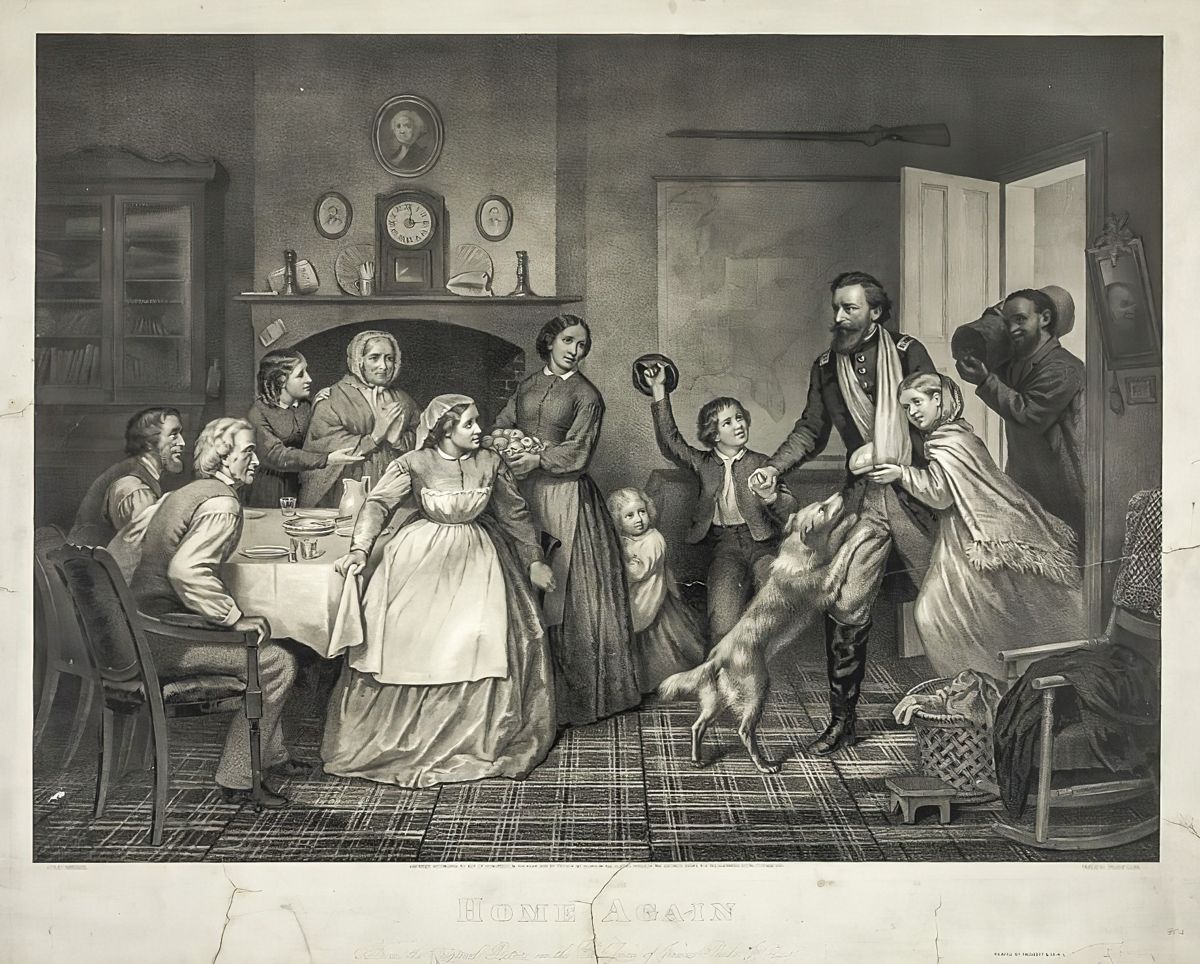
He returned to Pittsburgh in 1863 where he ran a drawing school until 1865. By 1877 McClurg had moved with his family to Chambersburg, Penn., where he turned to photography professionally.1 The local newspaper, the Pittsburgh Weekly Gazette called McClurg’s drawing of Emmanuel Leutze on exhibit in a local gallery “the most superb specimen of graphite drawing we have ever seen, and we believe that, without exaggeration, it is the finest ever produced.”2 His painting “Home Again,”
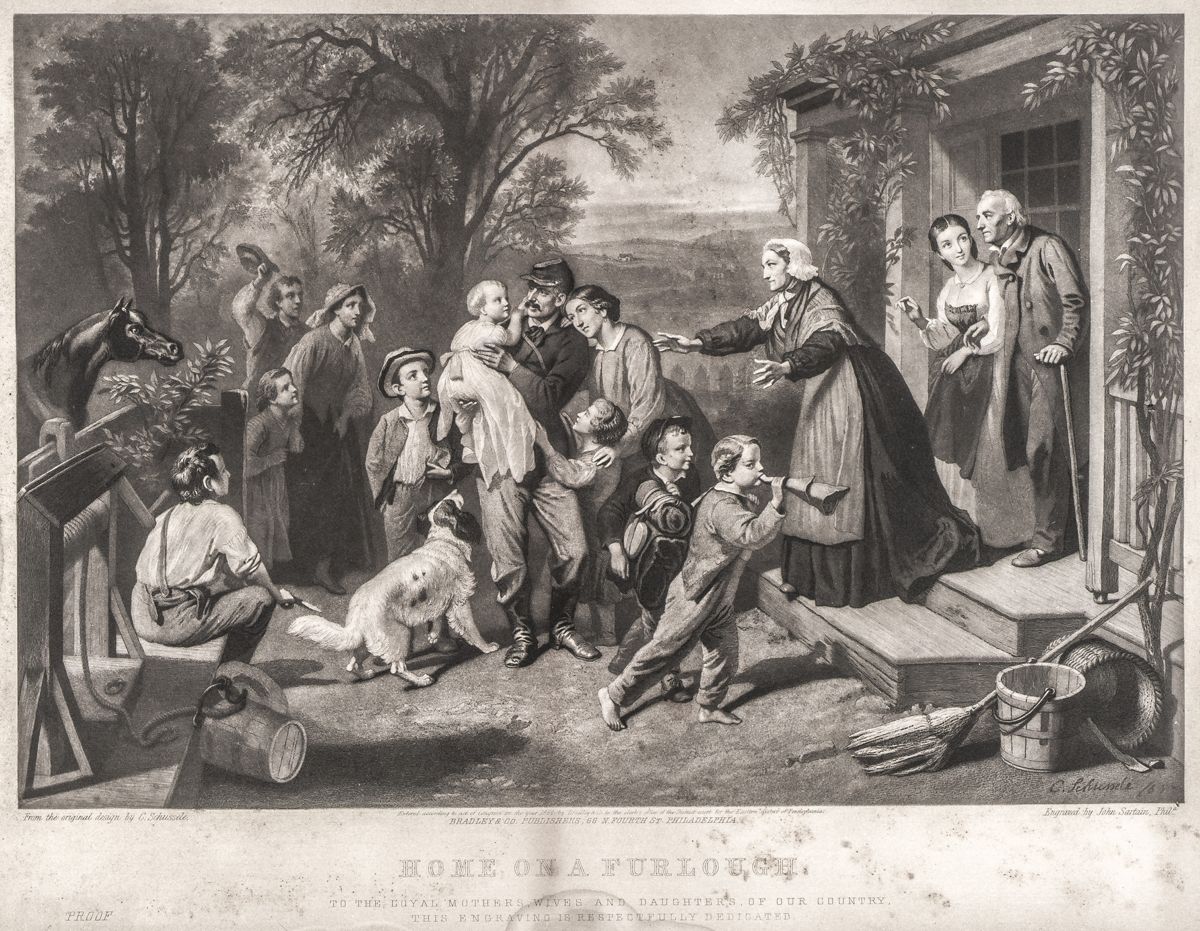
evokes the hero’s return from war. It was originally painted for a James Parke Jr, Esq. From the painting, Dominque Fabronius crafted an evocative remembrance of a joyful reunion. The returning veteran is an officer with one arm in a sling. He is greeted by a throng of children and a pet dog. Every generation is represented seated around the family table representing home, in front of the fire place representing “hearth.” Behind the door, on the wall is a musket and map of the United States. A lone black servant carries our hero’s bed roll. Above the mantle is a print of George Washington, completing the patriotic, and mythic, return. A war time rendering of a similar motif is played out doors with similar symbols, the most important being the multigenerational greeting with which the furloughed soldier is met. Children and the usual dog greet the veteran at his front door. One child blows a welcome horn. This happy scene of a Civil War soldier returning home on furlough, was executed by John Sartain in 1864 and published by Bradley & Co. of Philadelphia. Importantly, an inscription below the title reads, “To the Loyal Mothers, Wives and Daughters of our Country, This Engraving is Respectfully Dedicated.” The original Schussele painting, from which this engraving was made, was done in 1863, and Sartain acknowledges as much with the artist’s signature in the lower right corner. We have written of John Sartain (1808– 1897) and his family in previous columns. The artist, Christian
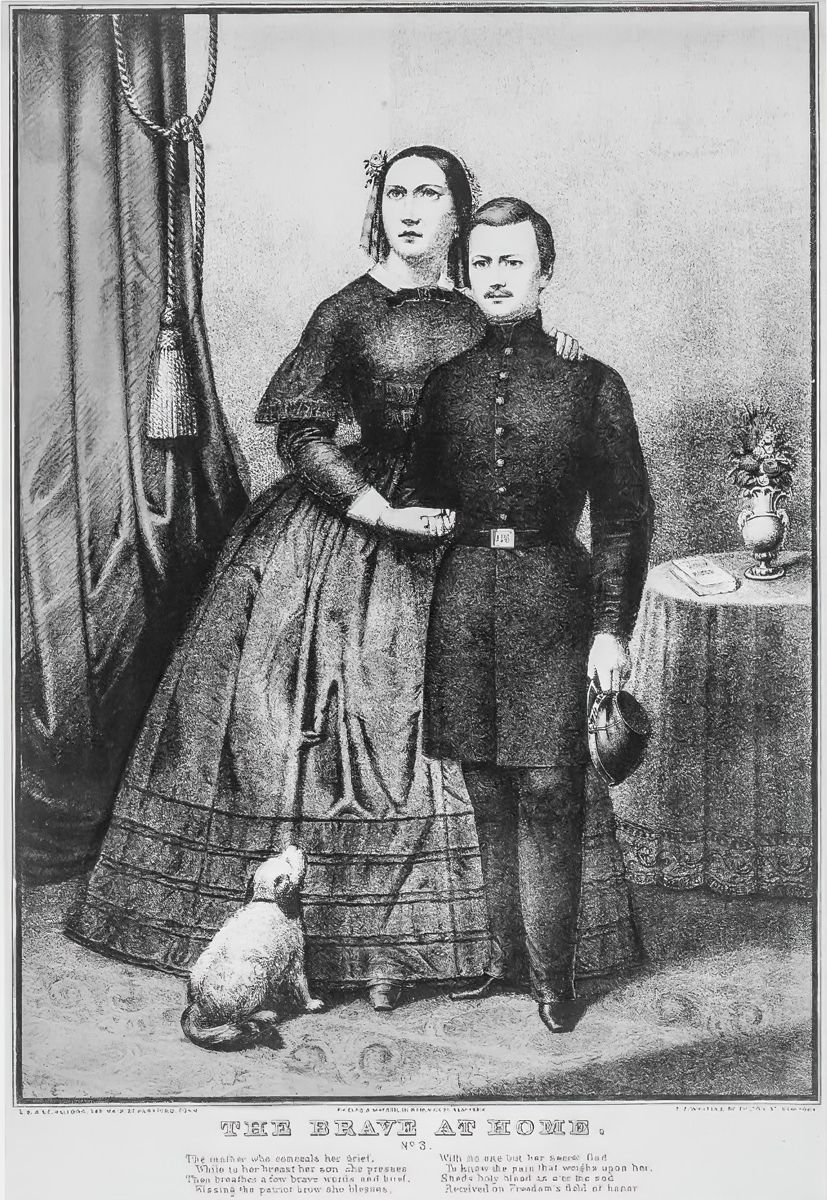
CivilWarNews.com Schussele (1824–1879) was born in Alsace, studied in Paris, and came to the United States in 1847. For 11 years he was director of Pennsylvania Art Schools. A third example of the patriotic home front is not one of reunion but the dread of separation. The title and the two verses were taken from the poem “The Brave at Home,” by Pennsylvania painter and poet, Thomas Buchanan Read. Published during the war, this period lithograph by the Connecticut lithography firm, Kellogg, depicts a young mother and her son who steels himself for the inevitable. An obligatory pet dog is at their feet. It is one of three numbered “leaving” prints showing the wife and her uniformed husband in number one accompanied by Read’s first stanza, then the wife, family, and soldier in number two with the second verse.3 The title margin contains the third and final stanza of Read’s poem in two columns: “The mother who conceals her grief, /while to her breast her son she presses/then breathes a few brave words, and brief, /Kissing the patriot brow she blesses.” “With no one but her secret God/to know the pain that weighs upon her/sheds holy blood as e’er the sod/Received on Freedom’s field of honor.” Endnotes: 1. Trevor McClurg. https:// de.zxc.wiki/wiki/ Trevor_McClurg 2. Pittsburgh Weekly Gazette, February 1, 1869. 3. Nancy Finlay, ed., Picturing Victorian America: Prints by the Kellogg Brothers of Hartford, Connecticut, 1830–1880. p. 144. After 43 years in the museum field, Cilella devotes his time collecting American prints and maps and writing. His last professional position was President and CEO of the Atlanta History Center. His most recent books are Upton’s Regulars: A History of the 121st New York Volunteers in the Civil War (U. Press Kansas, 2009). His twovolume Correspondence of Major General Emory Upton, (U. of Tennessee Press, 2017), received the 2017-2018 American Civil War Museum’s Founders Award for outstanding editing of primary source materials. His latest book “Till Death Do Us Part,” an edit of Upton’s letters to his wife 1868-70, was published in 2020 by the Oklahoma University Press.