
The Atlanta Intelligencer Covers the War
By Stephen Davis · Originally published June 2022 · pp. 36–37
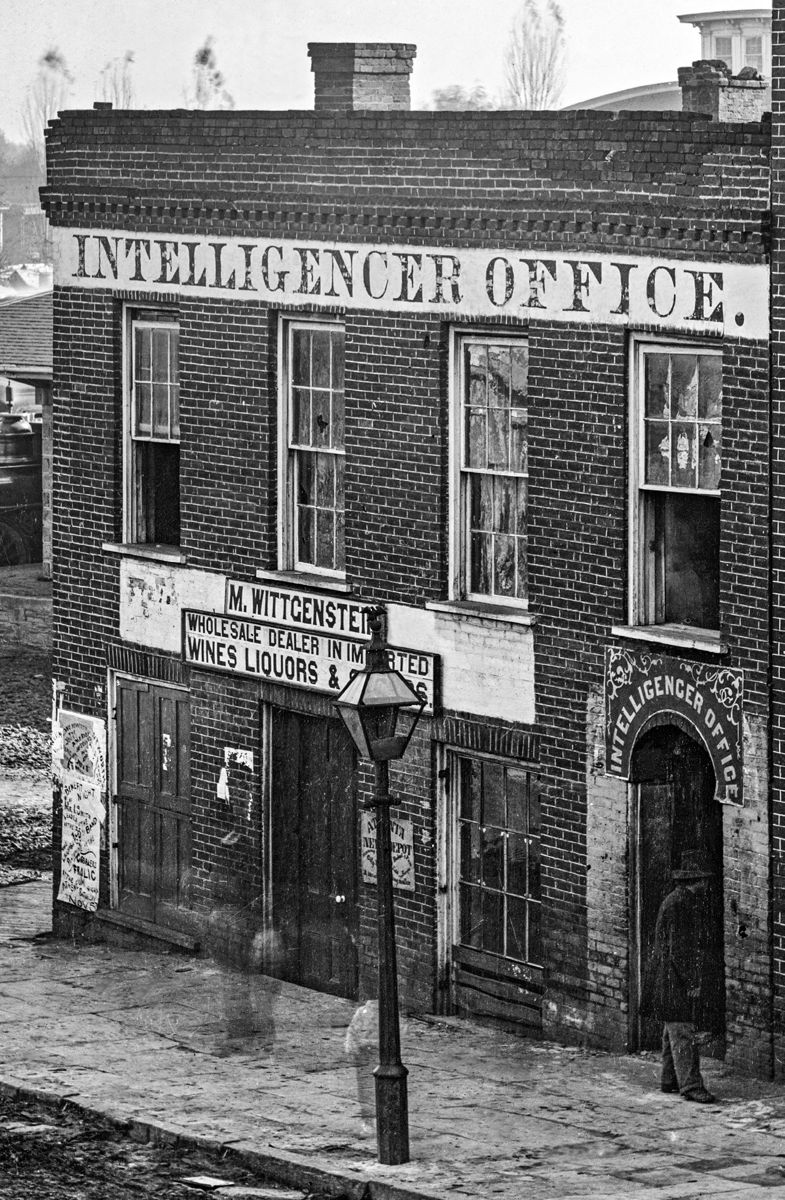
Who Was “Clio”?
by Stephen Davis The study of Civil War journalism has come a long way in the last few decades. That’s especially true regarding Confederate newspapers. Fifty years ago, the go-to source was J. Cutler Andrews, The South Reports the Civil War (Princeton University Press, 1970). Since then, we’ve had studies of prominent editors and reporters, such as Knights of the Quill: Confederate Correspondents and their Civil War Reporting, a collection of twenty-nine articles edited by Patricia G. McNeely, Debra Reddin van Tuyll and Henry H. Schulte (Purdue University Press, 2010). In his essays on Partisans of the Southern Press: Editorial Spokesmen of the Nineteenth Century (University Press of Kentucky, 1994) Carl R. Osthaus includes one on John M. Daniel, the acerbic editor of the Richmond Examiner. Upstaging this is now Peter Bridges’ book, Pen of Fire: John Moncure Daniel (Kent State University Press, 2002). There are also studies of individual Southern newspapers during the war. Barbara Ellis’ The Moving Appeal: Mr. McClanahan, Mrs. Dill, and the Civil War’s Great Newspaper Run (Mercer University Press, 2003) deserves mention if only for its ponderous size (677 pages). Ford Risley of Penn State advances the scholarship with Dear Courier: The Civil War Correspondence of Editor Melvin Dwinell (University of Tennessee
Press, 2018). Professor Risley’s work focuses on the Rome (Georgia) Courier during the war. Bill Hendrick and I hope to make a similar contribution with The Atlanta Daily Intelligencer Covers the Civil War, which is due out this summer from the University of Tennessee Press. Dear Courier reprints a number of Dwinell’s articles in the newspaper. So does Writing & Fighting the Confederate War: The Letters of Peter Wellington Alexander Confederate War Correspondent, edited by William B. Styple (Belle Grove Publishing, 2002). Along with Felix G. De Fontaine, Peter Alexander, writing as “P.W.A.” for the Savannah Republican, is considered one of the preeminent reporters for Confederate newspapers. (Incidentally, one thing we’ve noticed is that historians speak of Confederate newspapers, not Federal ones. Partly this is a temporal device, referring to the four-year period of Southern nationhood. But it is also a reflection of the nationalistic fervor one sees in almost all papers operating in Confederateheld territory.1) Despite all this commendable scholarship, “the whole topic of the Civil War-era press deserves much more study,” George C. Rable wrote as recently as 2015 in Damn Yankees! Demonization & Defiance in the Confederate South (Louisiana State University Press). Incidentally, when Dr. Rable spoke to the Atlanta Civil War Round Table a few years ago on his book, he quoted the
Available
NOW The Atlanta Daily Intelligencer Covers the Civil War
Stephen Davis and Bill Hendrick Order online UTPress.org or call 800-621-2736
Confederate soldier who declared in January1862, “I have no more idea that the Yankees will whip us than that a chicken can teach Latin.” [General laughter.] …which brings us back, in a roundabout way, to our lead question: who was Clio? Well, aside from being the Greek Muse of History, “Clio” was the pen name of a reporter whose writing appeared the Atlanta Daily Intelligencer from November 1862 to June1864— more than 150 articles in all, most sent as letters from Richmond. It was the style back then for veteran reporters to cloak their identities in colorful noms de plume. Dr. Andrews lists a lot of them: for the Richmond Dispatch, Peter Alexander took the name of “Sallust.” (Many field correspondents wrote for multiple papers and took different names for themselves; Sallust [86-35 B.C.] was a Roman historian.) Another example: Dr. George W. Bagby was the Charleston Mercury’s prolific reporter in Richmond, “Hermes.” For a long time, the identity of another reporter for the Mobile Advertiser & Register, “Shadow,” was unknown. Andrews devoted a whole Appendix to the problem, and guessed that “Shadow” was Henry Watterson, who after the war famously edited the Louisville CourierJournal. (There’s an avenue in the city named after him.) More recently, Barbara Ellis and Stephen Dick have confirmed Watterson as “Shadow” by using a computerized word content analysis that compared “Shadow’s” wartime writings with Watterson’s postbellum articles in the Louisville paper.2 But we still don’t know the identity of “Clio.” Andrews doesn’t even list him in his index, though he was able to identify Richard Hawes as “Vidi” for the Atlanta Intelligencer.3 (Vidi is Latin for “I see.”) Was “Clio” an Atlantan? Perhaps. In his letter from Richmond dated Nov. 12, 1862, he wrote of the recent death of Confederate Brig. Gen. Allison Nelson, “formerly Mayor of our city,” Nelson served briefly as Atlanta’s mayor in 1855. We also think that “Clio” was an
CivilWarNews.com established man of letters. In introducing him, Intelligencer editor John Steele referred to “Clio” as “one of the most distinguished Southern writers.” “Clio” reported on everything he heard about: a skirmish at Culpeper Court House, prospects for Confederate recognition by England, the state of the Yankee army (“an unwieldy, half disciplined and unmanageable body”). He commented that dueling between gentlemen was passing out of fashion. He engaged in spiteful denunciation of speculators, people driven by “a reckless, insatiable avarice,” such as hotel keepers who had the temerity to demand three dollars a day: “if the government does not speedily intervene to put down extortion with a strong hand…I do not know what will become of us.”4 Because “Clio’s” handwritten articles reached the Intelligencer office by mail, they were usually several days behind the paper’s telegraphic dispatches, sent from Richmond, that John Steele relied upon for news of the war in Virginia. More than once did the editor throw up his hands at these postal delays: “How is this? Surely there must be some neglect somewhere!” “Clio,” of course, could only relate what he had heard, and pass it on with comment. Burnside and the Army of the Potomac, he wrote on December 5, “has taken to ditching on the other side of the Rappahannock in the mud, and does not venture across for falling on a Lee shore with a Stone wall in the rear.”5 “Clio” sometimes scooped the telegraph. When he wrote from Richmond in May 4, 1863, that “General Jackson, by ascending the Rappahannock, succeeded in getting into the rear of the enemy,” he gave readers of the Intelligencer (printed on May 9) their first information about Stonewall’s flank attack at Chancellorsville.
The Atlanta Daily Intelligencer, Sunday, May 3, 1863.
Throughout his writing, “Clio” exhibited the fervent Southern patriotism characteristic of Confederate newspapermen. “With two such Generals as Lee and Johnston, the one in Virginia, the other in Georgia, at the head of two such armies,” he enthused on June 2, 1864, “we may well be hopeful, if not confident, of the glorious results of the coming conflicts.”6 Okay. To paraphrase Meatloaf, one out of two ain’t bad. Endnotes 1.
Richard M. McMurry, “The Confederate Newspaper Press and the Civil War: An Overview and a Report on Research in Progress,” Atlanta History, vol. 42, nos. 1-2 (Spring-Summer 1998), 59-75. Barbara G. Ellis and Steven J. Dick, “’Who Was “Shadow”?’ The Computer Knows: Applying Grammar-Program Statistics in Content Analyses to Solve Mysteries about Authorship,” Journalism & Mass Communication Quarterly, vol. 73, no. 4 (Winter 1996), 947-62. J. Cutler Andrews, The South Reports the Civil War (Princeton: Princeton University Press, 1970), 251.
CivilWarNews.com 4.
“CLIO,” “FROM RICHMOND” (November 12), ADI, Nov. 18, 1862; Franklin M. Garrett, Atlanta and Environs: A Chronicle of Its People and Events, 2 vols. (Athens: University of Georgia Press, 1962 [1954]), vol. 1, 387 (on Nelson); “OUR RICHMOND CORRESPONDENT, ‘CLIO,’” ADI, Nov. 18, 1862; “CLIO,” “FROM RICHMOND” (November 15), ADI, Nov. 21, 1862; “CLIO,” “FROM RICHMOND” (November 26), ADI, Dec. 3, 1862. “THE RICHMOND MAIL,” ADI, Nov. 28, 1862; “CLIO,” “FROM RICHMOND” (December 5), ADI, Dec. 9, 1862. “CLIO,” “RICHMOND” (May 4), ADI, May 9, 1863; “CLIO,” “FROM RICHMOND” (May 27), ADI, June 2, 1864.
Stephen Davis, our “Critic’s Corner” columnist, resides in Cumming, Ga., with his wife Billie and two cats. His doctoral dissertation at Emory (1979) is entitled, “Johnny Reb in Perspective: The Confederate Soldier’s Image in the Southern Arts.”