
New Perspectives on the Atlanta Campaign and General John Bell Hood
By Stephen Davis · Originally published June 2022 · pp. 38–39
The Sesquicentennial of the American Civil War is over, and the country’s cultural conversation has moved on to other things. But for us armchair historians, the anniversary of the war’s end gives opportunity for us to sit back and consider what we’ve learned, say, since the war’s last big anniversary, the Centennial of the 1960s. In the case of the Atlanta Campaign, and Confederate General John Bell Hood, it’s been a lot. Fifty years ago, the bibliography could list just one book devoted to the Atlanta Campaign: Union Gen. Jacob Cox’s Atlanta (1882), by a division commander in Sherman’s army! Now, by my count, we have fully six more: Samuel Carter III, The Siege of Atlanta, 1864 (1973); James McDonough and James Jones’ War So Terrible (1987); Albert Castel’s superb Decision in the West (1992); Richard McMurry‘s excellent Atlanta 1864 (2000); my own Atlanta Will Fall (2001); and Russell Bond’s enjoyable War Like the Thunderbolt (2009). Wait, there’s more. An excellent documentary history is Larry M. Strayer and Richard A. Baumgartner, eds., Echoes of
Battle: The Atlanta Campaign 1991). Atlantan William R. Scaife contributed The Campaign for Atlanta (second edition, 1993). Lee Kennett personalizes the story in Marching Through Georgia: The Story of Soldiers and Civilians During Sherman’s Campaign (1995). Philip L. Secrist follows the armies’ routes in Sherman’s 1864 Trail of Battle to Atlanta (2006). A handy tour guide comes in Jay Luvaas and Harold W. Nelson, eds., Guide to the Atlanta Campaign: Rocky Face Ridge to Kennesaw Mountain (2008). Marc Wortman’s The Bonfire: The Siege and Burning of Atlanta (2009) is more readable than enlightening. A novel approach in the literature is Larry Peterson’s Decisions of the Atlanta Campaign: The Twenty-One Critical Decisions That Defined the Operation (2019). And all of this doesn’t include recent studies of individual battles, Pickett’s Mill, Kennesaw Mountain, Peachtree Creek, July 22, Ezra Church, by Ecelbarger, Hess and others. The really new focus, however, has been on General Hood. In the spring of 1864 Jefferson Davis wanted Joe Johnston to take the initiative before Sherman did.
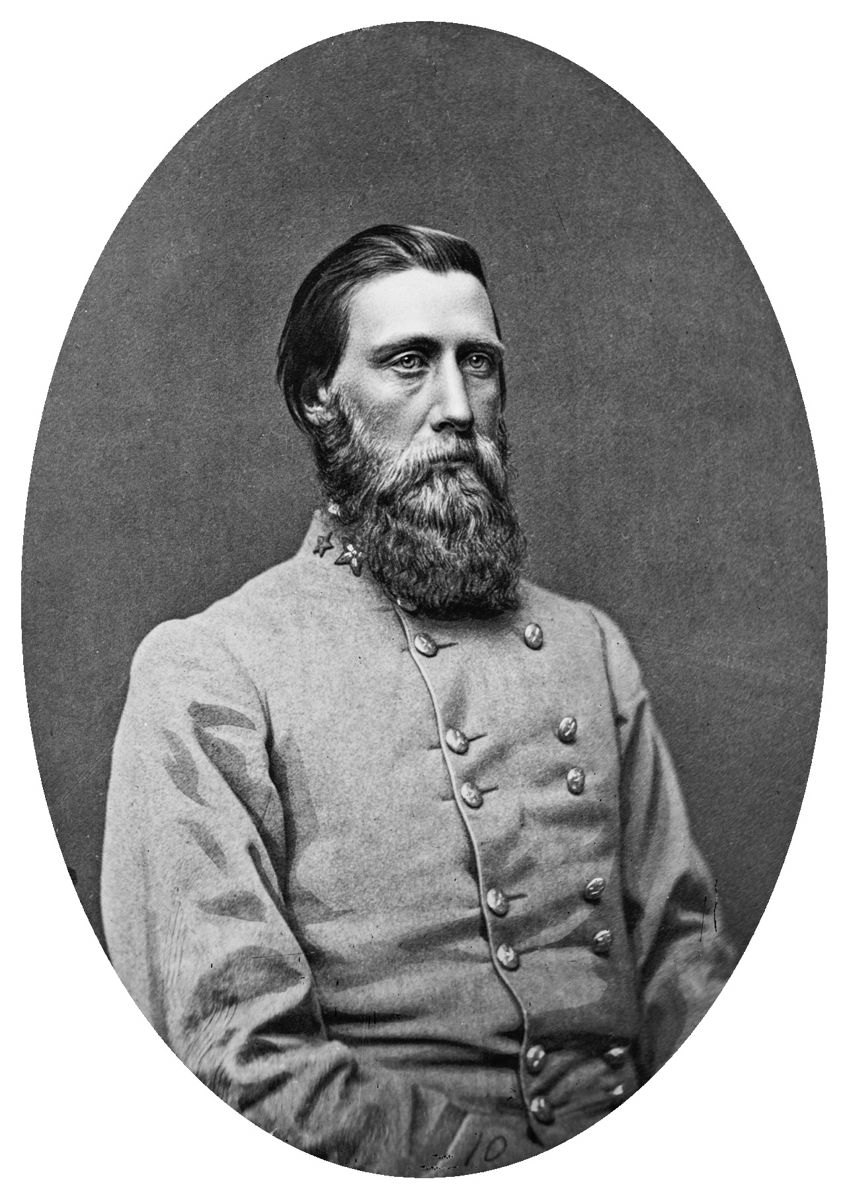
John Bell Hood
Hood, who arrived at Dalton from Richmond in February to lead an infantry corps in Johnston’s army, knew this. When Johnston balked, blaming enemy numbers and position as well as his own weaknesses, Hood secretly wrote Richmond five letters during March and April (e.g., to Davis March 7, “I am eager to take the initiative,” and to Bragg, April 13, “I have done all in my power to induce General Johnston to move forward.”) Historians have known of this backstabbing for a while. What’s new, though, is recent awareness that other of Johnston’s generals were doing the same thing. A notorious example is when W. H.T. Walker sent Davis Pat Cleburne’s emancipation proposal after Johnston said he wouldn’t. Back-biting among officers in the Army of Tennessee was a long tradition, as in the case of States Rights Gist writing Bragg, “Hindman is one of the Chief Offenders, and is I think the most dangerous man of all.” (Bragg Papers, Western Reserve). Joe Wheeler, for instance, wrote Bragg on July 1, complaining that Johnston would not let him raid into Sherman’s rear (Connelly, Autumn of Glory, 409-10). Johnston was unaware of Hood’s letters to the boss, and after Hood’s arrival, seemed to favor him more than Hardee, the army’s senior corps commander. At Resaca it was to Hood that Johnston gave the assignment for the May 14 attack. He did the same at Cassville and at Pickett’s Mill. When Johnston was interviewed by Georgia Senator Ben Hill on July 1 on campaign prospects, only Hood was in the room. All of this caused Hardee to grumble to his wife Mary, “Hood, I think, is helping the General to do the strategy, and from what I can see is doing most of it.” In mid-July 1864 Sherman’s armies were just a few miles outside Atlanta. Fearing that Gen. Joseph E. Johnston would give up the city without a decisive battle, the Confederate government relieved Johnston, promoted Hood and gave him command of the Army of Tennessee. A half-century ago, the literature characterized the administration’s decision as a huge mistake. A good instance comes from the writing of Joseph B. Mitchell, who in Decisive Battles of the Civil War (1955), informed us that “the change was not popular.” “One man was pleased,” he adds: “General Sherman.” All this has changed. The new viewpoint is expressed by William C. Davis in his biography of the Confederate president (1991): “Davis’s only mistake with Johnston was assigning him to the command in the first place and then retaining him while he gradually lost most of north Georgia.” In the centennial, Hood at Atlanta was characterized as headstrong, even stupid, for ordering futile frontal infantry assaults against entrenched enemy forces. “The recklessness of Hood,” as William Key termed it (The Battle of Atlanta, 1958). To be sure, Hood’s decision to attack Schofield at Franklin five months later colors this perception. But the current literature stresses that around Atlanta in July ’64 Hood ordered attacking battles that were not only justifiable, but which offered successful prospects. At Peachtree Creek he sought to exploit a two-mile gap between Thomas’ and Schofield’s
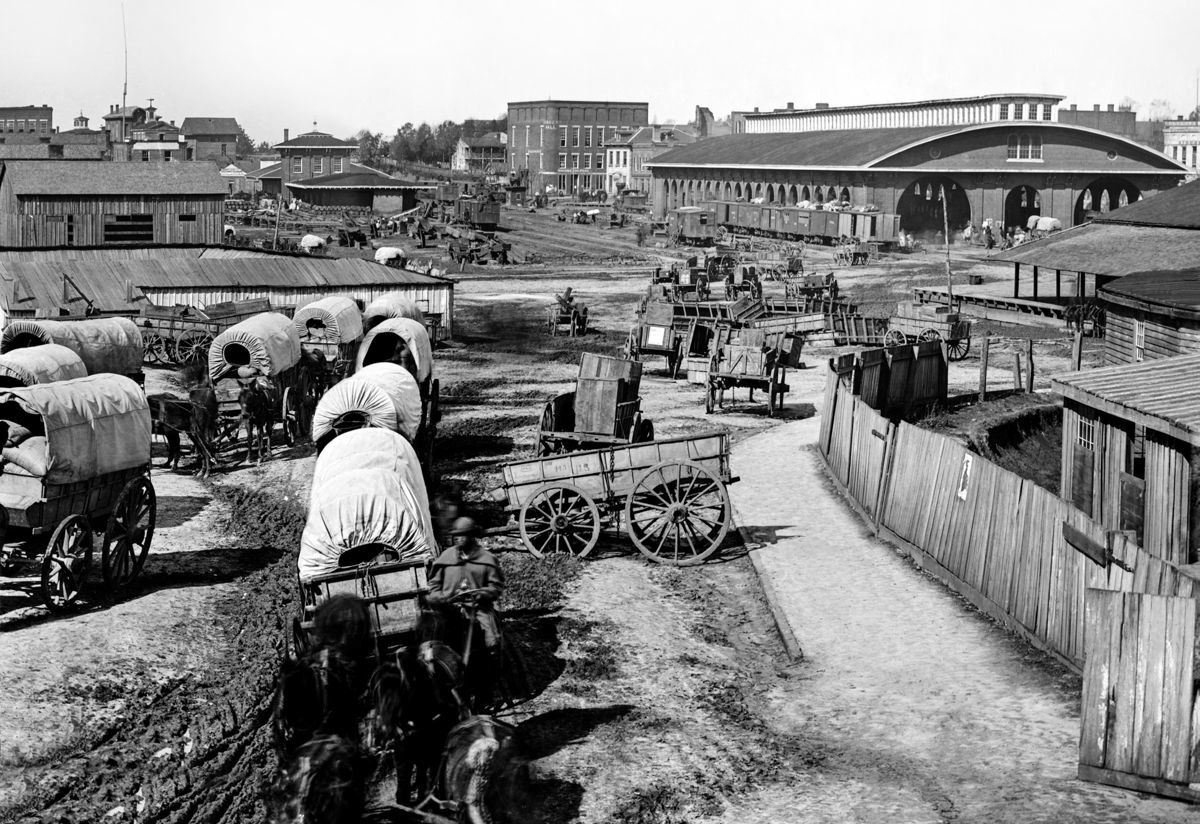
Lt. Russell Tuttle of the 107th New York recorded in his diary for Nov. 5 that he attended “33d Mass. concert in the evening.” But he attended others that week; George Barnard’s pictures capture their advertising billboards. Sometime around Nov. 8, Barnard took a number of shots of a train being loaded at Atlanta’s downtown rail depot, called the “car shed.” Everyone knew that soon Sherman would be abandoning Atlanta, leading his army away on a march whose destination only a few high-ranking officers knew. But all could see the quartermaster and commissary officers loading northbound trains with supplies and equipment that would not be carried in wagons in the forthcoming march. The perspective is a long one, encompassing army wagons to the left, the car shed, and right behind it the light-colored Georgia Railroad Bank Agency and the threestory “Concert Hall”—which really wasn’t a concert hall (the Atheneum was).
armies (“not since Chickamauga have chance and circumstance so favored the Army of Tennessee,” Castel writes). East of Atlanta on July 22 he ordered a Jacksonlike flank attack after Sherman foolishly sent off the cavalry guarding the left of McPherson’s army, as Gary Ecelbarger emphasizes in The Day Dixie Died (2010). Historians have zoomed in on the possibilities for Hood’s flank attack. Hardee’s march would follow a route “that had brought success to Stonewall Jackson at Chancellorsville” (Samuel Carter, 1973). “Could Hood repeat Chancellorsville?” (McDonough and Jones, 1987). “If Hood’s plan works…he will win the most spectacular victory of the war” (Castel, 1992). Confederate infantry did indeed launch frontal assaults against entrenched Federals at Ezra Church on July 28, but that’s only because S. D. Lee disobeyed Hood’s orders. Richard McMurry did something you don’t always see: he went back to the OR to read how Hood intended a flank attack on July 29. Earl Hess’ recent, fine battle-study makes this clear (Chapel Hill, 2015). (By the way, Sherman should not be given a free pass on this score. Recall that he ordered
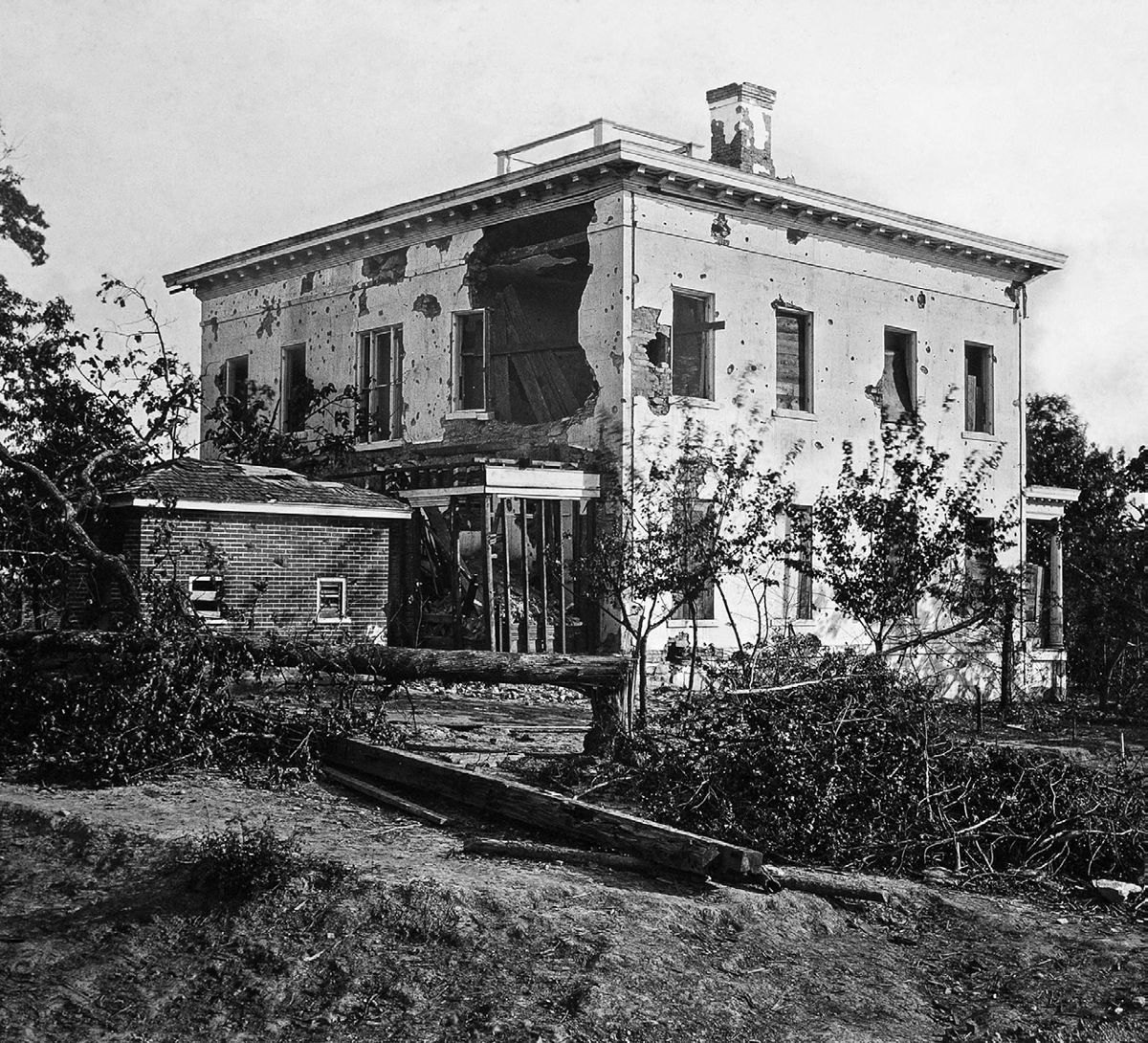
Ellen Ponder had abandoned her house well before it came under Federal artillery fire because of its unlucky location so close to Confederate lines. Sherman ordered a heavy bombardment of Atlanta and the Rebel works for August 9. That day, Union Lt. W. W. Hopkins, a signal officer perched in a tree near the lines of Brig. Gen. John W. Geary’s Division of the XX Corps, reported “the most noticeable effect of the shelling was in front of General Geary’s Division at a fort and house. The fort was struck; also the works near it, and the house had a large hole knocked in it besides being riddled.” Several days later, a reporter for the New York Times reported, “Bundy’s battery (Thirteenth New York) has been making a target of one very fine house, until now it presents a very ventilated appearance.” Bundy’s 13th New York battery was attached to Geary’s Division. (All photographs courtesy Library of Congress)
CivilWarNews.com frontal infantry attacks against entrenched Rebels at Resaca, New Hope Church, Pickett’s Mill, Kennesaw Mountain, and Utoy Creek. Sherman’s mediocrity as battle commander is also an emerging theme in the Atlanta Campaign literature.) Ongoing study of other battles has led to changed understandings. Fifty years ago most writers accepted Joe Johnston’s contention that at Cassville, May 19, Hood called off a planned Confederate attack after he got spooked by a “phantom” Federal column that never existed. Today, the consensus favors Hood’s side of the argument. (Go to the federal WPA pavilion along US Highway 41 at Cassville, and you’ll see a new plaque with a map clearly showing the menacing Yankee troops.) Numbers are in the mix, too, as evidenced by the confusion around Confederate casualties at Peachtree Creek. In his article for Battles and Leaders (1888), Sherman pegged the Rebels’ losses as 4,796, and that number has unfortunately been accepted by too many: William Key, The Battle of Atlanta (1958); Wilbur G, Kurtz (CWTI, July 1964); Samuel Carter, The
Siege of Atlanta (1973); Wiley Sword, Embrace an Angry Wind (“nearly 5,000 men,” 1992); Webb Garrison, Atlanta and the War (1995), Philip L. Secrist, Sherman’s 1864 Trail of Battles (2006); Steven E. Woodworth, This Great Struggle (2011). Even McMurry, in his John Bell Hood (1982), guesses “perhaps 5,000.” Fortunately, there are a few scholars who actually did the math, beginning with Livermore (1901), who came up with ca. 2,500. Following him are Connelly (1971); myself in Blue & Gray, August 1989; Castel (1992); Russell Bonds in War Like the Thunderbolt (2009). McMurry switches to 2,500 in Atlanta 1864 (2000). Robert Jenkins’ calculation of Southern losses in his recent history of the battle (Mercer University Press, 2013) is 2,316, and that against 2,167 Union killed, wounded, or missing! (Sherman put Federal casualties at 1,710.) Speaking of numbers, let’s talk about Wheeler’s raid into Sherman’s rear, that began August 10. Edward Pollard started it all in his Southern History of the War (1866): “Hood made the fatal mistake. He sent off Wheeler and his entire cavalry [emphasis added] to raid on Sherman’s line of communications.” Eisenschiml and Newman (1947) claim, “He sent off his entire cavalry” [emphasis again added]. Check the returns of August 10 (the day the raid started): cavalry in the Army of Tennessee numbered 12,803 officers and men. Even those who acknowledge that Wheeler rode off with 4,500 troopers, less than half of the mounted arm, still claim that Hood’s decision to send off the raid was a blunder (for which, by the way, Hood had sought and gotten President Davis’ express permission). “All Hood had done was deprive himself of ‘his eyes and ears,’” Castel wrote in CWTI, February 1978, ignoring that Red Jackson’s 4,500 troopers kept Hood very well informed of Sherman’s movements while Wheeler was away. Even when Hood deserves censure (Franklin perhaps, certainly Nashville), in recent decades writers have been more understanding, if not forgiving of his faults. No small thanks go to a University of Southern California sociologist, of all people: Dr. Laurence J. Peter, who coined the phrase “Peter Principle” in 1969. Now just about everyone on the planet knows that hierarchies (including armies at war) tend to elevate individuals to their levels of incompetence. We’ve known about this practice for a long
CivilWarNews.com time. Ambrose Burnside was a competent corps leader in the Army of the Potomac, but he failed miserably as its commanding general. Same thing with Joe Hooker: able corps leader, but a dud as army commander at Chancellorsville. Now, to explain such rise-and-falls we have a catchy sociological term, and it’s stuck. Hood is “the General Whom the President Elevated Too High” (Herman Hattaway, 1999). He is “’A Bold Fighter’ Promoted beyond his Abilities” (Keith Bohannon, 2004). Perhaps the most important development in the new “Hoodiana” overturns the old legend that the general, maimed from his wounds, resorted to laudanum. Several decades ago, writing for Blue & Gray, I traced the wobbly origin of this libel: Percy Hamlin’s 1940 biography of General Dick Ewell. I then looked at how later writers have alluded to it, and saw a lot of supposition and guessing. Even the redoubtable McMurry wrote in 1972 that Hood “may have been taking a derivative of laudanum” to ease pain from his wounds. Seeing no confirming evidence in the literature, I sought to squelch the drug-use contention. Stephen M. Hood has finally done so in his study of Hood (The Rise, Fall, and Resurrection of a Confederate General, 2013), thanks to his discovery of the medical reports of Hood’s surgeon, Dr. John Darby. “Sam,” as we call him, has recently repeated the argument in Civil War Times Illustrated: “Myth Busted!,” the front cover exclaims. Those of us long-of-tooth believe that if you just live long enough, new discoveries will come along to make us all feel young and excited again. Proof comes in Sam Hood’s recent work, The Lost Papers of Confederate General John Bell Hood. Having discovered—I’m not kidding—a cache of Hood letters in a descendant’s attic, Sam has seen to their publication (Savas Beatie, 2015). Henceforth all Civil Warriors writing about John Bell Hood must steep themselves in this wonderful research trove. Here’s just an example. In 1879 Gustavus W. Smith, who commanded the Georgia Militia in the Atlanta Campaign, reflected in a letter to Hood on General Johnston’s statement to the Richmond authorities, made July 16, 1864, that he intended the have the militia hold Atlanta’s fortifications while he took his three infantry corps out of the city to maneuver against Sherman. Smith’s comment: “Carrumba! Wouldn’t that have been a kettle of fish?” “Kettle of fish,” indeed! Stephen Davis and Atlanta newspaperman Bill Hendrick have collaborated on a book, The Atlanta Daily Intelligencer Covers the Civil War. It is due out this summer from the University of Tennessee Press.