Through The Lens
Hancock Was Superb Battle of Williamsburg – Part II
By Stephanie Hagiwara · Originally published June 2022 · pp. 16–17
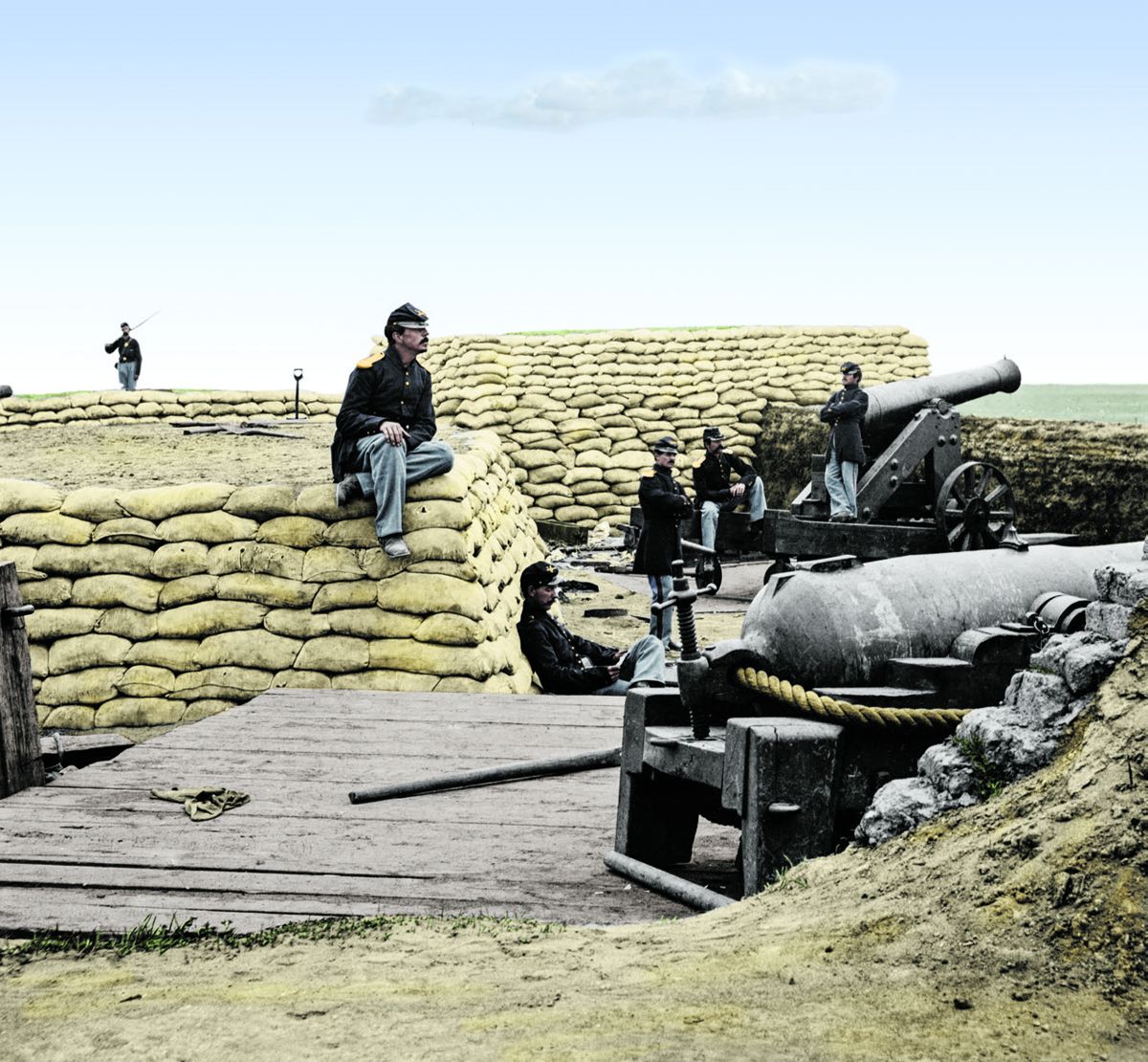
Revolution War, reported, “Our Revolutionary sires did not suffer more at Valley Forge than did our army at Yorktown and in the retreat from it. Notwithstanding the rain, mud, cold, hunger, watching, and fatigue I never heard a murmur or witnessed a single act of insubordination.” The Federals were so surprised the Confederates vacated Yorktown before the Federals attacked, they were slow to pursue. McClellan assigned Gen. Edwin “Bull” Sumner, II Corps, to command the pursuit. Sumner, detached from his own men, would also be handicapped by being unfamiliar with the area.
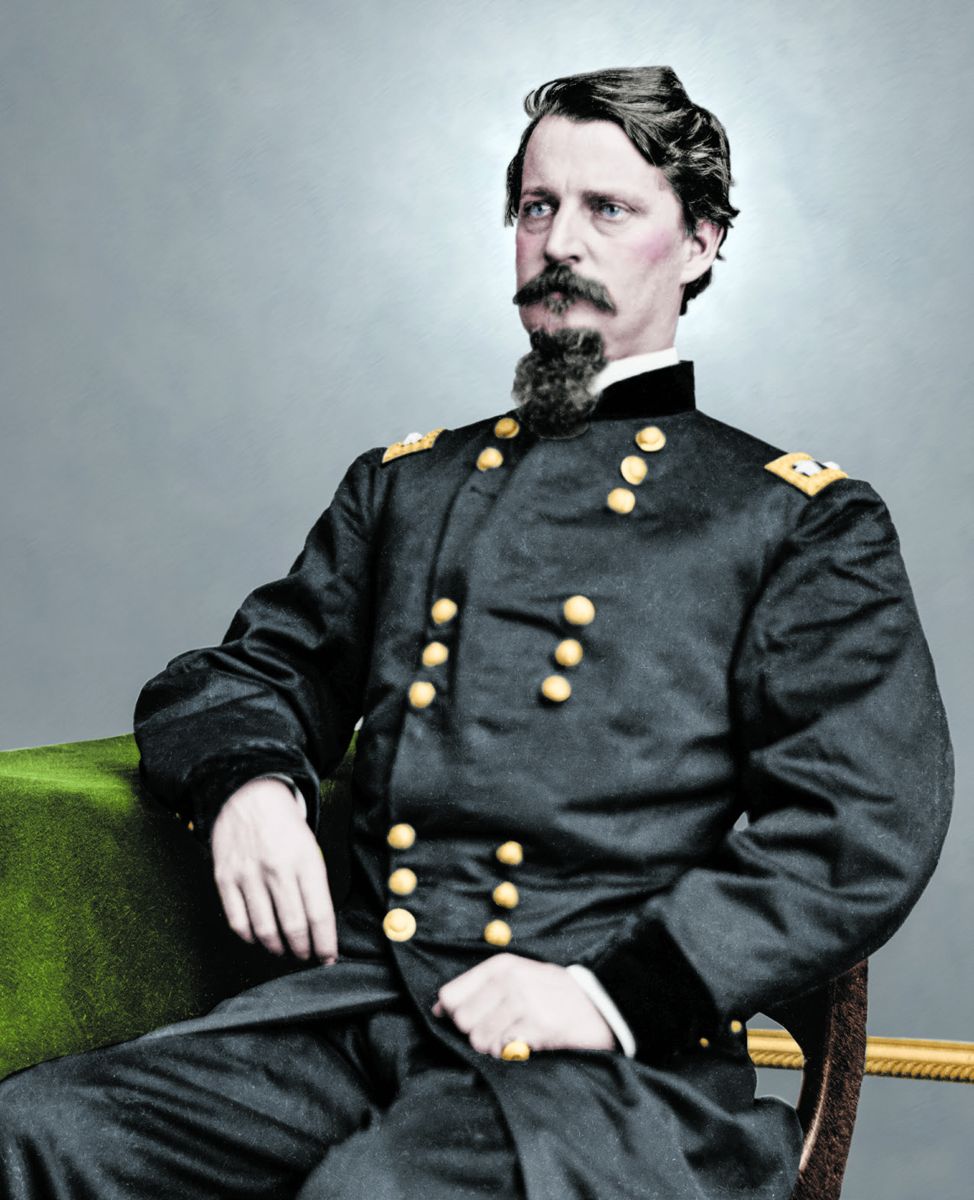
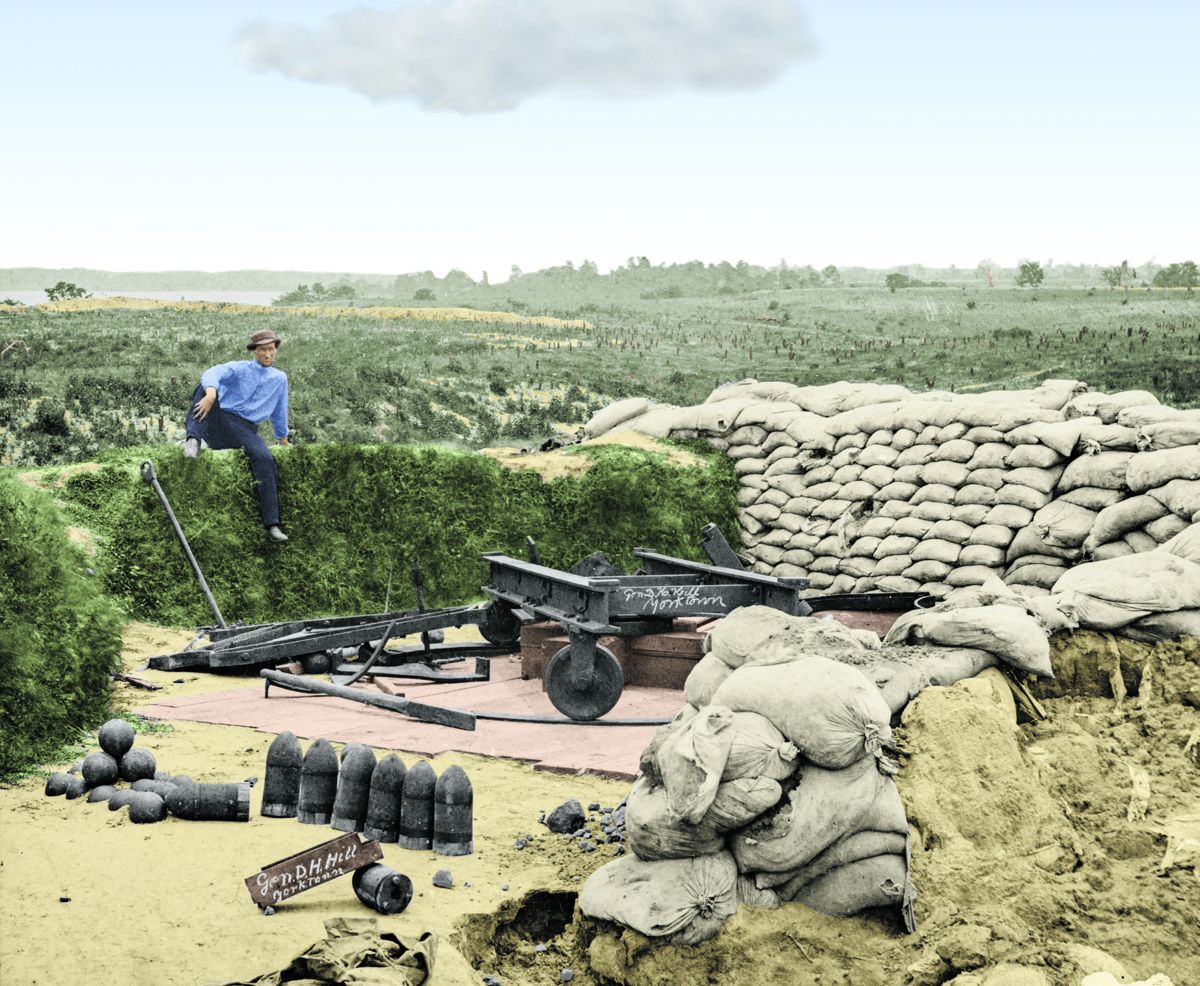
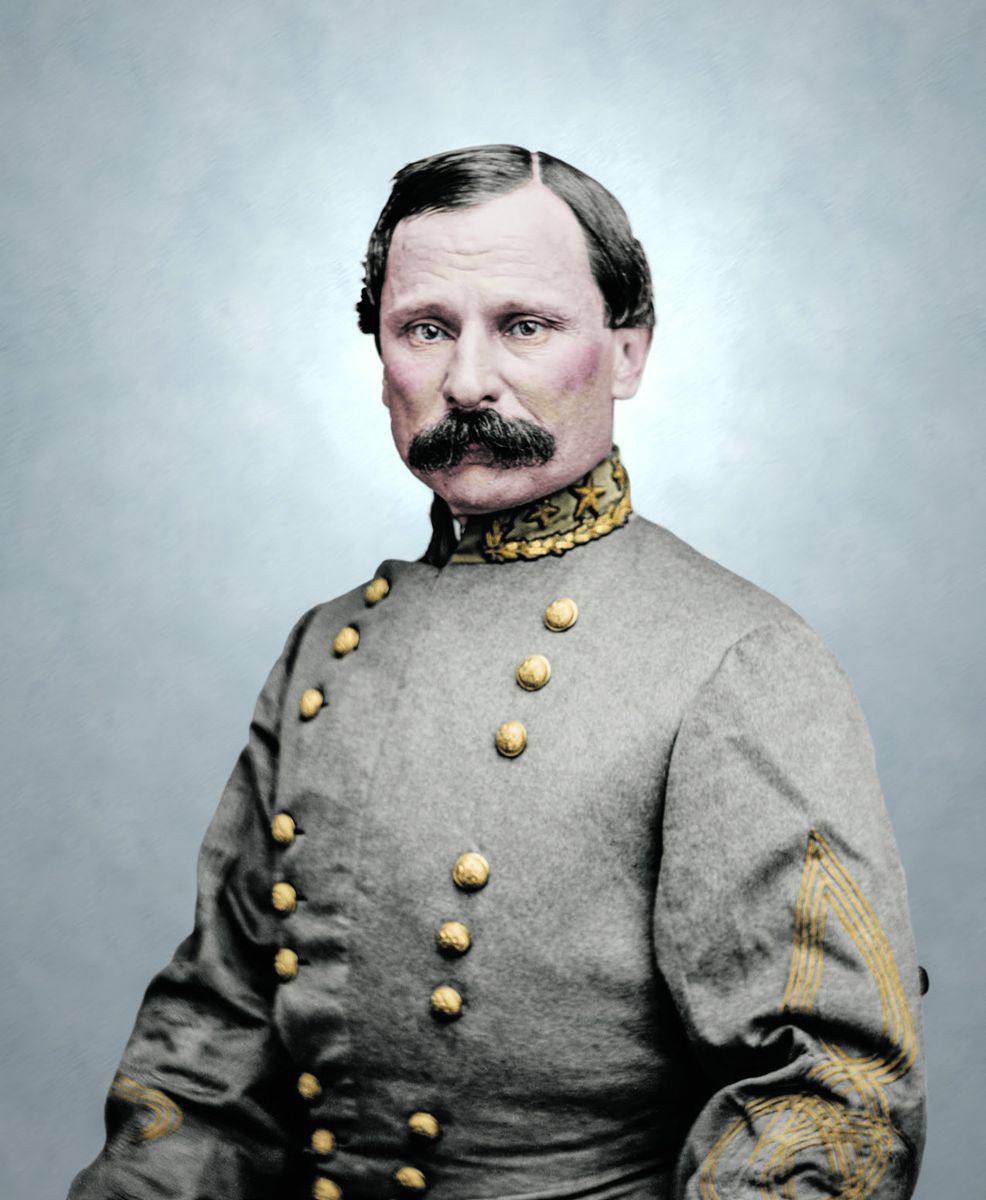
On May 5, 1862, during torrential rain, the Battle of Williamsburg was fought at the Confederate reserve fortifications, a line of 13 redoubts held by 10,350 Confederates against 9,000 Federals. C.S. Gen. James Longstreet had been ordered to delay the Federal pursuit. It was Longstreet’s first battle after three of his four young children died of scarlet fever at the start of the year and as a division commander. He spent most of the day in his headquarters at the College of William and Mary. Having issued his orders, Longstreet left the fighting to his subordinates, which was typical naval guns from the Gosport Navy Yard in Norfolk that were too heavy to transport, especially over the wet roads. Alexander later “recall[ed] that night’s march as particularly disagreeable. The whole soil of that section seemed to have no bottom and no supporting power. The roads were but long strings of guns, wagons, and ambulances, mixed in with infantry, artillery, and cavalry, splashing and bogging through the darkness in a river of mud, with frequent long halts when some stalled vehicle blocked the road. Then men from the nearest ranks would swarm in to help the jaded horses pull the vehicle out. Meanwhile, everything in the rear must halt and wait, and so it went on all night — a march of one or two minutes, and halt for no one could guess how long. The average time made by the column was under a mile an hour.” Hill, whose men had occupied, then refurbished and altered the same Yorktown works built by British Gen. Charles Cornwallis during the American “Play some marching tune! Play ‘Yankee Doodle,’ or any doodle you can think of, only play something!” – U.S. Gen. Samuel Heintzelman As part of his 1862 Peninsula Campaign, U.S. Gen. George McClellan’s “Army of the Potomac,” brought 121,500 men, and gave them 13-inch mortars that could fire 200 pound shells, to attack Confederate defenses at Yorktown, Va. According to C.S. Gen. Alexander Porter, at Yorktown the men crowded into the trenches had to either sit or crouch behind the parapet, in water up to their knees, from daylight until darkness permitted one to stand upright or to step outside the trench. The only rest at night was to sleep in the universal mud and water. After his own inspection, C.S. Gen. Joseph Johnston concluded that the works could not stand up to a Federal assault. Johnston was “determined to retire because we can do nothing here… The enemy will give us no chance to win. We must lose. By delay we may insure the loss of Richmond, [Va.,] too.” While McClellan was transporting and positioning his siege guns, Johnston was figuring out how to evacuate the area, a maneuver that was compounded by the rain-soaked roads. On April 30, McClellan test fired his guns and planned an attack to begin on May 4. His time to resist or evacuate having run out, Johnston ordered his 55,000 men to depart the evening of May 2. The infantry moved out as the cavalry kept the campfires burning and guns were fired. The men made dummies “to represent sentinels. These latter had placards on their backs highly complementary of course to the ‘incoming’ Yankees.” Unable to secure sufficient wagons, Johnston advised Gen. D.H. Hill that, “any powder you don’t shoot away had better be thrown away.” Left behind were fifty-six of his command style. Confederate generals Cadmus Wilcox, 4th Brigade, and Richard H. Anderson, 2nd Brigade, were ordered to attack U.S. Gen. “Fighting Joe” Hooker’s III Corps from the line of redoubts. Wilcox and his 1,100 men crossed an open field to get at a Yankee battery positioned in woods “so dense that a colonel could not see his entire regiment when in line of battle.” The Confederates pushed the Federals back, capturing six rifled pieces. Wilcox noted that, “After the enemy had been driven into the fallen timber this regiment as well as others refilled their cartridge boxes from those of the enemy’s dead. Their knapsacks contained 60 rounds.” Visibility was poor. Lt. David Steele, 2nd N.H, armed only with his sword, stumbled across a group of Wilcox’s men and yelled, “Surrender, you damned cusses or I’ll blow you to hell!” The Rebels threw down their rifles. At 3 p.m., the Federal line began to falter. U.S. Gen. Samuel Heintzelman called for the musicians to play to rally the men. As if on cue, U.S. Gen. Philip Kearny, 3rd Division, III Corps, galloped onto the field waving his sword. Kearny, the most experienced and colorful general on the field, had lost his left hand in the Mexican American War. He had marched his men double quick past idle troops to reach the battlefield. Kearny, positioned each unit and then ordered, “Men, I want you to drive those blackguards to hell at once.” The Confederates were pushed back through the woods to their original position. On the opposite side of the field, U.S. Gen. Winfield Scott Hancock was pushing onto the Confederate left flank. Earlier that morning, a contraband reported that a redoubt covering a dam was unguarded by the Confederates. The report confirmed, Hancock took 3,400 men and eight artillery pieces onto a ridge above a wheatfield. C.S. Gen. Jubal Early could hear Hancock’s guns but could not see his position. Although Longstreet’s objective to cover the Confederate retreat past Williamsburg had been accomplished, Early and Hill requested and received permission to attack. It was growing darker as the assault began near 5 p.m. Yelling, “Bull Run” and “Ball’s Bluff,” the first companies charged, driving the Federal skirmishers behind the ridge crest. The Confederates continued running forward; when they came within 30 paces, Hancock’s entire battle line stood up and fired into them at a range of less than 25 yards. According to Maj. Peter Sinclair, 5th N.C. Infantry, the second battle line continued their advance through, “the valley of death—our line as perfect and unbroken as if on parade, at each step our gallant boys would fall”. The Confederate assault buckled. Early was shot in the shoulder and grew faint from blood loss. Hancock galloped forward shouting, “Forward! Charge!” The wheatfield turned into a blood bath. “The slaughter of the 5th N.C. regiment was one of the most awful things I ever saw,” said Hill. The Confederates who could, ran the gauntlet back to safety in the woods. Hancock’s engagement had lasted 23 minutes. On May 6, the sun greeted
CivilWarNews.com the day; the Confederates were gone. McClellan, who arrived after the battle was over, had a victory to proclaim. The Battle of Williamsburg would be remembered in the North for Hancock’s charge. McClellan wired Washington, D.C., “Hancock was Superb!” Sources: ✬ Sears, Stephen W. To the Gates of Richmond: The Peninsula Campaign. Houghton Mifflin Harcourt, 1992 ✬ Bailey, Ronald H. Forward to Richmond: McClellan’s Peninsular Campaign. Time Life Books, 1983 ✬ Symonds, Craig L. Joseph E. Johnston: A Civil War Biography. W. W. Norton & Company, 1994 ✬ Wert, Jeffrey D. General James
Longstreet: The Confederacy’s Most Controversial Soldier. Simon & Schuster, 1933 ✬ Patterson, Gerard. From Blue to Gray: The Life of Confederate General Cadmus M. Wilcox.Stackpole Books, 2001 ✬ Alexander, Edward Porter. Military Memoirs of a Confederate: A Critical Narrative. Charles Scribner’s Sons, 1907 Stephanie Hagiwara is the editor for Civil War in Color.com and Civil War in 3D.com. She also writes a weekly column for History in Full Color.com that covers stories of photographs of historical interest from the 1850’s to the present. Her articles can be found on Facebook, Tumblr and Pinterest.