
Critic's Corner
Battles and Leaders of the Civil War
By Stephen Davis · Originally published July 2022 · pp. 14–15
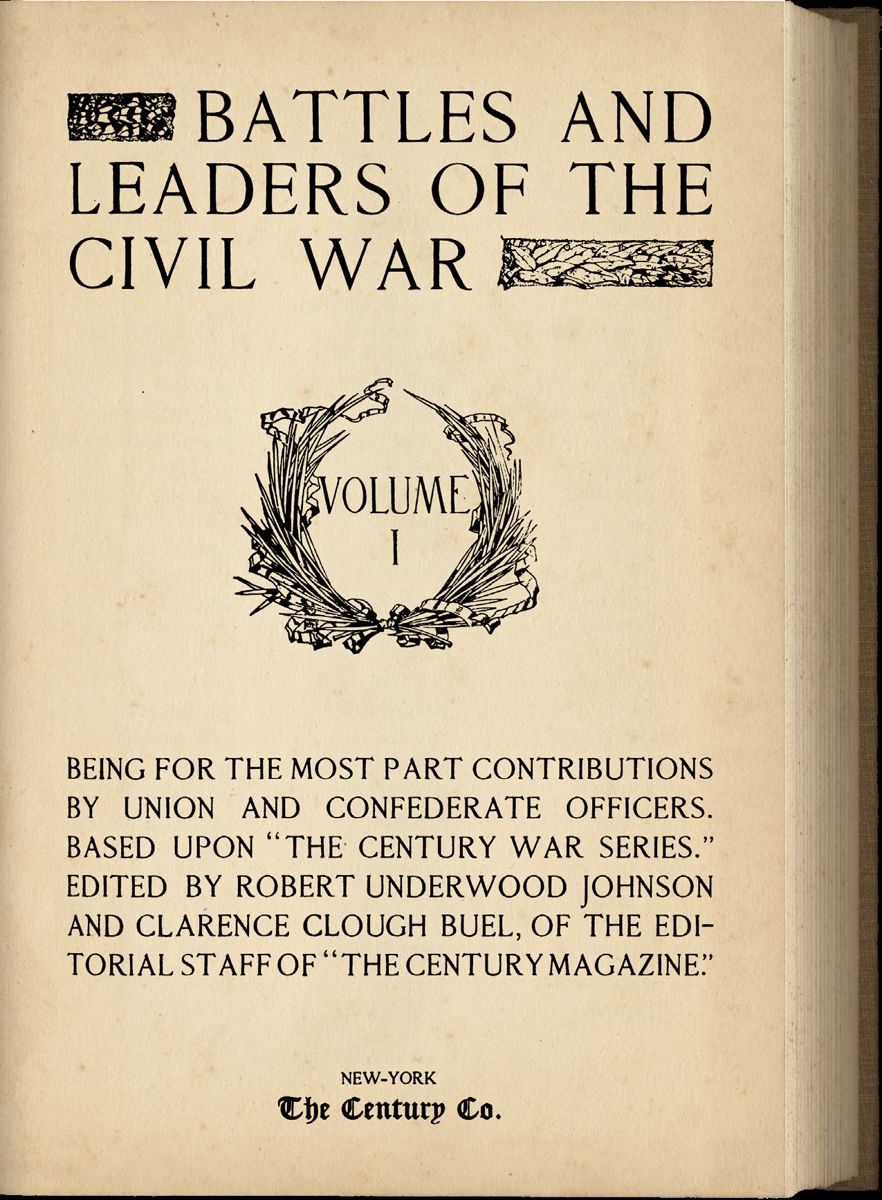
Douglas Southall Freeman deemed it one of “the basic reference works” on the war.1 Ralph Newman and E. B. Long included it the same way in their “Basic Civil War Library.”2 The very first issue of Civil War History (March 1955) ran Newman’s “For Collectors Only”; of course it was listed there, too.3 In an article, “Battle of the Books” The “Battles and Leaders” series was conceived by Clarence Clough Buel, assistant editor for Century magazine. In early 1883 Buel thought of pairing an article on John Brown’s raid at Harpers Ferry written by a Virginian, with a “Comment by a Radical Abolitionist.” The pieces, published that June, aroused considerable interest. Soon Buel outlined a more ambitious project using the same format: a series of eight or ten articles on decisive battles of the Civil War, written by generals who had commanded the opposing armies. Buel proposed his idea to the associate editor, Robert Underwood Johnson. Both Johnson and the Century editor-in-chief, Richard Watson Gilder, liked the plan. Gilder put Johnson in charge of it, with Buel assisting. The most important task, the lining up of contributors, was begun in the spring of 1884. In the early days of “general catching” (Gilder’s phrase), the editors met with setbacks. Ulysses S. Grant, the first officer to be contacted, declined to write because his biographer, Adam Badeau, had said it all. William T. Sherman said the proposed series would fail. G. T. Beauregard said he was too busy. Some officers refused because they would have to criticize their dead comrades; others held back because of the living (Johnson termed this dilemma “Scylla and Charybdis”). But the editors worked their prospects energetically. They persuaded Beauregard by using as intermediary his friend George Washington Cable, whose fiction Gilder had published. Grant, attracted by the editors’ promise of $500 per article, consented after his banking house had failed, and he in turn helped convince Sherman to write an essay. Eventually Joseph E. Johnston, David D. Porter, James Longstreet and many other important military leaders agreed to help.10 Despite their array of contributors, the editors regretted the refusal of some notables to cooperate. Johnson could not persuade generals Winfield S. Hancock, Nathaniel P. Banks, Simon B. Buckner, or Benjamin F. Butler to participate in the series. Philip H. Sheridan wanted to save his commentary for a book; Jubal A. Early claimed that he opposed writing history for money. Neither Robert E. Lee’s son, George Washington Custis Lee, nor Lee’s chief of staff, Col. Charles Marshall, could be induced to contribute a piece on the great Virginian. With these exceptions, though, most of the war’s major figures
CivilWarNews.com participated, and the series progressed. From the start, the editors emphasized an interesting, colorful format. Johnson admonished his contributors to avoid the style of official reports and tell of their battles as they would an after-dinner chat, preferably with personal incidents and even secrets. But many contributors submitted articles that were too long and sometimes so colorless that they were returned or discreetly set aside. General Grant, considered the biggest “catch,” was one such case. Having received his article on Shiloh in early July, Johnson was dismayed to find the general’s writing too much like an official report. On his next visit, Johnson induced Grant to talk offhand about the battle, then informed him that this was the style which the editors were seeking. “He seemed astonished at this,” Johnson recalled, but the general eagerly applied himself to revision. Before long he had completed a more lively piece, as well as three others on different battles.11 Plentiful illustrations by such staff artists as Walton Taber and Allen C. Redwood (himself a Confederate veteran) would accompany the articles. To balance the generals’ factual narratives, lighter pieces were also commissioned. In December 1885, for instance, there appeared a witty piece by Mark Twain, “The Private History of a Campaign That Failed,” relating in a highly imaginative way the celebrated author’s brief stint in the Confederate service. At the same time, the editors planned to continue their policy of publishing Southern fiction by Joel Chandler Harris and others, long a trademark of
Scribner’s-Century, as another counterweight to the war series. “I’ve just been blubbering over [Harris’] “Free Joe,” wrote Gilder. “How well it goes with the war articles!” With plans set, the editors chose a title for the series. After considering “Men and Events,” Buel proposed “Leaders and Battles.” Gilder liked the dramatic emphasis on fighting, as opposed to political events in the war, and approved Buel’s suggestion in August 1884. By the time the war series was announced in October 1884, the title had become Battles and Leaders of the Civil War. The next month’s issue carried Beauregard’s piece on First Manassas. Thereafter each issue of the magazine carried a least one or two articles by famous officers. Public response was immediately favorable. A year later, in November 1885, circulation figures for Century peaked at 225,000, up from 127,000 the year before. Letters from readers poured in such quantity that the editors created a special column, “Memoranda of the Civil War,” to print some of them. Unsolicited manuscripts and illustrations also came in, and generals heretofore reluctant to contribute now readily agreed. On the strength of this good showing Battles and Leaders of the Civil War, which had originally been forecast to run for a year, was extended. The unexpected abundance of manuscripts resulted in a hefty pile of unpublished work even after the final piece in Battles and Leaders appeared in November 1887. To use the remaining materials and to capitalize on the success of the magazine series, Johnson and Buel planned an elaborate four-volume set of books. The ninety-nine feature articles in the magazine provided its basis. In all, 226 writers contributed four hundred articles in the four volumes. As much an anthology of participants’ narratives, B & L also gave officers on both sides a forum for airing complaints and criticisms. Grant and Buell argued about Shiloh; Longstreet was attacked for his role at Gettysburg. Nearly two hundred pages, in fact, were devoted to the Pennsylvania battle. Meade was defended against charges of slow pursuit; Mosby spoke up for Stuart. Johnson and Buel gave space to Sickles’ argument that his corps’ placement had saved the army and the battle. Buel and Johnson sought new material for the books. Significantly, and a point overlooked by many students, is that only a fourth of the books’ articles had appeared in some form as part of the original “Battles and Leaders” series of the Century. There were some deletions, too. Many of the lighter pieces, such as Twain’s “Private Campaign,” didn’t make their way into the final volumes. The editors welcomed controversy, but they also worked hard to vouch for the historical reliability of their contributors’ writings. Their efforts paid off; the Century’s circulation doubled, allowing it to surpass Harper’s, the topselling magazine in the United States. The books sold well, too; some 75,000 sets were purchased before the pictorial edition of 1894. Johnson estimated that the entire project netted the Century Company a million dollars.12 As the largest and most scrupulously edited compilation of war-related articles by major military figures of the Civil War, Battles and Leaders remains an indispensable source for historians and general readers alike. Endnotes:
“A Confederate Book Shelf” in Douglas Southall Freeman, The South to Posterity: An Introduction to the Writing of Confederate History (New York: Charles Scribner’s Sons, 1939), 217. Ralph G. Newman and E. B. Long, “A Basic Civil War Library,” Illinois State Historical Society Journal, vol. 56 (1963), 392. Reprinted with additional listings as “The War in Books: A Basic Civil War Library” in Newman and Long, The Civil War Digest (New York: Grosset & Dunlop, 1960), 392. Ralph G. Newman, ed., “For Collectors Only,” Civil War History, vol.1, no. 1 (March 1955),
CivilWarNews.com 72. James I. Robertson, Jr., “The Battle of the Books,” Civil War Times Illustrated, vol. 8., no. 10 (February 1970), 47. Gary W. Gallagher, “The Civil War 100: Civil War Magazine’s Essential Titles on Military Campaigns and Personalities,” Civil War, Issue 49 (February 1995), 43. David J. Eicher, “Finding the Civil War in Books,” North & South, Issue #44 (April 1998), 69. David J. Eicher, The Civil War in Books: An Analytical Bibliography (Urbana: University of Illinois Press, 1997), 260-61. Michael K. Shaffer, “Battles and Leaders of the Civil War,” Civil War News, vol. 42, no. 9 (October 2016), 6. Roy F. Nichols, “Introduction to New Edition” in Robert Underwood Johnson and Clarence Clough Buel, eds., Battles and Leaders of the Civil War, 4 vols. (New York: Thomas Yoseloff, 1956 [1888]), vol. 1, iii. Stephen Davis, “’A Matter of Sensational Interest’: The Century ‘Battles and Leaders’ Series,” Civil War History, vol. 27, no. 4 (December 1981), 340-41. Davis, “’A Matter of Sensational Interest,’” 341. Stephen Davis and J. Tracy Power, “Battles and Leaders of the Civil War” in Clyde N. Wilson, ed., American Historians, 1866– 1912 (Detroit: Gale Research Company, 1986), 373-76.
Publisher’s Note: Battles and Leaders of the Civil War is online at https://ehistory.osu.edu/books/battles. Decades ago Steve Davis spent an afternoon in the New York Public Library perusing the Robert Underwood Johnson Papers. He then wrote an article on Battles and Leaders that appeared in Civil War History, December 1981. He has drawn on it for this piece in our newspaper.