
The Graphic War
Glorious Victories April 3 and 9, 1865
By Salvatore Cilella · Originally published January 2022 · pp. 28–29
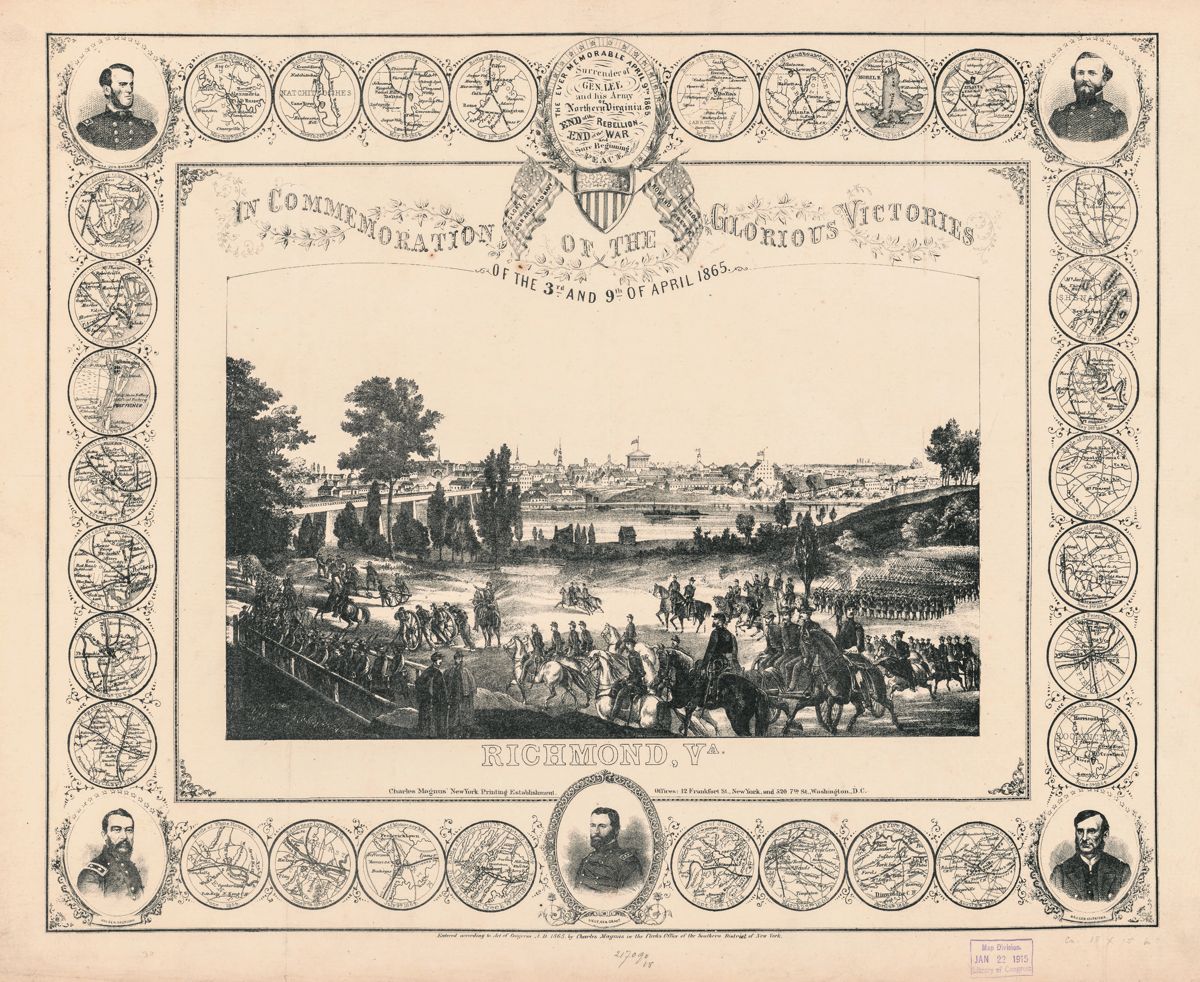
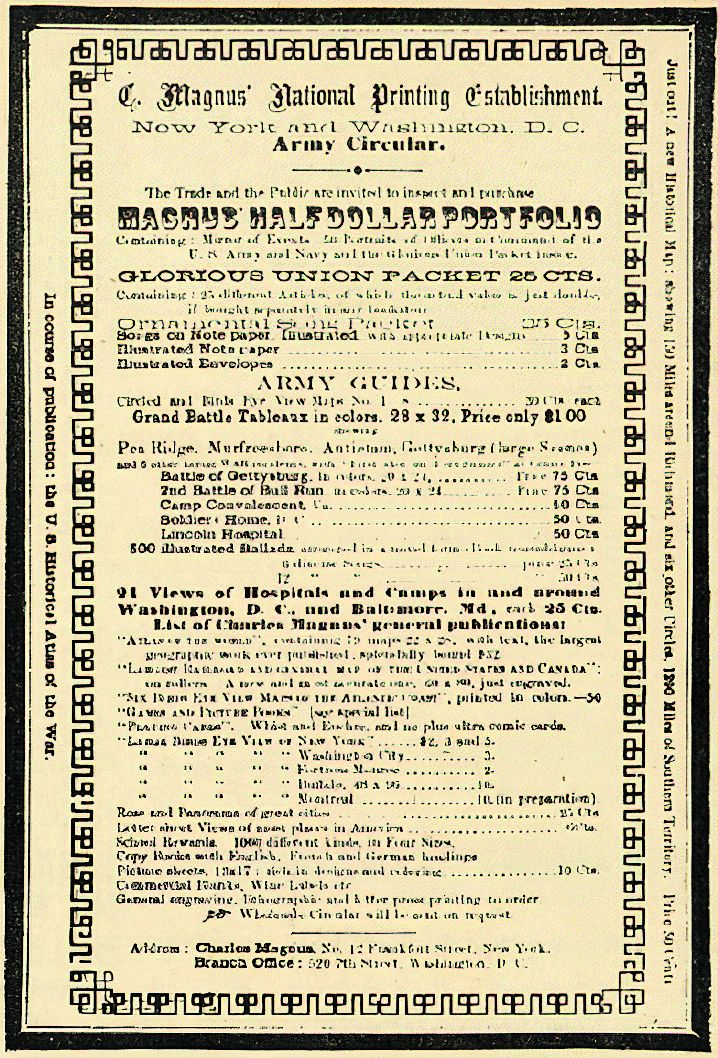
Glorious Victories April 3 and 9, 1865 The Graphic War highlights prints and printmakers from the Civil War discussing their meaning and the print maker or artist’s goals. We have featured the lithographer, Charles Magnus in previous articles. Remembered largely for his ephemera and books, and his extensive Civil War imprints, Magnus’ output included maps, letterhead or letter sheets with views of many American cities, games, and children’s toys (think lithographic depictions on toy blocks.) His thoughts and opinions on the war are unknown, but as author E. Richard McKinstry has written, Magnus realized early on that his customers would be northerners. As a result, “he did all he could through the printed word and imagery to promote the Union” to potential customers: soldiers and their families. According to McKinstry, Magnus insured that whatever he was producing, it had a patriotic flavor. “In order to be competitive with his fellow printers, Magnus was opportune in what he produced.”1 Much of his output was generic and “copied from other printmakers. He often altered or combined design elements from several sources, rarely crediting the original artist. Many of his works after 1865 were based on photographs, which he often altered, drawing in figures or re-drawing lines for clearer reproduction.”2 During the war, he “produced around 700 patriotic envelopes and over 300 illustrated song sheets. He produced images of allegorical figures, battle scenes, political cartoons, portraits and state emblems, frequently using the same images in different combinations.”3 Maps, detailing the progress of Union troops, were a common item. One particular type he favored was Union encampments. Who wouldn’t want a memento of their time in camp with comrades? “With a branch office in Washington, D.C., Magnus could create individualized pictures as soon as a new regiment arrived and camped in nearby Virginia or Maryland, then sell them to soldiers eager to send reassuring pictures home to worried families.” They were always “clean-looking camps.”4
His advertising circular is revealing. He boasted products such as “Glorious Union Packet” of songs and decorated letterheads and envelopes for 25cts. The “Army Guides” bundle contained views of all the major battles and “21 Views of Camps and Hospitals in and around Washington and Baltimore at 25 Cts. Each.”5 With Appomattox, the steady stream of battle maps and encampments came to an abrupt end. Then Magnus created the mother of all prints to celebrate the war’s end. Magnus not only included the events of April 9, Lee’s surrender, but also April 3, the fall of Richmond. The print commemorates the end of the war by showing a central view of Federal troops entering Richmond. It is surrounded by 30 vignette maps of major war battles. Center top is the “piece de resistance” showing Magnus’ jubilation with the words: “The Ever Memorable April 9, 1865 Surrender of Gen. Lee and his Army of Northern Virginia. End of the Rebellion. End of the War. And Sure Beginning of Peace.” At bottom center is a portrait of US Grant. Generals Sherman and Sheridan are at top left and lower left respectively. Facing them on the right are Generals Thomas and Kilpatrick. It is unclear why Magnus chose to depict Kilpatrick in the company of the other stellar players in the war. His choice of battles is curious also. In the upper right of the image Magnus depicts the Battle of Fort Morgan, Ala., Aug. 22, 1864, sandwiched between Sherman’s battles at Dallas, Kennesaw, and Atlanta, Georgia. Close examination reveals that
Magnus chose to show miniature battle maps of only those engagements that were fought in the final two years of the war. The earliest shown is the cavalry battle at Yellow Tavern, May 11, 1864, progressing up to Lee’s surrender. He did not cover the Battle of the Wilderness, but depicted the fall of Columbia and Charleston. Clearly, although he produced a large folio print, he had no room for the entire war. Magnus passed away in May 1900, still clinging to the old methods of lithography when the rest of the printing fraternity had moved on to photography, chromolithography, or photolithography. He and the 19th century went out together. 1.
Endnotes:
E. Richard McKinstry, Charles Magnus, Lithographer: Illustrating America’s Past, 1850–1900. Winterthur Museum, Oak Knoll Press, 2013, 117. New York State Library from a biographical statement created for the finding aid to the Charles Magnus Collection at the Winterthur Libraryexternal link. Ibid. Harold Holzer, Mark E. Neely, (Library of Congress)
Jr. The Union Image: Popular Prints of the Civil War North, Chapel Hill: The University of North Carolina Press, 2000, 57. Raymond Marsh, “Who Was Charles Magnus?, Stamps Magazine, February 12, 1949.
After 43 years in the museum field, Salvatore Cilella devotes his time collecting American prints and maps and writing. His last professional position was President and CEO of the Atlanta History Center. His most recent books are Upton’s Regulars: A History of the 121st New York Volunteers in the Civil War (U. Press Kansas, 2009). His two-volume Correspondence of Major General Emory Upton, (U. of Tennessee Press, 2017), received the 2017–2018 American Civil War Museum’s Founders Award for outstanding editing of primary source materials. His latest book “Till Death Do Us Part,” an edit of Upton’s letters to his wife 1868-70, was published in 2020 by the Oklahoma University Press.