
The Unfinished Fight
Kibler Knapsacks
By Craig L. Barry · Originally published February 2022 · pp. 8–10
Kibler Knapsacks The image of a soldier with a thick blanket roll or “horse collar” slung diagonally across his mid-section is practically a universal representation of the Confederate infantryman on campaign. However, many wore painted or oil cloth knapsacks on campaign in all theaters of war. This is not to say that blanket rolls were not widely found as well but knapsacks were frequently in use on the march except when heading into combat. Even then, some soldiers had mixed feelings about leaving the knapsack behind. The decision on what gear was necessary to carry or left behind by soldiers going into an armed confrontation with the enemy depended on the proposed tactics, i.e., how quickly the movement of troops was necessary. Common sense played a role as well. For example, the following period account from the 1862 Shenandoah Valley Campaign suggests that “light marching orders” in the Second Corps of the ANV usually meant dropping the knapsack and other non-essential gear, potentially leaving all that was contained in them behind. One man of the 4th Virginia’s Co. I, the Liberty Hall Volunteers, was part of Jackson’s Second Corps and described how they “stored” their packs at the beginning of a flank attack. At the close of the battle, details were sent back to recover the baggage. The “storing” of knapsacks was standard operating procedure for the “Foot Cavalry” during the campaign and when the order was given, it signaled to the men that there would soon be “some hard marching and fighting ahead of us.” At the beginning of any campaign, leaving Winter Quarters under “heavy marching orders” knapsacks were in wide use, in an inverse proportion to the simple blanket roll. In the words of Confederate officers, while the knapsack was viewed as far from perfect, it was seen as
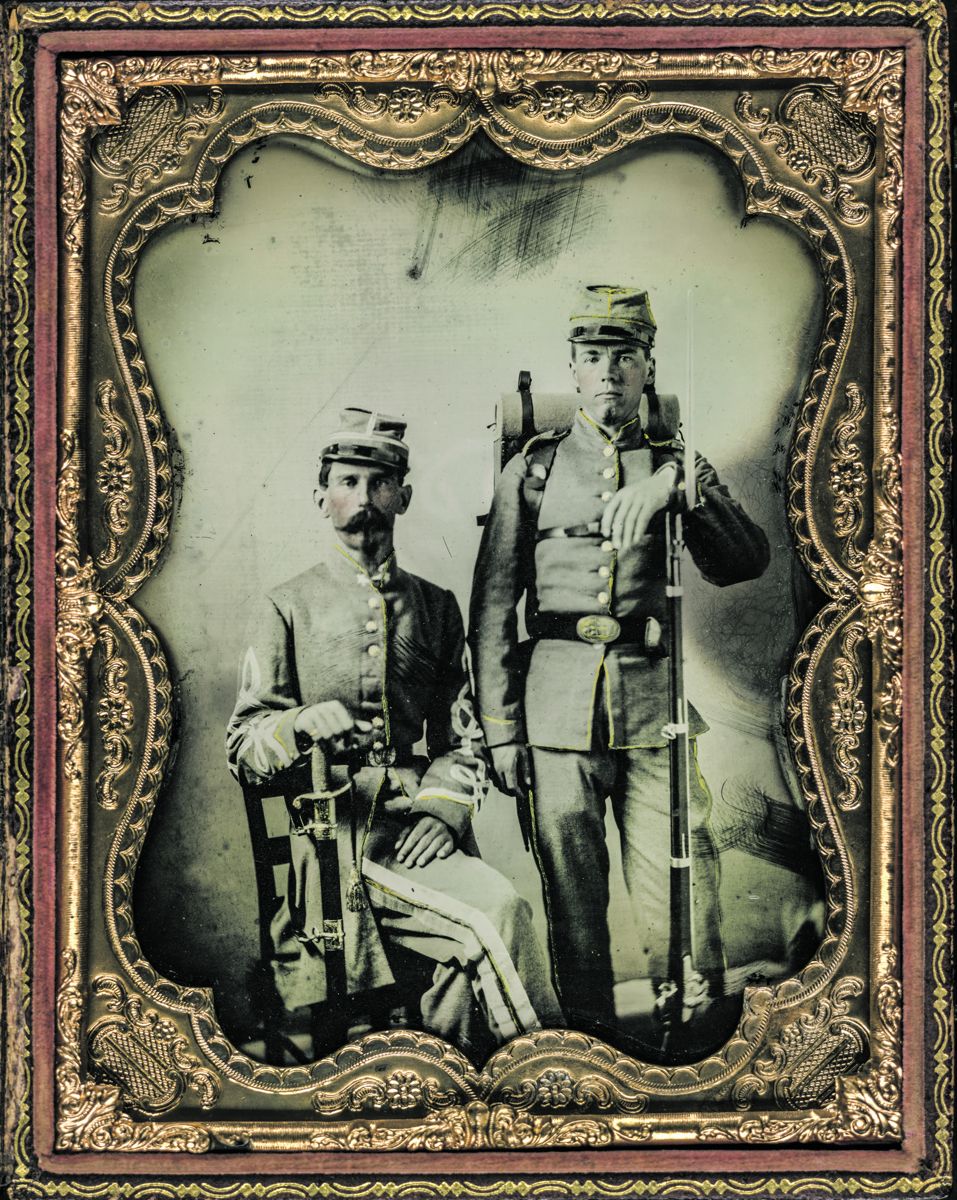
An early war photograph of two similarly uniformed militia men. The seated officer holding a foot officer’s sword with engraved top and middle sword mounts, with sword hangers attached, is wearing a Model 1851 U.S. sword belt with eagle sword belt plate with applied silver wreath. The officer’s trousers have two large white stripes and white quatrefoil is found on his sleeves along with white decoration on his kepi. The enlisted man standing next to him wears same light color uniform with same thin gilded edge trim wearing state issued box knapsack, belt with oval US buckle and cap box. He is resting his wrist on the muzzle of a U.S. Model 1855 rifle musket with fixed bayonet. The officer also has single white stars adorning each collar’s front edge unlike centered collar insignia usually seen on Confederate uniform. Liljenquist Family Collection of Civil War Photographs (Library of Congress).
“…an assistance (to the soldier) on the march.” The reason being was that if not loaded with excess personal baggage a soldier could transport a few extra days’ worth of rations in their knapsacks, as well as extra cartridges, eliminating the need for some baggage wagons. According to soldiers, the knapsacks also held “many other things as each man’s idea of what he was to encounter varied. On the outside of the knapsack, solidly folded, were two great blankets and a rubber or oilcloth. This knapsack, &c., weighed from fifteen to twenty five pounds, and sometimes even more.” Perhaps if other period accounts are to be trusted, they weighed as much as forty to fifty pounds, though not for long once the hard marching began. Some losses during a campaign for this piece of equipment were attributed to casualties or accidents yet the main reason was the practice of throwing off knapsacks prior to going into battle or leaving them behind when filing out in “light marching order.” Leaving a knapsack behind in camp or bivouac was a common way to become separated from it permanently. In fact, one Confederate soldier wrote after the battle of Sharpsburg in September 1862, “Next morning early, (we) resumed the search and found the rest of our brigade
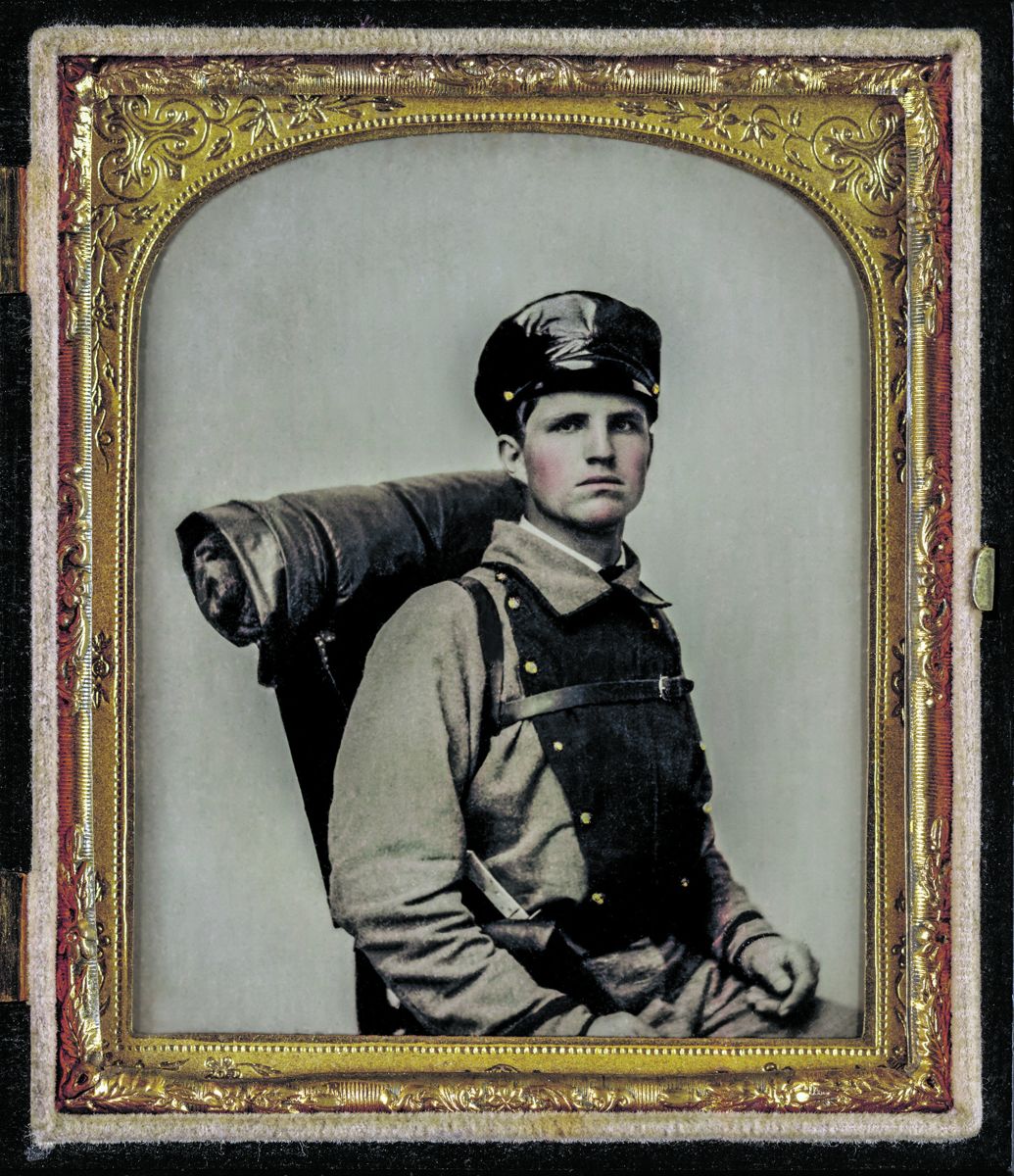
An early-war Virginia soldier, most likely from near Lynchburg, Va. The distinctive wide collars and plastron uniform front are indicative of units from this area. There is at least one known image of an infantryman identified to the 11th Virginia Infantry with same oil cloth rain cover on his kepi, which makes this Lynchburg unit a likely candidate. The stern young infantryman wears knapsack and bedroll with a side knife stuck in his belt behind his cartridge box. Liljenquist Family Collection of Civil War Photographs (Library of Congress). not far from where we threw our knapsacks when we went into action. Everything I had was gone. Overcoat, blanket, clothing, and all. Right there and then I swore by Jeff Davis, Abe Lincoln, and all the rest of them, that I would never drop my knapsack again. If I got where I could not carry it, I would lie down with it.” Another soldier in the 21st Virginia echoes the same hard lesson learned, “The two divisions in front of us were hurried forward, our division halted after going a short distance, and we were told to stack arms and rest, as we would not go into the fight. The men took off blankets, oilcloths, packs, etc., and stretched them in fence corners, on muskets and rails, to make a shelter from the sun. We were in the road and on a hill which overlooked the battle that was about to be fought in our front. We made ourselves comfortable and lay down under the shelter provided, to look at the battle.” (Then) the order was given, “Take arms!—no time now for blankets (or packs) get into your places at once. Right face! Forward march!” (This) was the command all down the line, and away we went…Many seemed to dislike to lose those articles more than miss seeing the battle.” Their knapsacks, including captured Federal gum blankets, and other personal effects, were lost to the enemy, as the 21st Virginia did not return to the hill after the battle of Monocacy Junction. That particular soldier swore he would never un-sling his gear for any reason again. Some knapsacks were designed with wooden frames for support while others were little more than large enameled or oil cloth bags with straps. Todd’s American Military Equipage suggests the most common pack produced for and issued by the Confederate Commissary is a variant of the pre-Mexican War knapsack. One example is currently nicknamed the “Kibler” pack after the surviving example used by Private James A. Kibler (often miss-spelled Kibbler) of the 10th Virginia Infantry’s Co. F, but would not have shown up in records by any name other than “knapsack.” Pvt. Kibler suffered a gunshot wound to his lower back at Chancellorsville in May 1863, so he was not wearing his knapsack into battle at that time. They were subsequently reunited and both Kibler and his now famous knapsack survived the war. The Kibler pack has an inside divider often made of ticking material (standard blue and white stripe) that ends just short of reaching the bottom of the bag. It is worn over the shoulder with two straps that cross over on the diagonal on the back and attach to the pack. The pocket of this type of knapsack tied shut with two thin strips of cotton, turned
CivilWarNews.com over and sewn along the seam; then attached to the flaps of the pocket. The basic version of this Confederate knapsack had blanket straps for an overcoat or blanket to be attached on top as needed. Confederate produced pre-Mexican War packs of the “Kibler” type can be found in museum collections and are documented to all theaters of war. This pattern of knapsack was in use from the late 1820s until the U.S. Army changed over to Model of 1853/55 “double bag.” There is a second commonly copied C.S. variation called the “Pritchard.” The main difference is that the “Pritchard” variant is more simply constructed, having a longer flap to close the “bag” portion of the knapsack and a much narrower flap. The “Kibler” has two crossing leather straps over the rear to help secure the load; the “Pritchard” variant omits these straps, and their exclusion affects comfort and utility. While the Pritchard was no doubt a less expensive article to produce, the “Kibler” was preferred for the straps that go around the body of the pack. The crossed straps kept the knapsack contents together better. The method was to load the pack and buckle it up, then let the leather straps stretch. The Confederate produced “Kibler” pack is essentially a “pocket and flap” arrangement. The flap is a practical idea, as it is a flexible compartment. The first layer to go in the flap is the blanket, unless it was carried on top, it was usually folded in thirds. The ground cloth goes in next over the blanket. That way, as the pack in un-slung and unloaded at the end of each day’s march the first thing out is the ground cloth, then the blanket, in just the order necessary. One caveat, the pocket of a “Kibler” knapsack takes common sense to pack comfortably. The part that goes against your back and its contents should be packed accordingly. Sharp or pointed objects in the inside pocket closest to the wearer’s back will make their presence known in an most unpleasant manner when on the march. Overall, the “Kibler” is a very good knapsack for field use. This general design was widely used during the Civil War, and it is one of the more comfortable of the Civil War-era knapsacks, including the 1853/55 Federal double bag knapsack. Were all soldiers on campaign carrying knapsacks? Apparently not, at least one Confederate soldier in the ANV discarded the entire knapsack and pilfered or foraged whatever he needed. He noted that, “It is amusing to think of the follies of the early part of the war, as illustrated by the outfits of the volunteers. They were so heavily clad, and so burdened with all manner of things, that a march was torture, and the wagon trains were so immense in proportion to the number of troops, that it would have been impossible to guard them in an enemy’s country. The knapsack vanished early in the struggle, It was inconvenient to
‘change’ the underwear too often, and the disposition not to change grew, as the knapsack was found to gall the back and shoulders, and weary the man before half the march was accomplished. The better way was to dress out and out, and wear that outfit until the enemy’s knapsacks, or the folks at home supplied a change.” This first-hand account is most likely unique to that single soldier’s personal experience as opposed to the behavior of the majority of Civil War soldiers on campaign, if other period accounts are to be trusted. In addition, Quartermaster records do not support a lack of knapsacks in the field. According to Larry J. Daniel’s Soldiering in the Army of Tennessee. A Portrait of Life in a Confederate Army, a mid-1862 inventory of equipment used by the Second Division, Army of the Tennessee is revealing. If his numbers are correct, then about 66% of the soldiers in the Second Division received and retained knapsacks during the 1862 campaign that included Shiloh and Corinth. Was that percentage of knapsack use exceptionally high for the time period and theater of war? No. At Chattanooga on August 23, 1862, the four brigades then comprising General William J. Hardee’s Division had nearly 6,000 men present for duty equipped with 4,877 knapsacks, (just over 80%) as well as 5,760 haversacks, and 5,714 canteens. “The percentage of men with packs or knapsacks was similar in General Leonidas Polk’s Corps, constituting the right wing of Braxton Bragg’s army. On August 18, 1862, Lt. John Rawle reported an aggregate force of 6,394 in Cheatham’s Division, the four brigades of which were equipped with 5,222 knapsacks (about 84%), 5,459 haversacks, and 5,209 canteens.” Further, there is evidence that requests for “reissued” or replacement knapsacks for those that were lost or discarded on campaign by Hardee’s Corps were rejected by the Quartermaster, as “the object is to furnish first those to whom they (packs) have never been issued.” Most soldiers on campaign greatly valued their knapsacks and considered them useful. The available supply did not always meet demand for this piece of equipment. Craig L. Barry was born in Charlottesville, Va. He holds his BA and Masters degrees from UNC (Charlotte). Craig served The Watchdog Civil War Quarterly as Associate Editor and Editor from 2003–2017. The Watchdog published books and columns on 19th-century material and donated all funds from publications to battlefield preservation. He is the author of several books including The Civil War Musket: A Handbook for Historical Accuracy (2006, 2011), The Unfinished Fight: Essays on Confederate Material Culture Vol. I and II (2012, 2013). He has also published four books in the Suppliers to the Confederacy series on English Arms & Accoutrements, Quartermaster stores and other European imports.