
Florida Presentation E.J. Johnston Officer’s Sword
By Shannon Pritchard · Originally published February 2022 · pp. 20–21

The upper mount is beautifully engraved “A.J.T. Wright Lt., Col., 3rd Regt. Fla. Vols. Oct. 7th, 1861.” Note line engraving below the throat that borders the ring mount. The middle ring mount has the same line engraving and decoration as the upper ring mount.
The brass drag is line engraved around its border and at the throat in simple form, while the drag’s body is ornately engraved. The sword’s blade (right) is etched with crossed Confederate First National flags, superimposed on a panoply of arms including crossed cannon. The bold CS is the largest size etched on Confederate sword blades.
Mr. Albaugh took the production figures from a newspaper article, and it was inaccurate. Neither the surviving records, nor the number of surviving specimens are indicative of such a large output. The “& Company” of E.J. Johnston has never been revealed, however recently discovered records show that the “& Co.” consisted of 38-year-old Massachusetts native George S. Obear, the Chief of the Macon Fire Department. Records show that in November 1861 the firm sold one plain and one etched sword for $25 and $28 respectively; included with these were 1 “folded belt with CS clasp and one belt, bridal leather.” I think this refers to patent leather over canvas webbing and single ply, heavy leather belts. These were received and signed for by an artillery Captain in Richmond, Va. On April 20, 1861, Edward Johnston enlisted in the “Floyd Rifles,” Company C, 2nd Battalion Georgia Infantry. He was discharged for disability the following July 2nd. Though he could not be a soldier, he turned his considerable talents to support the Confederacy; in December 1861, he supplied William H. Young with three officer’s swords and belts. His letterhead even at this early date stated that he and Obear supplied “Confederate States Service Swords, Belts, etc.” In August 1862 he supplied 50 artillery sabers to the Macon Arsenal. It is interesting to note, that by December 1862, though using the otherwise same letterhead, the reference to Confederate States swords had
CivilWarNews.com been removed. In dozens more receipts over the next 9 months there are no recorded sales of swords, but he is renting his building to the Confederacy as an ordnance warehouse and it appears that he sold off all, or at least a large amount of, his tools and equipment. Judging by their rarity, and the time frame in which Johnston had to make swords, he likely turned out no more than a few dozen officer’s swords and as many cavalry swords. Then inexplicably, in September 1863 the reference to Confederate swords, etc., reappears on his letterhead. The month before, he and 64 Macon firemen, known as Captain Obear’s Company mustered in as the “Firemen Guard,” Company D, 14th Battalion Georgia State Guards. As noted earlier, E.J. Johnston and George S. Obear were partners in their sword making enterprise. Here we leave Mr. Johnston, and move to the owner of Johnston’s work of art. The top mount of the E.J. Johnston sword shown here is engraved: “A.J.T. Wright Lt., Col., 3rd Regt. Fla. Vols. Oct. 7th, 1861.” During the Seminole Wars, Private Arthur J.T. Wright served in Asa A. Steward’s Company, Second Regiment, Florida Foot Militia. In 1856, Captain Wright was commanding a company hunting Indians in Levy County, Florida, and its environs. In 1857, he was a Lieutenant Colonel of the Florida Regiment Mounted Volunteers. A few years later, the 36-year-old Georgia native was appointed Lieutenant Colonel of the 3rd Florida Infantry in Fernandina, Fla., on July 25, 1861. The regiment served along the coast at Talbot Island and
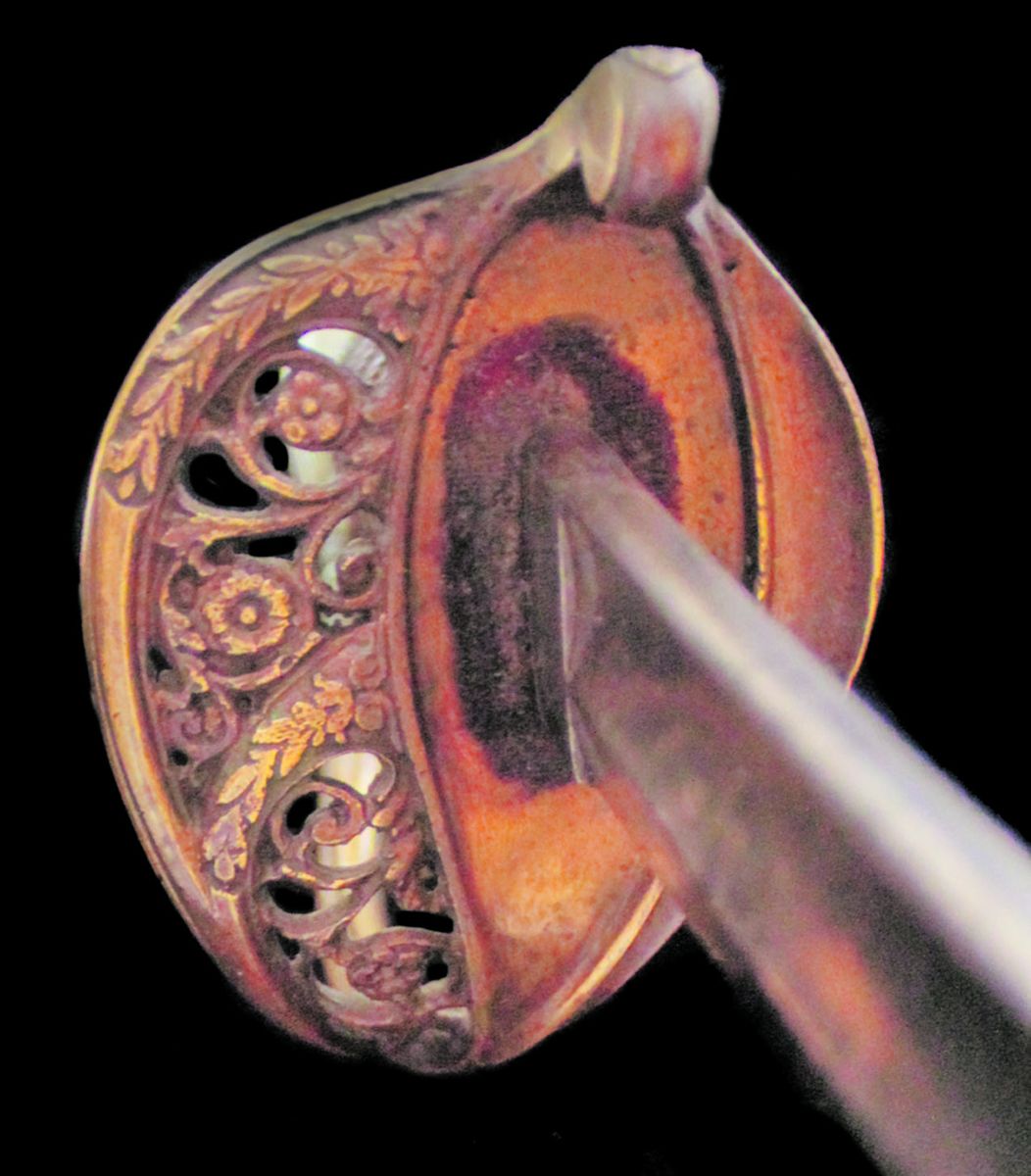
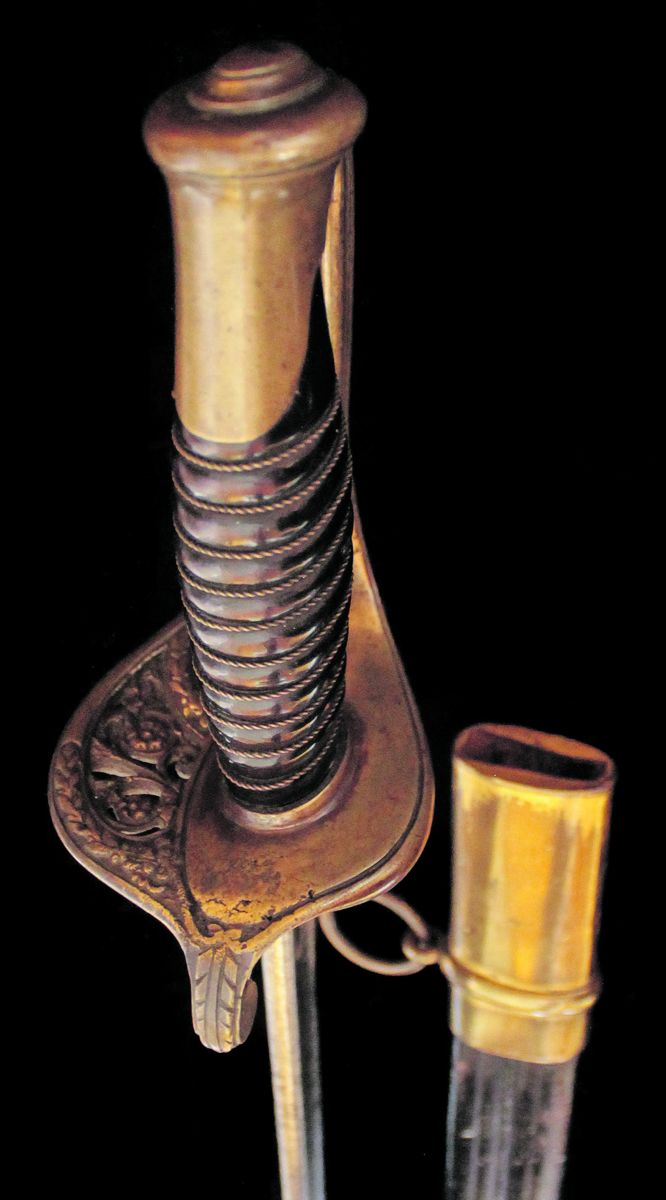
Cedar Keys, and then moved to Mobile, Ala. After fighting at Perryville, Ky., it was assigned to Preston’s, Stovall’s, Finley’s, and J.A. Smith’s Brigade, and during December 1862, it was consolidated with the 1st Florida Infantry Regiment. The 3rd’s February muster roll shows Wright as commanding the 3rd Regiment, Florida Volunteers, though still a Lieutenant Colonel. He was with his regiment until dropped from the regimental roll on May 3, 1862, when he failed at being elected during the reorganization of the Confederate armies in the spring 1862. After leaving the 3rd Florida Volunteers, Wright sought the position of a “Major in the Confederate Army.” Colonel Wright had powerful friends, so in furtherance of that desire, an unusual document was drawn up which reads: “Petition of A.J.T Wright, The undersigned members of the Convention of the State of Florida, respectfully petition the President of the Confederate States of America to appoint Lieut. Col. A.J.T. Wright a Major in the Confederate Army.” This petition was signed by 29 members of the Florida Legislature, the same men who signed Florida’s Ordinance of Secession. Wright had been a member of the Secession Committee. For undisclosed reasons, he did not receive the appointment to major, but like a true Southern Patriot, he enlisted as a simple private in Mooty’s Company F, 9th Florida Infantry on February 16, 1863, notwithstanding his exalted position in civilian life. In July Note the stopped fuller. A rare feature on Confederate swords, but common for E.J. Johnston. CivilWarNews.com 1864 he was furloughed from the hospital in Lake City, Fla., for 60 days, for Chronic Inflammatory Rheumatism. In September, he was reported as physically unfit for field service and detailed to the Lake City, Confederate Hospital. In the 1860 census, Wright was recorded as a wealthy merchant, owning $30,000 worth of property. Both his health and fortune were broken by the war; five years after the war, he owned only $1,500 in property. He died two years later and has only a small stone reading “A.J.T. Wright 1825 1872,” marking his grave in Lake City’s Oakdale Cemetery. Certainly, a sad end to a noble man; nothing to be remembered by but this extraordinary sword! E.J. Johnston’s swords display well the skills of its maker. His standard officer’s, enlisted cavalry, and artillery swords were better quality than those made by nearly all his Southern contemporaries, and equaled the quality found in northern and European made swords. His artillery swords had machined fullers; his enlisted cavalry sword had a pen knife type stop at the ricasso and his officer’s sword had polished wood grips simulating horn, a pen knife type stop, and exquisite etching. This example has these features, and it has beautifully etched mounts on the scabbard. The sword was published in William Albaugh’s 1963 edition of A Photographic Supplement of Confederate Swords, (pages 105 and 106), and again in Daniel Hartzler’s 1988 edition of Confederate Presentation & Inscribed Swords & Revolvers, (pages 244 and 245). It remains in excellent original condition. The beautiful etched blade has some mottled carbon staining, but retains excellent etching, featuring E.J. Johnston & Co’s name and address, a large Roman “CS,” and assorted military panoplies and floral patterns. The black polished wooden grip retains its original luster, and its twisted brass wire wrap remains tight. Shannon Pritchard has authored numerous articles relating to the authentication, care and conservation of Confederate antiques, including several cover articles and is the author of the definitive work on Confederate collectibles, the widely acclaimed Collecting the Confederacy, Artifacts and Antiques from the War Between the States, and is co-author of Confederate Faces in Color.