
The Graphic War
Bull’s Run
By Salvatore Cilella · Originally published February 2022 · pp. 30–31
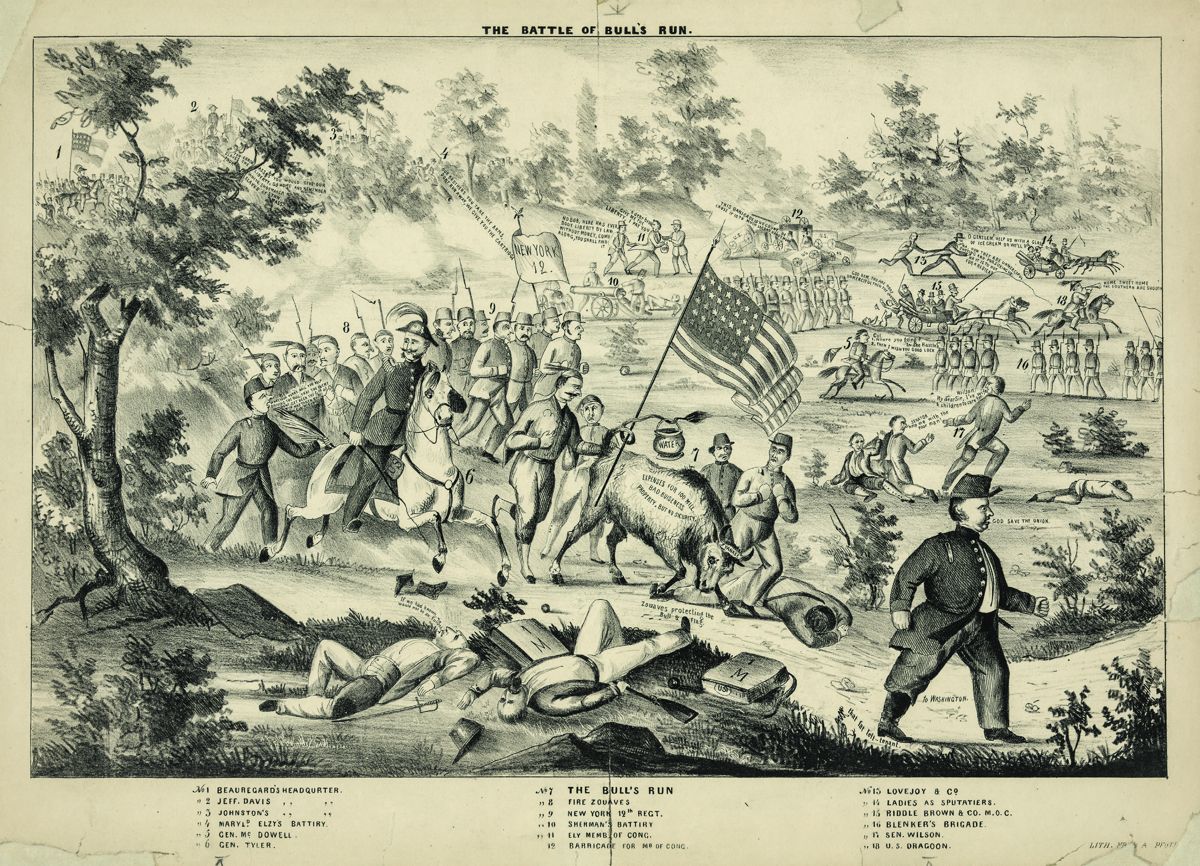
Bull’s Run The Graphic War highlights prints and printmakers from the Civil War discussing their meaning and the print maker or artist’s goals. No student of the Civil War would argue that the new born Confederacy with its newly minted soldiers, routed the untested Union boys and men at
First Bull Run. Brigadier General Irwin McDowell complained that his men weren’t ready for battle after all. But President Lincoln insisted; “You are green, it is true; but they are green, also; you are green alike.” The rout of Federal troops was roundly criticized by northern papers and the new Confederacy rejoiced. Aside from two lithographs by Currier and Ives and this peculiar “print-cartoon,” nearly all depictions of the First Battle of Bull Run seen by the public, were through the lens Alexander Gardner’s camera. Unlike his pictures of the Antietam battlefield the next year, he did not focus on the grim aftermath of bodies strewn about the field. This particular lithograph has been categorized by the Library of Congress as a piece of Copperhead propaganda. If so, it is an early manifestation of Copperhead desires to end the war and return the country to the Jacksonian agrarianism of previous generations. It wasn’t until 1863-64 that the Copperheads reached the zenith of their influence. By 1868, they were no longer politically viable. So, could this be an early Copperhead piece of propaganda? We know nothing about the artist “A. Pfott.” An educated guess is that he was one of the many lithographer emigres from Germany following the revolutions and upheaval of 1848 in Europe. Some balloon captions contain crude English spellings based, perhaps, on mis-hearing the spoken word. Additionally, the artist was unsparing in lampooning the elite spectators who had gathered on the field of battle to watch the action as they picnicked beneath the trees. In the keys to the points in his image, Pfott portrays the Confederates in a kind light, contrasting starkly with the fleeing Federals. The print is keyed to eighteen points: 1) [P.G.T.] Beauregard’s headquarters, 2)
Jefferson Davis’ headquarters, 3) [Joseph E.] Johnston’s headquarters, 4) [Confederate Major General Arnold] Elzy’s Maryland battery, 5) General [Irwin] McDowell, 6) General [Daniel] Tyler, 7) The Bull’s Run, 8) [Colonel Elmer Ellsworth’s 11th NY Volunteer] Fire Zouaves, 9) New York 12th Regiment, 10) [William Tecumseh] Sherman’s battery, 11) [Alfred] Ely member of Congress, 12) barricade for member of Congress, 13) [Abolitionist Owen] Lovejoy & Company, 14) Ladies as sputatiers [sic], 15) [Abolitionist Albert Gallatin] Riddle Brown & M.O.C., 16) [U.S. Colonel Ludwig (also Louis)] Blenker’s Brigade, 17) Senator [Henry] Wilson, and 18) [Company K, 2nd ] U.S. Dragoon. The most damning language Pfott saved for the “balloon” captions over the various actors in the mad dash back to Washington. Putting words in the mouths of characters particularly in political cartoons goes far back in English and continental cartoon making. In doing so, Pfott sounds very much like a Copperhead. He lampooned Congressman Owen Lovejoy, a prominent abolitionist, who was being petitioned by the “Ladies as sputatiers” [sic]. “O Gentlem [sic] Help us with a Glass of ice cream or we’ll die” the women swoon. Lovejoy cries out “Ha. How they are unmerciful. Shooting and pursuing us. Ha, it is too hot for a retreat.” The Dragoons in retreat bugle out: “Home Sweet Home, the southern [sic] are shooting.” Senator Wilson is asked for help by a wounded soldier and he coldly responds, “My dear sir, I’ve wife and children to care for.” Member of Congress Alfred Ely was captured by the Confederates. In this print he is shown offering a bribe to be released. “O dear brother, give me the liberty, I will pay you.” To which his captors remark: “No Bob, here was liberty by law, without money, come along, you shall find it.” From President Davis’ headquarters, in broken English, comes the dire warning: “You chach asses [jack asses]. You would give our slaves the
CivilWarNews.com liberty, go home and remember your white shoemaker slaves at Synn [Lynn] Mass.” Abolitionist Albert Gallatin Riddle is shown fleeing in a carriage toward Washington as a member of his party, whip in hand, fends off stragglers wishing to climb aboard his wagon as one of them accuses him: “God Dam, you are more unmerciful then [sic] the overseers.” To the lower left, a soldier reproaches General Tyler: “Gen: What [is] your hurry. Will you help driving the bull, that the enemy don’t get beck [sic] the 5/4th of it, wich [sic] was taken by Gen. McDowell?” In other words “are you willing to retake that which was lost?” From all internal evidence, the anti-federal mockery, the references to slavery and abolitionists, it appears that perhaps indeed this print is a rare early manifestation of “Copperheadism” in the extreme. The artist’s identity remains a mystery. It is very possible that it is a pseudonym. Clearly, the artist intended to mock the immigrant, the Lincoln administration, the feeble Union army effort at Bull Run, and promote the Confederacy. It is a prime example of a Civil war lithograph that is less about art and more about documentation of an historical event.1 1.
Endnote:
World Cat notes only three copies, two in Kentucky repositories at Danville and Williamstown, and one in the Library of Congress.
After 43 years in the museum field, Salvatore Cilella devotes his time collecting American prints and maps and writing. His last professional position was President and CEO of the Atlanta History Center. His most recent books are Upton’s Regulars: A History of the 121st New York Volunteers in the Civil War (U. Press Kansas, 2009). His two-volume Correspondence of Major General Emory Upton, (U. of Tennessee Press, 2017), received the 2017–2018 American Civil War Museum’s Founders Award for outstanding editing of primary source materials. His latest book “Till Death Do Us Part,” an edit of Upton’s letters to his wife 1868-70, was published in 2020 by the Oklahoma University Press.