USS Jamestown Served U.S. Navy for More Than Six Decades
By Bob Ruegsegger · Originally published December 2022 · pp. 38–40
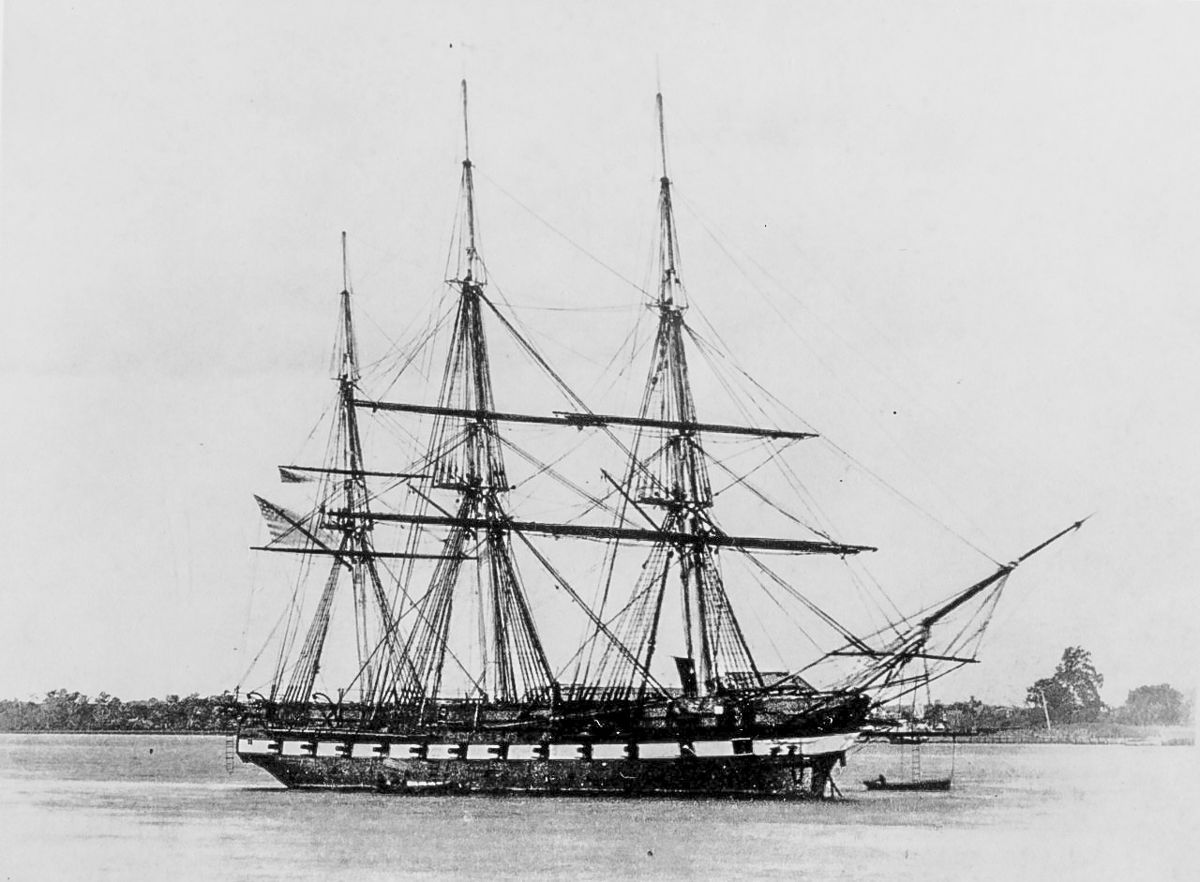
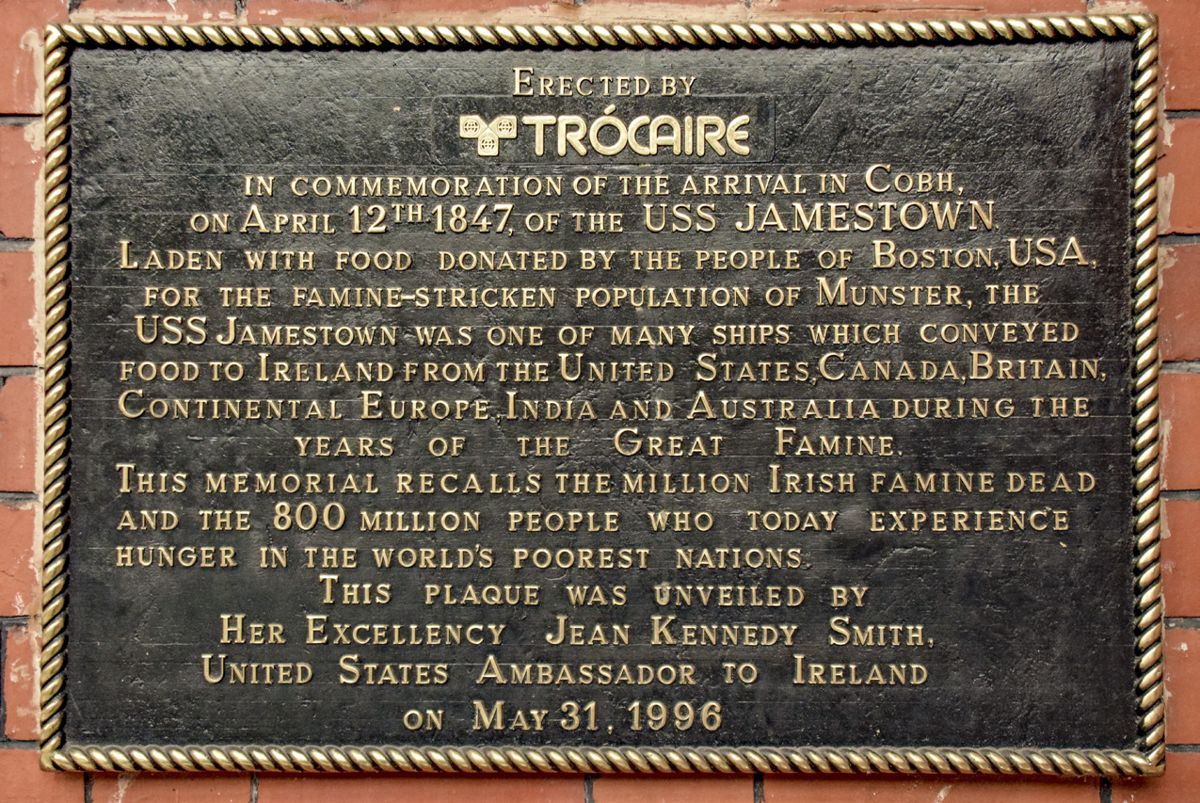
Long before the sloop of war USS Jamestown saw Civil War service with the Atlantic Blockading Squadron, the three masted ship-rigged warship had unquestionably secured her place in American maritime history. A modest bronze plaque mounted on the brick wall in the Cobh Heritage Centre on the southern Ireland coast commemorates America’s first massive humanitarian undertaking during Ireland’s Great Famine in 1847. The tablet commemorates the USS Jamestown’s gallant voyage to bring lifesaving provisions and vital supplies to the starving Irish during the mid-19th century’s Great Hunger. “The Jamestown was built in the Gosport Navy Yard, now known as the Norfolk Navy Yard. She was laid down in 1843 and launched September 16, 1844,” said Ross Patterson II, assistant curator for the history division of the Portsmouth Museums which includes the Portsmouth Naval Shipyard Museum. “Jamestown was a ship-rigged sloop-of-war with three masts for improved speed and mobility, compared to a two-masted sloop-of-war,” said Patterson. “She was more agile at sea while still having rather decent firepower.” “She was commissioned, under the command of Captain Robert B. Cunningham shortly after on December 12, 1844.” The newly commissioned sloop-of-war was quickly designated as flagship of the African squadron, assigned to suppress the slave trade off the coast of western Africa. After its first deployment off the African coast, the Jamestown returned to Boston in August 1846. When word arrived from England in January 1847 aboard the Hibernia of the devastating starvation spreading across Ireland, a Boston-based relief committee called the New England Committee for the Relief of Ireland and Scotland was established to organize relief efforts and collect contributions from Boston, and from all over New England. Boston merchant and shipbuilder Robert Bennett Forbes, and his brother John, developed a plan to send direct relief to Ireland in the form of provisions, instead of money, via a refitted warship that sat idle in the Charlestown Navy Yard. “The Jamestown was back from her overseas expedition and was essentially idle in the shipyard waiting standard maintenance after having been at sea for her first big expedition,” said Patterson. “She was sitting right there. She was a nice, new ship between assignments,” observed Patterson. Forbes believed that the sloop-of-war USS Jamestown could be filled with provisions and shipped to Ireland’s aid expeditiously and supply more food at less cost. Robert Forbes also thought that New Englanders would be more willing to contribute food than dollars. If Congress endorsed the loan of naval vessels to the merchants of Boston, Forbes, a civilian, expressed his willingness to command a ship with a crew of volunteers and sail it to Ireland. Congress, with some minor opposition, approved the request for using a navy warship on a humanitarian mission during the Mexican War. President Polk supported the proposal as well. It was a truly historic operation. The congressional decision helped set a pattern that has endured until the present. Sending humanitarian assistance via navy ships and aircraft during a crisis has become an American tradition, and the world expects it, although the motive may not always be strictly philanthropic. Of the $3,000 earmarked to retrofit the USS Jamestown by the New England Committee for the Relief of Ireland, Forbes spent $1,700. All but two of the vessel’s deck guns were removed to allow space for stowing comestible supplies. “The primary thing would have been stripping the gun deck and using it as a civilian-type sloop cargo hauler,” said Patterson. “The Jamestown was equipped with 8-inch and 32-pounder guns. Taking all that armament out of a ship was quite an effort,” he noted. “That helped free up room for the supplies that were loaded on the ship.” Following the cargo lading, Forbes signed a voucher agreeing to return the sloop to the Navy Yard in Charlestown as soon as his voyage was completed, the perils from the sea, pirates, and foreign enemies excluded. Captain Robert Bennet Forbes left the Charlestown Navy Yard in command of the USS Jamestown on March 28, 1847. The warship was loaded with 800 tons of provisions and supplies. The American vessel was welcomed by thousands of people who gathered on the hillsides and assembled on wharves. The Irish cheered enthusiastically and wept openly as they beheld the supply laden ship. The immediate cause of the Irish famine, the Great Hunger, was the widespread potato blight in Ireland. The lowly potato provided the Irish with nourishing food. The near universal reliance of the Irish on the potato produced devastating consequences when the potato crop failed. Irish clergyman Reverend Theobald Mathew of Cork had been ministering to his flock by dispersing his own food and money among the starving, opening his own home to the destitute, and risking his own health praying over the feverravaged Irish. Father Mathew had supported Forbes’ mission through letters he sent to the United States emphasizing the desperate starvation and fever that were steadily worsening throughout Ireland. Father Mathew requested that Captain Forbes accompany him back to Cork City in order that Forbes might gain an understanding of the colossal scale of the Irish anguish. “I saw enough in five minutes to horrify me,” observed Forbes. He saw suffering and was surrounded by a mob of starving people during his disheartening walk in Cork. Forbes never forgot his narrow escape from an aggressive mob seeking relief. Forbes, an experienced traveler, had seen paucity and deplorable conditions in other regions of the globe, but he had never seen the dreadfulness he encountered in Ireland during the Great Famine. Forbes kept the worst of the horror he witnessed to himself, noting that the details were “too revolting” to be “recorded on paper.” While dockworkers unloaded the provisions and supplies from the Jamestown in Cork Harbor, Forbes reflected in utter dismay on the awful sights that he witnessed along the streets of Cork. Most of the relief delivered by the Jamestown was distributed in Cork and the areas immediately surrounding County Cork. While USS Jamestown was the initial food-laden relief ship to arrive in Ireland, other American
USS Jamestown under full sail.

CivilWarNews.com ships continued arriving in Irish ports such as Galway, Dublin, and Cork, for months. American generosity was astonishing. American relief for Ireland was, at that time, the most supreme humanitarian effort ever organized for one nation by another. Captain Forbes characterized his mission of mercy as the most significant event of his life. While the USS Jamestown’s mission of mercy to Ireland had been successfully completed, Forbes, as promised, returned the USS Jamestown intact to the
Charlestown Navy Yard. USS Jamestown continued to serve in the United States Navy, on and off, for another 66 years. “Jamestown actually served in four squadrons, the Africa, Mediterranean, Brazil, and Home, leading up to the Civil War” said Patterson. “She did everything a warship could have done in the Atlantic.” At the outbreak of the Civil War, the USS Jamestown was recommissioned and assigned duty as part of the Atlantic Blockading Squadron, a unit of the U.S. Navy formed to apply the Union blockade to Confederate ports. Navy recruitment depended largely upon immigrants and blacks to provide the manpower to man the vessels that enforced the Atlantic blockade. Pay advances and bonuses were used to attract potential recruits. One in five sailors was born in Ireland. Without the immigrants as recruits, the Union blockade would have been impossible. Created in 1861, the Atlantic Blockading Squadron was divided that same year into the North Atlantic Blockading Squadron and the South Atlantic Blockading Squadron. Combined with the blockade of Gulf ports and seizing control of the Mississippi River, General
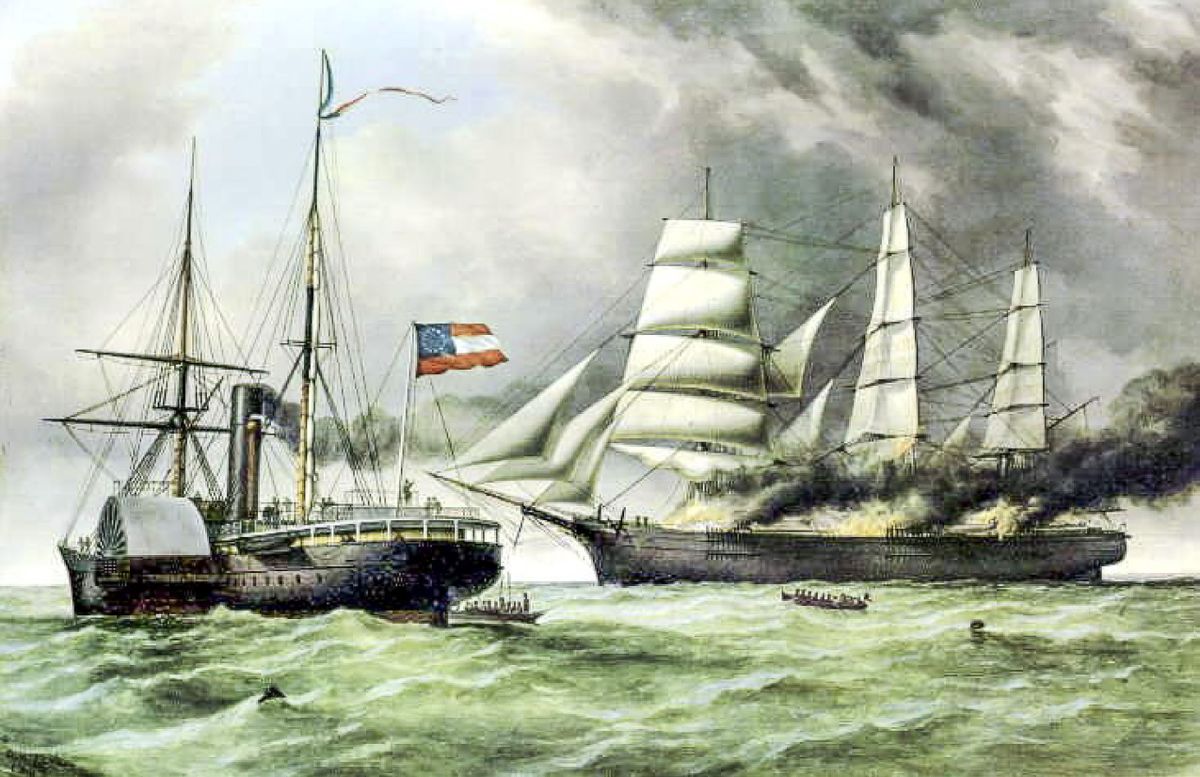
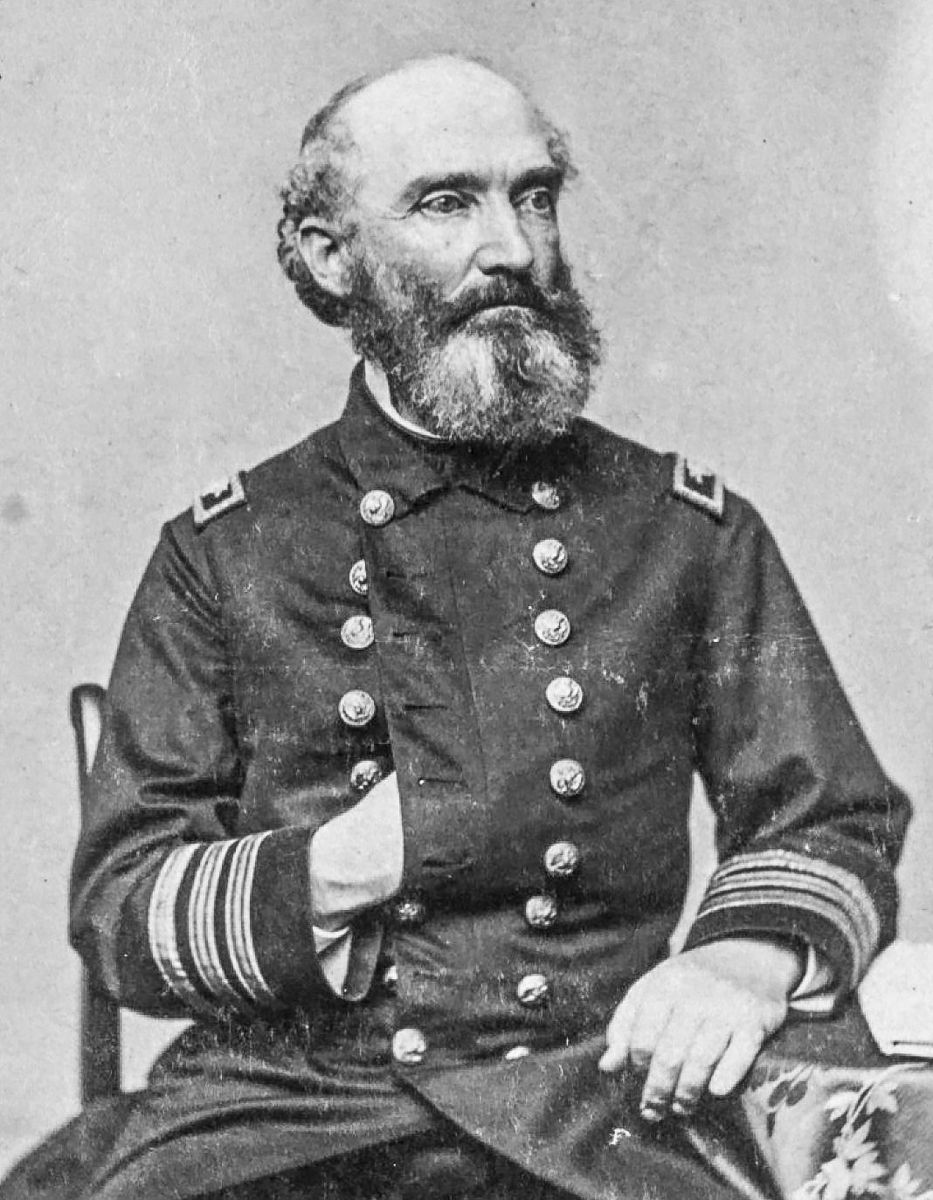
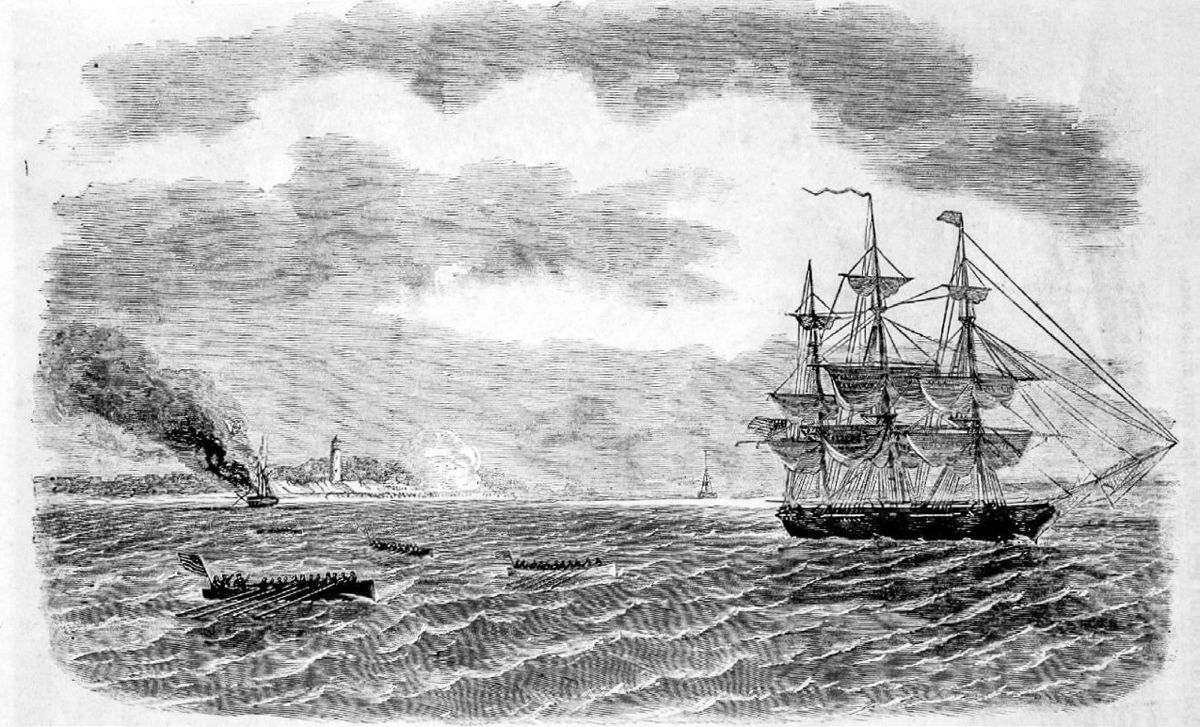
CSS Nashville and the USS Jamestown (right). Winfield Scott’s “Anaconda Plan” slowly but surely squeezed the viability out of the economy of the South over the duration of the war. Initially, the Atlantic Blockading Squadron consisted of 14 ships, but with the addition of civilian vessels quickly converted to military use, the unit grew to more than 40. The Jamestown was credited with sinking two Confederate vessels, the bark Alvarado and the schooner Colonel Long, and also captured three blockade runners. The captured prizes included the schooner Havelock near Cape Fear on Dec. 15, 1861, schooner Aigburth off the Florida coast on Aug. 31, 1861, and the brig Intended seized off Wilmington on May 1, 1862. According to Commander Charles Green’s official report on August 1861, the American bark Alvarado was destroyed by fire off Fernandina, Florida. When the Alvarado ran aground while being chased by the USS Jamestown, the crew abandoned the ship. Fearing shoals, without a pilot, Commander Green elected to launch boats and attempted to refloat the grounded ship. When local Southerners fired on Green’s small boats with rifled guns, the attempt to salvage the bark was abandoned and the Alvarado and its cargo were set afire to keep it from falling in to Confederate hands. Commander Green reported, based on the Alvarado’s logbook, that 454 bales of wool, 20 bales of buckskins, 58 bales of goatskins, 23 hides, 290 bales of sheepskins, and 70 tons of iron. On September 4, 1861, the USS Jamestown captured and scuttled the rebel schooner Colonel Long. The Confederate sailing vessel, a fishing schooner, had a cargo of one barrel of whisky, a few sacks of arrowroot, and a bag of sponges. After the cargo was removed, the schooner was scuttled. Although the sailing vessel USS Jamestown had a respectable record for capturing Confederate sail powered vessels, her inability to capture the CSS Nashville, a Confederate brig-rigged, side-wheel steamer, that was infamously proficient at running the Union blockade brought the sloop-of-war more attention than her handful of successes. Two entrances to the Cape Fear River, along with barrier islands and shoals, kept the Union navy from completely blockading the port of Wilmington area. When the CSS Nashville ran aground on New Inlet Bar, the USS Jamestown and screw gunboats Mount Vernon and Monticello were unable to seize the Confederate steamer.
Commander Green was forced to relinquish his command of the USS Jamestown to travel to Philadelphia to face a court martial. Ultimately, Commander Green was acquitted because the Jamestown had been ordered to sea with “great haste;” repairs had not been completed, and needed supplies, boats, and anchors, had not been provided. In October 1862, the Jamestown was transferred to the Pacific squadron and served off California until the War’s end. The vessel was converted into a transport and stores ship. The Jamestown also served in Panama and was sent to Hawaii and used as a public marine school. In 1881-82, the Jamestown was refitted as naval training ship and based at Norfolk until being transferred to the Treasury Department and used as a hospital quarantine vessel for the Portsmouth Naval Hospital. The USS Jamestown was destroyed by fire January 3, 1913, at the Norfolk Naval Shipyard in Portsmouth. While the USS Jamestown’s naval service was long and commendable, her brief stint as a civilian ship transporting humanitarian relief to Ireland brought the sloop-of-war a distinction that ultimately proved the highlight of her seafaring history. Ireland will never forget the magnanimity and compassion that the American people sent to relieve suffering during the Great Hunger. The bronze plaque on the wall of the Cobh Heritage Center succinctly commemorates the USS Jamestown’s voyage of compassion in 1847 as one of the greatest humanitarian efforts of all time. Note: Voyage of Mercy by Stephen Puleo offers readers a full account of the USS Jamestown’s passage to Ireland with 800 tons of food, clothing, and supplies for Irish relief in America’s phenomenal national demonstration of charity and compassion for a country struggling to survive during a time of incredible misery. Bob Ruegsegger is an American by birth and a Virginian. His assignments frequently take him to historic sites throughout Virginia, the Mid-Atlantic, and the Southeast. His favorite haunts include sites within Virginia’s Historic Triangle— Jamestown, Yorktown, and Williamsburg. Bob served briefly in the U.S. Navy. He is a retired educator and has been an active newspaper journalist for the last twenty years.