
Through The Lens
Through the Lens — December 2022
By Stephanie Hagiwara · Originally published December 2022 · pp. 24–25
Battle of Port Royal Sound – Part II
“A deep-mouthed rifled gun from Hilton Head on our left belched forth its welcome to the ‘hospitable graves’ of South Carolina. ‘Not that time, my dear!’ was whispered furtively by a captain of a gun” – U.S. Lt. John Sanford Barnes, USS Wabash
On November 1, 1861, a hurricane scattered U.S. Flag officer Samuel Du Pont’s 77 vessel fleet as it headed to capture Port Royal Sound, S.C. The Federals targeted the deep-water harbor to use it as a coaling station for Federal blockading vessels. Port Royal was on the wealthiest of South Carolina’s Sea Islands located between Charleston and Savannah, surrounded by marsh. Several rivers, including Skull Creek, which meandered 22 miles to Charleston, emptied into the sound. Local plantations raised cotton and during the “sickly season,” it was the summer resort of the wealthy. C.S. Gen. P.G.T. Beauregard didn’t consider the sound defendable due to its entrance being over two miles wide. South Carolina Governor Francis Pickens successfully appealed to Jefferson Davis to have two forts built at the sound’s entrance.
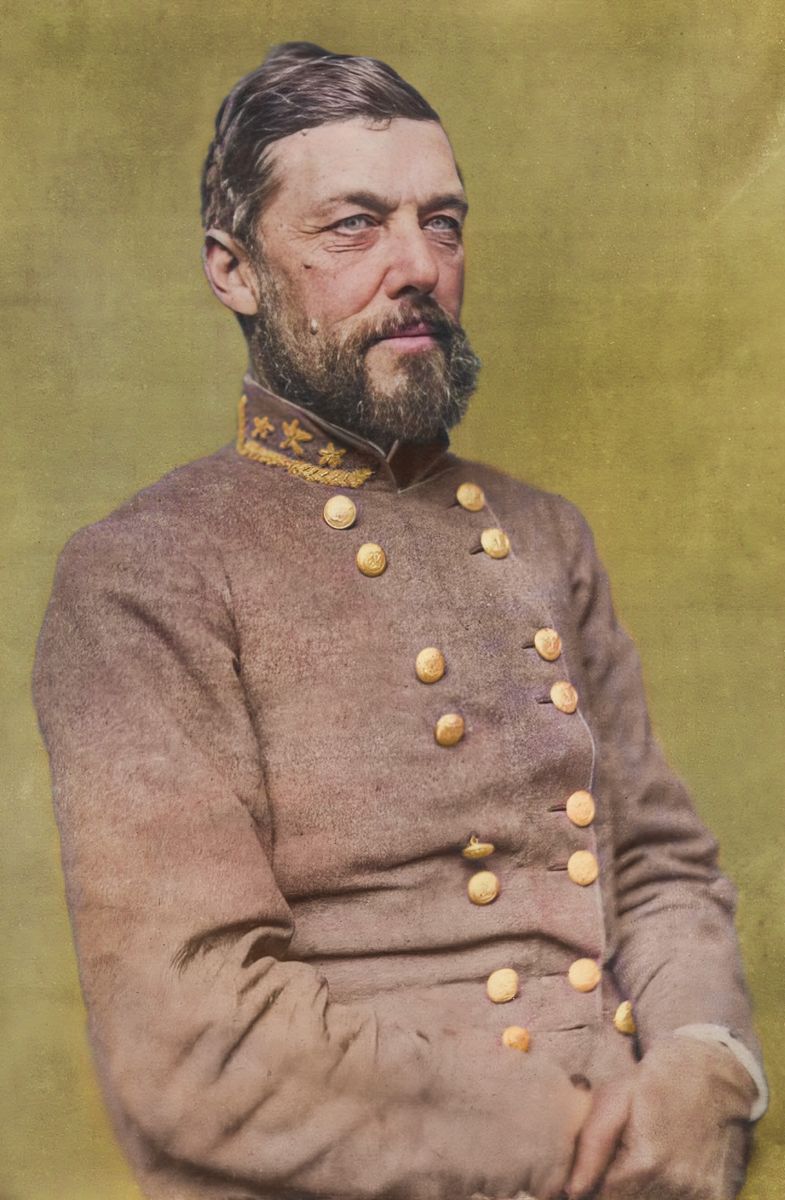
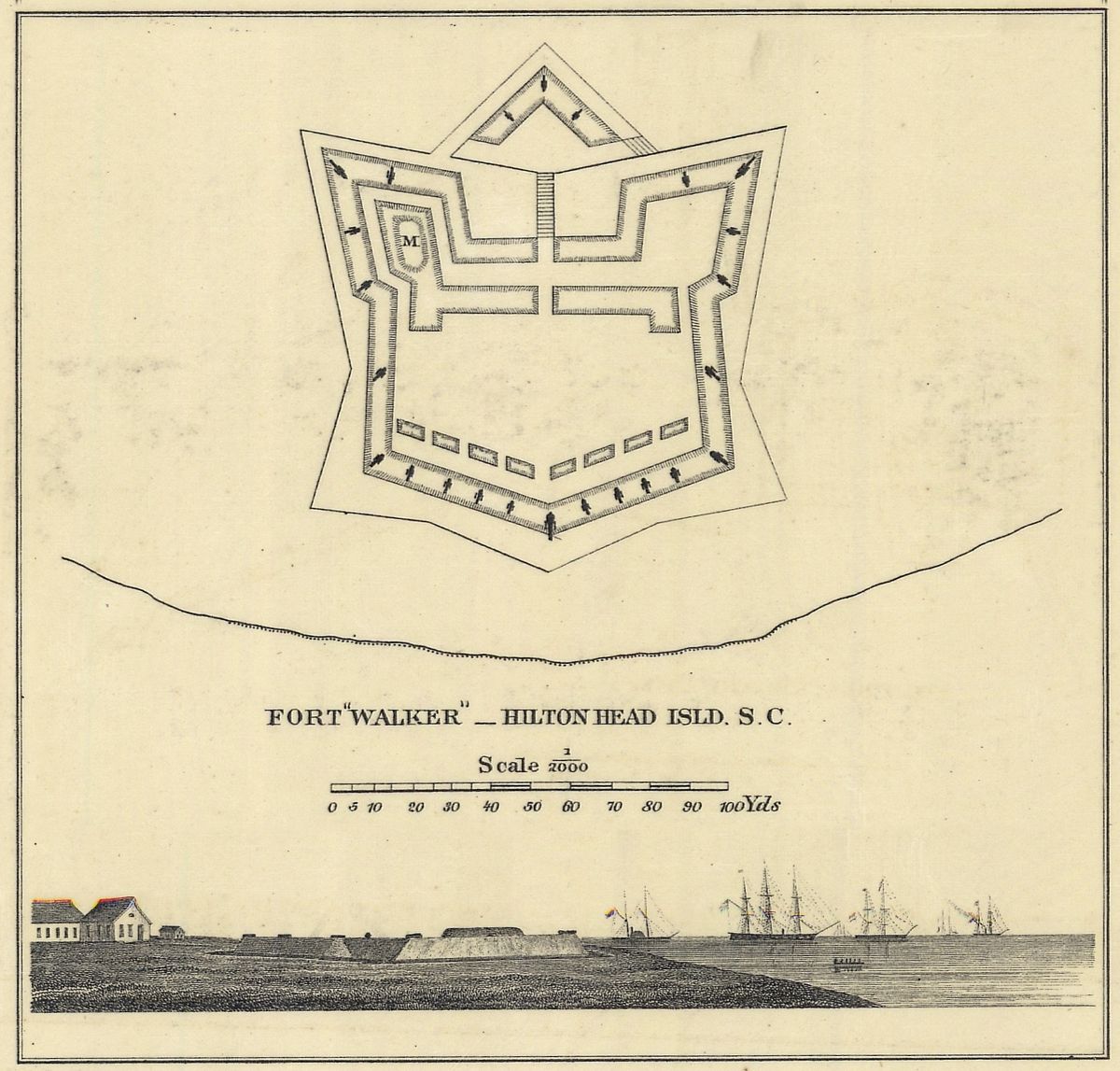
On September 24, Thomas F. Drayton was promoted to brigadier general. Drayton was born into a wealthy Charleston family, was classmates with Jefferson Davis at West Point, and used his Hilton Head Island home, Fish Hall Plantation, located about one mile away, as his headquarters. Drayton’s slaves were among the laborers who built the log and earthwork forts while singing anti-slavery songs. Fort Walker mounted the following smoothbore cannon: one 10-inch Columbiad, six 32-pounders, one 9-inch Dahlgren, one 8-inch Columbiad, three 42-pounders, and one 24-pounder facing the channel, with an additional eight cannon facing the land. Fort Beauregard mounted 20 smoothbore cannon including five 32-pounders, two 24-pounders, and one 8-inch and 10-inch Columbiads. (Inch is the diameter of the cannon bore in inches, and pounder is the weight of the solid shot in pounds for that gun.)
In a war of brother against brother, Drayton’s younger brother Percival had joined the navy at 15 and stayed with the Union. Percival believed, “A country can recover from anything except dismemberment. I hope this war will be carried on until any party advocating so suicidal a course is crushed out.”
Before the War, the brothers met for the final time in Charleston. They shook hands before going their separate ways. Months later, Percival would return as the captain of the USS Pocahontas. He wrote, “To think of my pitching in here right into such a nest of my relations … is very hard but I cannot exactly see the difference between their fighting against me and I against them except that their cause is as unholy a one as the world has ever seen and mine is just the reverse.”
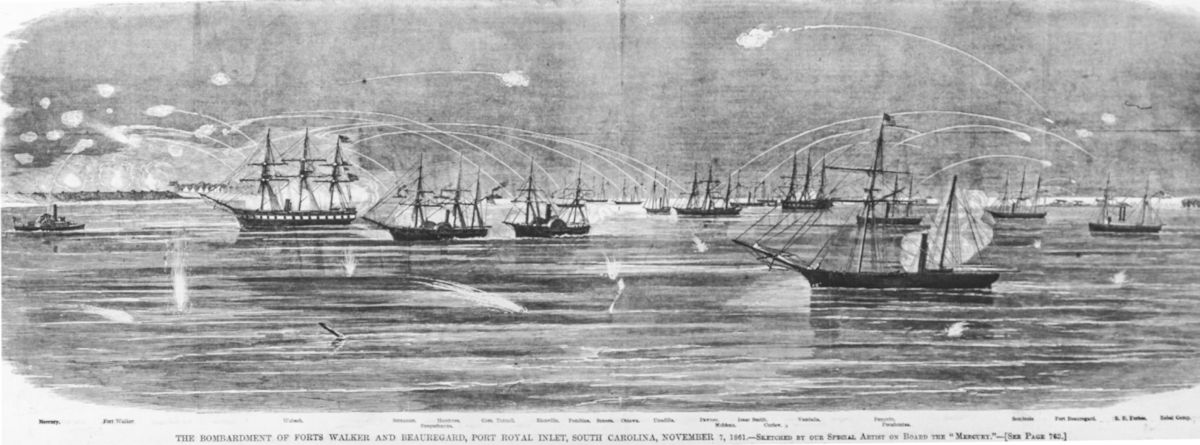
On November 4, 25 vessels joined Du Pont’s flagship, USS Wabash off Port Royal. The harbor was naturally protected by an almost two-mile long sandbar. Commander Charles Davis, fleet captain and an expert from the U.S. Coast Survey began buoying the channel through the outer bar.
Confederate Flag Officer Josiah Tattnall, who four months later would be the last commander of the ironclad CSS Virginia, led his three decrepit river steamers to attack the Federals in an unequal exchange of fire before retreating into the river. Tattnall, who had served 48 years in the “old” navy, was known for his aggressiveness. On June 25, 1859, he violated neutrality by aiding British steamships against Chinese forts. His explanation, “blood is thicker than water,” became famous.
The plan to capture Port Royal was revised to be an all navy venture. Ships continued to arrive but the vessels carrying the army’s guns, ammunition, supplies, and landing transports to take the 12,000 troops ashore were missing. “General [Thomas W.] Sherman says in my hearing that: ‘These ships can’t take the forts without cooperation with the troops,’” wrote a navy lieutenant.
On November 5, the USS Ottawa, USS Pawnee, and USS Isaac Smith ventured to make a reconnaissance of the two forts. The USS Seneca, USS Pembina, and USS Curlew followed. According to future Rear Adm. Daniel Ammen, “One of our shells blew up a caisson in Fort Beauregard, and we soon became fairly informed of the number of the enemy’s guns bearing on the entrance, and in a measure as to their caliber.”
On November 6, the Wabash, which had passed the bar with only a couple of feet to spare, ran aground, and it took hours to refloat her. During the night Davis came up with a new attack plan. The ships would steam in an elliptical pattern between the two forts enabling them to fire at the weaker side of Fort Walker and enfilade the main battery. Five shallow draft gun boats were tasked with preventing Tattnall’s fleet from joining the fray.
The next morning was bright and clear without a ripple on the water “to disturb the accuracy of fire from the broad decks of that magnificent armada about advancing in battle array to vomit forth its iron hail with all the spiteful energy of long-suppressed rage and conscious strength”, wrote Drayton.
The November 7, Battle of Port Royal began at 9:26 a.m. when Fort Walker fired its 9-inch Dahlgren at the Wabash leading the van of 14 ships. The Wabash’s guns replied. Both sides fired rapidly until the Wabash reached her turning point. “Stretching out of the port I could plainly see the outline of the fort [Walker] clear-cut against the sky. Every gun and every man in them were in bold relief.”
Inactivity “was changed for the deafening roars of our own guns, the rapid shouting of orders, the drifting smoke, and an occasional crash succeeded by showers of splinters. … The men had, many of them, stripped to their waists and with brawny chests and arms exposed worked and hove at the guns like demons. … For 25 minutes did we remain right abreast the fort, the engines barely turning over so as to keep the ship in command as she headed the strong flood tide,” wrote Lt. John Sanford Barnes.
The Pocahontas with her five guns arrived in time to join the Wabash in the second circuit in the eclipse. Fort Walker’s 32-pounder on the right flank had been shattered leaving an unprotected opening. Ships positioned themselves to fire into Walker’s unprotected north and south flanks. The Wabash alone fired 880 rounds into the forts at a range of about 600 yards and led a third circuit of the eclipse.
Shells fell inside both forts, “as fast as a horse’s feet beat the ground in a gallop.” The gunners inside successfully landed many blows against the ships but many of their guns became disabled. “The air over the fort was filled with clouds of sand, splinters, and fragments of gun carriages and timbers.” After more than four hours of fighting, low on ammunition, Walker’s defenders abandoned the fort and Beauregard’s soon followed. Barnes wrote, “Going aloft, with my glass I could see the men running for dear life, scattered in every direction, some with arms, most of them without, carrying many wounded.”
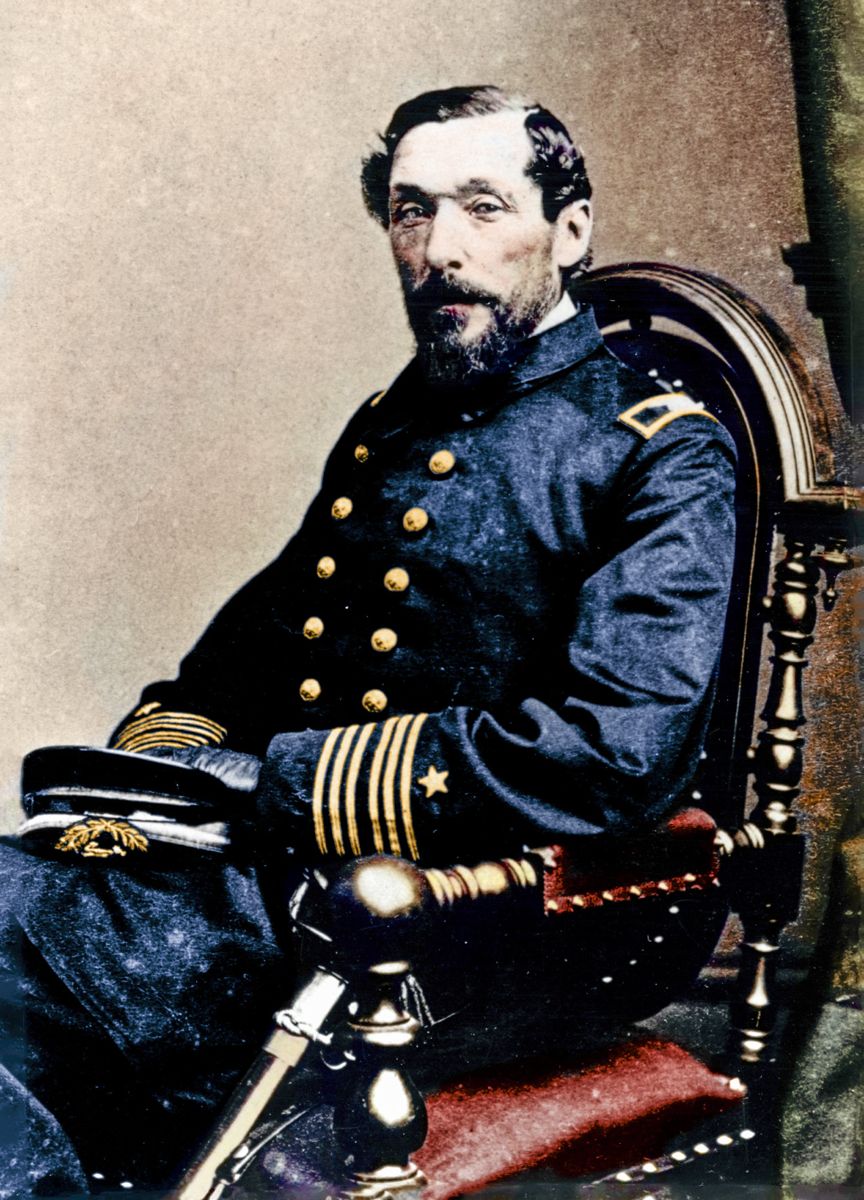
The Federal’s victory at Port Royal changed the South’s coastal defense strategy. Jefferson Davis, recognizing the prospect of a three-front war, sent Gen. Robert E. Lee to assess the situation. Lee arrived to discover that the forts had been lost the very day he got there. He reported that nothing could be done to defend the coast against the superior firepower of the gunboats. “Trying to defend everywhere would use up scarce manpower that was desperately needed elsewhere.” Lee suggested defending “only a few essential points” and avoiding any battle location where the Federals could be assisted by gunboats.
Du Pont wrote to his wife, “It is not my temper to rejoice over fallen foes, but this must be a gloomy night in Charleston.”
Sources:
✦ Anderson, Ben. By Sea And By River: The Naval History of the Civil War: Da Capo Press, 1989
✦ Barnes, John Sanford. “The Battle of Port Royal, S.C.” Edited by John D. Hayes. New York Historical Society Quarterly 45 (1961): pp. 365-95.
✦ McPherson, James. War on the Waters: The Union and Confederate Navies, 1861– 1865: The University of North Carolina Press, 2012.
✦ Ammen, Daniel. “Du Pont and the Port Royal Expedition”, Battles and Leaders of the Civil War. Vol. 1: Century, 1887, pp. 673-676.
✦ Symonds, Craig. The Civil War At Sea: Oxnard University Press, 2012
✦ Du Pont H. A.. Rear-Admiral Samuel Francis Du Pont, United States Navy: A Biography: New York National Americana Society, 1926
Stephanie Hagiwara is the editor for Civil War in Color.com and Civil War in 3D.com. She also writes a column for History in Full Color.com that covers stories of photographs of historical interest from the 1850’s to the present. Her articles can be found on Facebook, Tumblr and Pinterest. Subjects identified below the image bottom are (from left): tug Mercury, Fort Walker, USS Wabash (DuPont’s flagship), Screamer (?), USS Susquehanna, USS Huntsville, Commo. Tattnall, USS Bienville, USS Pembina, USS Seneca, USS Ottawa, USS Unadilla, USS Pawnee, USS Mohican, USS Isaac Smith, USS Curlew, USS Vandalia, USS Penguin, USS Pocahontas, USS Seminole, Fort Beauregard, USS R. B. Forbes, and “Rebel Camp.” Engraving published in Harper’s Weekly, July-December 1861 volume, pp. 760-761.
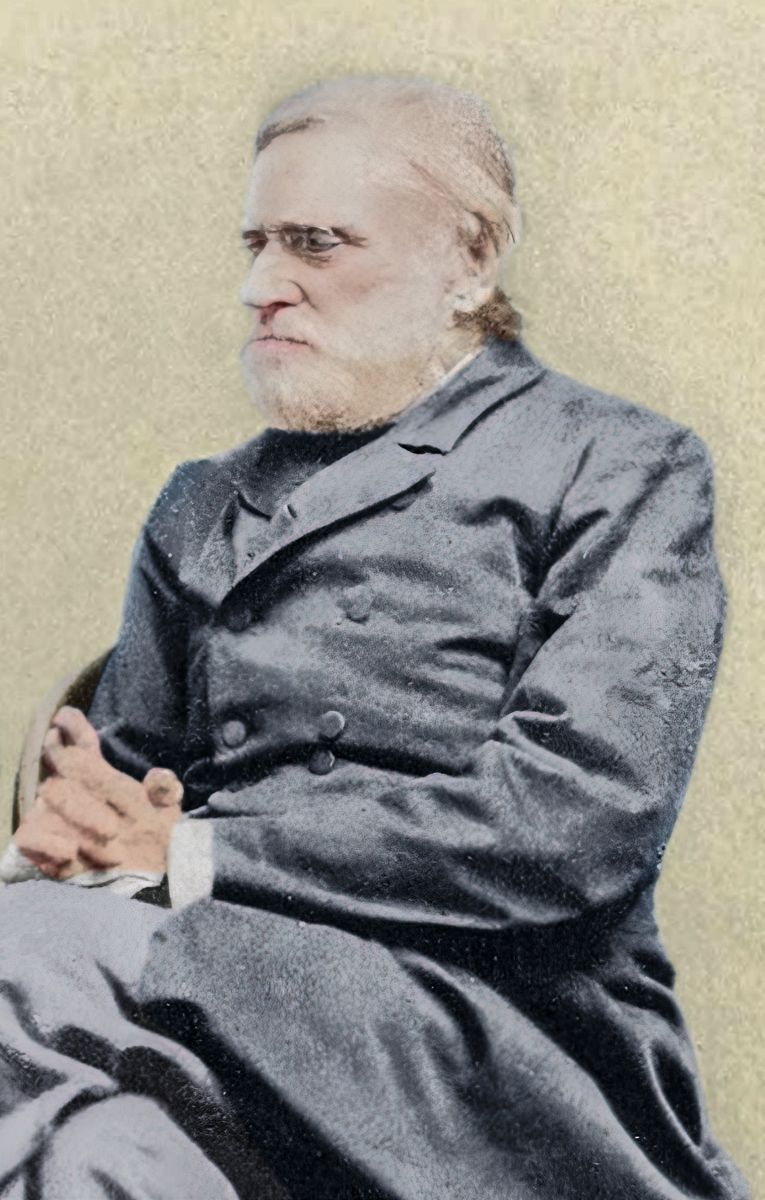
Captain Josiah Tattnall. Colorization © 2022 View of Fort Walker – Hilton Head Island, S.C. (Image ID: cgs05199, NOAA’s Historic Coast & Geodetic Survey (C&GS) Collection)