
Emerging Civil War
Emerging Civil War — December 2022
By Chris Mackowski · Originally published December 2022 · pp. 34–35
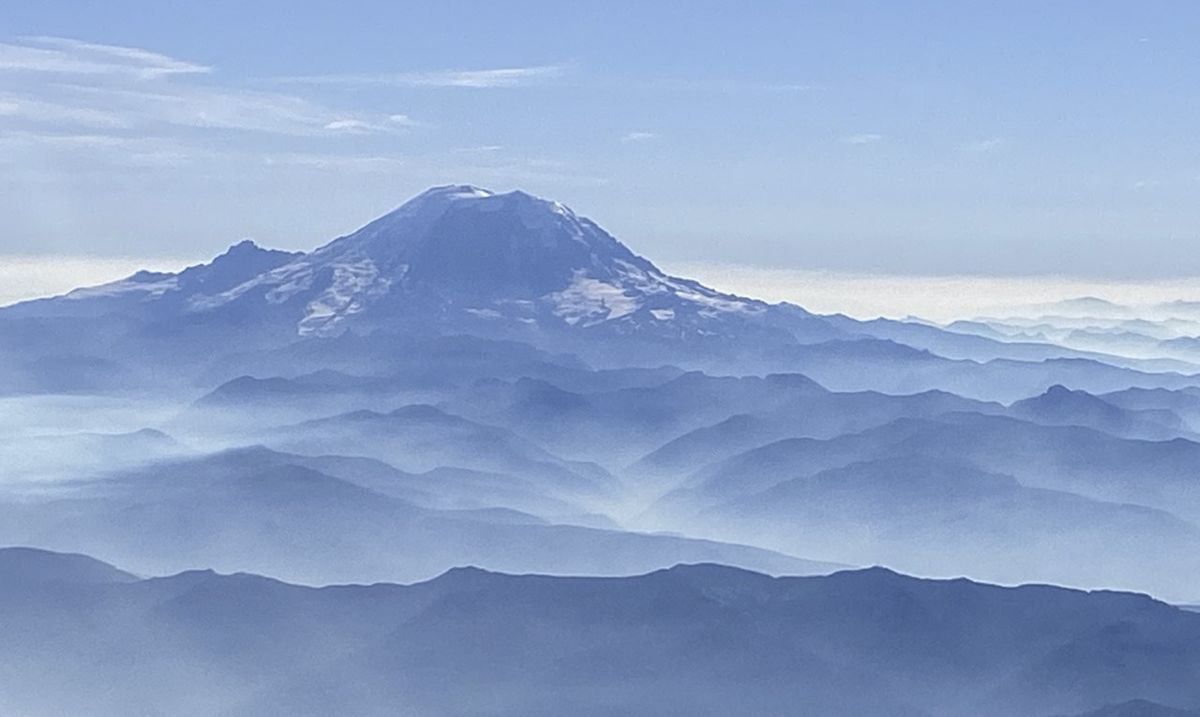
From the Editor Mount Rainier floated above the clouds like an impossible mirage. It appeared in my window so suddenly, so completely, that I gasped—literally. My flight continued to bank away from Sea-Tac Airport, and the mountain somehow assumed its normal proportions. I stared, transfixed, as Rainer seemed to hover just beyond the tip of the airplane’s wing. The clouds around the mountain’s base, it turned out, were not clouds at all. Wildfires burned along the Cascade Mountains, and from my height, the smoke hung over the mountains like fog drifting over some ancient moor. I had been in Seattle to speak to the Puget Sound Civil War Roundtable, which hosted me in one of the funkiest, and most fun, locations I’ve ever presented in. The China Harbor restaurant stood like an obsidian box along the shore of Lake Union, one of many Puget Sound inlets that Seattle clings to. Bright English letters in a faux-Chinese font proclaimed the name of the restaurant, and a giant round glass door offered access through the shiny black exterior. The roundtable met in a corner of the open dining room in a space that overlooked the harbor; nothing separated us from the rest of the diners, who went on with their meal as if some dude was not standing in a corner raving about Ulysses S. Grant and his cigars. The food, as I discovered, was delicious. I loved the place. I’ve spoken to roundtables that meet in all sorts of restaurants. In Fredericksburg, one of the roundtables meets in a banquet room that overlooks the Rappahannock River. In Houston, the roundtable met in a German restaurant that tucked us into a small back room after dinner. In North Carolina, we moved through a cafeteria-style buffet before settling down. Other groups I’ve spoken to meet in country clubs, social clubs, libraries, and community rooms. They meet in museums and historic sites, VFWs, and assisted living facilities, at least until COVID put the vulnerable residents too much at risk. The Brunswick Civil War Roundtable meets in a church hall nearly big enough to play football in, and they fill it up pretty well, too! All sorts of logistics and circumstances go into finding a meeting place, so I have mad respect for the person in any group responsible for securing a meeting space, a job made all the more challenging in the COVID era. The common denominator in all those venues is fellowship. Each Roundtable offers an opportunity to get together with a small community of folks who share a common interest. We swap stories, get entertained, learn something new, and generally “catch up” with each other. Roundtables offer a chance for us to come together and secure our bonds of mutual affection. I’m privileged to be invited in. I’m lucky to meet so many kind and interesting people, visit so many cool places, and see so many spectacular things. – Chris Mackowski, Ph.D. Editor-in-Chief took as his topic the brigade’s participation in the battle of South Mountain. Brian also spent a day tramping the Honey Springs battlefield in Eastern Oklahoma, his first visit to the site in fifteen years.
ECW News and Notes Neil Chatelain published a pair of articles on the U.S. Civil War’s naval side. US Military History Review published his article, “Postwar Identity Crisis of the Confederate Navy’s Officer Corps” in its October 2022 issue. It explores postwar struggles for purpose, place, and memory by the Confederacy’s naval officers via numerous outlets including foreign exile, foreign naval service, filibustering, and battling in veterans’ organizations for control of the conflict’s memory. Civil War Navy published his article, “Communications Afloat: Signal Flags, Lights, and Identification Markings of Civil War Naval Vessels” in their Fall 2022 issue. It surveys the different day and night communications systems warships of the Civil War era utilized, as well as naval codes used for encrypting such messages. Doug Crenshaw spoke recently to the Lynchburg CWRT on the Seven Days. David Dixon is speaking to the Scottsdale, Ariz., Civil War Round Table on November 15. His topic is August Willich’s Civil War: Radical International Revolution. Bert Dunkerly’s Emerging Revolutionary War Series book, Unhappy Catastrophes, has just been released by Savas Beatie. It chronicles lesser-known battles and events in New Jersey. Frank Jastrzembski continues his work with Shrouded Veterans: Veteran headstones were recently placed at the unmarked graves of Colonel Addison Gardiner Rice (155th New York Infantry) at Forest Lawn Cemetery in Buffalo, N.Y., and Brevet Brigadier General Henry Rienza West (67th Ohio Infantry) at Forest Home Cemetery in Forest Park, Ill. Brian Matthew Jordan addressed the Great Lakes Civil War Forum in Kenosha, Wisc., as part of the 75th anniversary celebration of the Milwaukee Civil War Roundtable. The day-long conference focused on the Iron Brigade, so he
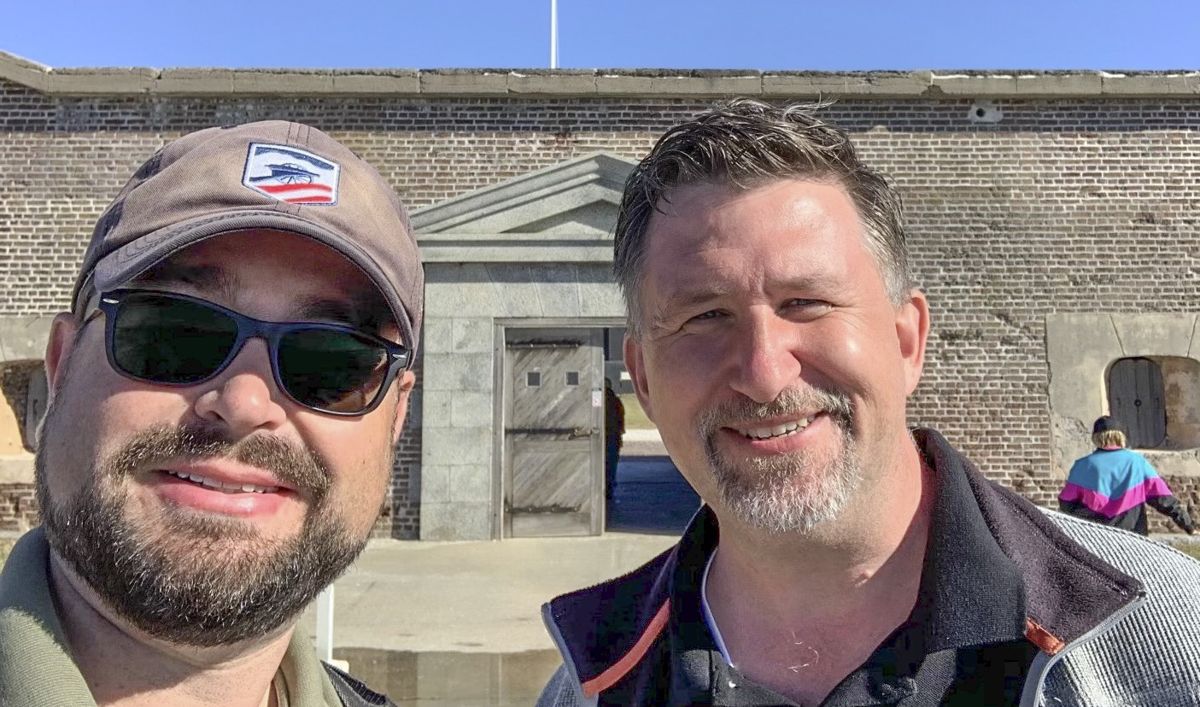
Frank Jastrzembski’s group Shrouded Veterans continues placing headstones for Civil War veterans. Chris Mackowski was an invited presenter at the National Civil War Museum’s “U.S. Grant: Strategy and Statesmanship Symposium,” held Oct. 15 in Harrisburg, Penn. Chris spoke about Grant’s role in the 1864 Overland Campaign. Brian Swartz spoke at the Brewer, Maine, Public Library on October 6 about the battlefield promotion of Joshua L. Chamberlain. Among the graphics that Brian utilized was the library’s original copy of the Senate-passed resolution approving Chamberlain’s promotion to brevet brigadier general. From Cecily Zander: “I have a book contract signed with LSU Press, but no established timeline yet. The manuscript is out for round one of review. But the contract is something! The tentative title is Republicans and Regulars: Anti-Army Politics in the Civil War Era.” Kris White and Chris Mackowski spent four days in Charleston, S.C., in early October for a “virtual field trip” being produced by the American
Battlefield Trust. Kris served as producer and Chris as onair talent. Their travels took them to colonial, Rev War-era, Antebellum, and Civil War sites in and around the city. Along the way, they met up with ECW contributor Jim Morgan, who joined them at Poe’s Tavern for a segment on Poe, Fort Moultrie, Fort Sumter, and more.
ECW Bookshelf The latest book in Savas Beatie’s Emerging Civil War Series is now out: Six Miles from Charleston, Five Minutes to Hell: The Battle of Secessionville, June 16, 1862, by Jim Morgan.
Six Miles from Charleston, Five Minutes to Hell by Jim Morgan is the latest book in Savas Beatie’s Emerging Civil War Series enemy and call them cowards,” one Confederate officer later said, “for nothing was ever more glorious than their three charges in the face of a raking fire of grape and canister.” https://www.savasbeatie.com/six-miles-from-charleston-fiveminutes-to-hell-the-battle-ofsecessionville-june-16-1862. Congratulations to Evan Rothera on the recent publication of his book, Civil Wars and Reconstructions in the Americas: The United States, Mexico, and Argentina, 1860–1880 from LSU Press. Evan does work for ECW behind the scenes with the Engaging the Civil War Series published through Southern Illinois University Press. About the book: In the latter half of the nineteenth century, three violent national conflicts rocked the Americas: the Wars of Unification in Argentina, the War of the Reform and French Intervention in Mexico, and the Civil War in the United States. The recovery efforts that followed reshaped the Western Hemisphere. In Civil Wars and Reconstructions in the Americas, Rothera highlights similarities and differences among the wars and reconstructions in the U.S., Mexico, and Argentina. In doing so, he uncovers a new history that stresses the degree to which cooperation and collaboration, rather than antagonism and discord, characterized the relationships among the three countries. This study serves as a unique assessment of a crucial period in the history of the Americas and speaks to the perpetual battle between visions of international partnership and isolation. https://lsupress.org/books/detail/civil-wars-andreconstructions-in-the-americas.
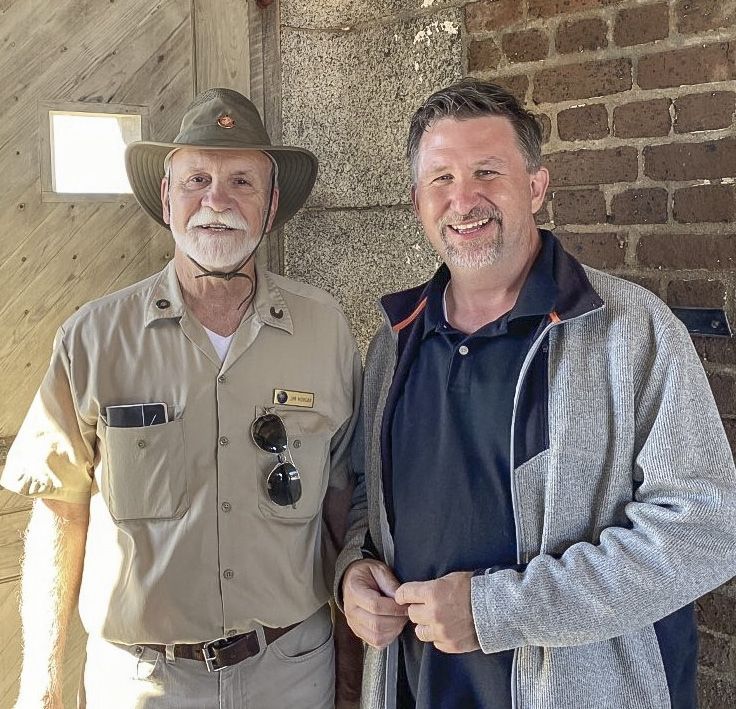
ECW contributor and Charleston resident Jim Morgan (left) met up with Chris Mackowski (right) and Kris White during the Kris and Chris tour of the city. About the book: The small, curiously named village of Secessionville just outside of Charleston, S.C., was the site of an early war skirmish, the consequences of which might have been enormous had the outcome been different. It quickly would be forgotten, however, as the Seven Days’ battles, fought shortly afterward and far to the north, attracted the attention of Americans on both sides. The battle was as bloody and hard fought as any similar-sized encounter during the war, but it was poorly planned and poorly led by the Union commanders whose behavior did not do justice to the courage of their men. “Let us never again disparage our
Civil Wars and Reconstructions in the Americas by Evan Rothera from LSU Press
ECW Multimedia On the Emerging Civil War Podcast in October: Gary Gallagher talks about his latest edited collection, a new Library of America edition of Bruce Catton’s Army of the Potomac trilogy.
Gary Gallagher returned to the ECW Podcast in October. Historian Evan Rothera talks about his new book, “Civil Wars and Reconstructions in the Americas: The United States, Mexico, and Argentina, 1860-1880,” putting the American Civil War in a global context that looks southward rather than across the Atlantic. You can also subscribe to our podcast through Patreon: ( h t t p s : / / w w w. p a t r e o n . c o m / emergingcivilwar), where we are now also offering exclusive bonus content for subscribers. That’s just $3.99/month, and proceeds go toward defraying the production costs of the podcast. As bonus content for Patreon subscribers this month, Chris Mackowski offered a video that shared the hidden dark history of Liberty Square/Gadsden’s Wharf in Charleston. On the ECW YouTube page, October offered us a chance to explore some of Texas’s history: • The San Jacinto battlefield, where Texas won its independence from Mexico
The edge of Galveston bay for an overview of the battle of Galveston • The site of the birthplace of Juneteenth in Galveston • John Magruder’s gravesite in Galveston The ECW YouTube page also featured video versions of our podcast interviews with Gary Gallagher and Evan Rothera. Please don’t forget to like and subscribe! You can also follow us on Facebook and Twitter.
10 Questions … with Patrick Kelly-Fischer ECW is pleased that we welcomed earlier this year a new writer to the fold: Patrick KellyFischer. Patrick lives in Colorado with his wife, dog, and cat, where he works for a nonprofit. A lifelong student of the Civil War, when he isn’t reading or working, you can find him hiking or rooting for the Steelers.
What can you tell us about your background? I grew up in upstate N.Y., attended Bard College in my hometown for political science, and lived in Boston for a few years, before moving to Denver in 2014 with my (now) wife. I’ve spent most of my life working in politics, either for campaigns or, for the last 10 years, nonprofits. I’ve always been passionate about military history, and nearly double majored in history as a result. More recently I’ve been lucky enough to be able to turn back to studying the Civil War more deeply than in the past. I believe that understanding the Civil War and its legacy is key to understanding significant parts of American politics today, which really underscores the importance of making Civil War history interesting and engaging for a wide audience. What is your Civil War “origin story”? How did you get interested? My interest in the Civil War started at a really young age. I was fortunate enough to grow up next to my town’s library, and spent a considerable part of my childhood browsing the shelves and reading just about anything that caught my interest. One of those books was The 290 by Scott O’Dell, a young adult novel about the CSS Alabama. That one book raised so many questions that I wasn’t getting answered in school: There were other countries involved in our Civil War? There were naval events besides the Monitor and the Merrimac?! This was spurred along by my parents taking me to Gettysburg, and much more frequently, renting the movie Gettysburg. It turns out that if they’ll sit through it, a fourand-a-half-hour movie is a great way to keep your kid occupied through most of a day off from school. Thanks to having a library at my literal fingertips, I was able to keep reading and keep digging, and my interest really snowballed from there. What are your areas of keenest interest? Living in Colorado, I’m utterly fascinated by the 1862 New Mexico campaign, which is the closest fighting to where I live by a fair margin. Most people I talk to outside Civil War circles have no idea that there even was fighting this far west, let alone the grandiose scope of the Confederate vision for Sibley’s small army in the desert. A fair part of my work career could be summarized as being focused on the logistics of executing projects for various campaigns and nonprofits. As hard as those projects were, even with the benefit of 21st century technology, they obviously pale in comparison to the absolutely colossal military machine that both sides of the Civil War created out of virtually thin air. I can’t help but be interested in the behind-the-scenes, nuts and bolts pieces of how armies numbering in the tens of thousands even got onto the battlefield, from funding the war effort, to the mechanics of coordinating, feeding and equipping that many people using primarily wagon trains, messengers on horseback, early railroads and steamships, and the occasional telegraph. Conversely, earlier this month I came across some paperwork Silas Soule was responsible for filling out to account for equipment used by the 1st Colorado Cavalry, and was struck by just how similar it was to how I might ask someone to track materials today. How do you balance your love of the Civil War with your geographic location? Living in Colorado makes this challenging because we’re not exactly overflowing with Civil War sites here. Denver had only recently been founded when the war broke out, and there was very little fighting in the state, so getting to the closest battlefields means driving at least as far as New Mexico. But that’s been an opportunity, too, in that it’s prompted me to dig much more deeply into the 1862 New Mexico campaign, how the Far West was viewed by decisionmakers back East, and how Colorado fit into all of that: From the 1st Colorado rushing to fight Sibley, to Sand Creek and Silas Soule, to the rumored Confederate presence in the state. I don’t know that I would have gotten as deeply invested in any set of topics if I lived somewhere like Virginia with hundreds of battlefields at my fingertips. How did you find Emerging Civil War? I first came across the site by dumb luck while Googling something. I wish I could remember the topic or the article I found. Ultimately, I got sucked in by the quality of the posts and the wealth of information available. When I saw that ECW accepts guest posts, it prompted me to finally take this lifelong but passive interest in the Civil War, and do something more proactive with it. So, I submitted my first guest post, and ever since as I’ve continued writing and researching, I’ve been struck by how welcoming, encouraging, and knowledgeable everyone in this community is. Lightning Round (short answers with a one-sentence explanation) Favorite primary source? The accounts by veterans of Sibley’s New Mexico campaign published in the Overton Sharp Shooter in the 1880s which I believe were found by Donald Frazier and published by Jerry Thompson more than a century later. Favorite Civil War-related monument? The 44th & 12th New York monument on Little Round Top. How can you not love a miniature castle? Favorite unsung hero of the Civil War era? Silas Soule helped Kansas abolitionists before the war, fought in the 1st Colorado at Glorieta Pass to fend off the Confederate invasion of New Mexico, and then risked his career and reputation by refusing to participate in the Sand Creek Massacre. What’s a bucket-list Civil War site you’ve not yet visited? The Valverde battlefield. Glorieta is better known, but Valverde was the largest battle of Sibley’s New Mexico campaign and arguably his last chance, if he even had one, to come out ahead in the end. Favorite ECWS book that’s not one of your own? The Great “What-Ifs” was some of the most fun I’ve had reading about the Civil War; I just hope there’s a sequel in the works.