The Graphic War
Children and War
By Salvatore Cilella · Originally published December 2022 · pp. 36–37
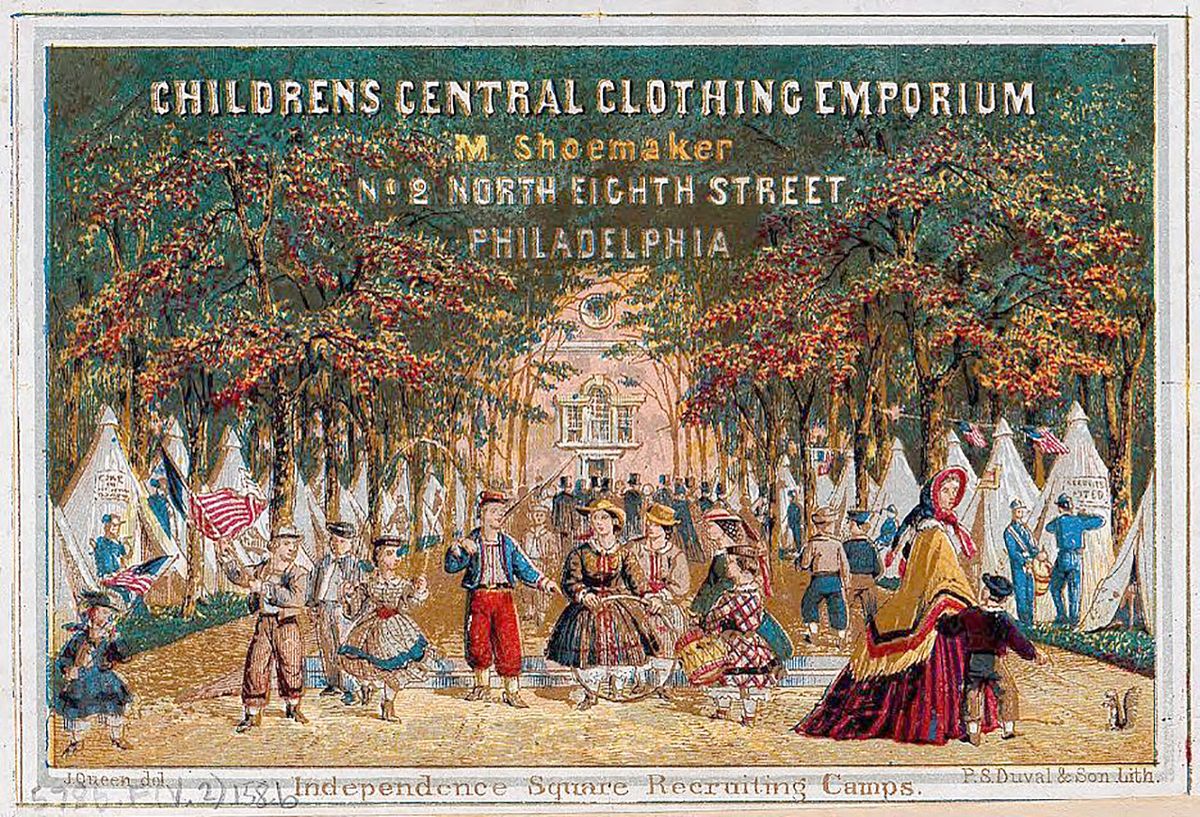
Children and War The Graphic War highlights prints and printmakers from the Civil War discussing their meaning and the print maker or artist’s goals. Throughout this series, we have featured prints related to the Civil War that were produced as single sheets designed to be sold individually. Discriminating buyers could then have the print framed and then proudly displayed on their walls. It was an inexpensive way to tell the world that the owner had sophistication and taste; in the case of a loyal citizen, it was a badge of his or her patriotism. Unlike engraved book plates and Harper’s Weekly woodcuts, single copies of lithographs hung in a prominent spot in the parlor, signaled to the world that the owner had arrived. Single sheet lithographs, however, weren’t the only product print makers manufactured. The evolution of printing and the advent of lithography was followed by chromolithography. The latter development, (“chromos”) according to the late Peter Marzio, “made its first Philadelphia appearance in the 1840’s, grew rapidly in the 1850’s, and matured by the start of the Civil War.” By century’s end, Philadelphia had become a chromolithographic center in America and Peter S. Duval its “most prestigious chromolithographer,” “the most important force in Philadelphia lithography.”1 Before the war, James Queen, a prolific lithographer we have featured before with his work on several iterations of the Philadelphia and Cooper Refreshment Saloons, apprenticed under Duval. Queen’s “earliest chromos appeared in the 1850s, but his most distinguished pieces were published during the Civil War.”2 As we have noted in earlier columns, Queen served briefly, 1862-63, in the militia.
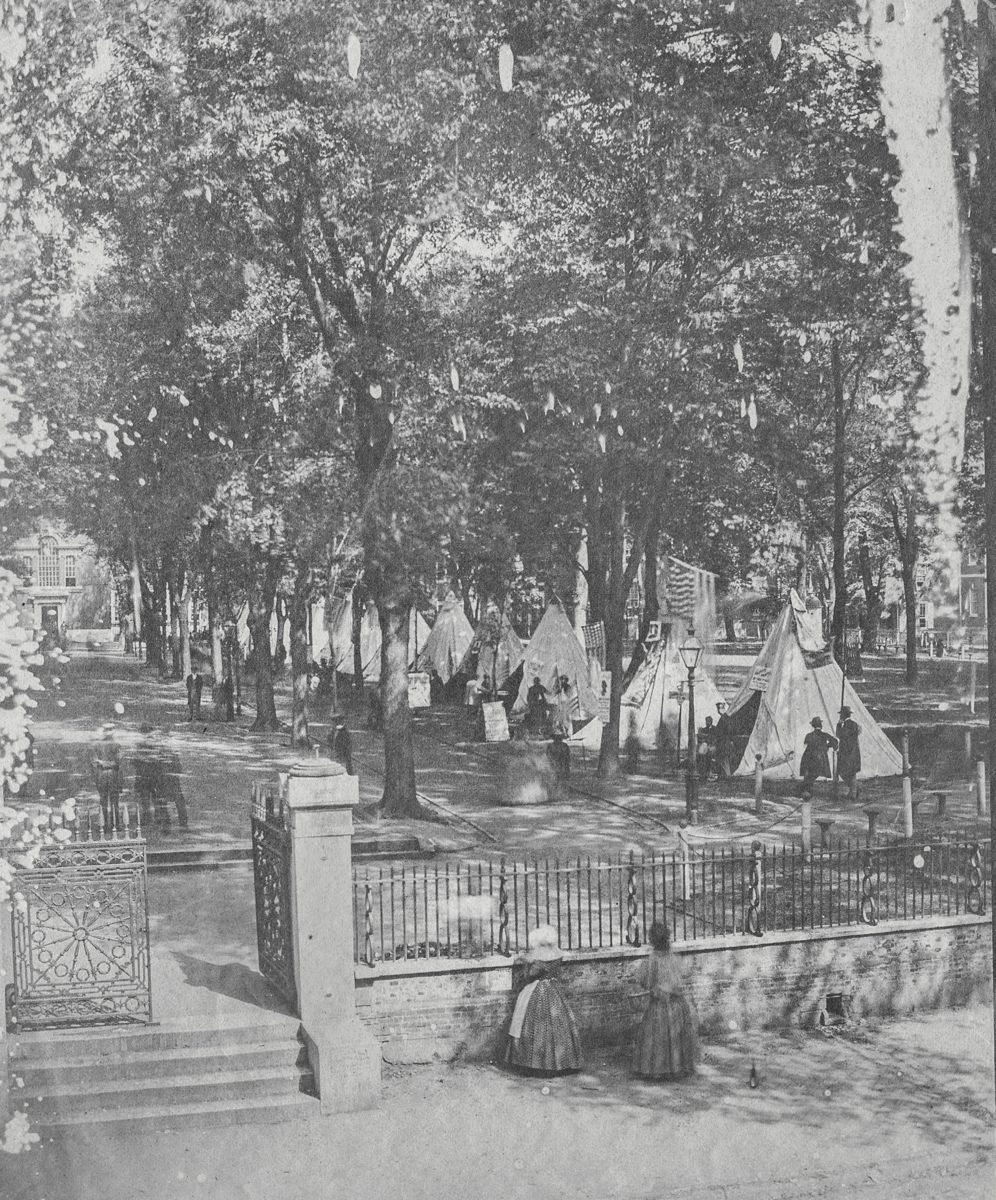
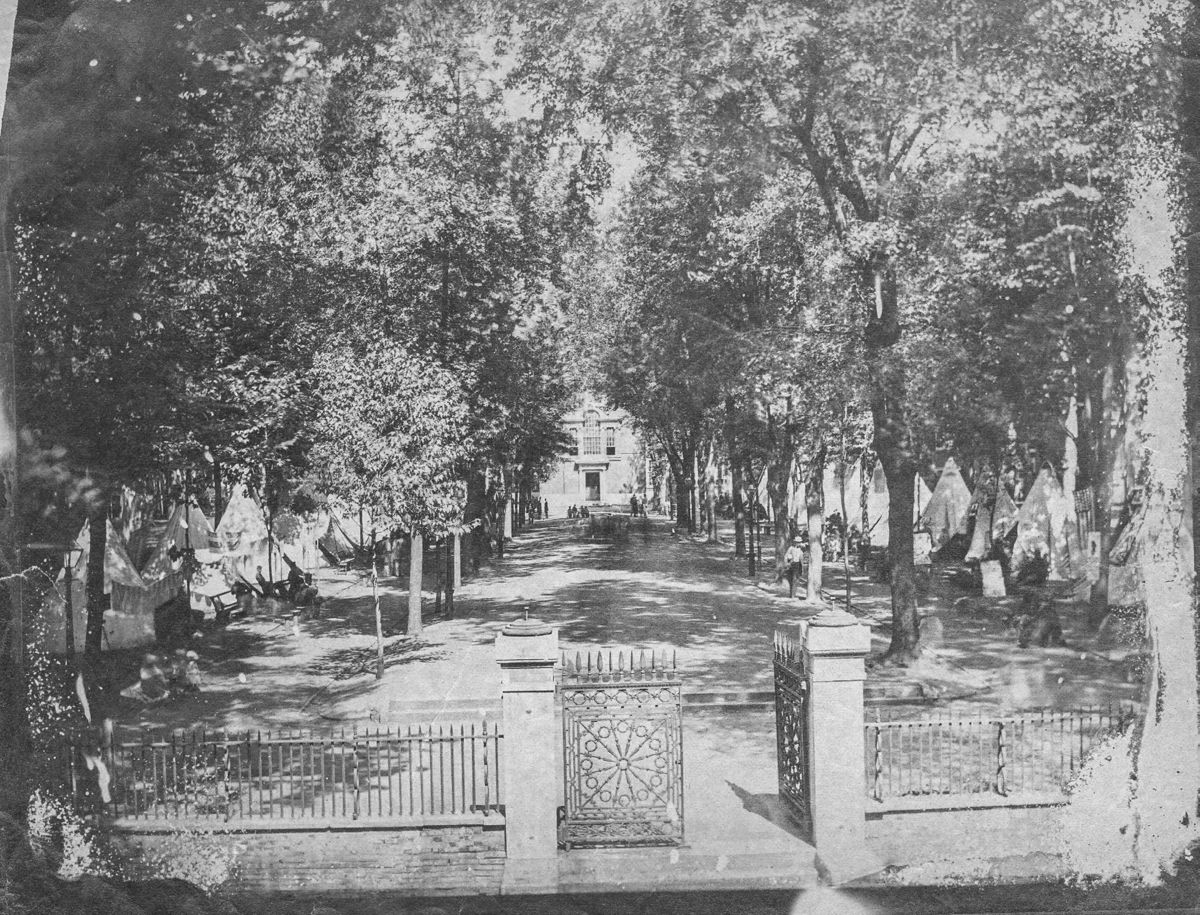
Printers and artists working in lithography fashioned every product imaginable, billheads, stationery, labels, checks, maps, plans, broadsides, circulars, anything printable on paper and in addition to “art” works suitable for framing. Trade cards were a staple in most printer’s portfolios. This month we feature a Philadelphia print, a collaborative effort by Duval and Queen. It is a trade card, which today we would categorize as an advertising circular or hand out. It is a mere 2.5 by 4.5 inches and depicts “well dressed children on the central promenade of Independence Square” in Philadelphia. Behind the children are soldiers manning tents, while the children carry drums, flags and a hoop” as they wander among the other adults and soldiers. Across the top of the miniature scene is the inscription “Children’s Central Clothing Emporium/M. Shoemaker/No. 2 North Eighth Street/Philadelphia.” On the bottom is the identification of the location, “Independence Square Recruiting Camp.” In the center background is Independence Hall framed by an allée of trees. It is a curious mixture of commerce and the deadly business of war. According to descriptive notes from the Library Company of Philadelphia, Mary Shoemaker operated her emporium from 2 North Eighth Street from “circa 1862-circa 1864.3 Camp Independence was even more short-lived. Its establishment grew out of the growing concern in the north that by 1862 the war was not going to be the short-lived “adventure” many young men imagined. “As casualties mounted, recruitment levels dropped significantly. In Pennsylvania, the threat of a statewide draft loomed, prompting recruiting officers of the Union Army to redouble their efforts to attract volunteers. In Philadelphia, it was decided that a new recruiting station be opened on Independence Square, directly in the shadow of the nation’s birthplace.4 By September 8, 1862, the new camp opened. It eventually grew to 20 to 25 tents “surrounding Independence Hall.” As the National Park indicates: “While military bands played patriotic tunes, hundreds of men enlisted in the Union Army, trading the comforts of Philadelphia for the harsh realities of war. Camp Independence closed on November 1, having completed its short-lived, but vital service to the Union war effort.”5 Eventually, the camp, where many men avoided the draft by voluntarily enlisting, drew “a few thousand” of the more than “80,000 Philadelphians” who served in the Union army. Historian Garry Nash estimated that the city’s population of 600,000 at wartime saw “90,000100,000” men enlist and serve, “more than half of the males of military age.”6 It was the most successful recruiting site in the city. The camp was well documented in Queen’s and Duval’s minuscule trade card. The camp was also captured in two early photographs. This is remarkable since the camp existed only two months. The pictures are attributed to Frederick De Bourg Richards, a prominent Philadelphia photographer and landscape artist who opened a daguerreotype gallery opposite Independence Hall. He began documenting the city’s many historical buildings around 1853. When he tired of photography, Richards turned his talents to painting, which proved profitable and well received.7 And Mary Shoemaker? What was her fate? Sadly, once she closed her children’s clothing
CivilWarNews.com store, she disappeared from the historical record. She only lives on in this small 2 by 4-inch trade card. According to one historian, this card “must make it one of the very earliest chromolithographed advertising trade cards to have been produced in the United States.”8 Her fusion of children and war was captured in this small slice of Civil War history.