
Critic's Corner
Bennett Young's Vermont Raid
By Stephen Davis · Originally published December 2022 · pp. 32–33
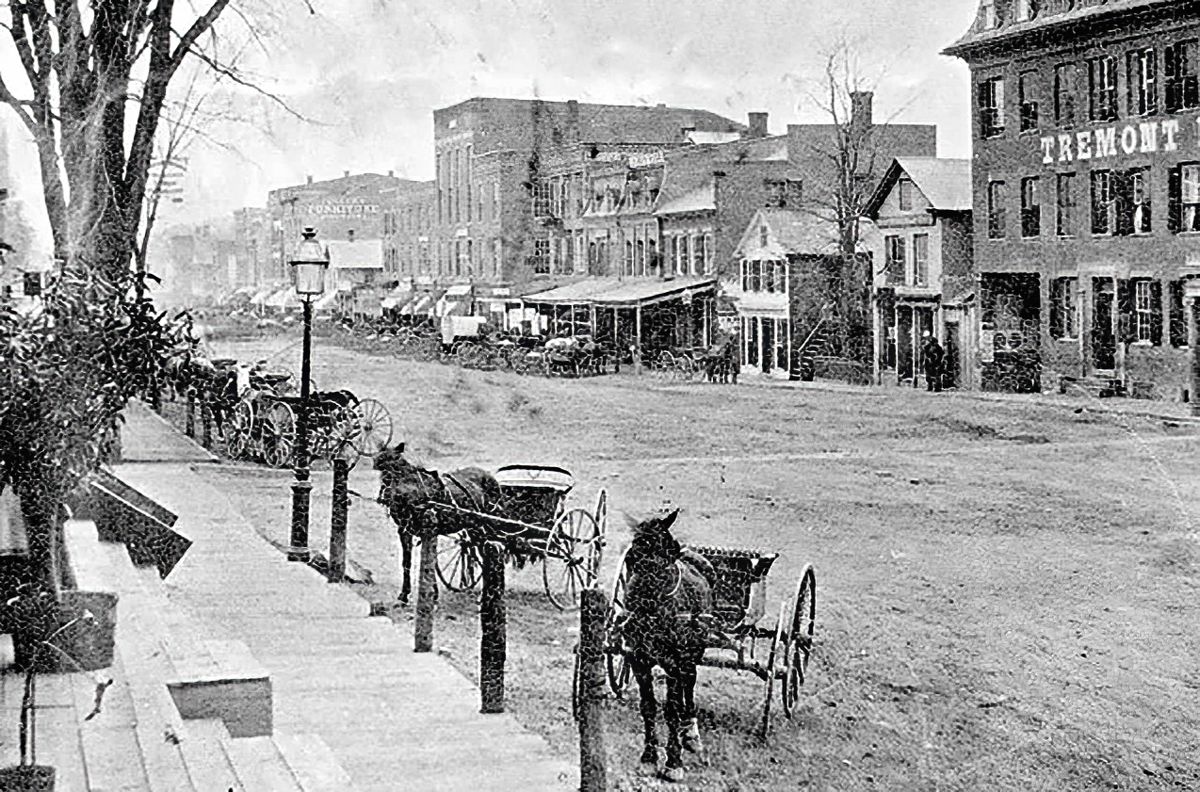
Bennett Young’s Vermont Raid One of the most daring exploits of the Civil War—and there were plenty—was the raid by a score of Confederate soldiers on a Vermont town, St. Albans, sixteen miles south of the Canadian border. How the raid was conceived is as dramatic a story as the event itself. Enter Bennett Henderson Young. Born in Kentucky in 1843,
Young enlisted in the 8th Kentucky Cavalry. He raided with Morgan, was captured and imprisoned with him. Bribing a guard, he escaped and headed for Canada. After the Lincoln administration adopted a policy of “hard war” in the summer of 1862, Federal troops committed countless depredations on Southern civilians’ property in areas under their occupation-Virginia, Tennessee, Mississippi, Louisiana, Arkansas, and the coastal Carolinas—robbing citizens, burning property, killing livestock. (And this was before Sherman’s march!) Young seethed in anger at this villainy and determined to find some means of retaliation against it. He conceived a foray into Northern territory with the aim of burning their property. At Halifax, Nova Scotia, in May 1864 he met with Clement C. Clay, Confederate commissioner to Canada. He explained his idea to Clay, who liked it. Clay then recommended Young to Confederate Secretary of State Judah Benjamin, writing that Young had a “plan for retaliating some of the injuries and outrages inflicted upon the South.” Thus encouraged, Young made his way through the blockade and on to Richmond. There Secretary of War James A. Seddon approved Young’s scheme. On June 16 he was promoted to first lieutenant and charged with conducting clandestine operations behind enemy lines.1 To accomplish these tasks, President Davis himself requisitioned $1 million for the operation out of a “secret service” fund administered by Secretary Benjamin. Davis had already appointed his friend Jacob Thompson to head clandestine operations in Canada.2 And secret they were. Thompson’s and Clay’s orders, dated April 27, 1864, were painstakingly oblique: SIR: Confiding special trust in your zeal, discretion, and patriotism, I hereby
Bennett Henderson Young.
direct you to proceed at once to Canada, there to carry out such instructions as you have received from me verbally in such manner as shall seem most likely to conduce to the furtherance of the interests of the Confederate States of America which have been intrusted to you. Jefferson Davis. The lieutenant was instructed to scout out towns along the U.S.Canada border vulnerable for raiding; Confederate authorities envisioned a series of such operations. Secretary Seddon authorized Young’s men to loot and burn banks, stores, shops, and railroad stations. Seddon added particulars in a letter of August 20, 1864. “It is but right,” he wrote, “that the people of New England and Vermont especially, some of whose officers and troops have been foremost in these excesses and whose people have approved of their course, should have brought to them some of the horrors of such warfare.” The secretary added a hint as to his preferred targets: “you will visit Burlington and St. Albans.”3 Lieutenant Young recruited twenty men who had escaped Northern prisons and made their way into Canada. On the night of October 18, they slipped into St. Albans in small groups and found rooms in hotels. Mid-afternoon of the next day they gathered in the street, took off their coats to show their Confederate uniforms, and announced that they were taking possession of the town in the name of the Confederate States. “Gentlemen,” Young declared to a small group in the streets, “I am a Confederate officer. I’ve come to take your town.” The Southerners ordered citizens into the town’s central square. Five of the raiders, including Thomas Collins, Marcus Spurr, and Squire Teavis, walked into the
Confederate soldiers pull guns on a bank teller during their bank robber spree in St. Albans in 1864. Courtesy of the Vermont Historical Society.
St. Albans Bank, pulled pistols, and stuffed money into satchels. One resident asked a raider if private property in town would be spared. The Rebel answered that because Grant, Sherman and Sheridan did not respect private property, neither would they.
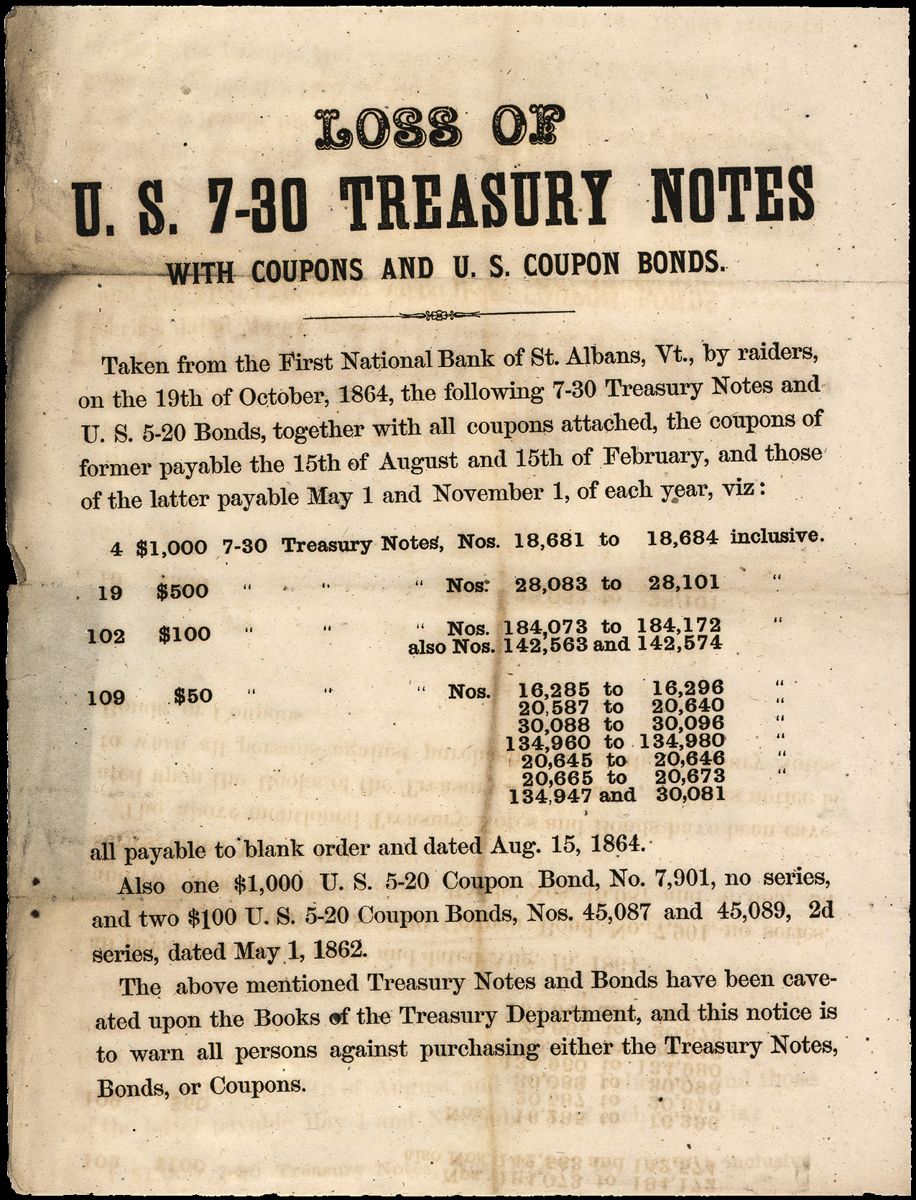
Another group entered the Franklin County Bank. One of them, Bill Huntley, announced, “We are Confederate soldiers. There are hundreds of us. We have come to rob your banks and burn your town.” The message was the same at the First National Bank, where Caleb Wallace warned, “We represent the Confederate States of America. We have come to retaliate for acts committed upon our people by General Sherman. You have a very nice village here and if there is any resistance we’ll burn it to the ground.” An onlooker remarked, “What gentlemen are these? Seems to me they are rather rude in their manners.”4 After raiders had robbed banks they began rounding up horses. Others set fires with glass jars filled with Greek fire; the Southerners had come prepared for their mission of arson. The flames, however, flickered out after the Southerners rode off. Some residents opened fire from windows; three Confederates were wounded. After about an hour Young and his band mounted up and rode off with ninety thousand Yankee dollars. The few Federal soldiers in town gave chase with some enraged citizens. Eight miles off, the Confederates burned a bridge to halt the pursuers.5 The Southerners reached Canada about nine that night, changed back into civilian clothing and dispersed. Eventually Young and five of his men were caught and arrested in Quebec. U.S. authorities requested their extradition, but the Canadian government refused. They were ultimately released.6 What had Lieutenant Young and his raiders achieved? Probably nothing of consequence as related to the course of the war, which by October 1864 had pretty much been decided. As a feat of daring, though, it merits the kind of accolade one Southerner gave it years after the war. “If the reader will consider that St. Albans had, at that time, a population of about three thousand five hundred, that it had an able-bodied male population, fit for military service, of about seven hundred and fifty, that it was located in the heart of the most populous section of the country, honey combed with railroad and telegraph lines, and that this “Rebel horde” (of twenty-six men) were many hundred miles from their base of supplies, he will agree that, for daring, it stands without a parallel among daring deeds.”7 Endnotes 1.
Oscar A, Kinchen, General Bennett H. Young: Confederate Raider and a Man of Many Adventures (West Hanover MA: Christopher Publishing House, 1981), 15, 19, 20, 33-35; Oscar A. Kinchen, Confederate Operations in Canada and the North (North
Quincy MA: Christopher Publishing House, 1970), 127-28; “Gen. Bennett H. Young,” Confederate Veteran, vol. 20, no.7 (July 1912), 313. William C. Davis, “The Conduct of ‘Mr. Thompson,’” Civil War Times Illustrated, vol. 9, no. 2 (May 1970), 6. OR, ser. 4, vol. 3, 322; Kinchen, Confederate Operations, 35-8, 128-29. Kinchen, Bennett Young, 42, 47-48. Ibid., 49-51, 53-54. Ibid., 54, 57, 67, 75. J. L. Driscol, “Capture of St. Albans, Vt.,” Confederate Veteran, vol. 5, no. 2 (February 1897), 75.
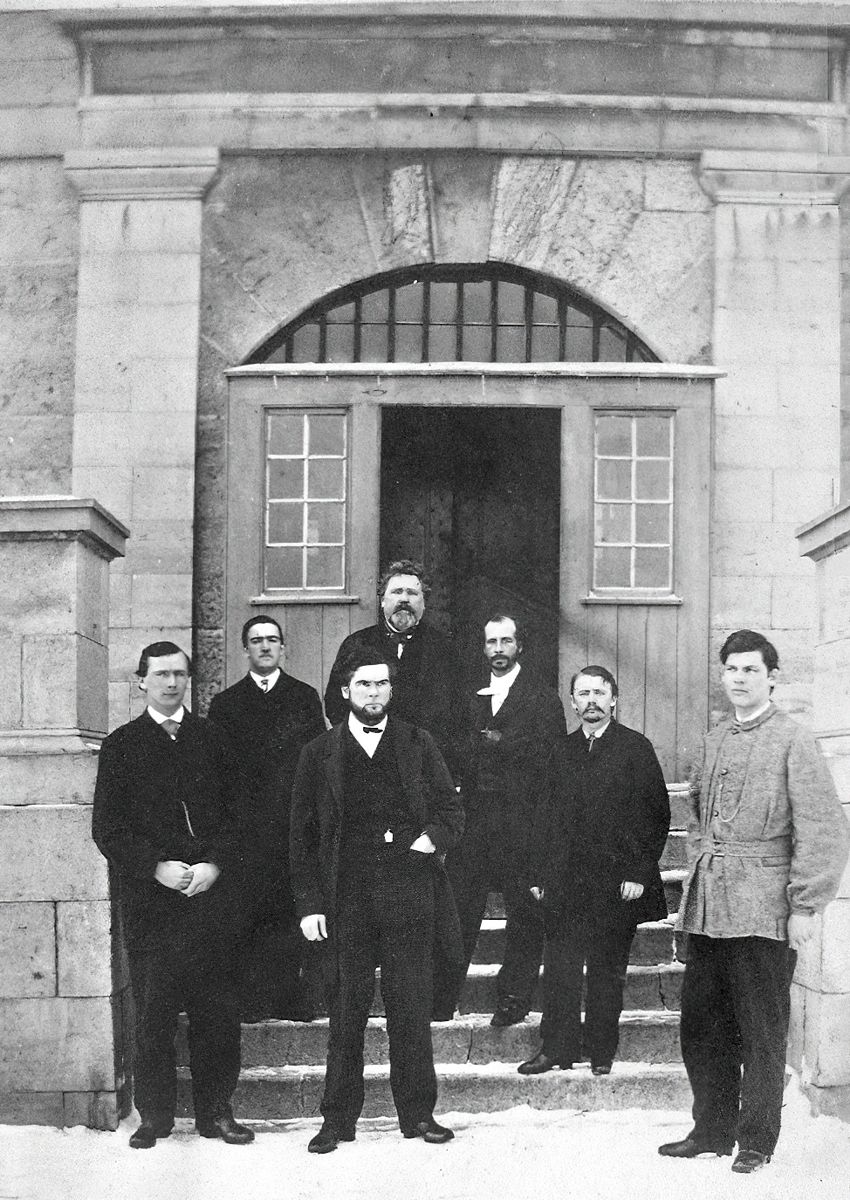
Editor’s Note Thanks to one of our readers, we have been provided with a list of the dozen-and-a-half men who raided St. Albans. They are: Alamanda Pope Bruce James A. Doty Thomas B. Collins Samuel S. Gregg Charles H. Higby William H. Huntley Samuel E. Lackey John D. McGinnis Joseph P. McGrorty William D. Moore Louis D. Price George C. Scott Marcus A. Spurr Charles M. Swagar Squire T. Tevis William T. Tevis Caleb M. Wallace Bennett H. Young Stephen Davis of Cumming, Georgia, has been a Civil War buff since the 4th grade. He grew up in Atlanta, attending Margaret Mitchell Elementary and Northside High. At Emory University he studied under the renowned Civil War historian Bell Wiley. After a Master’s degree in American history from the University of North Carolina at Chapel Hill, he taught high school for a few years, then earned his Ph.D. at Emory, where he concentrated on the theme of the Civil War in Southern literature. He’s also taught at Oglethorpe University. Now retired, Steve resides in Cumming, Georgia, with his sweet wife Billie and two cats. Steve is the author of seven books on the Atlanta Campaign: •
•
•
•
•
•
•
Atlanta Will Fall: Sherman, Joe Johnston and the Yankee Heavy Battalions (Scholarly Resources, 2001); What the Yankees Did to Us: Sherman’s Bombardment and Wrecking of Atlanta (Mercer University Press, 2012); A Long and Bloody Task: The Atlanta Campaign from Dalton through Kennesaw to the Chattahoochee, May 5-July 18, 1864 (Savas Beatie, 2016); All the Fighting They Want: The Atlanta Campaign from Peachtree Creek to the City’s Surrender, July 18-September 2, 1864 (Savas Beatie, 2017); 100 Significant Photographs: The Atlanta Campaign (Historical Publications, 2019); From Texas Brigadier to the Fall of Atlanta: John Bell Hood (Mercer University Press, 2019); and Into Tennessee and Failure: John Bell Hood (Mercer University Press, 2020).
His next work will be I Thank the Lord I Am Not a Yankee: Selections from Fanny Andrews’s Wartime and Postwar Journals (Mercer University Press, 2023).