
A Gettysburg Hero's Shameful End
By Joseph Wilson · Originally published December 2022 · pp. 28–29
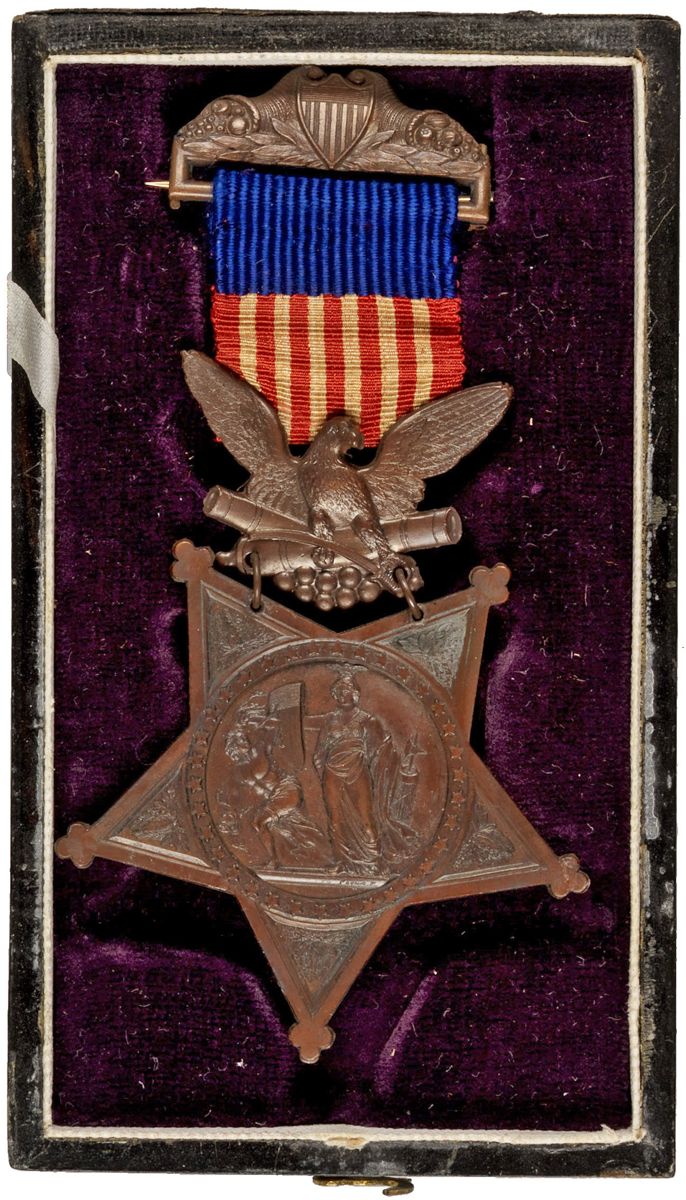
Remembering our deceased soldiers on Memorial Day is a long-held tradition across the country. By placing flowers or a flag on a grave we acknowledge their sacrifice. But not all our honored soldiers rest beneath the stars and stripes. Some of our heroes vanished into obscurity. Corporal Bernard McCarren was one of many who won the Medal of Honor at Gettysburg. McCarren didn’t live long after the war. He died of dysentery in 1870. He left behind a wife and no children. The Irishman was buried in the Old Cathedral Cemetery in Wilmington, Del., where most local Irish Catholics were laid to rest. In the 1880’s McCarren’s neglected corpse went missing for well over a century. After the Civil War the Old Cathedral cemetery fell into disrepair. The diocese urged the families of those buried in Old Cathedral grounds to move the remains to the New Cathedral Cemetery on Lancaster Avenue. Leaving the task to individual families to move the remains opened the door to neglect. As a result, closing the cemetery around 1882 resulted in a botched effort to reinter all the dead at the new location. Corporal Bernard McCarren’s remains were left behind along with hundreds of other bodies. McCarren rested beneath an empty dirt lot for decades unbeknownst to anyone. In 1954, the lot was sold by the diocese to a hospital. The new owner paved over the former cemetery for a parking lot; McCarren’s body remained lost for five more decades. Drivers parked their automobiles for years on the lot in Wilmington, never knowing Bernard reposed just below the surface along with hundreds of other forgotten bodies. Finally, in 1998, a construction crew resurrected his abandoned bones. Removing the bodies from the old cemetery to the new grounds took years. The diocese thought all the bodies had been successfully removed and the job completed. Cities grew rapidly in the years after World War Two. Wilmington wasn’t any different. The diocese sold what they believed to be an abandoned lot to the new hospital located next to the former cemetery. The hospital paved over the land to construct the parking lot. Patrons of the hospital had no idea they parked their cars over a burial ground. Neither did city officials or hospital administrators. In 1998, expansion once again brought more upgrades around what is now Christiana Hospital. More buildings to expand the hospital meant new plans for the parking lot. In digging up the lot, shocked construction crews discovered hundreds of old bones. All construction came to a halt as archaeologists arrived on the scene.
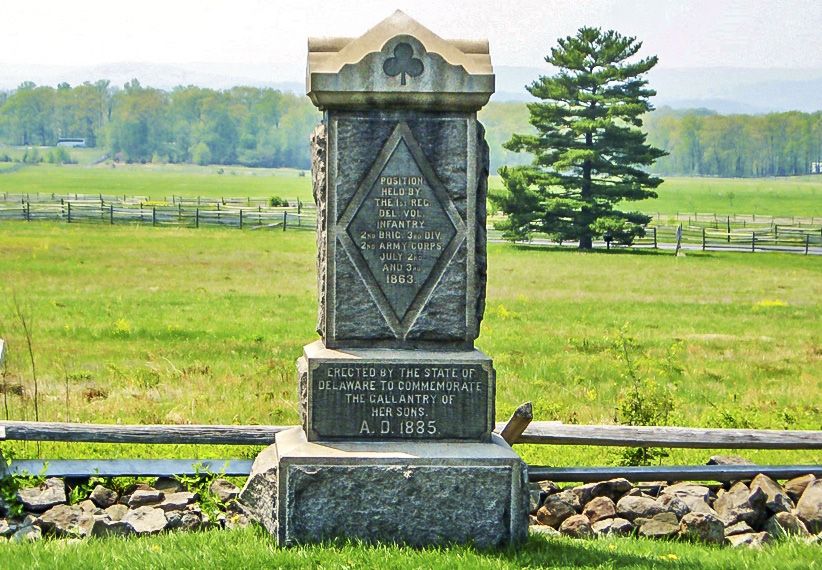
Officials found nearly 2,000 bodies remained from the Old Cathedral Cemetery. Records at the New Cathedral Cemetery on Lancaster Avenue revealed that McCarren’s body was never buried in the new cemetery. After so many years, identifying the bodies wasn’t possible. The archaeologists carefully removed all the bones from the parking lot. McCarren was born in 1830 in Ireland. Like so many patriotic Irishmen, McCarren rushed to answer President Lincoln’s call to arms to save the Union. The 18-year-old Irish immigrant followed another Irishmen, Captain Thomas Smyth, into the 24th Penn. Regiment. Bernard served for three months in that regiment. When that term ended, he enlisted for three years with now Major Smyth in the 1st Delaware Infantry. Smyth quickly rose to Colonel. The regiment served bravely in all major battles in the eastern theater losing 12 officers and 146 men killed or mortally wounded. Their sacrifices earned them the designation as one of the 300 best fighting units in Colonel William Fox’s post war study. At Gettysburg, the 1st Delaware served in Colonel Thomas Smyth’s Second Brigade, Third Division, as part of General Winfield Hancock’s II Corps. The regiment marched to Gettysburg as part of General Alexander Hays’s Division. Bernard McCarren and the 1st Delaware Infantry took part in the thick of the fighting at Gettysburg. On the second day, the regiment spent most of the day fighting around the Bliss Farm well in front of the main line on Cemetery Ridge. Things got much hotter for the Delaware regiment on the third day of the battle. The 1st Delaware lay in the path of Pickett’s Charge on July 3, 1863. Along with the 12th NJ and the 14th Conn., the Delaware boys held the low stone wall at the Inner Angle just south of the Bryan Farm house. To their left, William Arnold’s battery of ordnance rifles engaged Confederate batteries in the terrific cannonade preceding the charge. The divisions of Generals
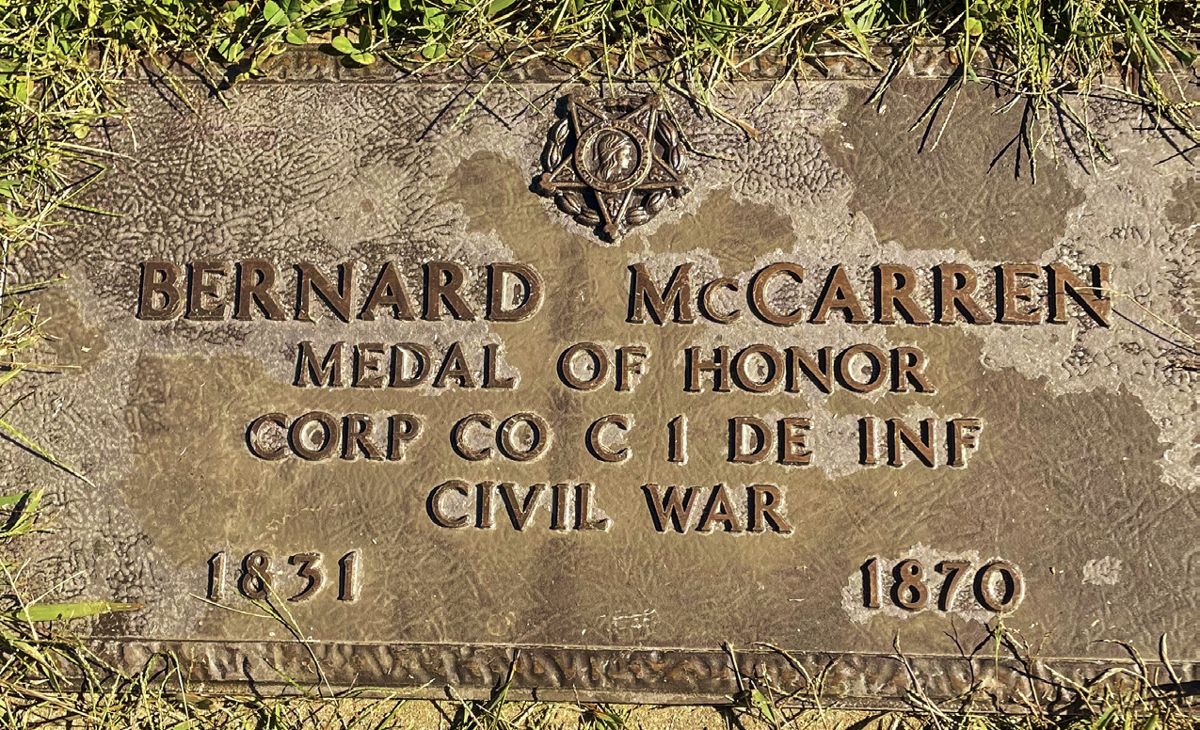
George Pickett, Isaac Trimble, and James Pettigrew soon emerged from the woods in fine order to attack the Union center. A mass of 13,000 gray clad soldiers went forward seeking to split the Union line into two separate units. Pickett aimed for the copse of trees. General Trimble and General Pettigrew directed their attack at the Inner Angle held by Hays and his division. When nearing the Union line, Trimble and Pettigrew faltered after heavy musket fire, accompanied by canister from Arnold’s guns, decimated the oncoming Southerners. While Pickett breached the Union line, the gray wave in front of Colonel Thomas Smyth’s brigade came to a halt. The 1st Delaware saw a golden opportunity. After halting the Alabama boys of General James Archer’s Brigade, the Delaware soldiers leaped over the stone wall and counter charged the broken Southerners. A stiff fight marker instead of a memorial. At last, an attractive bronze marker now acknowledges for future generations McCarren’s status as a war hero. After so many years lost to history, Corporal Bernard McCarren’s remains now receive a flag atop the grave marker every Memorial Day to honor the service to country of a patriotic and dedicated veteran. convinced the Alabama Brigade to retreat. Coming out of the fight with the Alabamians, Private McCarren had possession of the battle flag of the 13th Alabama. For capturing the colors, the private received our nation’s highest award. In 1864, McCarren took the field in the spring as a corporal when the regiment marched in Grant’s Overland Campaign. At the Battle of the Wilderness, he suffered a severe gunshot wound to the shoulder. The war was over for Bernard. After eight months in the hospital, a discharge returned McCarren to the civilian ranks. The Gettysburg hero died in 1870 and rested forgotten under what became an asphalt parking lot. Bernard McCarren’s bones arrived at the cemetery all jumbled together with other remains in several wooden crates. An ending not so fitting for an honored veteran. A mass grave for the 2,000 folks reburied at All Saints Cemetery holds an immense pile of bones that lack any identification. Sometime after the 1998 transfer, a grave marker for Bernard was placed in the section holding remains reinterred from the parking lot. A large Irish cross marks the location of the pit. Corporal McCarren’s status as a Medal of Honor winner is noted on a handsome bronze MOH marker in the center of the grassy mass grave. The Veterans Administration approved the marker. Rules by the VA require any marker placed in a cemetery without a body beneath it be clearly inscribed with the phrase
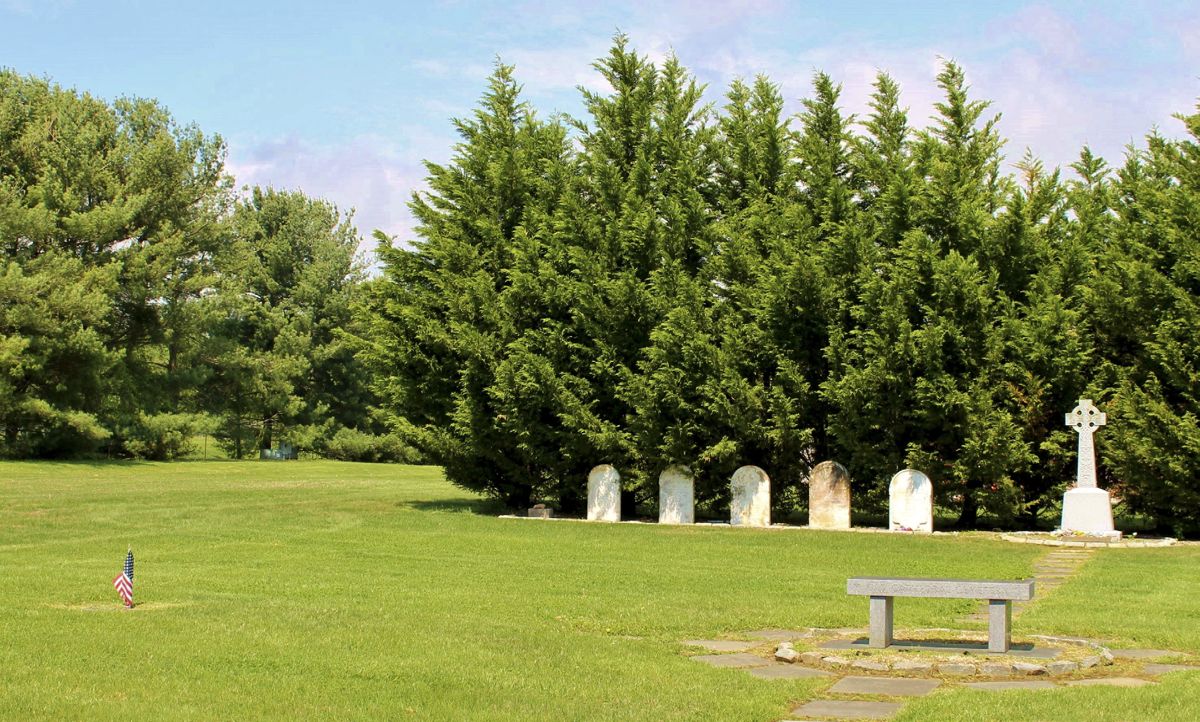
“In Memory of.” That designates the stone a memorial versus a grave stone. Bernard’s bronze plaque has no such wording. So, it’s a grave marking the burial of an actual body. Here’s where a technicality may be at work. McCarren’s body is surely buried in All Saints Cemetery mass grave. The McCarren marker sits atop the mass grave. His body being directly under that marker is doubtful. The unidentified remains from 2,000 bodies cover a large area. No body rests in the grave fully assembled as the Lord had created; McCarren’s leg bone may be yards away from his arm bone. Although his remains aren’t exactly under the marker, Bernard’s final resting place is certainly beneath the surface somewhere in the open area in front of the Irish cross, but the VA determined that would be close enough to allow a grave
Joseph F. Wilson lectures on Andersonville Prison and many other Civil War topics. The writer, a member of Old Baldy CWRT and the General Meade Society, also wrote and produced a documentary film now available on Amazon titled, “Civil War Prisons – An American Tragedy.” Contact – [email protected].