
The Graphic War
Cooper Saloon: Philadelphia
By Salvatore Cilella · Originally published August 2022 · pp. 34–35
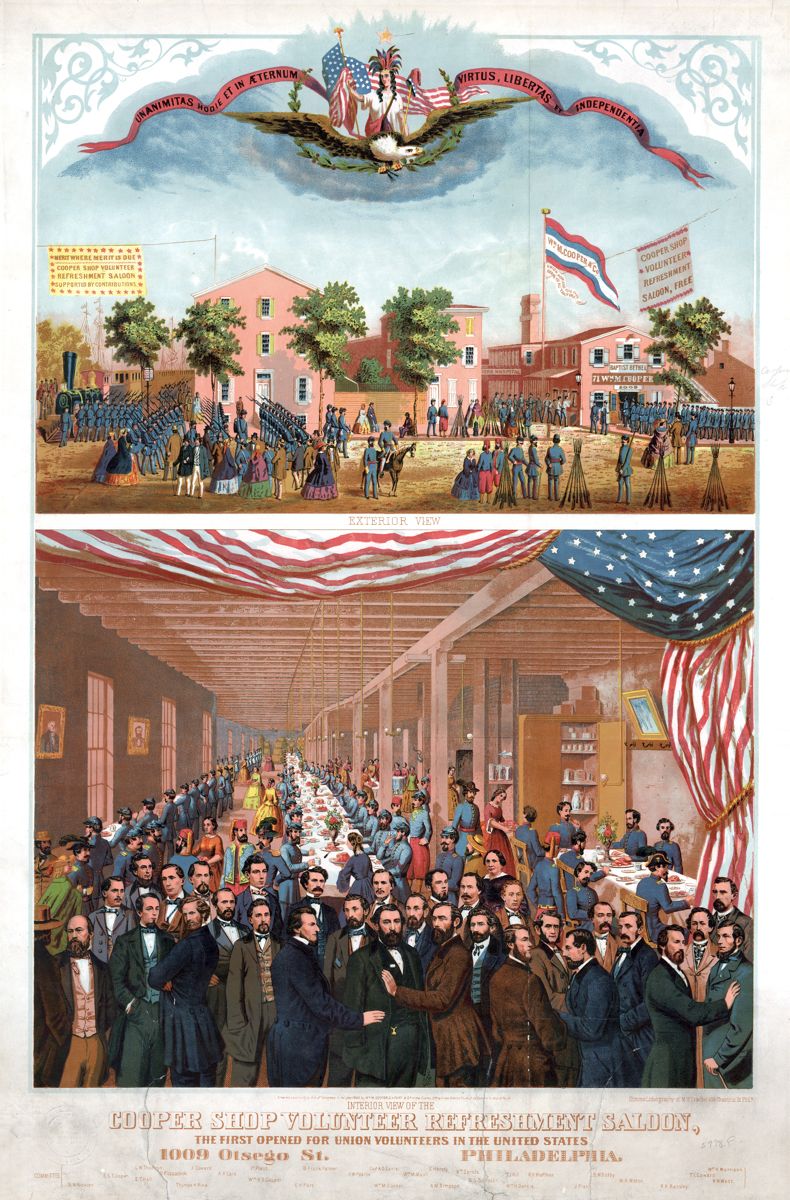
Cooper Saloon: Philadelphia The Graphic War highlights prints and printmakers from the Civil War discussing their meaning and the print maker or artist’s goals. Last August we featured a lithograph produced by artist James Queen and published by Thomas Sinclair. It depicted the Volunteer Saloon of Philadelphia founded by South Philadelphia grocer Barzilla S. Brown who began by passing out food to transient soldiers on their way to the front lines. This month, a year later, we devote equal time to another and slightly older Civil War “USO” in Philadelphia, the Cooper Shop Volunteer Refreshment Saloon. Both saloons issued vivid colored lithographs to celebrate, commemorate, and more importantly, raise money to maintain their services to soldiers passing though the city. The operations of both were comparable, their lithographic prints were similar, their missions were identical, and both established rudimentary hospitals. They were both located near the Philadelphia, Wilmington, and Baltimore Railroad station, an important transportation hub between the North and battle lines to the south during the Civil War . The Cooper Shop print was the work of German immigrant Maurice H. Traubel (or Morris Traubel). He was both the artist and the lithographer/printer/ publisher. Traubel honed his craft in Europe. Born in 1820 in Frankfort-am-Main, by 1850 Traubel found himself in Philadelphia where he started the firm of Traubel, Schnabel and Finkeldy. Like most printers/artists/lithographers, he and his firm underwent changes throughout the years they operated: 1850–1869. Like the others, he produced advertisements, maps, sheet music covers, portraits, political cartoons, trade cards, and stationery. Sadly, he committed suicide in 1897. When he produced this print, his establishment was at 409 Chestnut Street. The print consists of two images. The top image, appropriately named “Exterior View,” depicts groups of civilians and soldiers taking advantage of free refreshments and some “rest and recreation” before heading to the front. Several banners denote that this is the “Cooper Shop Volunteer Refreshment Saloon, Free” while also soliciting donations to support the establishment. Above all, in a clear blue sky, the figure of Liberty appears astride an eagle holding an American flag. Behind her is a banner reading, “Unanimitas Hodie Et In Aeterum Virtus, Libertas et Indepentia” (Unanimity today and in the eternal power of freedom and independence). Below the exterior scene is an interior view of the saloon “with long dining hall with troops at table. Officers dine at a smaller table to the right. Female volunteers attend to the men at tables and at a dining bar, where the men stand. In the foreground is a group of civilians whose names are given below the caption.” Front and center is William R. S. Cooper, to the left is E. S. Cooper. In the rear is one woman, conjectured to be Mrs. Cooper. The Cooper Shop Saloon, established May 26, 1861 in the cooperage of William M. Cooper & Company, provided meals, hospital care, and facilities for washing, sleeping, and writing to over 400,000 military personnel, refugees, and freedmen during the War. As the saloon’s historian remembered it, “Regiments followed on in quick succession. Morning, noon, and night they came with bands playing, banners waving, glistening bayonets, and parks of artillery.” The Saloon even fed deserters. In 1863, seven AWOLs from Virginia and North Carolina “rejoiced to be so well fed, as they were not much used to a good meal.” Both saloons were a huge hit with green recruits. One wrote: “Nowhere that I have been are soldiers treated with so much consideration and respect as there…Every tired and hungry regiment that has marched through there, has been rested and fed, and treated with every attention which the kind hearts of the Quaker City could suggest.” A Vermonter wrote of “a glorious supper…good enough for a firstclass hotel” when he visited in September 1863. With war’s end, both saloons closed. As its historian, James Moore wrote: “Like the temple of Janus at Rome, it was open in time of war, and closed in time of peace. It began with war, flourished in war, and in peace its mission ended and the labors of its active and efficient Committee were brought to a close.” On August 28, 1865, the Saloon fed the last meals to the 32nd US Colored Troops and the 104th Pennsylvania.
Endnotes: 1.
In fact, the two were so similar that they were often confused. Author Gary B. Nash, in his history of Philadelphia pictures the Cooper Shop and misidentifies it as the Union Volunteer Saloon. See Gary Nash, First City: Philadelphia and the Forging of Historical Memory. University of Pennsylvania Press, 2006, figure 108, pp. 245-246. Nash attributes the print to a Robert Newell, when in fact the print is the work of Maurice Traubel. Harry Peters, America on Stone, 389; Cooper Shop Volunteer Refreshment Saloon, the First Opened for Union Volunteers in the United States. 1009 Otsego Street, Philadelphia. https:// www.loc.gov/resource/gdcwdl. wdl_09448/. https://www.loc.gov/resource/gdcwdl.wdl_09448/. Nicholas B. Wainwright,
Philadelphia in the Romantic Age of Lithography, The Historical Society of Pennsylvania, Philadelphia, 1958, entry 85, p. 121. Depicted committee members include S.W. Nickles; E.S. Cooper; L.W. Thornton; E.T. Hall; Philip Fitzpatrick; J. Coward; Thomas H. Rice; A.H. Cairn; Isaac Plant; Wm. R.S. Cooper; B. Frank Palmer; C.V. Fort; H.W. Pearce; Capt. A.O. Davis; William M. Maull; E. Herety; A.M. Simpson; William Sprole; R.G. Simpson; J.J. Hill; William H. Dennis; L.B.M. Dolby; Jacob Plant; Walter R. Melon; R.H. Ransley; T.L. Coward; Wm. H. Morrison; and H.H. Webb. See also Digital Library Company of Philadelphia, https://digital.librarycompany.org/islandora/object/digitool%3A36363. 5. Wainwright and https://www.loc.gov/resource/gdcwdl.wdl_09448/. 6. James Moore, M.D., History of the Cooper Shop Volunteer Refreshment Saloon, Philadelphia, 1866, p.16. 7. Moore, p. 167. 8. Nash, pp. 245-246. 9. Moore, p. 10. 10. Brenna MeKelvey, “Refreshment Saloons in Civil War Philadelphia, Dickinson College Civil War Research Engine, https:// housedivided.dickinson.edu/ essay/essay_philadelphia.html
After 43 years in the museum field, Cilella devotes his time collecting American prints and maps and writing. His last professional position was President and CEO of the Atlanta History Center. His most recent books are Upton’s Regulars: A History of the 121st New York Volunteers in the Civil War (U. Press Kansas, 2009). His twovolume Correspondence of Major General Emory Upton, (U. of Tennessee Press, 2017), received the 2017–2018 American Civil War Museum’s Founders Award for outstanding editing of primary source materials. His latest book “Till Death Do Us Part,” an edit of Upton’s letters to his wife 1868-70, was published in 2020 by the Oklahoma University Press.
Cooper Shop Volunteer Refreshment Saloon, the First Opened for Union Volunteers in the United States. 1009 Otsego Street, Philadelphia. (Library of Congress)