
Civil War Impressionists Association Offers Visitors a Plethora of Historical Impressions
By Bob Ruegsegger · Originally published August 2022 · pp. 32–33
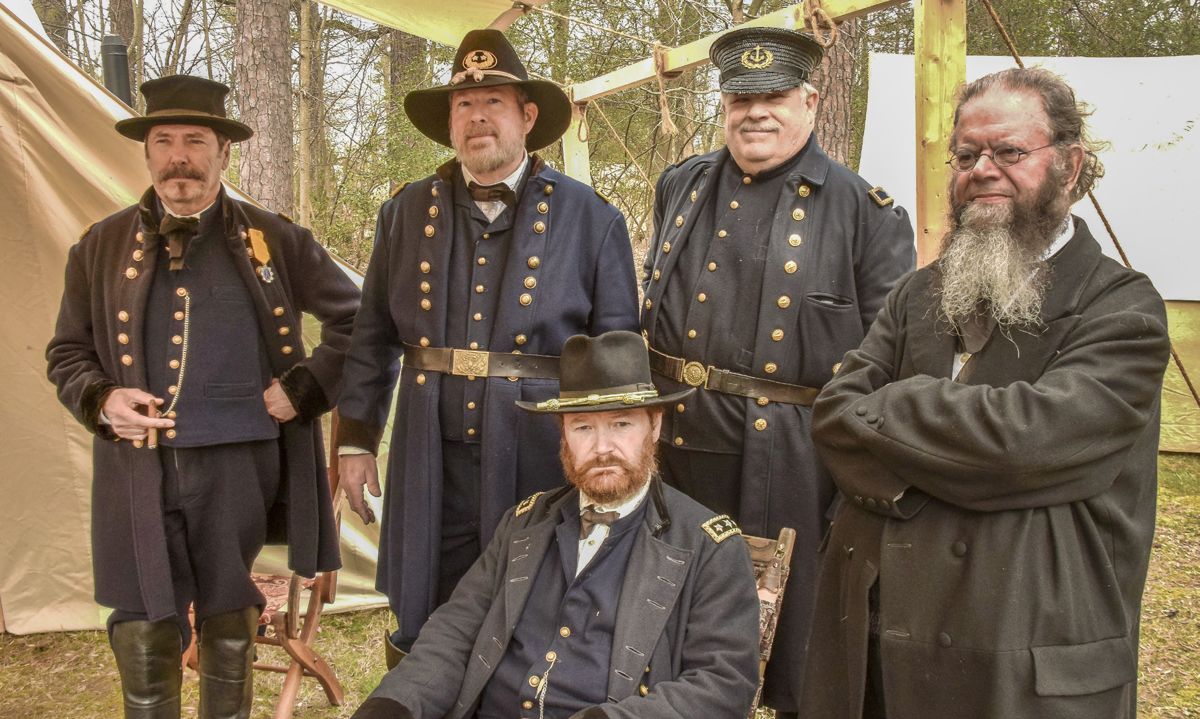
The Civil War Impressionists Association’s shared immersion in Civil War research and studies has inspired individual portrayals of a host of prominent Civil War era personae at War of the Rebellion annual event sites throughout the Mid-Atlantic from Gettysburg to Fredericksburg, and beyond. Most recently this diverse ensemble of accomplished interpreters set up camp at Jamestown Settlement and participated in the 38th annual Military Through the Ages event. Military Through the Ages is a time-line event that features reenactors and living historians who come to the JamestownYorktown Foundation museum at Jamestown Settlement, set up their individual camps, and offer event patrons an opportunity to interact with people and military units of the past. The CWIA organization musters members from a variety of re-enactment units. It affords members an opportunity to engage in a broad variety of portrayals, events, and venues beyond battlefield reenactments. The Civil War Impressionists Association has very strict protocols. The individuals who do specific impressions have to bear a resemblance to the individual they aspire to portray. The impressions must be wellresearched. Ideally, the CWIA wishes the interpreters, “in their hearts,” to be ambassadors to the memories of the notables they portray. “The period we’re representing is 1864 at City Point headquarters during the Petersburg Campaign after the crossing of the James River,” said Brian Withrow who portrays General Ulysses Grant. “During this period, at least until November, the headquarters was still a tent city.”
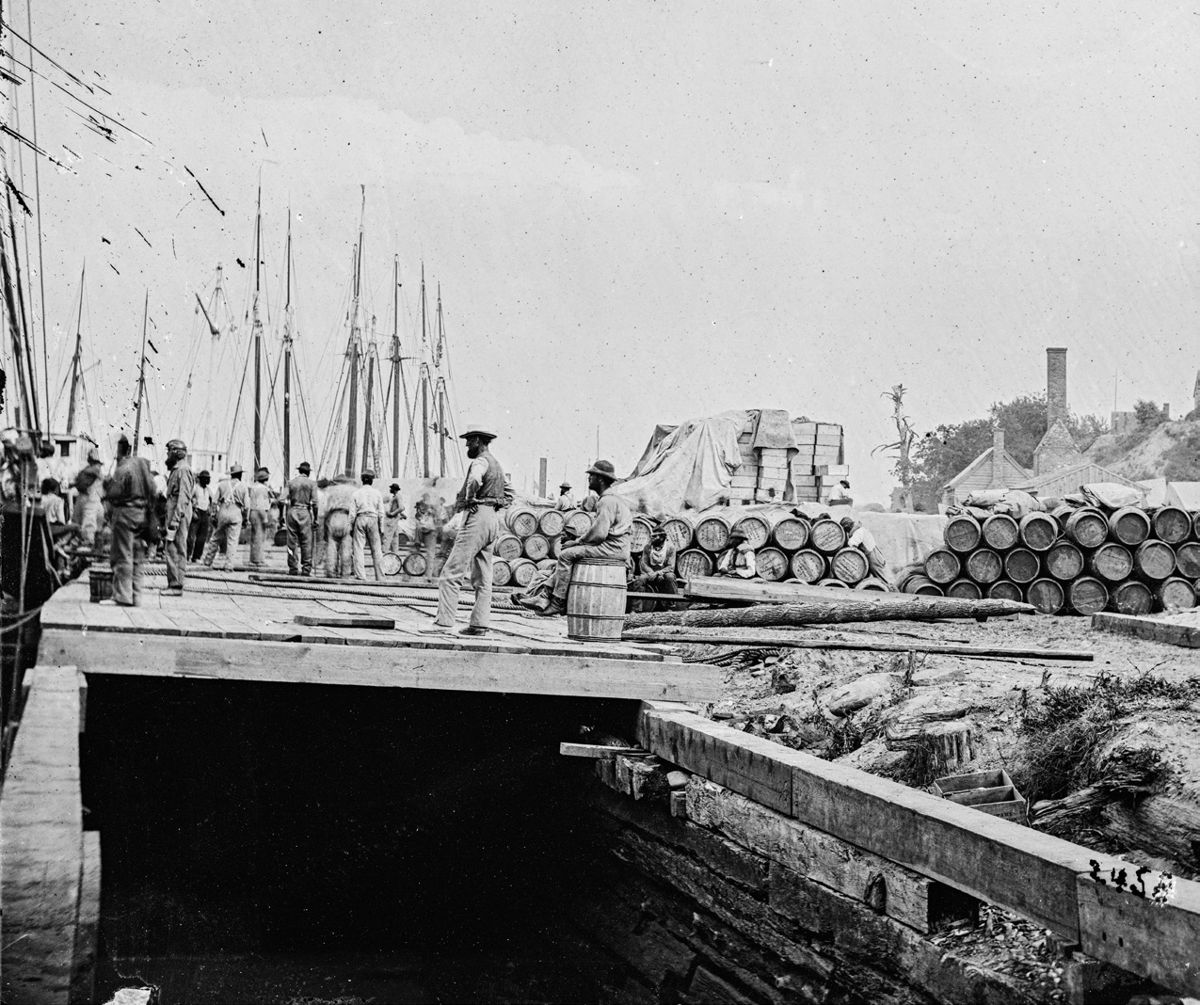
Unloading supplies on the wharf at City Point, (now Hopewell). City Point is located in central Virginia at the confluence of the James and Appomattox rivers, was the site of Union general-in-chief Ulysses S. Grant’s field headquarters during the Petersburg Campaign at the end of the Civil War. It was one of the largest ports in the United States during that time. (Library of Congress)
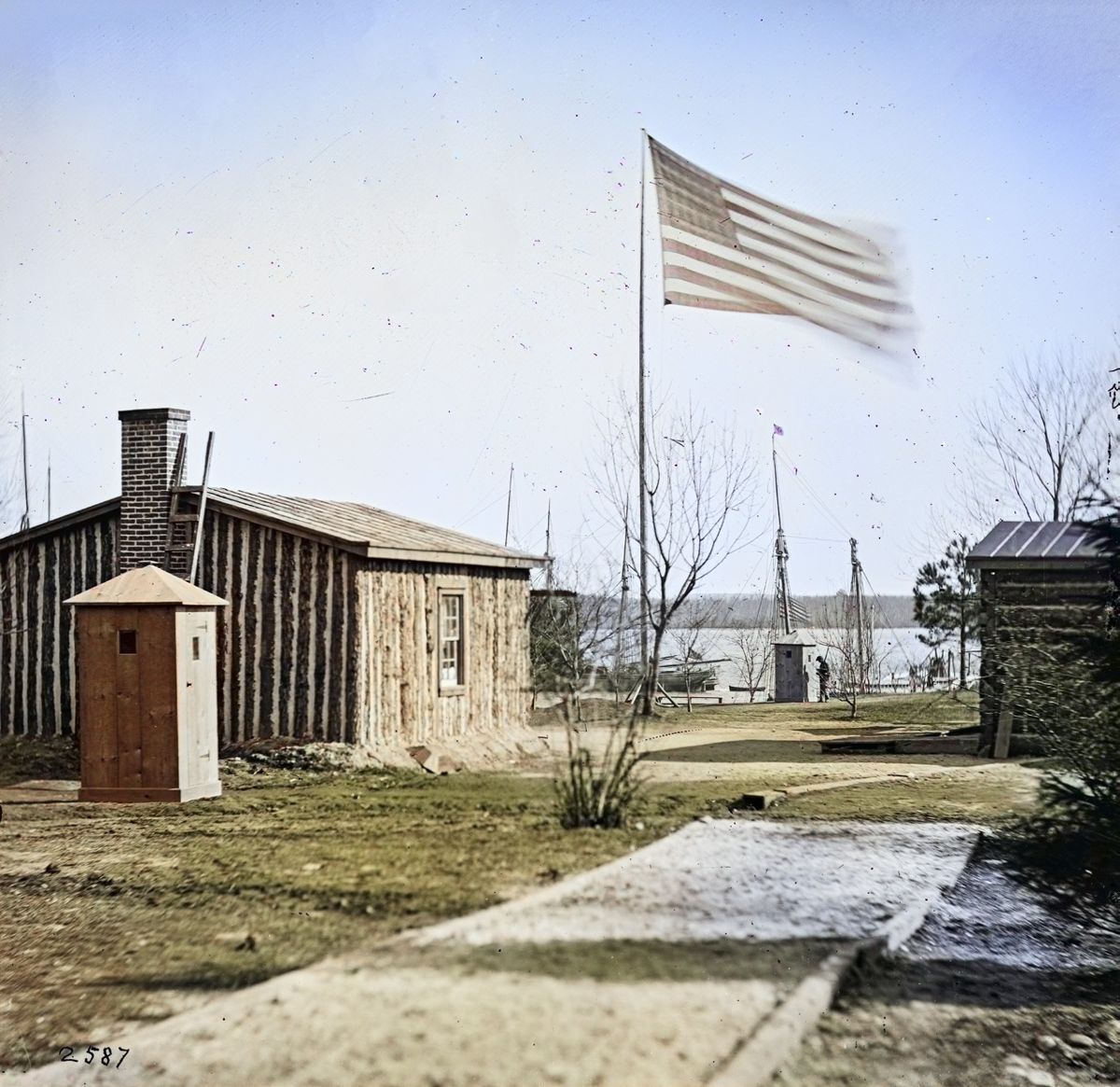
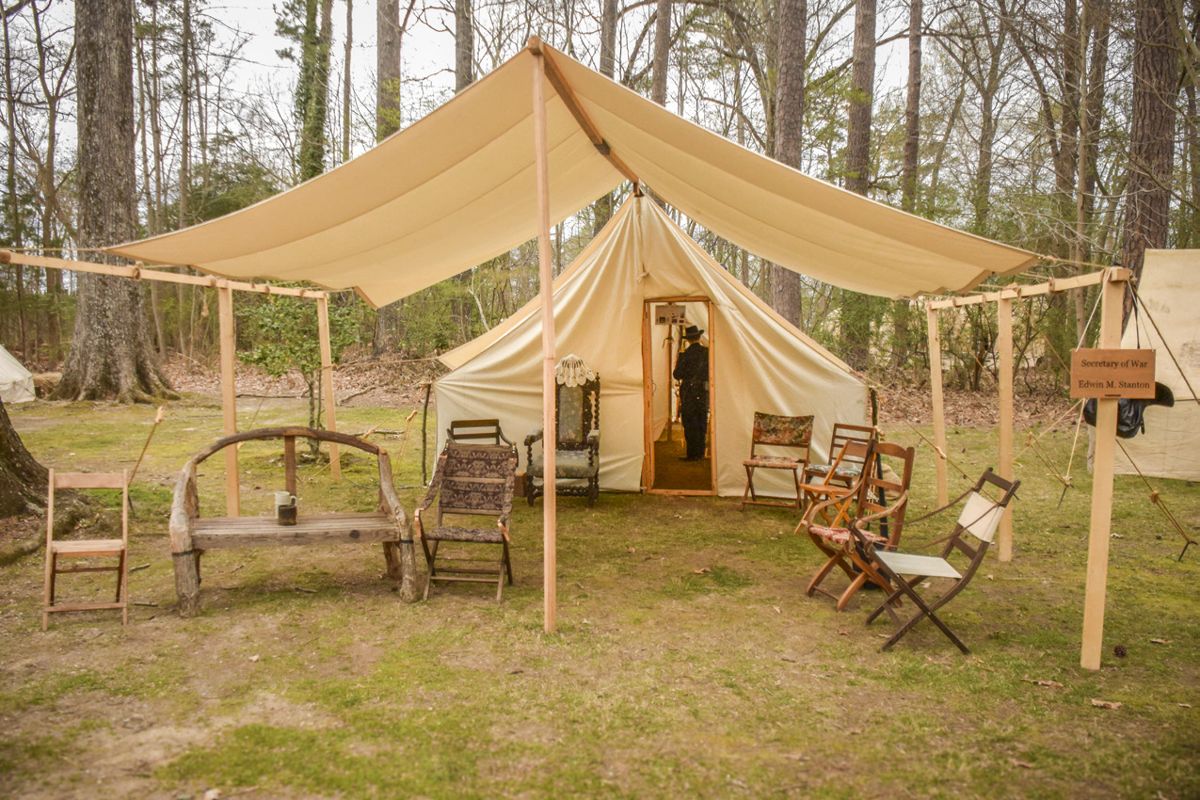
Brian Withrow portrays Lt. General Grant. CWIA has created an exact replica of the exterior of Grant’s “tent city” headquarters complex based upon a Matthew Brady photograph taken during the summer of 1864 prior to building wooden cabins for winter quarters. The interior of the CWIA exhibit reflects descriptions of Grant’s quarters made by Horace Porter in his book Campaigning with Grant. “We have the front area which was the general meeting area. The hospital tent was used as a business office; his personal quarters were in the rear,” explained Withrow. “We have tried our best to faithfully reproduce the setting, as you see here, at City Point.” Brian Withrow is a retired Air Force officer who has been reenacting and doing historical impressions for 22 years. He started his adventure in historical interpretation as a private in the 3rd U.S. Infantry Regular Army. Withrow remains a member of the 3rd U.S. Infantry Regiment. He began portraying military officers a decade ago. “I still portray a regular private from time to time,” said Withrow. “I do the private or the general-in-chief with equal enthusiasm.” Withrow’s career as General Grant began at the beginning of the 150th Civil War commemoration cycle. When the interpreter who was supposed to show up didn’t appear at an event, Withrow was “drafted” to portray Grant. He was convinced by his associatesin-arms that he “did indeed” resemble Grant. No one in Northern Virginia was portraying Grant at the time so, after a “little arm twisting,” Withrow took up the challenge. His career as Lt. General Grant took off immediately. For Withrow, assuming the role has been a phenomenal career enhancing decision.
“You have already gotten many more words out of me than you would have gotten from Grant,” said Withrow. “You saw me sitting in camp at a distance; quiet, reserved, unassuming. By nature, Grant was a very humble man and very quiet.” Withrow characterized Grant as a man of action. Grant’s military know-how came from his regular army experience with the 4th U.S. Infantry during the Mexican War. Grant reluctantly went to West Point. His father insisted that he get his education there. Grant did not really want to be a military man. He would have preferred to have been a teacher or farmer, but after completing his military obligation, Grant who excelled at mathematics at West Point, hoped to secure a position as a professor of mathematics. “Then the Mexican War occurred. It was a war that Grant was opposed to. He didn’t feel it was a just war,” noted Withrow. “He also felt that the American people had paid for his education, and that became his reason for serving in the Mexican War.” Service during the Mexican War greatly influenced the military Colorization by Adobe Photoshop. (Library of Congress) leaders, North and South, who came to prominence during the War of the Rebellion. Grant, serving in the 4th U.S. Infantry, was assigned as a quartermaster. He didn’t really like the assignment. He would have preferred to have been fighting on the front lines. “That is where he really learned the trade of what it took to supply an army in the field, and it became invaluable experience during the War,” noted Withrow. “When the War broke out, Grant was adamant that the country should stay united and that he needed to provide his services,” he said. “Ultimately, he ended
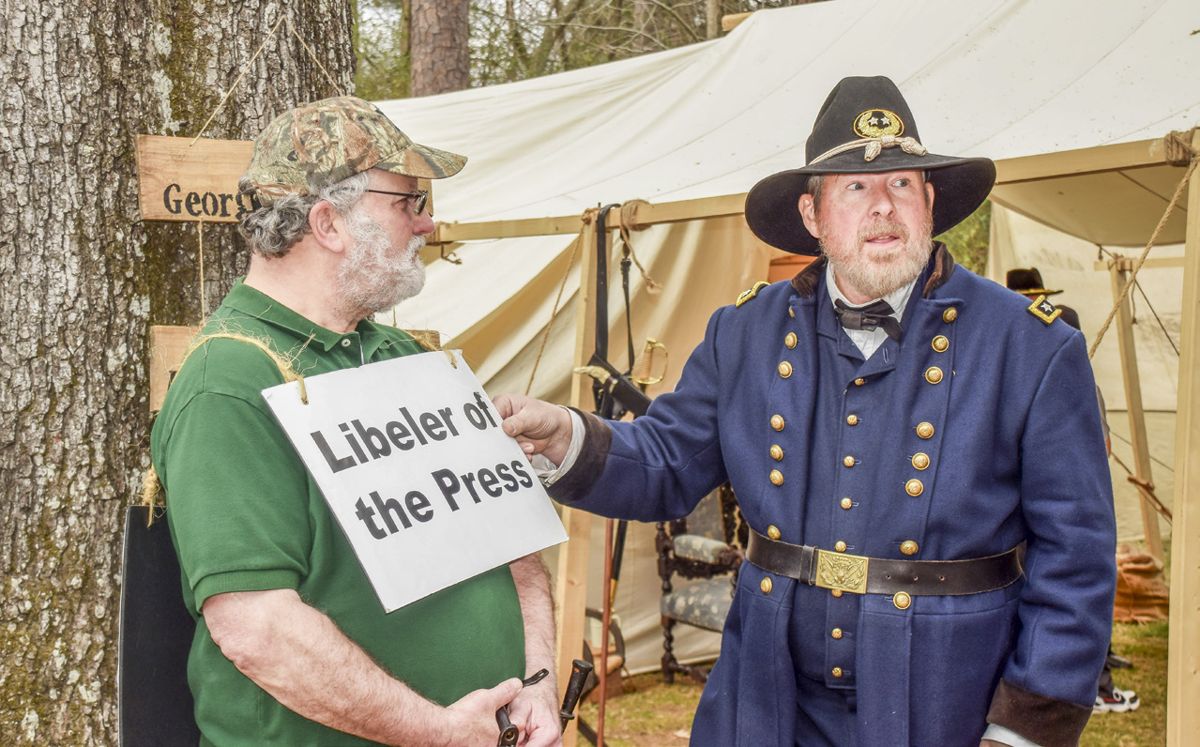
Samuel Washburn portrays Lincoln’s Secretary of War for the CWIA.
James Standard portrays Major General Philip Sheridan.
up commanding the 21st Illinois Infantry.” While Grant’s initial engagements led to him being promoted to brigadier general, it was after the assaults on Fort Henry and Fort Donelson that his star really began to rise. Those major Union victories stirred the interest of people in the North. “Grant became one of the first big heroes, the victorious “Unconditional Surrender” Grant, in the newspapers,” said Withrow. While some Union generals tended to sit on their laurels, Grant looked forward, planning to do whatever was necessary to win the war. Grant was always looking ahead to continue the offensive. “That’s what set him apart. Even when there was a setback, he still looked ahead.” That’s what set him apart.” Major General Philip Sheridan was part of General Grant’s entourage during Military Through the Ages. Impressionist James Standard depicted Major General Sheridan, Little Phil, who was most famous for his 1864 campaign that aimed at depriving the Confederate military of vital resources and supplies. Sheridan’s Shenandoah Valley campaign was dubbed “The Burning.” He ordered the destruction of barns, factories, and railroads in the Valley. His campaign was successful; it rendered most of the Shenandoah Valley uninhabitable north of Lexington. On April 1, 1865, Sheridan’s victory at Five Forks and capture of the Southside Railroad, forced General Lee to abandon Richmond and Petersburg, ultimately ending in Lee’s surrender to Grant at Appomattox eight days later, and the eventual conclusion of the War of the Rebellion. James Standard portrays “Little Phil” Sheridan the cavalry commander. “My ancestor rode with the 1st Wisconsin Cavalry on Wilson’s 1865 Raid through Alabama and Georgia,” said Standard. “When I entered the hobby, I started out in a cavalry mode. I was doing dismount initially because I didn’t know how to ride.” Standard soon started riding with a mounted unit and gained some extra experience. He took riding lessons. Six years ago, Grant impressionist Brian Withrow suggested that Standard consider resurrecting Sheridan. “I guess because I’m short. That helps. And with my background in cavalry,” said Standard. “For the last four or five years, I’ve actually been able to do the ‘Sheridan Ride’ at the Cedar Creek battle,” he said. Standard’s wife approves of him staying aboard his big black horse during the Cedar Creek reenactment. As Standard gallantly rides, his Confederate friends wave to him with raised fingers. While there are many period photos of Sheridan wearing a forage cap, Standard prefers outfitting himself with a distinctive civilian porkpie that became Sheridan’s trademark. Sheridan initially graduated from West Point as an infantry officer. At the beginning of the war, he was just a captain. In six months, he went from being a captain to brevet major general. “Sheridan was quite a capable individual. He was recognized for his ability,” said Standard.
“He looked after his men well, and looked after the horses. That was number one. Sheridan was always at the front when it came to battle. He was always leading,” he noted. “He earned a tremendous amount of respect from his troops and was able to get a good performance out of them.” Standard regards stepping back into history in the role Major General Sheridan, and portraying him accurately, is a serious undertaking. “Hopefully, if there is a hereafter and I manage to bump into the gentleman, I hope he’s kind to me, and he has a sense of humor too,” said Standard. The Civil War Impressionist Association brought a unique presentation to the Military Through the Ages annual time line event. Few units are encouraged to offer first-person interpretive camps at MTA because the impressions are so difficult to do well. CWIA impressionists portraying prominent Union officers and leaders spent their time in camp welcoming visitors, talking with their guests, and answering personal questions. Every year, the Military Through the Ages staff polls event visitors to ask their patrons which interpretive unit was their favorite. Usually, one unit will “pull away from the pack” according to Cindy Daniel, interpretive program manager at Jamestown Settlement. The unit with the most votes from event visitors receives the coveted Visitors Choice Award, a blue ribbon. This year, the Greek Phalanx unit made a big impression and took the blue ribbon by one vote. Normally, no additional awards are made in the Visitors Choice category. “This year, surprisingly, we had two contenders at the top who were separated by only one vote,” said Cindy Daniel. “Given how close the contest was, we decided to award an honorable mention to the CWIA for their enthusiasm and accuracy,” she explained. “We think that they’re a great addition to the event.” Bob Ruegsegger is an American by birth and a Virginian. His assignments frequently take him to historic sites throughout Virginia, the Mid-Atlantic, and the Southeast. His favorite haunts include sites within Virginia’s Historic Triangle— Jamestown, Yorktown, and Williamsburg. Bob served briefly in the U.S. Navy. He is a retired educator and has been an active newspaper journalist for the last twenty years.