
American Battlefield Trust — August 2022
Originally published August 2022 · pp. 18–19
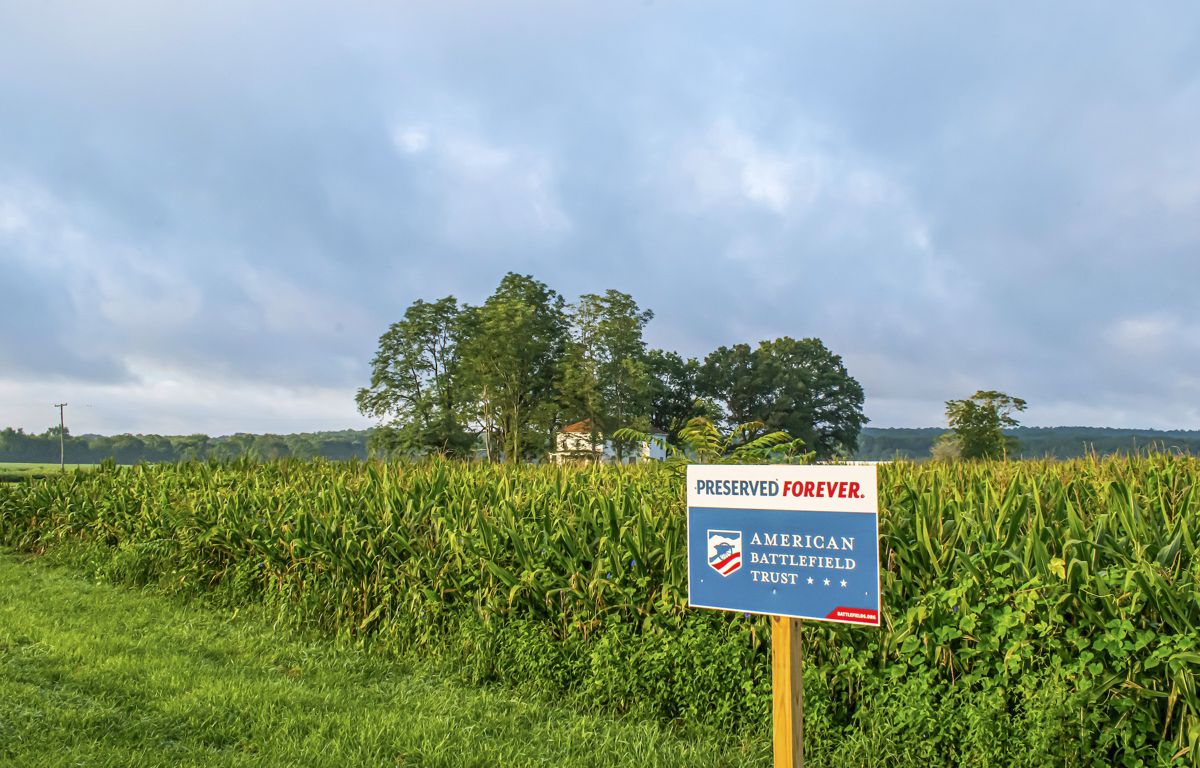
An effort that has helped define the American Battlefield Trust as a top-tier force in battlefield preservation, the largest private battlefield purchase in America’s history was fully paid off in May 2022 Once billed as the most desirable property for industrial development in Virginia, the Fredericksburg Battlefield’s Slaughter Pen Farm is now saved forever following a 16year, $12-million fundraising campaign to ensure its protection. “When we began this journey, the goal was beyond audacious,” said Trust President David Duncan. “But the unparalleled historic significance of this land demanded that we stretch beyond what had then been considered possible.” Although the Battle of Fredericksburg is most famous for the doomed Union assaults on Marye’s Heights, the battle was won and lost in intense fighting farther south where many of some 9,000 casualties fell in an area dubbed the “Slaughter Pen.” Historian and Fredericksburg Campaign expert Frank O’Reilly calls this “the very heart and soul” of the field, “the point where the battle was won and lost.” In the 1930s, the Confederate line along Prospect Hill was added to Fredericksburg and Spotsylvania National Military Park, but the open plain remained a dairy farm, gradually hemmed in by a highway, a railroad and a small airport. Again and again, developers came calling but never struck a deal. When the longtime owner died in September 2005, his preservation-averse niece made plans to sell, prompting Trust leaders to contact Tricord Homes, a local firm they had worked with previously at nearby Chancellorsville Battlefield. Working together, they secured a contract for the property. The $12 million campaign to pay for the Slaughter Pen Farm began in March 2006. Closing occurred in June thanks to the Trust’s banking partner, SunTrust, now Truist, agreeing to fund the entire acquisition. The Trust was able to reduce the loan by taking advantage of land preservation tax credits available in Virginia and by refinancing the balance of the original loan into a long-term bond issue. The project received a $2 million matching grant from the American Battlefield Protection Program. Meanwhile, the Commonwealth of Virginia contributed $300,000 toward the acquisition, a process that directly led to the creation of a first-in-the-nation state matching grant program for battlefield preservation. Ultimately, nearly half the $12 million raised came via private funds, mostly from Trust members. The loan’s terms required an annual payment of $400,000, and many donors scheduled a recurring gift to help pay down the balance. The Central Virginia Battlefields Trust completed its hefty $1 million pledge in 2011.
Since taking ownership of the property, the Trust has focused on landscape restoration and interpretive initiatives. It has gradually removed several derelict farm outbuildings and, in 2009, installed an almost two-mile educational walking trail that is popular with locals, students of history, and military units participating in staff rides. The Trust was on track to complete the Slaughter Pen Farm fundraising campaign in 2024, when a longtime supporter who wished to remain anonymous issued a remarkable matching challenge: If individual donors could supply the next $400,000
annual payment, he would contribute the entirety of the $800,000 then remaining on the loan, paying it off two years early. Once again, Trust members answered the call and the final payment on the debt was made to Trust in May. With Slaughter Pen Farm now owned free-and-clear by preservationists, the Trust and its many partners now turn toward celebrating the milestone. “More than once I’ve said, somewhat tongue-in-cheek, that after the property was paid off, I’d fire a copy of our mortgage out of a cannon,” said the Trust’s Duncan. “I think they might hold me to it.” Slaughter Pen Farm. (Buddy Secor)

Coming Soon: Culpeper Battlefields State Park In early June, the Virginia General Assembly adopted a two-year compromise budget, including authorization for the creation of Culpeper Battlefields State Park. As a final step, Virginia Gov. Glenn Youngkin ceremonially signed the budget on June 21, 2022. The Trust has spent decades protecting thousands of acres in Culpeper County, and this action allows the organization to donate the park’s initial 1,700 acres to the state outright. This sets the stage for the state park’s opening to the public July 1, 2024. An additional $3 million appropriation in the budget will allow the Trust to pursue even more land, up to 800 acres, that, once preserved, will enhance the park’s visitor experience. The park’s creation from these Trust-protected landscapes is the culmination of a tremendous vision shared by not only elected officials across the Commonwealth, but also the preservation community and Culpeper residents. Land allocated for the new park is primarily associated with the battles of Brandy Station (June 9, 1863) and Cedar Mountain (August 9, 1862), but also includes elements of the battlefields at Kelly’s Ford (March 17, 1863) and Rappahannock Station (November 7, 1863). Moreover, Culpeper was not only a place of massive strategic importance in the Civil War but also a stop for thousands of enslaved peoples as they hurried northward to freedom; many crossed the Rappahannock and Rapidan Rivers there.
American Battlefield Trust is Recognized for Video Excellence in 43rd Annual Telly Awards The Trust announced it was the recipient of two Silver awards in the 43rd Annual Telly Awards in late May, recognized for Carved in Stone, in the General NonBroadcast category, and How We Became America: The UNTOLD History in the online series group. Honoring excellence in video and television across all screens, the Telly Awards are judged by leaders from video platforms, television, streaming networks and production companies. Carved in Stone, filmed by Francisco Aliwalas of Pinatubo, Inc., and created in
CivilWarNews.com partnership with the Washington Rochambeau Revolutionary Route National Historic Trail, tells the story of how two French officers, who died fighting for American freedom, finally received permanent headstones nearly 250 years later. How We Became America: The UNTOLD History is part of an ever-growing series that celebrates that not everything worth knowing exists inside history textbooks. The series is associated with the Driving Force Institute’s larger Untold initiative, which is produced and distributed by Makematic and the University of Southern California’s Center for Engagement-Driven Global Education.
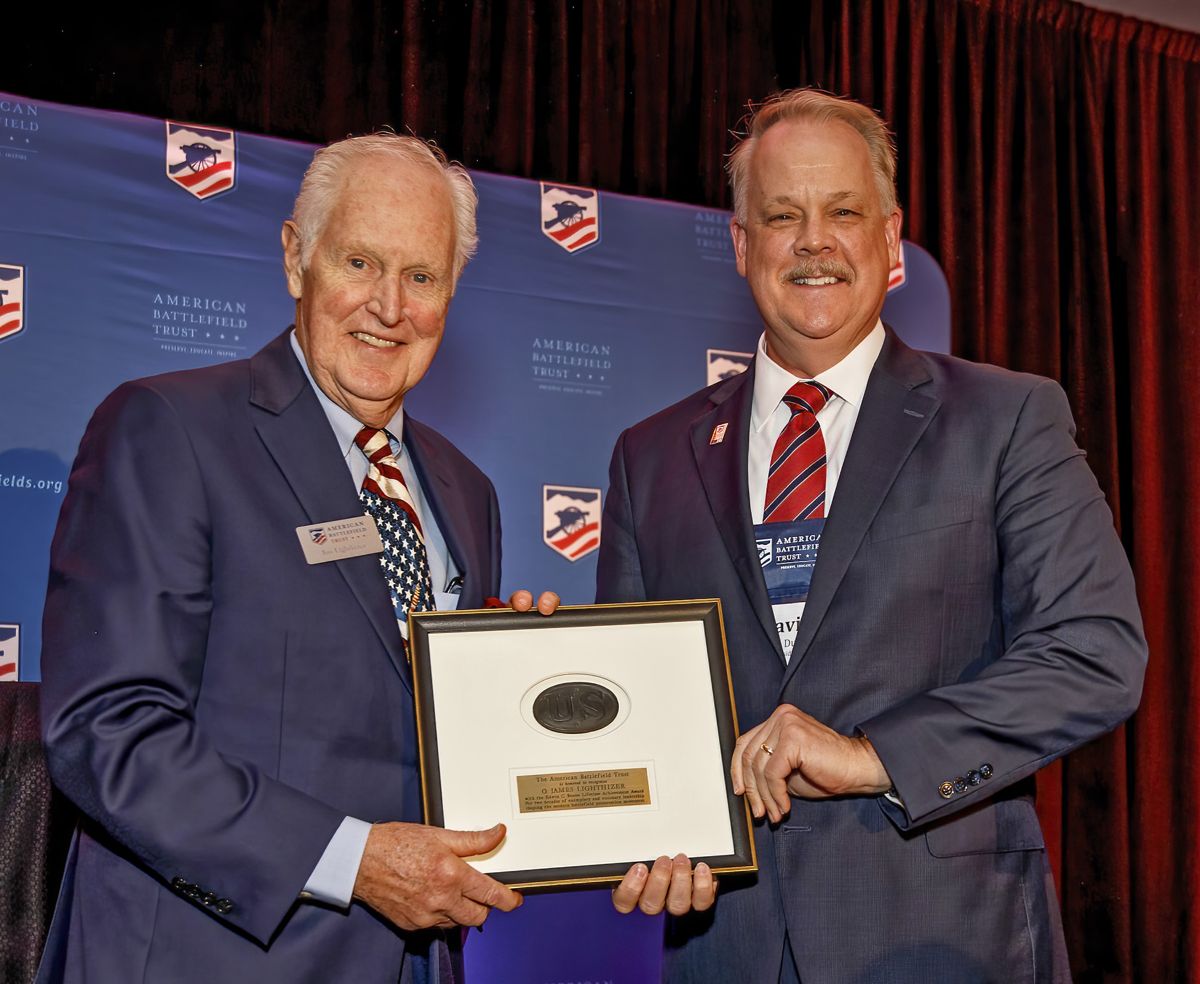
Longtime Leaders in Battlefield Preservation Recognized Although retired since the fall of 2020, Trust President Emeritus Jim Lighthizer took to the stage to be recognized for his two decades of leadership and to bid an official farewell to Trust members at the organization’s 2022 Annual Conference in May. “Being your president was the great honor of my very full career,” he said. In a tribute twice delayed as events were postponed and shifted throughout the pandemic, current Trust President David Duncan presented his friend, mentor, and predecessor with the organization’s Edwin C. Bearss Lifetime Achievement Award. Even as he praised past recipients, Duncan noted that Lighthizer’s impact was the furthest reaching of all. Also recognized was Charlie Crawford, who was presented with the Trust’s Shelby Foote Preservation Legacy Award for his decades of work in battlefield preservation and interpretation, especially in Georgia.

Help Battlefields Fulfill Their Destiny as True Outdoor Classrooms A rusting, weed-infested, abandoned auto repair shop and former gas station. An old, dangerous, and derelict tract house. Long-neglected, rotting, and unsafe farm buildings, shacks, and sheds. These non-historic and often hazardous structures are ruining the battlefield landscape of properties the Trust has protected at Antietam, Fredericksburg, and Harpers Ferry. So, this year, amidst the 160th anniversary of all three battles, the organization is embarking on significant restoration projects. This work is pivotal, as the Trust is often required to restore the land before it can be transferred to another entity. In fact, when these lands were purchased, it was agreed that all non-historic structures would be removed, and the properties restored to their original appearance within 3 to 5 years. In total, the three restoration projects face a total bill of $240,000 and are required to be completed by the end of the year. At Fredericksburg, where elements of Union Gen. George
Meade’s Pennsylvania Reserves penetrated Gen. “Stonewall” Jackson’s lines on December 13, 1862, five houses must be removed to help restore the hallowed ground to its 1862 appearance. However, this comes with a price tag of $125,000. Meanwhile at Harpers Ferry, the site of a vital Union garrison and a key fight in Gen. Robert E. Lee’s Antietam Campaign, an auto repair shop, former gas station, and a commercial office building must be removed. The project’s approximate cost is $90,000. Finally, at Antietam, a nonhistoric house and outbuildings are currently standing on the heart of the battlefield. There, the restoration work will require $25,000. These efforts will receive support from the same federal government matching grant program that matches the Trust’s gifts for land preservation; this time, it will match, dollar-fordollar, all gifts for battlefield land restoration. To learn more about these battlefields and the Trust’s special Battlefield Restoration Fund, visit www.battlefields.org/ restoration2022.