
The Civil War, Tariffs, and Baltic Trade
By Yuriy Kyrpychov · Originally published April 2022 · pp. 10–11
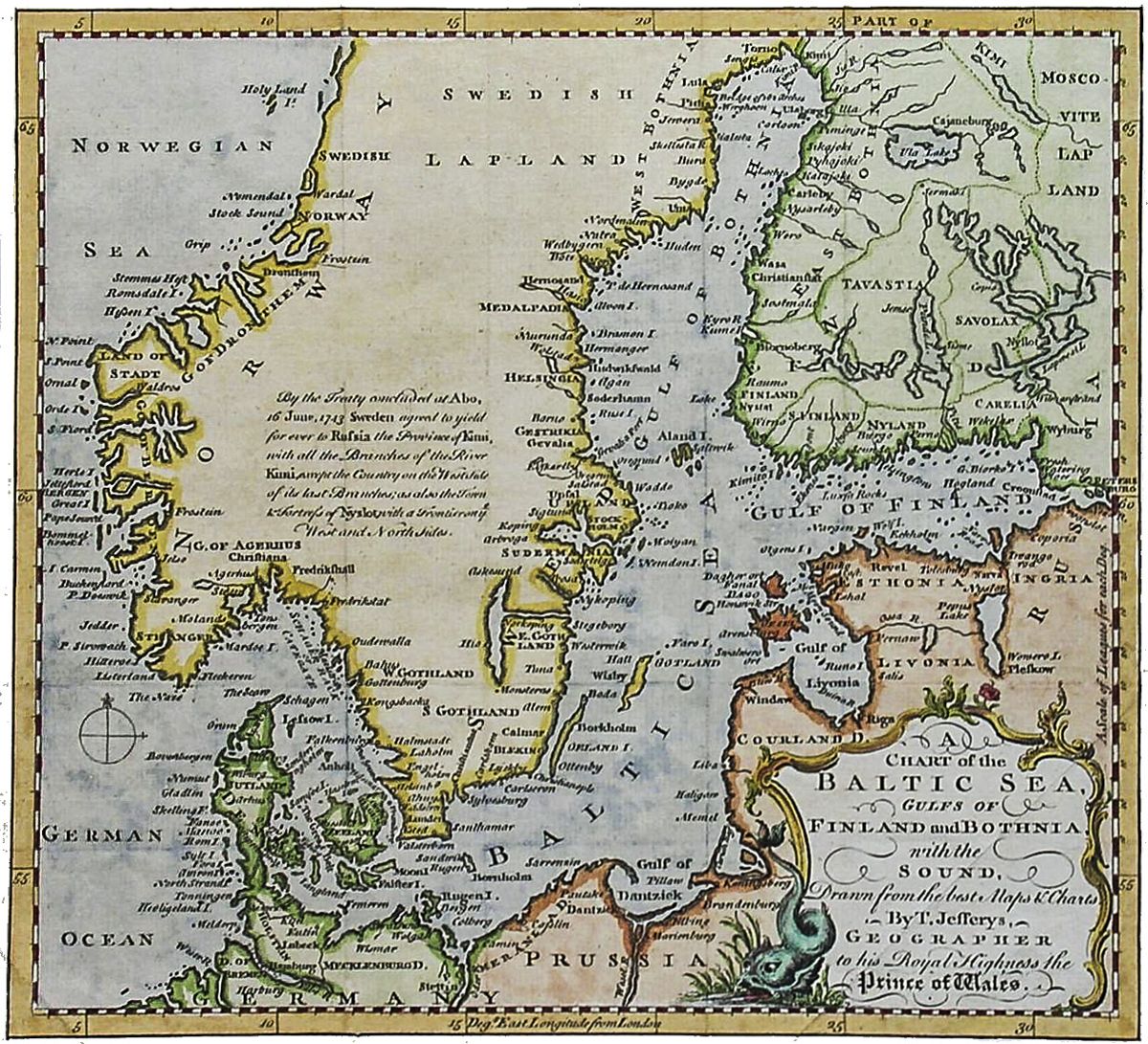
In Copenhagen, behind the double steel doors of special room No. 11, Danish National Archives, there are 60 meters of shelving containing 700 logs of the Sound Toll Registers. The first records in them date to 1497; Columbus at this time had just returned from his second voyage to the Americas. More than 2 million entries exist for the next 360 years. They are an invaluable source of information about maritime commerce, and thus about the political, economic, and social history of Europe and countries connected to the Old World, including America. Since 2017 I have been involved in the Danish-Dutch project Sound Toll Registers Online (STRO) devoted to digitizing recordings and creating an accessible database of these customs registers. At the beginning of May 2020, recordings of the last of the 377 microfilms appeared on the website. The project team is now working on error correction, structuring, and classification of records.1 In the course of this work I managed to close America! The decipherer of one record for the year 1533, it seems, knew old Danish well, but knew little of economic geography as he had a captain from Danzig with a cargo of apples going to the West Indies island of Santa Cruz instead of Norway, confusing towns with the same name Fredrikstad. After I reported it, the entry was moved to another section.2 The Sound, in Danish, the Øresund; in Swedish, the Öresund, is the strait between Zealand (Sjælland), Denmark, and Skåne, Sweden, connecting the Kattegat (northwest) with the Baltic Sea (south). A toll for the passage of The Sound was introduced in 1429 by the Danish King Erik VII of Pomerania. The toll was levied at the customs in Helsingør, Shakespeare’s Elsinore, and it was an important source of revenue for the crown. Let us first turn to a transcription of the earliest record of sailing to the English North American colonies. Trade with the Baltic was extremely important to the colonies and, later, to the United States. An entry dated July 2, 1687, reports that shipmaster Robbert Cølsthiel of Barnstable in what is now Massachusetts was returning from Danzig to his hometown carrying a hundred Pipenstafurn, rolls of heavy silk fabric, 120 pieces of Krakaust lerit (correctly spelled Krackouws lerridt), Krakow cloth, a type of fine cloth woven throughout Europe, 30 centners of iron, and 100 dalers [sic thalers] worth of other goods. Barnstable County was formed as part of the Plymouth Colony on June 2, 1685. It included the towns of Falmouth, Sandwich, and others lying east and north of Cape Cod. The thaler, a silver coin of high quality, was called the daler in Scandinavia and eventually became the American term, dollar. This record demonstrates a characteristic set of goods coming from the Baltic to America, Russian and Swedish iron, quality sailcloth, and hemp, that were required for shipbuilding. Building a brig of 350 tons in 1834 demanded about 15 tons of iron, 14 tons of rope, line, and cable, and 60 rolls of sailcloth, two thirds of which was highquality sailcloth. These were all things Russia was famous for. As a result, depending on ship type, imported materials accounted for 15-40% of construction costs. In the 1840s brigs on transatlantic routes were replaced by larger vessels and, as cotton exports increased, their number increased considerably, thus requiring more and more iron, sailcloth, and hemp. It was all brought in from the Baltic. Trade between the United States and Russia was quite significant, and about 85% of the iron American ships carried from the Baltic to the United States in 1783-1807 was loaded in St. Petersburg. For the second period of the STR (1634–1857), there are 4,887 customs records of
Antique chart of the Baltic Sea.
CivilWarNews.com voyages to North America from the Baltic. Since the project is far from being completed, and transcription errors, abound; in general the total error will not exceed 4-5%. It should be borne in mind that quite often there is a generalized name for the purpose of the voyage: North American, including Canadian, ports are located here. One reason for difficulty in analyzing the records is the existence of ports of the same name in England and in America. In our case, the biggest problem is Charleston. In such cases, it is usually indicated where, or from where, the ship is traveling; Charleston in America. It turned out, however, that it is necessary to check the groups of records without a specific port. For example, the group Charleston (17) in the destination port column (17 entries) begins with this entry: 7-9-1796 shipmaster Jacob Noys from Newperry Port i America (home port) Kiobenhavn – Charleston. Newperry Port is today’s Newburyport in Massachusetts, but Charleston for some reason deciphered as Charlestown (UK) and a reasonable question arises, why would an American captain want to carry hemp, iron, ropes, etc. from Copenhagen to a small Scottish town not far from Edinburgh? More perplexing is the existence of Charleston, Massachusetts, a seaport, and Charleston, South Carolina, another seaport. Another entry from this group is even more revealing: 10-8-1816 John Safford from Charleston i Amc. Stockholm – Charleston. Here it is explicitly stated that the captain’s home port is Charleston, America, but the transcriber still wrote Charlestown (UK) as the port of destination. Of the 17 entries in this group, four mention American captains and we can safely say that they were headed for a South Carolina, or Massachusetts, port. Four more American captains are found in the group Charleston (26) and we will include them in our counts. Thus, Boston accounts for about 1,570; New York for about 1,350; Salem for 320; Philadelphia for 180; Providence and Rhode Island for 130; Baltimore 121; Alexandria for 60; Marblehead about 40; there are fewer records for other northern ports. In all, there are as many as 4,000 records of voyages from the Baltic to ports in the northern states. Southern ports were much less frequently visited: Savannah about 45, New Orleans about 40,
Charleston at least 42, Norfolk about 6, Mobile 3, Richmond 1, and Carolina 1; that is about 140 in all. The port traffic in the North is very large, but what are the reasons? It is because the South, which had no developed industry and a fairly small population compared to the Northern states, did not need imports as much as the North. The Southern states were very dependent on their cotton exports, and cotton was a major commodity America supplied to the Baltic. That is why the “cotton triangle” was formed; that is why the number of voyages from Southern ports to the Baltic many times exceeds the return flow of ships. From New Orleans, according to the registers, about 160 ships left for the Baltic, four times more than from the Baltic to Louisiana. The difference between imports and exports for Charleston is even greater: about 390 ships left that port for the Baltic. Savannah 54 records, Norfolk 12, and Mobile 15. Such a small number of voyages from the ports through which Southern cotton was exported seems odd. Charleston was the leader among the Southern ports, but many more ships went from it as European ships were going for cotton. As we already pointed out, half the U.S. merchant fleet was involved in exporting cotton. The vast majority of ships belonged to northerners, and the customs agents at The Sound listed the Northern ports as the port of departure. Even those captains who listed Charleston as their port of departure were from Boston, Philadelphia, New York, Newberry, Portland, and other Northern ports, while only a few captains were from the South. Here is an example. Captain L. Bridge, home port Boston U.S., was on his way to St. Petersburg from Boston on November 15, 1856, carrying a lot of cotton, raw sugar, indigo, sarsaparilla, and valuable tropical wood, paying a large sum of duties: 506 dalers 11 skilling. What is the “Cotton Triangle”? The fact is that most American ships were built in Northern shipyards and were owned by Northern shipowners. Before the development of industry and the beginning of machinery exports and other high-tech products, the North had little to offer the Baltic States. Therefore, the Northern ships carried cargoes to ports in the South and to the Caribbean, where they took on colonial goods, valuable timber, coffee, rum, spices, rice, tobacco, chocolate, and sugar, and headed for the Baltic, from where they carried goods to ports in the Northern states. This route was first called the “sugar triangle” and later became the “cotton triangle” with the growth of cotton production in the southern states. The cotton trade became so large that half the U.S. commercial fleet was engaged in it. As for customs records, in the case of Charleston we have to check the data of the STRO. Many records do refer to the small Scottish port, but it is unlikely that American captains carried rice, tobacco, rum, and cotton from it to the Baltic. Of course, England was a transshipment base for goods from all over the world, but transshipment to European countries usually occurred at ports like London, Liverpool, Hull, and other major transit ports. I had to carefully check about 1,500 records of the port of departure Charleston, and came to the conclusion that if a ship was carrying Southern goods from it, it was clearly American Charleston, and if coal and iron, it was certainly Scottish Charlestown. In mid-February 2022, I reported this to the STRO website and the records were moved to the U.S. section. The number of voyages to America also changed. There are now 2,737 records of voyages from North America to the Baltic, and 4,902 in the opposite direction. An unexpectedly large number, 8,888 captains, named American home ports. This means that they were actively working in Europe, on local routes, as the registers confirm. But for our topic it is not
CivilWarNews.com so important. But why make this excursion into history and introduce readers to the customs records of The Sound? First, it is an interesting source. Secondly, the fact that one cause of the Civil War was called unfair tariffs on imported goods. Allegedly they favored the North. Duties on imports made goods more expensive, and since, as we can see, much more imports came into Northern ports and were purchased by their people, the burden of the tariffs fell on their shoulders. Since the last entries in The Sound’s registers were made in September 1857, that is, shortly before the outbreak of the Civil War, they may serve as a useful tool for studying the causes of that war.
Greg Ton Buying and Selling the Finest Confederate, Obsolete and Southern States Currency
Endnotes: 1.
Sound Toll Registers online h t t p : / / w w w. s o u n d t o l l . n l / index.php/en/over-het-project/ str-online Юрий Кирпичев. «Регистры Зунда и продажа Аляски». «Троицкий вариант - Наука», № 346, 2022. https://trv-science.ru/2022/01/registry-zunda-iprodazha-alyaski/
Yuriy Kyrpychov, born in 1952, Ukraine, a radiophysicist, worked as the General Director of the Production Association. He now lives in the U.S. and began publishing in newspapers and magazines in the U.S., Canada, Russia, and Ukraine as a novelist, publicist, and historian. He is a popular author, especially in naval history, and published on the website of the Russian Navy FLOT.com.